End-of-Life Management Best Practice Guidelines (Version 1.0)
Do you prefer the guidelines as a pdf file?
Download PDFAre you interested in downloading a specific chapter?
Search the reports?
SearchTakeback and recycling programmes
With increasing numbers of PV panels due to reach the end of their operational lives in the near future, recycling and takeback programmes will be pivotal for the responsible management of PV waste. Recycling becomes an option when re-use and repurposing (as outlined in Chapter 2) have been exhausted. It serves as the means to recover valuable materials from PV components, relieving pressure on supply chains for these materials and minimising waste.
This chapter will explore the role of Producer Responsibility Organisations (PROs) in managing the responsible disposal and recycling of PV components, the challenges and obstacles faced in the pursuit of sustainable and efficient recycling processes and, lastly, the recycling and take back processes of PV components (notably for PV modules, inverters, communication devices and batteries).
4.1. Recycling challenges
Over the past two decades, the production of solar panels has witnessed a remarkable surge. As these panels near their EoL, an unprecedented waste management challenge has emerged. It is projected that PV waste will account for a substantial portion, ranging from 4% to 14%, of the total electricity generation capacity by 2030 and could reach 60 to 80 million tons by 2050. This poses serious questions about whether current recycling technologies will be advanced enough to deal with PV panels, and whether they exist at the scale required to absorb these new waste streams.
There are three primary PV recycling processes: mechanical, chemical, and thermal. However, a common drawback of most recycling methods is that they generate secondary raw materials with reduced purity and integrity compared to the original components used in PV manufacturing. This is particularly true for solar glass.
The recovery of silicon, a crucial material in PV solar panels, is of strategic importance due to the stringent purity requirements for solar-grade silicon. The process of refining metallurgical-grade silicon into solar-grade silicon is resource- and energy-intensive, imposing both economic and environmental costs.
Notably, silver stands out as one of the most valuable materials in PV panels, constituting 42% of their theoretical value. Glass is the heaviest component in PV panels by far and represents the largest fraction by weight among all components. Lastly, encapsulant materials composed of non-recycled polymers, often derived from fossil sources, can have a significant negative environmental impact. They are challenging to recycle due the low maturity of the current processing methods.
While PV module recycling techniques have developed significantly in the past decade, full commercialisation and high material recovery rates, especially for the prevalent c-Si PV technology, is yet to be achieved. Support for technological development can enhance performance and increase recycling value. Not only is the recovery of materials from discarded PV modules crucial, but the quality of these materials is also important, as it often falls short of maximising their potential value. Advancements in technological development have the potential to bridge this gap, enabling more efficient recovery of raw materials and components.
4.2. Takeback processes for different components
4.2.1. PV panels
There are various EoL options for PV panels, depending upon their condition, type, and the available recycling infrastructure. For instance, upcycling is a technique aiming to transform waste materials into new products of a greater value or quality. It is a promising practice in terms of environmental benefits and reduction in WEEE, however it is still relatively limited. Where second life, re-purposing or upcycling routes have been exhausted, then recycling or landfill disposal are the two remaining alternatives, with recycling being the next preferred option. Resource conservation is a cornerstone of sustainable development. The recycling of EoL PV modules and the focus on the recovery and re-use of critical minerals and valuable materials, offers several environmental and economic advantages.
Dependent on the available recycling technologies, silicon, glass, aluminium, copper, silver, indium, and tellurium, can be recovered, processed, and prepared for re-use across various industries. This contributes to reducing the need for further extensive mining and extraction, preserving natural ecosystems and habitats, and supporting a more sustainable supply chain, whilst also reducing the economic strain associated with volatile commodity prices.
Recycling also consumes less energy than producing new materials from scratch, reducing the potential greenhouse gas emissions of the upstream supply chain and the volume of waste entering landfills and incinerators. By doing so it prevents unnecessary pollution, mitigates the risk of contamination of the environment and frees up valuable landfill space.23
Of the recycling technologies available, the most basic involves the separation of the major components. This usually includes the glass, which can be cleaned and re-used, the aluminium frames and junction boxes, encapsulant materials which can be processed for energy recovery and the PV cells which can be processed to extract silver and copper.
Advanced recycling involves more sophisticated and innovative techniques to maximise the recovery of valuable materials and minimise environmental impact. Advanced recycling may involve automated disassembly processes, laser technology to selectively remove encapsulant materials, selective chemical etching to allow recovery of high-purity silicon wafers, or hydrometallurgical processes to recover valuable metals more efficiently.
PV module technology is advancing all the time. Designing for recyclability, reducing the use and consumption of critical and rare resources, improving manufacturing processes to increase PV module lifespan and integrity, and adopting circular economy principles are all vital steps toward achieving a more sustainable and circular PV industry.
4.2.2. Inverters
As PV inverters are complex electronics with capacitors, coils, valuable metals, and other elements, their EoL processing is of particular relevance and importance. Proper EoL management of PV-inverters can help the recovery of valuable metals, facilitate the implementation of circular economy principles (by reusing recovered components), limit supply dependencies and environmental impacts across the value chain (at the EoL but also at resource extraction with secondary raw materials).
As best practice, once an inverter has reached EoL, it should be returned to the manufacturer for analysis and confirmation that the device is no longer usable and that no repair is possible. From there it can be collected and treated according to the EPR compliance plan of the producer (the inverter manufacturer).
If this is done collectively through a PRO, or another compliance scheme, the inverter manufacturer must make information on possible recycling methods available. This should include instructions for dismantling and the materials that can be recovered. Ensuring a high-level of detail in the information provided is key to ensuring that the most appropriate EoL solution is chosen. As best practice, manufacturers should design inverters that provide for easy dismantling and material recovery, with the information on how to do so stored in a QR code, or in some other form of “product passport” that is readily available for recyclers. For these reasons, inverter manufacturers are seeking to promote repairability and exchange as much as possible with a dismantlable design and the presence of a repair centre (for more information on inverter repairs, refer to section 3.4.2. PV inverters). Support and strong common ground in Europe are also needed for recycling.
4.2.3. Communication Devices
To ensure compliance with relevant regulations, it is vital that consumers check that manufacturers of communications devices for PV systems comply with the WEEE Directive. Contacting the manufacturer for more information about their recycling process and partnerships is recommended to ensure proper handling of the devices.
As communication devices provide key linkages between all the different elements of a PV system, their disposal is covered by several parts of the legislative framework described in Chapter 2. EU Legal Framework for PV industry products at End-of-Life. For example, when handling communication devices with batteries, manufacturing and disposal will be governed by the Battery Directive. As the directive is transposed into each EU Member State’s national law, there are differences in the exact requirements between each country. Verifying the laws and regulations that apply to different communications devices in each market that a company operates in is crucial.
Devices, is essential for environmental stewardship and customers' data privacy. Manufacturers and users alike must work together to ensure that these devices are recycled responsibly at the end of their lifecycle, contributing to a greener and more secure future in the photovoltaic industry.
4.2.4. Batteries
Currently, approximately 95-97% of the lithium-ion battery recycling market is made up of small-format batteries, found in consumer electronics. The recycling of these batteries is reasonably lucrative and straightforward as most of this small hardware uses lithium cobalt oxide cathodes. Separating lithium and cobalt is relatively simple due to their different physical properties, namely distinct solubilities and melting temperatures. However, current practises are neither portable nor scalable, posing significant problems as the volume of waste and different types of materials that are expected to be generated in the next few years are significant.
Evolution, dimension, and materials
The volumes of waste batteries coming from PV systems will be larger format than the ones linked to the consumer electronics. The deployment of large- format Li-ion packs will soon take off because of the widespread expansion of stationary storage that will accompany the growing penetration of solar and other renewables. Large format batteries are projected to account for approximately 90-93% of the recycled battery market by 2030, or roughly 1.4-1.9 million metric tons annually.
Recycling process
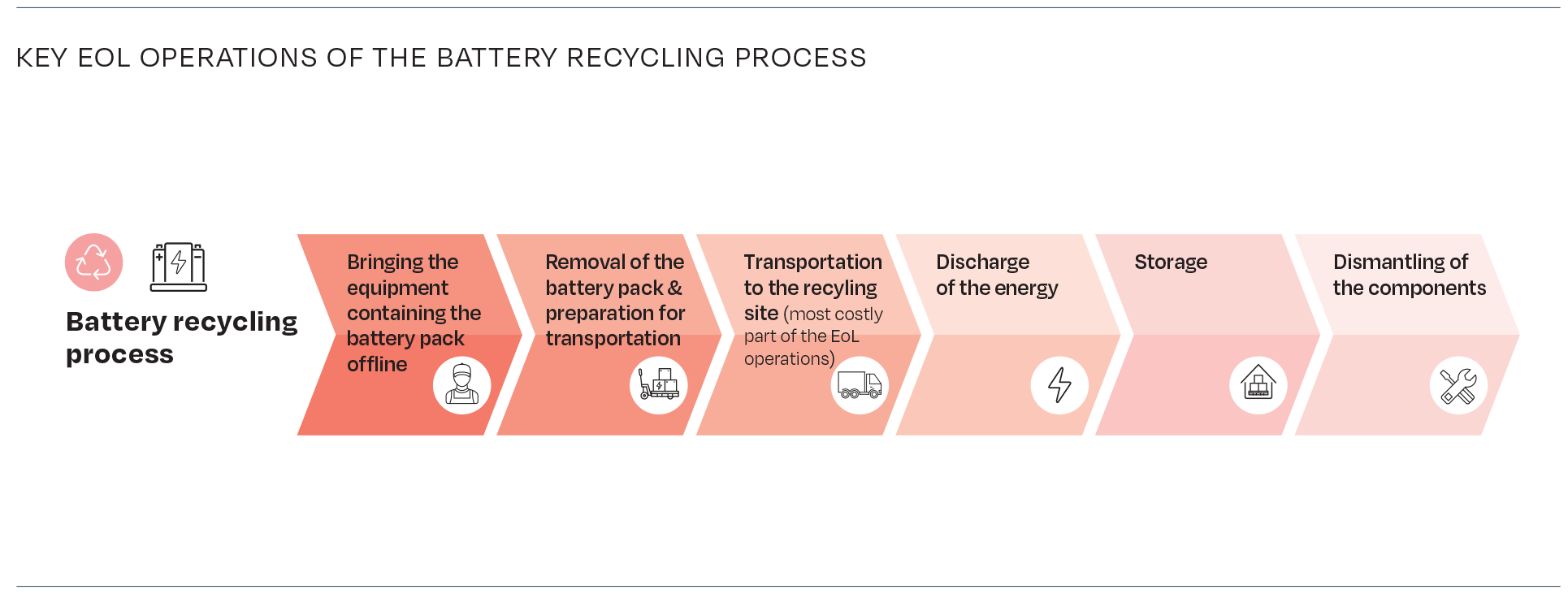
The most expensive part of the battery recycling process is the method used to extract the desired metals from the scrap material, the figure below indicates the order of the key EoL operations.
Then, following mechanical treatment, each material undergoes one of two possible processes, which get their names from the key step used to extract the metals from the battery material.
• Pyrometallurgic process: this consists of heating the components at a high temperature to extract the valuable material .
• Hydrometallurgy process: materials are extracted using liquid chemical extraction to remove the valuable ones.
Recycling Li-ion battery packs includes recycling new scrap
It is not only batteries that are damaged, or have reached their EoL that get recycled. Around 6.5-8.5% of the material used for manufacturing large format battery cells is scrapped. New scrap is easier to process and can be more profitable to recycle.
Competitive landscape
The recycling industry of the large format batteries will face competition from several agents, some already present:
• Metal Miners, Refiners
• Battery recyclers
• Battery manufacturers (expansion from Lead-Acid)
This competition is expected to be influenced by the fluctuations and sensitivity to the value of materials recovered from batteries. There will exist minimum per metric ton for a certain recycling of lithium ferrophosphate or lithium ferro manganese nickel or nickel manganese cobalt or sodium battery be profitable. And as mentioned before size, mix and transportation distance are a large fraction of Li-ion battery recycling economics. It will shape the facilities more profitable than others; early developers of large regional centres may cut costs substantially leading to the creation of entry barrier the new entrants.
To complicate the equation and as result of the strong R&D to launch novel batteries with higher capacity, higher volumetric and gravimetric density, safer and with more cycling there will exist relevant changes in the main components of the large format batteries, at least in the next 10-15 years.
23 Human health risk assessment methods for PV, Part 3: Module disposal risks, International Energy Agency (IEA) PVPS Task 12, Report T12- 16:2020. ISBN 978-3-906042-96-1.].