Operation & Maintenance Best Practices Guidelines (Version 6.0)
Do you prefer the guidelines as a pdf file?
Download PDFAre you interested in downloading a specific chapter?
Search the reports?
SearchContractual framework
This section contains a set of considerations for the contractual framework of O&M services for the utility-scale segment, and more specifically, systems above 1 MWp. A complement to the technical specifications detailed in the previous chapters, the contractual framework described in this chapter is considered best practice.
11.1. Contractual Framework
We recommend using the O&M template contract developed as part of the Open Solar Contracts suite of template contracts. Formerly known as the Global Solar Energy Standardisation Initiative (SESI) this is a joint effort of the Terrawatt Initiative and the International Renewable Energy Agency (IRENA). SolarPower Europe contributed to the drafting of the template O&M contract.
There are a total of six templates in a suite of contracts, designed to be used as a package to streamline the procurement of solar projects and make it simpler to aggregate projects using standard terms. Aside from the O&M contract, the other templates include:
• Implementation Agreement
• Power Purchase Agreement
• Finance Facility Agreement term sheet
• Supply Agreement
• Installation Agreement
• Asset Management Agreement
A common contractual framework for solar PV O&M is the “fixed price” model for a specified scope of work that can include administrative, operational, and Preventive Maintenance tasks. A “cost plus” element can then be added for Corrective Maintenance or additional services.
The “cost plus” element requires, labour rates, equipment markup, overheads and profits to be negotiated in the contract and added to the actual equipment costs incurred in correcting unexpected problems.

11.2. Contractual Risk Allocation
The O&M contract is a project agreement between the Asset Owner and the O&M service provider for the purpose of managing, operating, and maintaining the solar PV power plant. The O&M contract, together with the EPC contract, is a key document in any project finance transaction.
Its provisions should stem financial risks associated with the failure of the O&M service provider to keep the solar PV power plant operating properly. In general, an O&M contract should minimise financial risks through appropriate operational risk allocation. Financial risks posed to the Asset Owner from operational failures include (i) shortage of actual revenues in comparison with expected ones - displayed in the base case, (ii) inability of the Asset Owner to meet their debt service obligations to the lenders, (iii) Asset Owner’s liabilities under other agreements with
third parties, including any PPA; and ultimately, (iv) the risk of depreciation of the project assets. As for the EPC contracts, the Asset Owner may choose between entering into a fully wrapped O&M agreement, which provides the lenders with a single recourse party for fulfilment of all
obligations and responsibilities in relation to the O&M of the Plant. Another option is to have several agreements that, together, cover the O&M of the plant. If some of the O&M services are allocated to third-parties under different agreements, the Asset Owner should clearly define the obligations and responsibilities of each contractual party to ensure the absence of risk allocation “gaps”.
A balance between the lenders’ demands and the Asset Owner’s interests can be struck by aligning key clauses in the contract regarding timing, cost and quality of the works, and market standards. In this regard, the main drivers are:
• A detailed list of Ordinary and Extraordinary services to be performed by the O&M service provider, both before and after commercial operation of the project. To prevent confusion over risk allocation the operator’s obligations may be defined as general performance requirements and closely linked to performance results
• Availability or Performance Guarantees: in a power project, performance requirements typically include availability, output, outages, emissions, and other performance-related standards. Penalties for non-fulfilment of the performance obligations should also be included. At their most severe, this can mean termination of the O&M contract. These performance guarantees are usually supported by Bonus Schemes and backed-up by Liquidated Damages (LDs)
• Spare Parts warranties: management and availability of spare parts is a key aspect of minimising the impact of both scheduled and unscheduled outages on the project’s revenue stream
• O&M service provider’s limited liability in respect of consequential loss, loss of revenue, loss of profit and other financial losses
• Incentives for the O&M on forecasting and planning outages during low radiation hours. Financial incentive and penalties can help align interests between the Asset Owners and the O&M.
11.3. Scope of the O&M Contract
Services to be provided by the O&M service provider include:
Technical Asset Management (either O&M service provider or Asset Manager)
Technical asset management of a PV plant typically provides reporting to the Asset Owner through a “Monitoring Services” (as per Open Solar Contracts templates) as a key activity. This involves providing detailed reports on plant performance, evaluating the effectiveness of O&M activities, and documenting any incidents that occur.
Regulatory compliance is another cornerstone of effective TAM. This includes adhering to the legal requirements for solar PV plant operations, meeting obligations under PPAs and Interconnection Agreements, and maintaining compliance with power generation license agreements. Additionally, it involves ensuring that all necessary building and environmental permits are in orders.
Beyond these operational aspects, TAM also involves overseeing warranty management, handling insurance claims and managing various contracts.
Power Plant Operations
To ensure the smooth operation of a PV power plant, it is crucial to ensure the documentation of the plant is well managed, to be able to easily access relevant data and information to address potential issues, technical or otherwise. The supervision of the plant notably needs to make sure that there is proper monitoring and documentation of activities, deliver analysis of performance and identify areas and actions for improvements, ensure a proper detection and diagnosis of issues and faults in the various areas of the plant operation. Moreover it is crucial to ensure proper service dispatch, with relevant supervision of workers and activities. Plant supervision may also include the security monitoring interface, notably related to security systems such as cameras etc.
More generally, it is crucial for proper operation of a solar power plant to have operational and sufficient plant controls tools and instruments. Plant operators are also in charge of managing the interface with the grid operator and ensure compliance with grid codes, as well as maintenance scheduling. Moreover, they may be in charge of power generation forecasting (especially for plants not subject to feed in tariffs).
Plant operation also covers change management on the site, as well as reporting to the technical asset manager, especially in the case when the O&M service provider is not the technical asset manager of the site.
Power Plant Maintenance
Solar PV power plant Maintenance is essential to prevent cascading failures and minimise degradation over the asset operating lifetime. It may notably include:
• Preventive Maintenance (which is referred to in the Open Solar Contracts as “Scheduled Maintenance”)
• Corrective Maintenance in accordance with agreed Response Time guarantees (some types of maintenance activities may be beyond the scope of the contract, for more information, see Section 5.2. Corrective Maintenance)
• Extraordinary Maintenance (generally not included in the O&M fixed fee but it is advisable that the O&M contract includes the rules to prepare the quotation and to execute Extraordinary Maintenance works, for more information, see Section 5.4. Extraordinary maintenance). In the Open Solar Contracts O&M template, this would fall within “Additional Services”.
Additional maintenance services
In the Open Solar Contracts O&M template, there are also various additional “Additional Services” which are optional (see Additional services).
Below is a non-exhaustive list of Additional services and general market trends with regards to whether these Additional services are generally included in the O&M agreement or not.
Services to be provided by the O&M service provider include:
Technical Asset Management (either O&M service provider or Asset Manager)
Technical asset management of a PV plant typically provides reporting to the Asset Owner through a “Monitoring Services” (as per Open Solar Contracts templates) as a key activity. This involves providing detailed reports on plant performance, evaluating the effectiveness of O&M activities, and documenting any incidents that occur.
Regulatory compliance is another cornerstone of effective TAM. This includes adhering to the legal requirements for solar PV plant operations, meeting obligations under PPAs and Interconnection Agreements, and maintaining compliance with power generation license agreements. Additionally, it involves ensuring that all necessary building and environmental permits are in orders.
Beyond these operational aspects, TAM also involves overseeing warranty management, handling insurance claims and managing various contracts.
Power Plant Operations
To ensure the smooth operation of a PV power plant, it is crucial to ensure the documentation of the plant is well managed, to be able to easily access relevant data and information to address potential issues, technical or otherwise. The supervision of the plant notably needs to make sure that there is proper monitoring and documentation of activities, deliver analysis of performance and identify areas and actions for improvements, ensure a proper detection and diagnosis of issues and faults in the various areas of the plant operation. Moreover it is crucial to ensure proper service dispatch, with relevant supervision of workers and activities. Plant supervision may also include the security monitoring interface, notably related to security systems such as cameras etc.
More generally, it is crucial for proper operation of a solar power plant to have operational and sufficient plant controls tools and instruments. Plant operators are also in charge of managing the interface with the grid operator and ensure compliance with grid codes, as well as maintenance scheduling. Moreover, they may be in charge of power generation forecasting (especially for plants not subject to feed in tariffs).
Plant operation also covers change management on the site, as well as reporting to the technical asset manager, especially in the case when the O&M service provider is not the technical asset manager of the site.
Power Plant Maintenance
Solar PV power plant Maintenance is essential to prevent cascading failures and minimise degradation over the asset operating lifetime. It may notably include:
• Preventive Maintenance (which is referred to in the Open Solar Contracts as “Scheduled Maintenance”)
• Corrective Maintenance in accordance with agreed Response Time guarantees (some types of maintenance activities may be beyond the scope of the contract, for more information, see Section 5.2. Corrective Maintenance)
• Extraordinary Maintenance (generally not included in the O&M fixed fee but it is advisable that the O&M contract includes the rules to prepare the quotation and to execute Extraordinary Maintenance works, for more information, see Section 5.4. Extraordinary maintenance). In the Open Solar Contracts O&M template, this would fall within “Additional Services”.
Additional maintenance services
In the Open Solar Contracts O&M template, there are also various additional “Additional Services” which are optional (see Additional services).
Below is a non-exhaustive list of Additional services and general market trends with regards to whether these Additional services are generally included in the O&M agreement or not.

All the services not included in the scope and in the fixed fee such as Extraordinary Maintenance (See Section 5.4 Extraordinary Maintenance) and Additional services (See Section 5.1 Additional services) should be regulated within the contract. A dedicated clause should indicate the procedure and should include: (i) a proposal by the O&M service provider within a fixed time frame, (ii) a fixed period for the Asset Owner to accept it or request modification, (iii) a final approval. Pre-agreed tariffs for personnel, machinery renting etc. could be agreed and a specific table could be attached as Contract Annex. This is provided for in the Open Solar Contract O&M template, with reference to “Standard Rates”, which can be pre-agreed for Additional services.
Spare Parts Management
Contracts for operation and maintenance typically include various provisions on spare parts, considering there is a continuous need for monitoring, update and replacement of components in PV systems. These notably cover: spare parts maintenance, replenishment and storage (which is an optional in O&M contracts). For more information on this specific items, please view the respective sections and chapters of the present Guidelines (see Chapter 8. Spare Parts Management).
O&M contract fee
As a best practice, O&M services should be provided on a fixed fee plus escalation basis. See the section Spare Parts Management further on in this chapter which discusses how spare parts management may impact on the contract fee.
Contractual guarantees and price adjustments
Although some O&M service providers still provide PR guarantees, recent developments, including the recommendations of the Open Solar Contracts initiative, show that eliminating PR guarantees and only using Availability guarantees and Response Time price adjustments has several advantages.
PR is to a large extent a result of equipment choice, design and construction, over which a (third- party) O&M service provider has little influence, beyond vegetation control and module cleaning. Moreover, removing PR as an O&M service provider KPI makes power plant handover between EPC and O&M service providers or between O&M service providers simpler. Generally, the PR warranties are applied on projects where the O&M and EPC service providers are the same company (or an affiliate). Here the O&M service provider carries forward the risk of the technology made by its sister company.
Availability guarantees and Response Time price adjustments protects Asset Owners from poor performance on the part of O&M service providers. Availability is the KPI that best reflects an O&M service provider’s service. Thanks to the Response Time price adjustment, the O&M service provider has to intervene within a pre-agreed timeframe (dependant on the fault) when events that effect plant performance are not covered by the Availability guarantee. Moreover, the O&M service provider is obliged to intervene during incidents that do not affect performance, referring
to good industry practices in general. A further upside is that it makes the transition to a new O&M service provider much smoother and allows Lenders and Owners to pick a service provider based solely on of quality of services. Availability guarantees and Response Time price adjustments avoid burdensome change management processes resulting from the need to recalculate the guaranteed PRon the event of a plant handover.
PR warranties are no longer standard in the independent/third-party O&M market. However, it is possible to set a PR target that, if not fulfilled, can trigger a joint analysis between the Asset Owner and the O&M service provider, to identify causes and agree on possible corrective actions, including revamping projects.
A best practice is a Minimum Guaranteed Contractual Availability of 99%+ over a year at least at inverter level. In certain jurisdictions, such as in Mexico, where labour legislation and the
requirements of the network operator stipulate the presence of full-time technical staff on-site, a Minimum Guaranteed Availability of 99% can be provided. This should be reflected in the O&M agreement’s price.
For contractual KPI reasons, Availability should be calculated at inverter level, on an annual basis. For more information on this, see Section Contractual Availability.
The Availability achieved by the O&M service provider is translated into Bonus Schemes and LDs. For more information on this, see Section Bonus Schemes and Liquidated Damages (LDs).
Response Time price adjustment
The O&M service provider should be obliged to react to alarms received from the plant within a certain period, 7 days a week. This translates in a minimum guaranteed Response Time with the consequence of an adjustment to the contract price (the O&M fee) payable to the O&M service provider in the event of failure to meet the Response Times. For a definition of Response Time, see Section Response Time.
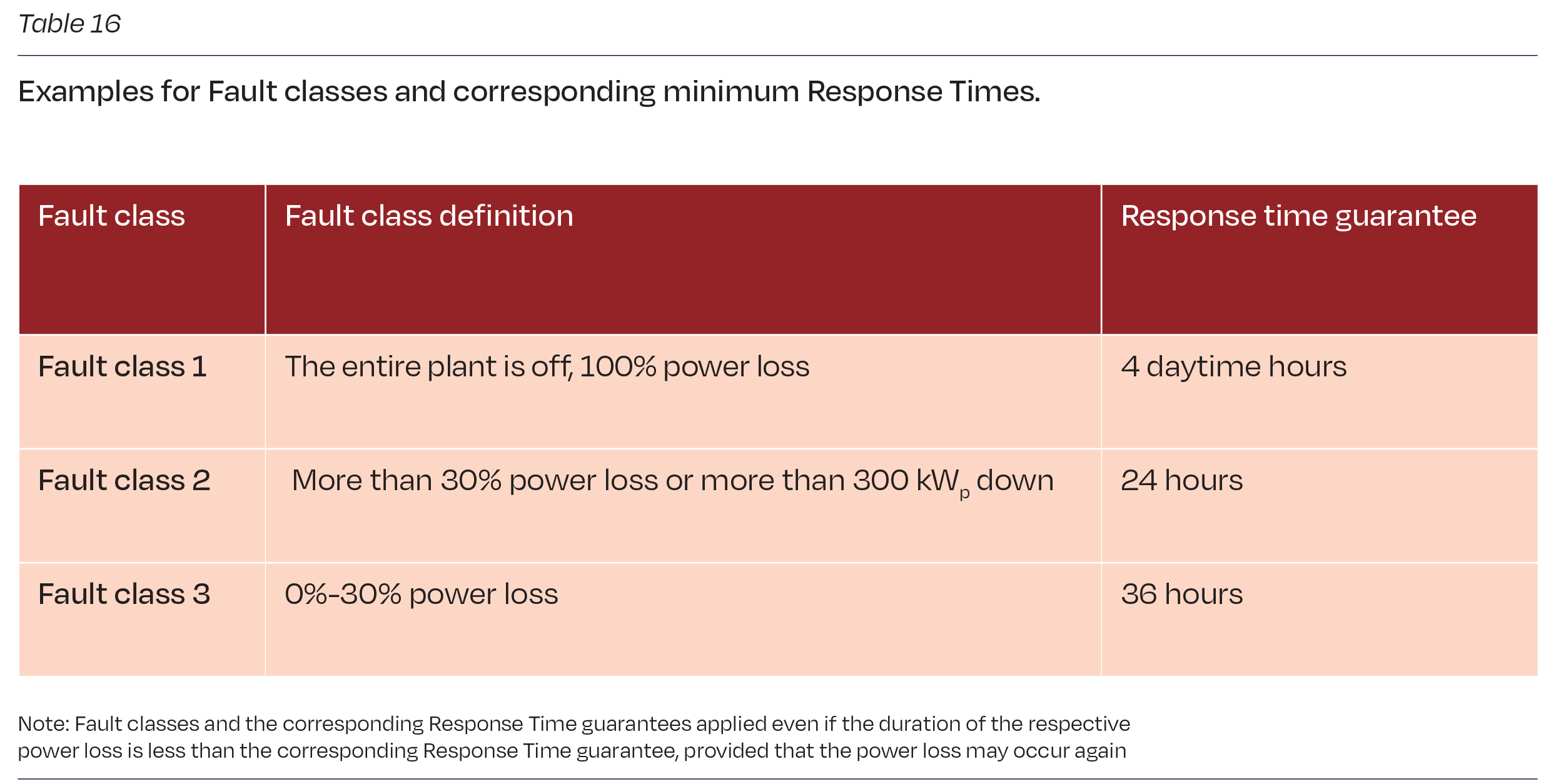
When setting a Response Time price adjustment, periods with high and low irradiance levels, and fault classes should be differentiated. This accounts for the (potential) loss of energy generation capacity or relevance in terms of safety impact of the failure.
An example for response times according to fault classes can be seen below in Table 16.
In case an equipment replacement is needed, the O&M service provider should commit to doing this within 8 business hours from the end of the Response Time, if the spare part is included in the portfolio of minimum spare parts list. If the spare part is not included in the minimum spare parts list, the O&M service provider should commit to ordering the spare part within 8 business hours from the end of the Response Time and to carrying out the replacement as soon as possible.
In case the fault cannot be fixed by the O&M service provider and the equipment supplier’s intervention is required, the following actions are necessary:
• If the intervention requires spare parts beneath the O&M cost responsibility (see Section Spare Parts Management), the O&M service provider may proceed without separate approval (insurance aspects to be considered)
• If the costs exceed the budget limit mentioned above, the O&M service provider should communicate the issue in writing to the Asset Owner within 8 business hours from the end of the Response Time
Force Majeure events are excluded from Response Time obligations.
In the Open Solar Contracts O&M template, failure to comply with a Response Time guarantee by more than five business days entitles an Asset Owner to terminate the O&M contract.
Bonus Schemes and Liquidated Damages (LDs)
The Availability guarantees provided by the O&M service provider can be translated into Bonus Schemes and LDs. The Bonus Scheme concept is referred to in the Open Solar Contract O&M template as the “Availability Bonus”. These ensure that the Asset Owner is compensated for losses due to lower-than-guaranteed Availability and that the O&M service provider is motivated to improve their service to achieve higher Availability. Higher Availability usually leads to higher power generation and an increase of revenues for the Owner. Hence, the Bonus Scheme agreements lead to a win-win situation for both parties and ensures that the O&M service provider is highly motivated. The Open Solar Contracts O&M template provides for a list of “Excusable Events”.
Since the O&M service provider’s responsibility are the O&M works for the solar PV asset, they should be exempted from other influencing factors like force majeure events, grid operator activities to reduce the plant output, grid instability, or offline periods, and any related LDs. (See exclusion factors in the section Contractual Availability)
An example for Availability Bonus Schemes and LDs can be found below:
• Bonus Schemes: if the measured availability exceeds the Minimum Guaranteed Availability, the additional revenue will be divided between the Asset Owner and the O&M service provider per previously agreed shares. In this case additional revenue should be calculated against
the expected annual revenue in the base case scenario. Targets for overall plant production constitute minimum thresholds for bonuses
• Liquidated Damages: if the Minimum Guaranteed Availability is less than the measured availability, all the revenue lost due to the availability shortfall should be reimbursed to the Asset Owner by the O&M service provider. In this case revenue lost should be calculated against the expected annual revenue in the base case scenario. This is usually invoiced by the Asset Owner to the O&M service provider
• Bonuses can be offset against LDs and vice versa
• The amount of yearly LDs should be capped at 100% of the O&M annual fee. Reaching this cap usually results in termination rights for the Asset Owner and the O&M service provider. In the Open Solar Contracts O&M template, the right is only given to the Asset Owner
Service standards
The O&M service provider must act in accordance with all laws, authorisations, good industry practice, planning consents, manufacturer’s warranties and operating manuals, and to the standard of a reasonable and prudent operator. Compliance with adequate H&S standards, is also a critical requirement and expectation within the standard of the services.
The Asset Owner should be entitled to instruct a third-party to provide any services that the O&M service provider cannot at the O&M service provider’s cost. This entitlement should only be triggered if the O&M service provider fails to follow a corrective maintenance programme.
O&M service providers’ qualification
The O&M service provider must have the means, skills and capabilities to operate and maintain the plant in accordance with the contractual obligations. Experience and professionalism, H&S capabilities, skilled teams, and access to spare parts are criteria for the selection of the O&M service provider. As O&M services are a combination of remote operations services and local maintenance activities, the Asset Owner should make sure that both components are well managed and interfaces between the two are well defined. This is especially important should the O&M service provider subcontract any aspect of the work, as each entity will need to be held accountable for the overall O&M performance.
Responsibility and accountability
The responsibility of the O&M service provider is usually defined in the Scope of work, which forms a part of the O&M contract. In the Open Solar Contract O&M template, this is set out in the O&M Services Schedule. A detailed description of the O&M scope items ensure clarity on what the O&M service provider will do during the term of the contract. In addition to the Scope of work, the Annual Maintenance Plan (AMP) and Annual Maintenance Schedule (AMS) (please refer to attachment “Annual Maintenance Plan”) outline the granularity and frequency of (predominantly) Preventive Maintenance works. The execution of the activities should be regularly reported to the Asset Owner– this forms the minimum requirements. Best practice in reporting is to compare the executed activities with the AMP and AMS, and outlines deviations and reasoning.
Corrective Maintenance activities performed in cases of component failure or energy generation shortfall, are controlled by performance commitments signed by the O&M service provider. In the Open Solar Contracts O&M template, these are set out as “Corrective Maintenance Services”.
Moreover, the Availability Guarantee and Response Time price adjustment explained in Section Contractual Guarantees and price adjustments of the present chapter also represent a level of accountability for the O&M service provider.
In most countries there are strict legal requirements for security service providers. Therefore, solar PV power plant security should be ensured by specialised security service providers, directly contracted by the Asset Owner or, exceptionally, subcontracted by the O&M service provider.
The security service provider should also assume liability for the services provided. For more information on this, see Section Power plant security.
Spare Parts Management
The Open Solar Contracts O&M template takes two approaches to Spare Parts management. Either the O&M service provider takes full responsibility for Spare Parts or there is a distinction between “Included Spare Parts” (included in the O&M service provider’s fee), and “Excluded Spare Parts” (payable in addition to the O&M service provider’s fee within a pre-agreed margin). In either case, replenishing Spare Parts stock will be the O&M service provider’s responsibility, although at the Asset Owner’s cost in relation to Excluded Spare Parts. This guidance considers it best practice
to take the second approach of clearly identifying Included and Excluded Spare Parts, in order to find an appropriate balance between the amount of risk that the Asset Owner is willing to accept against the cost of the O&M fee.
There should be a component, materials, and spare parts defects warranty for 12 months from the date of installation, which should continue to apply even after expiry or termination of the O&M contract.
For more information on Spare Parts Management, see the Chapter 8. Spare Parts Management.
Power plant remote monitoring
The O&M service provider should operate and maintain the metering system according to local regulations and norms. In some countries there are two metering systems: one that measures power injection in the grid, owned and operated by the grid operator, and one that measures power production, owned by the Asset Owner and operated by the O&M service provider.
The O&M service provider will also make sure that performance monitoring and reporting is operated and maintained according to the monitoring specifications and best practices (see Chapter 9. Data and Monitoring Requirements).
The Asset Owner has the right to carry out the verification of the metering system to evaluate and control the exactness of the measured data.
Reporting
Reporting should be done periodically, as contractually agreed between the O&M service provider (the Technical Asset Manager) and the Asset Owner. The Asset Owner should have the right to contest the report within a certain timeframe.
For more information on industry best practices regarding reporting, see SolarPower Europe’s report Asset Management Best Practices Guidelines V.2 at (www.solarpowereurope.org).