Operation & Maintenance Best Practices Guidelines (Version 6.0)
Do you prefer the guidelines as a pdf file?
Download PDFAre you interested in downloading a specific chapter?
Search the reports?
SearchRevamping and Repowering
Revamping and repowering are usually considered as part of Extraordinary Maintenance from a contractual point of view – however due to their increasing significance in the solar O&M market, these Guidelines are addressing them in a standalone chapter. This chapter focuses on revamping and repowering in the context of solar PV O&M, which is often classified as extraordinary maintenance from a contractual standpoint. It covers the benefits of revamping and repowering, different types of these processes, key performance indicators (KPIs) associated with them, and the structure of repowering/revamping contracts. Additionally, the chapter addresses the end-of-life process for solar PV systems, providing a comprehensive overview of these critical aspects.
Revamping and repowering are usually considered as part of Extraordinary Maintenance from a contractual point of view – however due to their increasing significance in the solar O&M market, these Guidelines are addressing them in a standalone chapter.
7.1. Definition and rationale of revamping and repowering
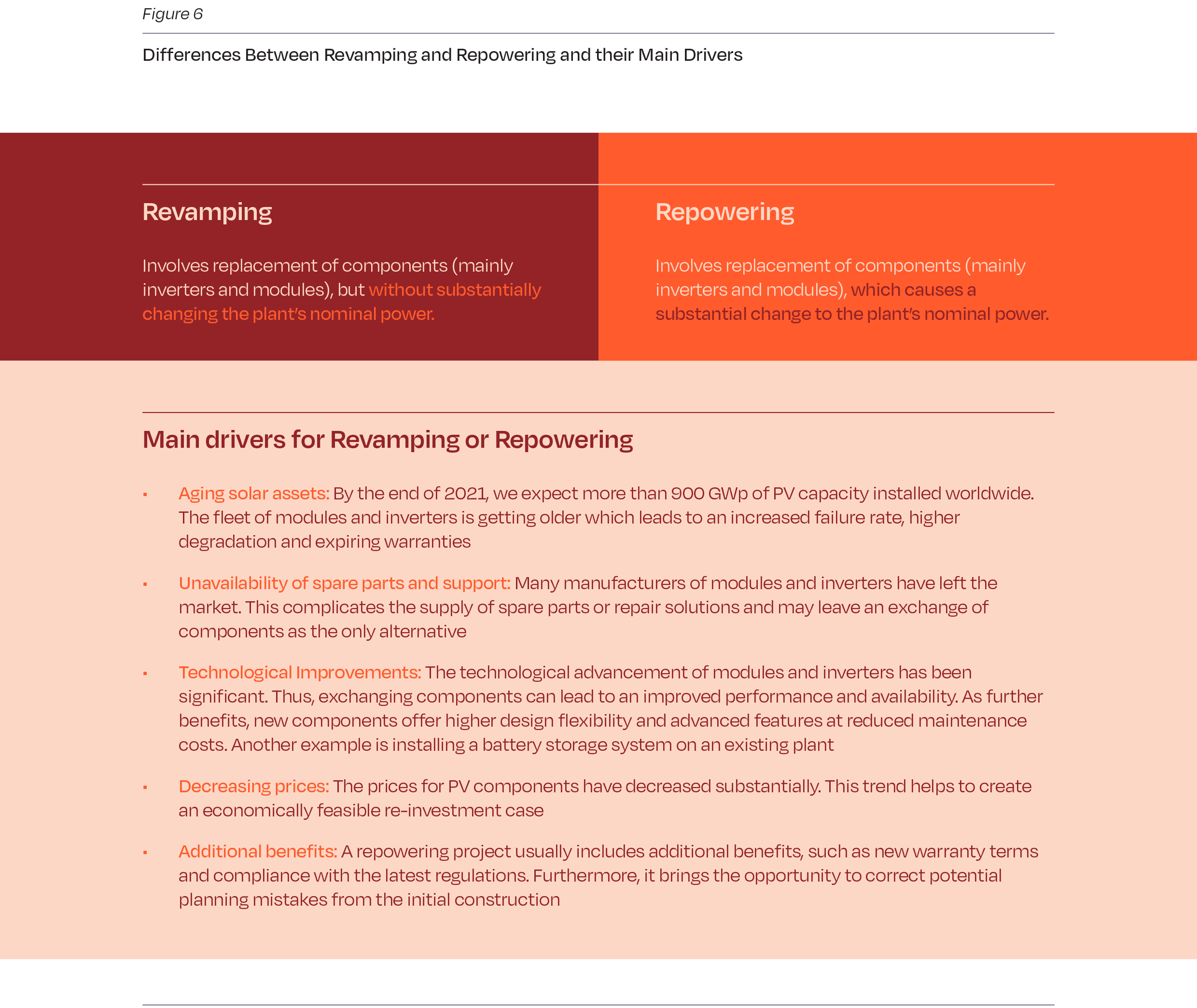
Revamping and repowering are defined as the replacement of old, power production related components of a power plant with new components to enhance its overall performance. Revamping involves component replacement, but without substantially changing the plant’s nominal power, whereas repowering involves increasing it. The difference between revamping and repowering, and ordinary replacement is that the former aims to increase performance by exchanging all components within a functional area or a significant ratio of them. The following sections focus principally on repowering but also broadly apply to revamping and even repairs and Extraordinary Maintenance. There are several reasons why repowering of solar PV power plants can be a necessary and/or beneficial investment. For an overview, see the following figure.
There are numerous ways of repowering a solar PV power plant. In the following we will concentrate on the two most important opportunities of module and inverter repowering.
7.2. Types of Revamping Projects
Revamping a PV project is a process that upgrades or replaces the components of a PV system. Depending on technical, regulatory and economic factors, operators may opt for total or partial revamping.
Total Revamping
Full revamping involves a comprehensive upgrade or replacement of most or all components in the PV plant. This may include:
• Solar Panels: Replacing all old solar panels with new, more efficient models
• Inverters: Updating all inverters to modern, higher-efficiency units
• Mounting Structures: Redesigning and replacing mounting structures to better support the new panels and optimise their orientation
• Electrical Infrastructure: Upgrading or replacing wiring, junction boxes, connectors, and other electrical components
• Monitoring and Control Systems: Implementing advanced monitoring and control systems to enhance performance tracking and system management
• Balance of System (BoS) Components: Updating all ancillary equipment, including transformers, switches, and protection devices
Partial Revamping
Partial revamping or repowering in photovoltaic (PV) plants refers to the process of upgrading or replacing certain components of an existing solar power system to improve its efficiency, performance, or extend its operational life. Unlike a full revamping, which involves a complete overhaul of the entire system, partial revamping targets specific parts of the PV plant. This approach can be more cost-effective and less disruptive while still achieving significant improvements.
Key components that might be involved in partial revamping include:
• Solar Panels: Replacing outdated or underperforming solar panels with newer, more efficient models
• Inverters: Updating inverters to modern, more efficient versions that can handle higher capacities and improve energy conversion rates
• Mounting Structures: Enhancing or replacing the mounting structures to better align panels for optimal sunlight capture or to support new, heavier panels
• Electrical Components: Upgrading cabling, connectors, and other electrical components to reduce losses and improve safety
• Monitoring Systems: Implementing advanced monitoring and control systems to better track performance and identify issues promptly
Partial revamping is typically undertaken to address specific issues such as declining performance due to aging components, advancements in technology that offer better efficiency, or changes in regulatory requirements. It allows plant operators to incrementally improve their systems without the need for the significant investment required for a full system replacement.
7.3. Types of Repowering Projects
PV projects are increasingly undergoing repowering as major breakthrough in PV technologies allow to deliver much higher power for the same area, or improve technical or economic efficiency of the system, typically with a view to increase rated capacity or availability of the PV plant.
Progressive Repowering
Progressive repowering is a process of gradually adding, upgrading and improving existing photovoltaic (PV) systems. This approach involves the partial and progressive addition or replacement of the system’s components (such as solar modules, inverters, and other electronic components) with more modern and efficient technologies, rather than a complete overhaul in a single intervention. The main scope of this type of repowering is to increase progressively the installed capacity of the PV Plant, it is worth saying that this model works only for non-incentivised PV parks.
Total Repowering
Total repowering involves a comprehensive replacement of all major components of a photovoltaic (PV) system, including solar modules, inverters, mounting structures, cabling, and often monitoring and control systems. This approach is typically undertaken when the existing system has reached the end of its operational life or when significant advancements in PV technology make it economically viable to completely upgrade the system. Total repowering aims to maximise energy yield, improve system reliability, and potentially increase the rated capacity of the PV plant. This type of repowering is particularly suitable for large-scale, non-incentivised PV parks or plants located in high-value electricity markets, where maximising output and efficiency is paramount.
Benefits of Photovoltaic Repowering
Progressive photovoltaic (PV) repowering allows to improve the performance of existing systems while minimising costs, and delivering environmental benefits. The core benefit of progressing repowering is improved efficiency. By replacing outdated solar modules with new-generation models, the system’s overall energy production can be significantly increased thanks to higher conversion efficiency in newer PV technologies. Similarly, upgrading inverters improves energy management while minimising conversion losses. As repowering happens, operational costs can come down significantly since modern PV components are not only more reliable but also require less maintenance, leading to lower long-term management expenses. Specifically, when undertaking progressive repowering, operators optimise the system’s lifespan. Gradually upgrading components to maximise the operation of the system while maximising the utilisation of initial investments.
Moreover, the introduction of new PV technologies allow a better integration with smart energy management systems, notably for energy storage, and other innovations that enhance the system’s efficiency and flexibility in the grid.
Repowering also delivers environmental benefit, increasing PV generation capacity with minimal environmental impacts linked to land use, delivering ever lower GHG/kWh produced. Progressive repowering, by maximising components use also allows to maximise the life-cycle benefits of PV components. Repowering aligns with evolving energy policies and regulations. Incremental upgrades can ensure compliance with updated standards while supporting broader sustainability goals and the transition to a cleaner energy mix.
Progressive photovoltaic repowering represents a sustainable and economic strategy to enhance the performance of existing PV systems, contributing to the transition towards more efficient and reliable renewable energy sources. There are numerous ways of repowering a solar PV power plant. In the following we will concentrate on the two most important opportunities of module and inverter repowering.
Module Repowering
Modules with irreparable defects that cannot be directly replaced in a like-for-like swap may force the investor to consider a module repowering. This can be carried out for the entire solar PV power plant or for specific parts. When repowering is focused on partial module replacement, exchanging more modules than is technically required is advised as this keeps old modules intact as spare parts for the future.
Due to the rapid development of solar PV technology it is not very likely that the same components are still available on the market in the required quantity or at a competitive price. Certainly, exchanging identical modules would make repowering very simple. However, this would mean spending money to maintain performance, instead of taking advantage of opportunities to raise efficiency at a lower proportional cost. Where different modules are used for the repowering project, the following aspects need to be considered during planning and execution:
Mechanical installation
If the modules have different dimensions in height, length and width, compatibility with the mounting system needs to be considered. Such issues may be solved by the introduction of new module clamps but in extreme cases (e.g. changing from thin film to crystalline modules) a new mounting structure needs to be installed. To avoid a total overhaul of the plant’s infrastructure, agile repowering strategies such as changing from central to string inverters, replacing transformers etc. should be considered.
Various factors, such as module weight also need to be taken into account: if the new module is heavier and has a larger surface area the structural impacts on the mounting system or the building need to be checked and managed. Compliance with relevant electrical safety is also key; for instance the new modules need to be integrated into the grounding system as before.

Electrical installation
Depending on the rated power and the electrical characteristics of the new module type a new string design may be required. In that case, the maximum DC power, voltage and current need to be in-line with the inverter requirements?
In general, mixing components with different electrical characteristics at one inverter or at least one MPP tracker should be avoided. Alternatively, bypass diodes can be integrated as protection in case of failures such as reverse current. Moreover, the dimensioning of existing cables and fuses needs to be checked and verified to ensure it is suitable for the new DC-layout.
Due to the evolution of standards and technologies, it is likely that the new module type will have different connectors. Therefore, the string cable connector needs to be replaced accordingly.
Further considerations
A module repowering may be subject to and impacted by various regulatory aspects, which will vary from country to country, and may even depend on the regulatory or support framework of the initial installation (e.g. if benefiting from a feed in tariff?). The regulatory body should be contacted well in advance to clarify aspects such as:
• Maximum power to be installed
• Requirements for proving the faults of modules
• Registration of new modules
• Disposal of old modules
Module repowering should be considered as a relevant interference into the electrical system. All affected strings should be tested and documented according to IEC 60364-7-712:2017, IEC 60364-6:2016 and IEC 62446-1:2016 after the repowering project. The new string layout should notably be optimised while considering shading or DC/AC ratio. Furthermore, an in-depth check of the mounting structures, cables and connectors should be performed. If only a small share of the modules are exchanged and power measurements of the old type of modules are being performed, it is recommended to install the old modules according to their remaining power. This means all modules in one string or connected to one MPP tracker should have similar power to reduce mismatching losses. Depending on the state of the old modules (and the regulatory requirements), they may either be sold to the secondary market or should be disposed or recycled by a professional provider.
Inverter Repowering
Inverters have a limited lifetime, typically shorter than some other components of the PV system such as modules or mounting structures. With increasing age and wear, the likelihood of failures and breakdowns increases. If the warranty of a device has expired, a technically and economically suitable solution needs to be identified. Some manufacturers or service providers offer repair and spare parts services. With new components it might even be possible to increase the efficiency of an older inverter (e.g. by replacing an old control board with a new device that has improved performance characteristics, such as Maximum Power Point (MPP) tracking). If an identical replacement inverter, repair services or spare parts are not available, using a new component becomes inevitable. There are different strategies for inverter repowering which should be evaluated on a case-by-case basis:
• Partial or complete exchange: If only some of the inverters are affected, a partial exchange of the inverter fleet of the solar PV system can be an option. This potentially reduces the overall costs, but it can also increase the complexity regarding the electrical design or the implementation of two different inverter types into one communication concept on-site. If the repowering does not affect all inverters on-site, it is advisable to store the old devices as potential spare parts. Additionally, it can be practical to exchange more inverters than technically required to store those as potential exchange devices for future defects of the old inverter type
• Exchange of same or different power class: Exchanging inverters with the same power class is easier for the DC and AC integration. However, replacing multiple devices through one with a larger power class can increase the system efficiency and reduce the component costs as well as future maintenance costs
When an inverter repowering is planned, several factors need to be considered:
Mechanical installation
If the new inverters have different dimensions or weight, a suitable solution for the installation or mounting of the inverter needs to be prepared. The same applies for proper cabling if DC or AC connections are changed. The manufacturer of the new device might have different requirements mounting the inverter with regards to fixings, distance to other components or to the roof, ventilation, etc. All such requirements need to be checked and implemented. The new inverters also need to be integrated into the grounding system according to the standards and the manufacturers specifications.
Electrical installation
The integration of the DC side to the new inverters needs to follow the DC input requirements of the new inverter. The string length and the number of connected strings may need to be adjusted to suit the technical parameters of maximum current and voltage as well as ideal operational conditions. In case larger inverters are installed, additional DC combiner boxes might be required, and different, or additional fuses may need to be integrated. If different inverter sizes are installed, the integration to the AC side needs to be re-engineered. This includes the cable diameters, protection devices (fuses) and connectors. In all cases the applicable electrotechnical rules and regulations need to be followed.
Communication system
Before choosing an adequate inverter, compatibility with the physical communication cables should be checked. The installed data logger needs to support the new inverter’s data protocol, otherwise, an update or exchange of the data logger will also be necessary. Moreover, if different inverter types are installed, it can be an option to integrate the different component types on different phases of one communication cable or integrate them into one network. The compatibility of the datalogger and the monitoring platform to work with different inverter types at one solar PV system needs to be validated.
Further considerations
An inverter repowering might be subject to various regulatory aspects, which will vary from country to country. The responsible regulatory institution should be consulted well in advance to clarify
aspects such as:
• Maximum power to be installed
• Compatibility to grid code and plant certificate
Inverter repowering should be considered as a relevant interference into the electrical system. All affected cables and connectors should be tested and documented according to IEC 60364-7-712:2017, IEC 60364-6:2016 and IEC 62446-1:2016 during the repowering project. The new inverters should be optimised towards shading or DC/AC ratio. When the new inverter has more advanced features than the old one (e.g. multiple MPP tracker), this could be an additional advantage for the repowering project. Other technical considerations, such as the noise levels of the inverters may vary, and it should be adequately checked against the permitting restrictions and the neighbouring activities. Depending on the state of the old inverters, they can be either kept as potential spare parts, sold to the secondary market. If these options are not practical, the devices should be disposed of or recycled by a professional service provider.
Moreover, following the installation of a new inverter or parts, updated or different maintenance scope and intervals need to be included into the Preventive Maintenance schedule and all involved people should be informed about the changes and accordingly trained regarding Preventive and Corrective Maintenance. It is also useful to point that in some cases, inverter repowering may be profitable even when the old inverter still operates with full availability, especially when a new inverter produces more energy due to higher efficiency or better operating conditions.

7.4. Key O&M KPIs and their role in identifying Revamping Opportunities
O&M KPIs (Key Performance Indicators) are crucial metrics that help monitor the performance and health of photovoltaic (PV) systems (see more in Chapter 10. Key Performance Indicators). By regularly analysing these KPIs, operators can identify underperforming components or inefficiencies, thus highlighting opportunities for PV revamping. Here’s how PV O&M KPIs help in this process:

By systematically tracking and analysing these KPIs, operators can pinpoint specific areas where the PV system is underperforming. This data-driven approach allows for targeted revamping efforts, ensuring that upgrades are made where they will have the most significant impact on improving system efficiency, reliability, and overall energy production.
7.5. Structure of Revamping/Repowering Contract
A PV revamping/repowering contract is a detailed agreement between the system owner and the contractor outlining the scope, terms, and conditions for upgrading an existing photovoltaic (PV) system. The structure can change depending on the contractor, the country, the legislation, etc. Below are the key components typically included in such a contract:

7.6. Potential risks faced by the Revamping/Repowering Contractor
The following table outlines the potential risks faced by the Revamping/Repowering Contractor during the project lifecycle. It categorises risks across various domains, detailing their nature and potential impacts to provide a comprehensive understanding of challenges that may arise.

7.7. End-of life process for dismantled materials after a Revamping/Repowering Project
After a PV revamping/repowering project, dealing with the end-of-life (EoL) disposal of old and replaced materials is a crucial step to ensure environmental sustainability and regulatory compliance. This process involves several key considerations and steps to manage the disposal of materials such as solar panels, inverters, wiring, and other components that are no longer in use.
Solar panels and other PV system components contain materials that can be harmful to the environment if not disposed of properly. These include metals, polymers, and hazardous substances such as cadmium or lead in certain types of panels. Responsible disposal practices help mitigate the environmental footprint of the revamping project and support the broader goals of sustainable energy practices.
Different countries and regions have specific regulations governing the disposal of electronic waste (e-waste). Ensuring compliance with these regulations is essential to avoid legal repercussions and potential fines. Compliance often involves working with certified e-waste recycling facilities that can handle the materials according to local and international standards.
Many materials in old PV components can be recovered and recycled, reducing the demand for raw materials and supporting the circular economy. Effective recycling programmes can extract valuable metals like silver, copper, and aluminium, as well as glass and silicon, which can be reused in manufacturing new products . More on this to be found in SolarPower Europe’s Sustainable Solar Report at www.solarpowereurope.org.
Steps in Disposal Process
The following section outlines the key steps involved in the disposal process, providing a clear, numbered overview for better understanding and implementation.

Benefits of Proper Disposal
Environmental Protection: Proper disposal prevents harmful substances from entering the environment, protecting ecosystems and human health.
Resource Efficiency: Recycling old PV components conserves natural resources and reduces the environmental impact of mining and manufacturing new materials.
Regulatory Compliance: Adhering to e-waste regulations avoids legal issues and promotes corporate responsibility.
Sustainable Development: Responsible disposal practices support the sustainable growth of the renewable energy sector and contribute to a circular economy.]
By prioritising the end-of-life management of materials in a PV revamping/repowering project, stakeholders can ensure that the environmental benefits of solar energy are maximised, even as the systems themselves are upgraded and improved. It is worth saying that for Revamping projects carried out at incentivised PV plants, the regulatory companies asks for the disposal and dismantling certificate, as well as all the serial numbers of the old main disposed components. This is mandatory for not losing the incentives.
General Repowering Considerations
Although, a repowering project is mainly technically driven, for the owner of the solar PV system it is a commercial re-investment case. Therefore, it is of great importance to calculate a detailed and solid business case before starting the project, and review it during the project stages. All technical and commercial data, such as historical performance, future performance, revenues, costs, extended life span and changed maintenance requirements need to be considered to come up with a prognosis of the future income streams. With this, a classical return on investment or break-even calculation can be performed and presented to the investor as the basis for a decision.
As an additional analysis, calculating the sensitivities of the most important factors is recommended. This will provide a better understanding of the influence of changing conditions (e.g. if the costs for the project will change or the projected performance will be different to the assumptions).
Each repowering activity should be approached as an individual project, which can be structured as follows:
Performance analysis
• Historical yield assessment & identification of performance issues
• Verification of issues on site with additional inspections or testing
• Determination of root causes and areas for improvement
Potential assessment
• Technical feasibility study of different options
• Commercial analysis, taking investment costs and additional revenues or reduced losses into account
• Analysis of the regulatory requirements and their implications
• Risk assessment for the case where the solution does not meet expectations
Solution Design
• Detailed technical engineering
• Determination of all costs for time and material
• Setting up project plan
• Update commercial analysis with more precise information
Implementation
• Execution of repowering measures
• Project management
• Constant quality control
• Commissioning and documentation
• Update of maintenance guidelines
Review
• Technical evaluation regarding reliability and performance
• Commercial evaluation regarding costs and return on investment
A rigorous project management and quality control across all project stages will ensure a realisation of the project in time, budget and quality. Similarly, reporting to the Asset Manager and Asset Owner should be provided throughout all stages of a repowering project.