Engineering, Procurement & Construction Best Practice Guidelines (Version 2.0)
Do you prefer the guidelines as a pdf file?
Download PDFAre you interested in downloading a specific chapter?
Search the reports?
SearchIntroduction
1.1. Rationale, aim and scope
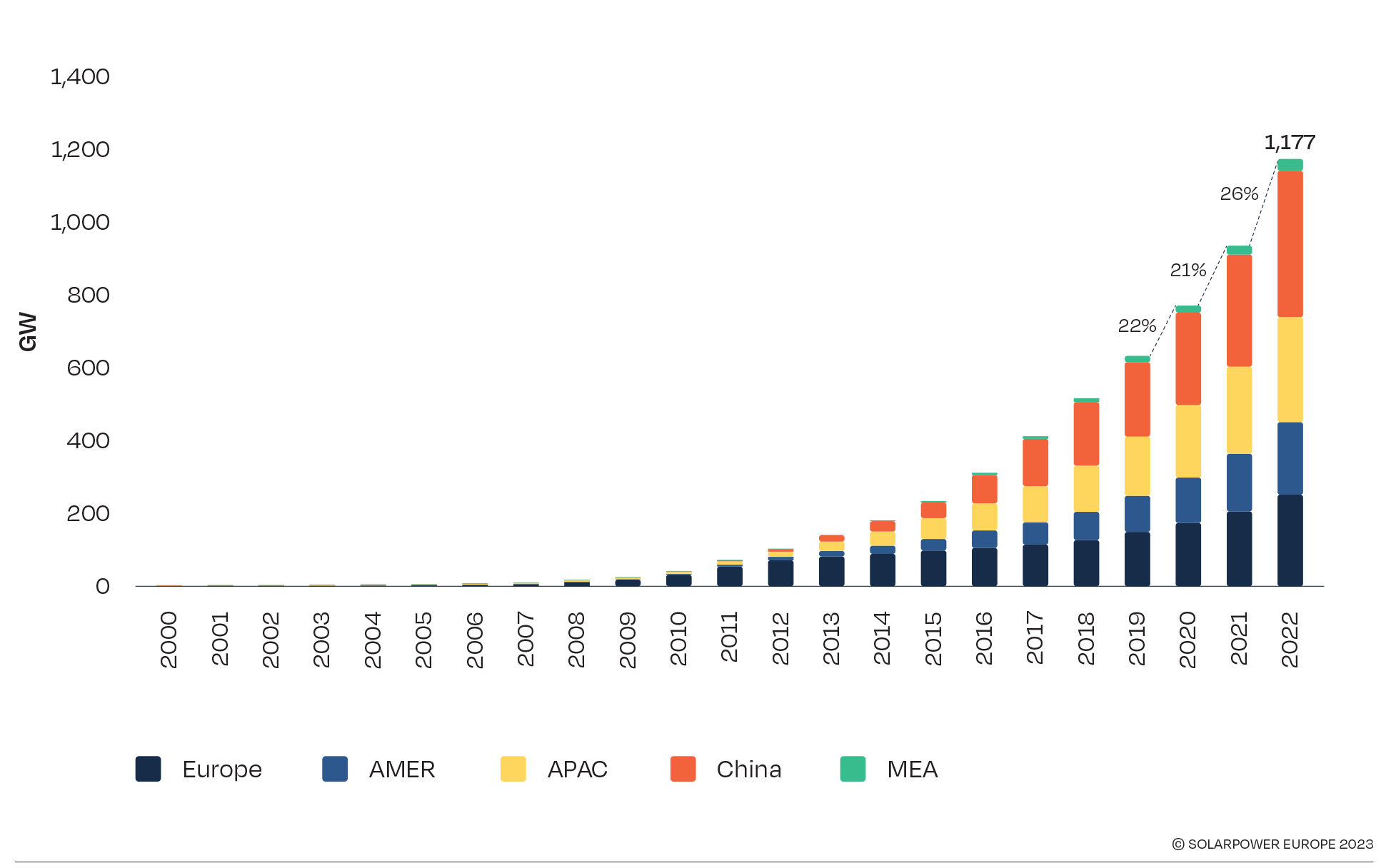
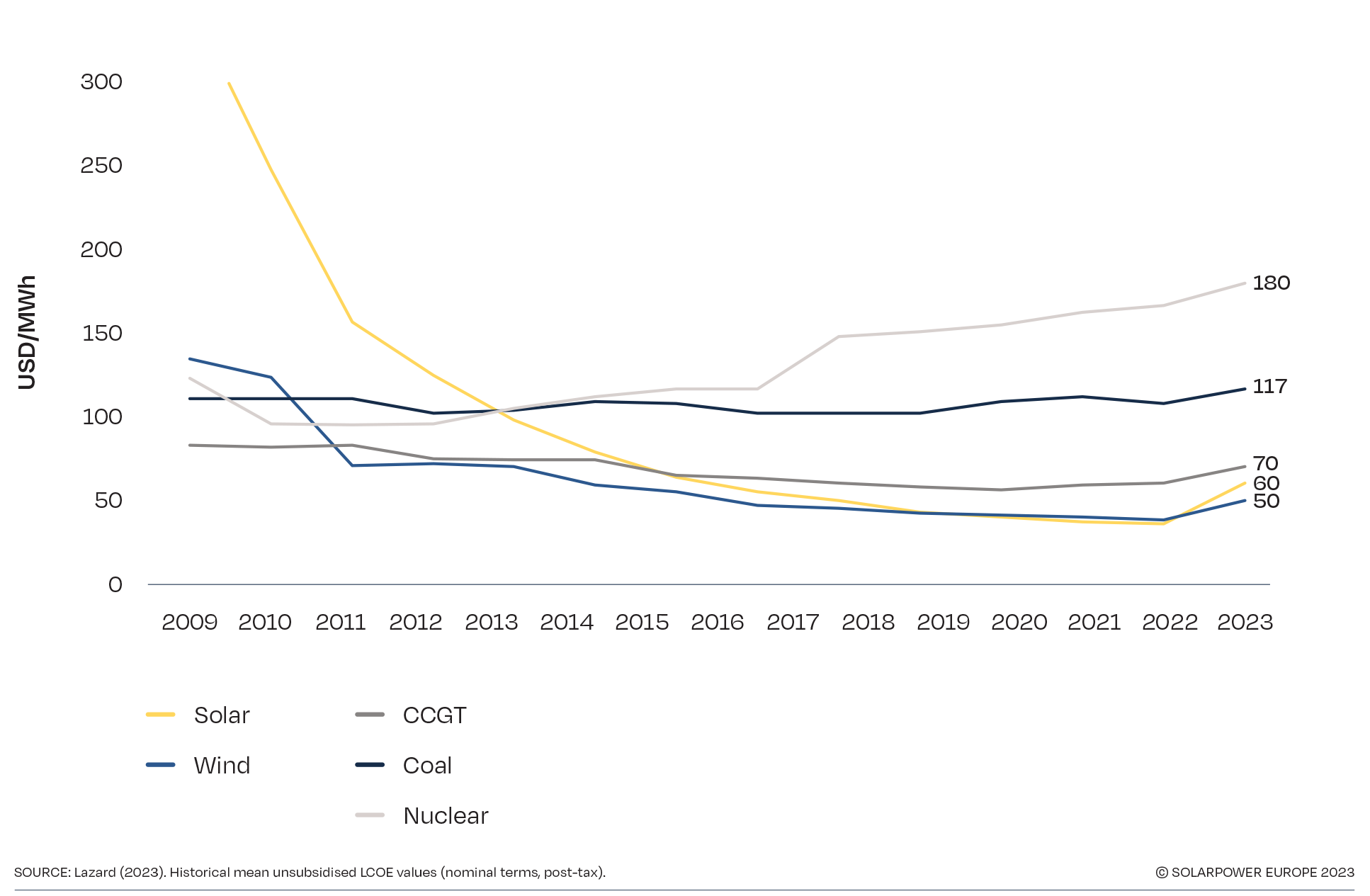
Solar PV is a maturing industry. Its development globally has been phenomenal, with a sustained double-digit annual growth rate in excess of 10% for the last three decades (see Figure 1). This is due to an equally impressive reduction in the cost of the energy produced by the technology (see Figure 2). Sustaining this cost reduction is critical for maintaining competitiveness against other energy technologies. This guide aims to contribute to further cost reductions. The collection of best practices cannot always be understood as a benchmark, as it might not fit to the company and project’s structure.
The cost of PV energy is a function of CAPEX, OPEX, finance, and the amount of energy generated by the PV system. There is relentless competition in the marketplace, which mostly is played out on cost. The four contributions above are often seen as independent of one another and are optimised separately. This may not be ideal. Quality assurance is the link between these elements, as CAPEX savings may lead to higher OPEX or reduced energy generation. One idea behind these Guidelines is to minimise risks linked to this siloed approach to optimisation.
PV assets need to be cost effective to ensure broad acceptance of the technology. Simultaneously, they must deliver against performance expectations to prove their attractiveness to investors. To connect these two, there are different quality assurance strategies that are employed throughout the industry. These Guidelines allow for these different approaches, by detailing what is considered essential to assure a worthwhile asset and indicating optional and recommended additions.
The Guidelines systematically go through the Engineering, Procurement, and Construction (EPC) phases of a solar power plant. It is assumed that quality underpins the entire process, and often the earlier in the process it is introduced, the lower the overall system build, and Operation and Maintenance (O&M) costs will be. For more information on how quality underpins the lifcycle of a solar PV power plant, please refer to section 4.4 Quality Management of SolarPower Europe’s Lifecycle Quality Best Practice Guidelines (available at www.solarbestpractices.com). The links between the “E”, “P” and “C” stages, as well as the links between Development and EPC, and the EPC and O&M phases are described in detail to minimise handover problems. Quality is often assured by the application of standards. There is a comprehensive list of these in Annex A. The Guidelines do not aim to substitute any of these, they aim to support the application of them and point out several relevant uses.
1.2. How to benefit from this document
These Guidelines include the main considerations for a successful and professional EPC service provision. Although they have not been tailored to individual stakeholders, the purpose of the Guidelines is similar for all - understanding the mandatory requirements and the necessity of high quality EPC services, as well as incorporating recommendations into service packages for more effective EPC services. Any of the directly relevant stakeholders (as described above) can benefit from this work, tailor it to their needs without lowering the bar and know what to ask for, offer or expect. The Guidelines are particularly useful for anybody in the industry involved in assessing or minimising risks of an asset. Although the focus is European, most of the content can be used in other regions around the world. The requirements described in the Guidelines apply without changes in other regions and additional requirements or modifications can easily be made for other regions with unique characteristics.
In line with other Best Practice Guidelines of SolarPower Europe the value proposition of this report is its industry-led nature, gathering the knowledge and experience of well-established and leading companies in the field of EPC, AM, O&M service provision, utilities, manufacturers, digital solution providers and insurance providers. The scope of the current second edition includes the utility scale segment and more specifically, systems above 1MW. The Guidelines are based on the experience of companies operating globally (with a focus on Europe) and identify high-level requirements that can be applied worldwide. Specific national considerations such as legal requirements are not included and should therefore be considered separately if the Guidelines are to be used in specific countries.
The content covers technical and non-technical requirements, classifying them, when possible, into the following:
- Minimum requirements, below which the EPC service is considered as poor or insufficient, and which form a minimum quality threshold for a professional and bankable service provider
- Best practices, which are methods considered state of-the-art, producing optimal results by balancing the technical as well as the financial side
- Recommendations, which can add to the quality of the service, but whose implementation depends on the considerations of the Asset Owner, such as the available budget
To differentiate between these three categories, verbs such as “should” indicate minimum requirements, unless specified otherwise, as in, “should, as a best practice” or “as a recommendation”.
1.3. List of abbreviations
AC ... Alternating current
AM ... Asset Management
ASCE ... American Society of Civil Engineers
BESS ... Battery Energy Storge Systems
BOM ... Bill of Materials
BOS ... Balance of System
BRP ... Balance Responsible Party
BTM ... Behind-the-Metre
CAD ... Computer Aided Design
CAPEX ... Capital Expenses
CCTV ... Closed Circuit Television
CFD ... Computational Fluid Dynamics
C&I ... Commercial & Industrial
CMM ... Number of Critical Milestones Missed
COD ... Commercial Operation Date
CPN ... Cost Priority Number
DC ... Direct Current
D/E ... Debt-to-Equity ratio
DEM ... Digital Elevation Models
DoD ... Depth of Discharge
DSM ... Demand-side Management
EBIT ... Earnings Before Interest and Taxes
EIA ... Environmental Impact Assessment
EL ... Electroluminescence
EPC ... Engineering, Procurement, Construction
ERP ... Emergency Response Plan
ESS ... Energy Storage System
EVA ... Ethylene-Vinyl Acetate; Economic Value Added
FAC ... Final Acceptance Certificate
FAT ... Factory Acceptance Test
FMEA ... Failure Modes and Effects Analysis
FTM ... Front-of-the-Metre
GPM ... German association for Project Management
HAZOP ... Hazard & Operability Study
H&S ... Health and Safety
HSSE ... Health, Safety, Security, and Environment
HV ... High Voltage
HVAC ... Heating, Ventilation, Air Conditioning
HVRT ... High Voltage Ride Through
IEC ... International Electrotechnical Commission
IECRE ... IEC system for certification to standards relating to equipment for use in Renewable Energy applications
IFC ... Issue for Construction
IP ... Inverter Protection, Internet Protocol
IRR ... Internal Rate of Return
ISO ... International Organisation for Standardisation
IVPD ... Induced Voltage test with Partial Discharge measurement
KPI ... Key Performance Indicator
kW ... Kilowatt
kWh ... kilowatt-hour
kWp ... kilowatt-peak
LCOE ... Levelised cost of electricity
LD ... Liquidated Damages
LeTID ... Light and elevated Temperature Induced Degradation
LFP ... Lithium Ferro (iron) Phosphate
LID ... Light Induced Degradation
LV ... Low Voltage
MCC ... Mechanical Completion Certificate
MTTR ... Mean Time to Repair
MV ... Medium voltage
MW ... Megawatt
NCU ... Network Control Unit
NMC ... Nickel Manganese Cobalt
NPM ... Net Profit Margin
NTP ... Notice To Proceed
O&M ... Operation and Maintenance
OD ... Operational Document
OPEX ... Operational Expenses
PAC ... Provisional Acceptance Certificate; Pac: AC Power
PCS ... Power Conversion System
PD ... Partial Discharge
PHSSER ... Project Health, Safety, Security, Environment review
PID ... Potential Induced Degradation
PLC ... Programmable Logic Controllers
PMI ... Project Management Institute
POD ... Point of Delivery
POI ... Point of Interconnection
PPA ... Power Purchase Agreement
PPE ... Personal Protective Equipment
PR ... Performance Ratio
PV ... Photovoltaic
QA ... Quality Assurance
QC ... Quality Control
QI ... Quality Improvement
QM ... Quality Management
QP ... Quality Planning
QR ... Quality Review
RACI ... Responsible, Accountable, Consulted, Informed
RFSU ... Ready for Start Up
RFP ... Request for proposal
RFQ ... Request for quotation
RFT ... Request for tender
RPN ... Risk Priority Number
ROCE ... Return On Capital Employed
ROS ... Return On Sales
SCADA ... Supervisory Control and Data Acquisition
SLA ... Service-Level agreement
SLD ... Single-Line Diagram
SOC ... State of Charge
SPV ... Special Purpose Vehicle
SSSP ... Site-Specific Safety Plan
STC ... Standard Test Conditions (1000 W/m2, 25°C)
STEM ... Science, technology, engineering, and mathematics
TA/SWMS ... Task Analysis/Safe Work Method Statement
TCU ... Tracker Control Unit
TSO ... Transmission System Operator
UPS ... Uninterruptible Power Supply
UV ... Ultraviolet
VPP ... Virtual Power plant
WBS ... Work Breakdown Structure