Asset Management Best Practice Guidelines (Version 2.0)
Do you prefer the guidelines as a pdf file?
Download PDFAre you interested in downloading a specific chapter?
Search the reports?
SearchContractual framework
This section contains a set of considerations for the contractual framework of AM services to be executed with respect to commercial, industrial and utility-scale systems. As a complement to the technical specifications detailed in the previous chapters, the contractual framework described in this chapter is considered as a best practice.
12.1. Scope of the Asset Management contract
The services provided by an Asset Manager will include the tasks shown in Figure 16 and detailed in this document.

12.2. Asset Management contract fee
As a best practice, AM services should be provided on a fixed annual fee. The Asset Management fees could also be calculated according to a formula which takes into account the capacity of the power plant:
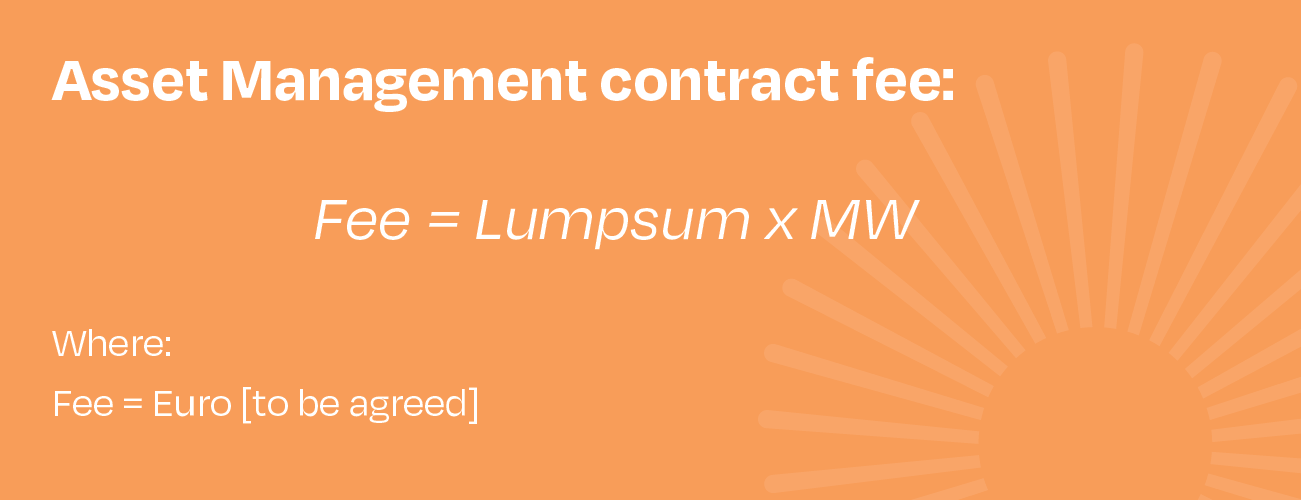
In addition to the annual fees, the Asset Manager may usually charge the client any out-of-pocket expenses within the annual maximum amount agreed between the parties.
Moreover, the parties may agree upon additional services to be executed at a predetermined price indicated under the contract.
12.3. Contractual guarantees
No contractual guarantees are generally provided under AM agreements.
12.4. Service standards
The Asset Manager will provide the services in accordance with all laws, authorisations, good industry practice and current market standard.
The services to be performed under the AM agreement and the action of the Manager shall be conducted honestly, in good faith, and in the best interest of the client.
With respect to the accounting services, the Asset Manager will keep the books and the relevant records in a proper manner and in conformity with all the required accounting principles and the applicable laws.
Reference to compliance with other project contracts' obligations may be negotiated separately and agreed between the parties to ensure that the SPV/Asset Owner is not in breach of any other relevant obligations undertaken under major contracts.
12.5. Limitation on authority
The Asset Manager shall not be entitled to sell, lease, pledge, mortgage, encumber any client's asset or grant any right or licence over the client's assets.
The Asset Manager shall perform the services in compliance with the annual business plan provided by the client.
In addition to the above, the parties may agree that the Asset Manager will not be entitled to enter into any contract having a value higher than the maximum amount identified in the AM agreement.
Moreover, with respect to any litigation that may arise between the SPV/Asset Owner and any third party, the Asset Manager will not have the power to settle any such claim or to submit to a court or an arbitration panel any such dispute.
12.6. Responsibility and accountability
The Asset Manager shall be liable towards the Asset Owner for every contractual breach or violation of any specific obligation set out under the Asset Management Agreement, including the confidentiality undertakings.
Parties may agree on a maximum liability threshold for the Asset Manager, which is usually equal to the payable annual fee.
12.7. Subcontracting
The Asset Manager could be authorised to subcontract part of the activities to be carried out under the Asset Management Agreement, provided that the subcontractor is a reputable and experienced entity or person capable of fulfilling all the subcontracted obligations and will comply with all the standards and requirements set out under the AM agreement. It is advisable to have a joint liability between the Asset Manager and the subcontractor so that the Asset Manager will remain liable for the subcontracted activities.
12.8. Reporting
Reporting should be done periodically if contractually agreed between the Asset Manager, the O&M Contractor and the Asset Owner. Should the client execute commercial agreements that require daily management and reporting, the AM agreement will also include such specifics. Please note that such activity is generally an additional service.
12.9. Continuity of operation and termination
In the event of termination or withdrawal from the AM agreement, the Asset Manager shall, if required by the client, continue to operate the assets for a specified period (i.e. 60 days) until the replacement of the manager. In such a period, the Asset Manager shall continue to act in accordance with all the provisions set forth under the AM agreement as if the agreement had not been terminated.
Termination is usually provided for general breaches of contract and obligations. Specific breaches leading to immediate termination are generally not included under this type of contract. Grounds for termination may vary a lot. They could go from a minimum of 15 days to a maximum of 90 days.
Termination for convenience may be negotiated between the parties as well as a relevant termination fee.
12.10. Force Majeure
In case of force majeure, the Asset Manager should mitigate the impact of the force majeure event on the performance of the services to be carried out under the AM agreement. The Asset Manager's obligation also includes minimising the timeframe of a suspension of services, understanding that the services must be restarted in the shortest possible time. During the suspension of services, the Asset Owner (or the lender, if a direct agreement has been executed) may have the right to step in in order to cure any default. Whether the suspension of services is forecastable or not, the Asset Manager should do its best to minimise to the extent possible the damage to the Asset Owner. The Asset Manager also has to inform the Asset Owner of the forecastable restart and the measures to be adopted for minimising the suspension. As a general remark, it should be underlined that in case of a breach of the Asset Manager's duty of care, the Asset Owner may have the right to request full compensation for the damages suffered; to this extent, compensation for indirect losses is generally excluded. Regarding the services suspension regime, it is market standard that the Asset Manager is relieved from the performance of such services as long as the force majeure event lasts. Therefore, each party may have the right to withdraw from the AM agreement upon the expiration of an agreed term or in case the force majeure event jeopardises the entire execution of the Asset Management Agreement.
12.11. Direct agreement
Should the PV plants be financed on a project finance basis, the Asset Manager, the Asset Owner and the lenders may execute a direct agreement in order to regulate lenders' step-in right in case of any default in the Asset Manager’s obligation occurs.
Moreover, regarding lenders' security, lenders may require the Asset Manager to deliver any form of agreed collateral guarantee in order to secure the performance of the AM services under the AM agreement.
12.12. Personnel
The Asset Manager should engage and deploy an adequate number of competent, suitably qualified and experienced personnel in order to perform their obligations under the AM agreement. The personnel allocated for the performance of the services should remain allocated to such activities for the entire term of the AM agreement. In case of misconduct or any other incapability in the performance of the services, the Asset Manager should remove and replace the affected personnel with a suitable and qualified replacement. The same provision should also apply to the subcontractor.