Onboarding Best Practice Guidelines
Asset management
12.1. Technical AM
Monitoring tool training, KPIs, benchmarking, insurance claim, warranties, contracts, production forecasts, specific inspections
Technical Asset Management
Technical Asset Management (TAM) encompasses support activities to ensure the best operation of a solar power plant or a portfolio, i.e., to maximise energy production, minimise downtime and reduce costs. It comprises the activities presented in this chapter. It is worth noting that TAM can be done by either the O&M service provider or the Asset Manager. The choice over whether to give TAM responsibilities to the Asset Manager or the O&M service provider is ultimately down to the Asset Owner. For more information on the role of the AM, please refer to SolarPower Europe’s Asset Management Best Practice Guidelines V 2.0.
It is not easy to draw a sharp line between the high-level tasks of the Operations team and the more technical responsibilities of the Asset Manager. A simple way to provide some clarity would be that TAM focusses on the administrative environment of the solar PV power plant and Operations Management focusses on performance and data analysis. In many cases, the O&M service provider assumes some tasks related to TAM, such as KPI reporting. The following tasks can be regarded as TAM and can be performed by the O&M service provider or the AM. In cases where the Technical Asset Manager and the O&M service provider are separate entities, close coordination and information sharing between the two entities is necessary. This involves an integral knowledge about how much power a solar PV power plant should be producing for any given time, considering factors such as weather, seasons, or degradation of assets, etc, ensuring long-term energy infrastructure reliability. It represents the entire value chain from investors to Asset Managers and service providers.
Technical reporting
The Technical Asset Manager is responsible for preparing and providing regular reporting to the Asset Owner and other stakeholders defined in the agreement between the Asset Owner and the Technical Asset Manager.
The frequency of the reporting should be relative to the level of TAM activity. Standard reporting can be set for monthly, quarterly, or annually. Where specific TAM actions are underway, for example insurance claims or warranty claims, reporting could be more frequent. Report content should be specifically defined. Generating a report for any specific time range in the past can also be possible. Detailed time-series data should also be reported or at least archived in the reporting system to improve the correct availability calculations. The spatial resolution of reports should be on the level of each inverter to better detect under-performing sections of the plants managed.
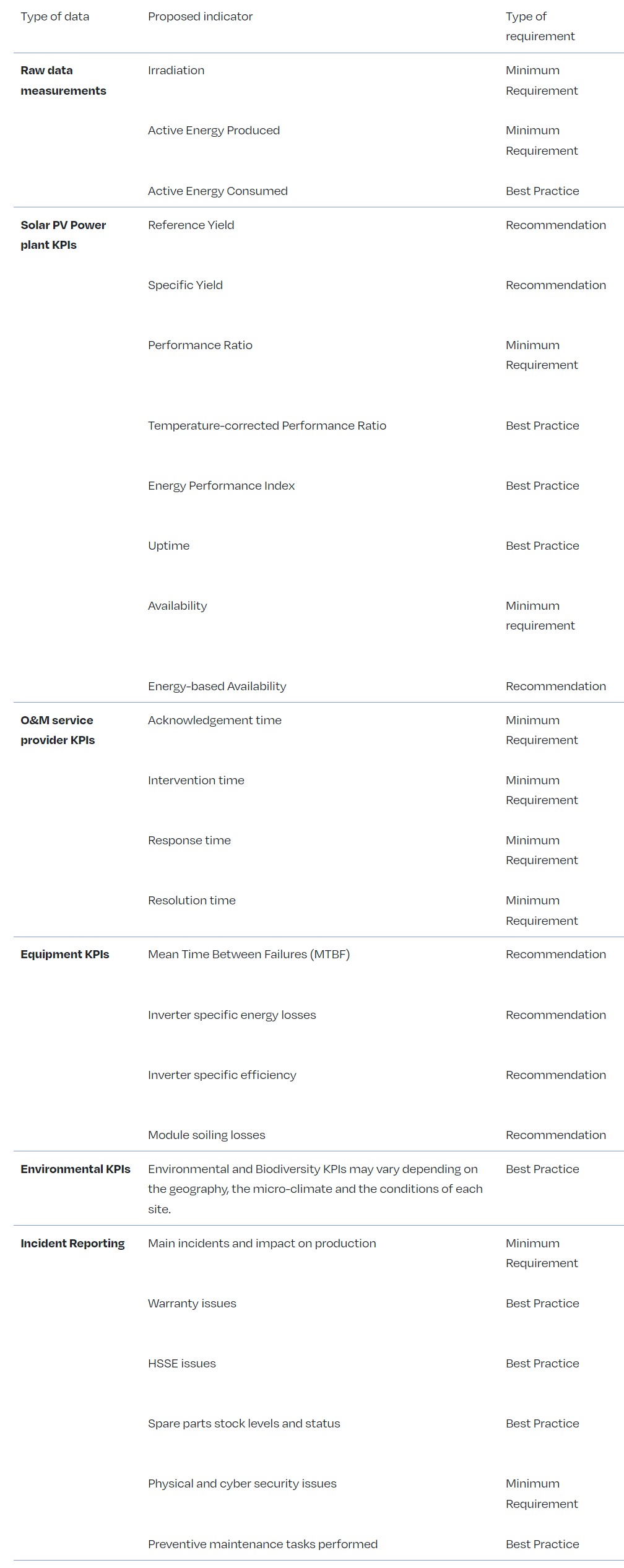
Table 33 below includes some proposed quantitative and qualitative indicators which should be in reports as a minimum requirement, a best practice, or a recommendation. For more details on the individual indicators, see chapter 10. Key Performance Indicators of the OM Best Practice Guidelines.
A new trend in the industry is to extend the reporting beyond the pure solar PV power plant indicators and to incorporate reporting on the actual activities. This means that both the Asset Manager and the O&M service provider can operate with an Asset Management Platform, ERP (Enterprise Resource Planner), or CMMS (Computerised Maintenance Management Systems) in order to measure various O&M service provider KPIs (e.g., Acknowledgement Time, Intervention Time, Reaction Time, Resolution Time) and equipment performance (e.g., Mean Time Between Failures).
The Technical Asset Manager should report on:
- Spare Parts Management and, in particular on, spare parts stock levels, spare parts consumption, in particular solar PV modules on hand, spare parts under repair. With the emergence of Predictive Maintenance, the Technical Asset Manager can also report on the state of each individual equipment (see chapter 8. Spare Parts Management)
- Compliance with regulatory requirements, including from grid operators, regional and national authorities for conditions of operation (refer to section 4.4 Interface with local energy authorities & regulatory compliance)
- Warranty management, warranty claims performance with various component suppliers (refer to section 4.5 Warranty management)
- Insurance claims management, providing lifecycle reporting on new claims raised, claims in progress and claims settled (refer to section 4.6 Insurance claims)
- Contract management, reporting on the performance of the O&M service provider and issues relevant to the O&M contract. For more information, refer to section 4.7 Contract management (operational contracts)
- Risk management, updating and reporting on the risk register for the solar PV power plant, highlighting significant changes to the risk register (refer to section 4.11 Technical risk management)
- Status of the security and surveillance system. In this case, the security service provider is responsible for providing the relevant input.
On top of the periodic standard reports (monthly, quarterly or yearly), where the Technical Asset Manager reports on operations activities to the Asset Owner, it is a best practice for the Technical Asset Manager to provide an intermediate operation report when a fault is generating a major loss. A loss due to a fault is considered major when PR and availability are affected by more than a certain threshold throughout the ongoing monitoring (or reporting) period. A best practice is to set this threshold to 1% of Availability or 1% PR within a reporting period of one month. The report should be sent as soon as the fault is acknowledged or solved and should contain all the relevant details related to it, together with recommendations for Extraordinary Maintenance when the necessary operations are not included in the maintenance contract.
Typically, this maintenance report should contain:
- Relevant activity tracks (alarm timestamp, acknowledgement time, comments, intervention time, description of on-site operations, pictures, etc.)
- The estimated production losses at the moment of the report was written
- The estimated production losses for the total duration of the period, counting on the estimated resolution time if the issue is not solved yet
- The device model, type, and Serial Number when the fault is affecting a device
- The peak power of the strings connected to the device(s)
- The alarm and status log as provided by the device
- The resolution planning and suggestions
- Recommendations on whether a replacement is needed
- Spare parts available
- Estimated cost for the extraordinary maintenance
Site visits and non-intrusive inspections
It is recommended as a best practise that a bi-annual site visit is undertaken from a Technical Asset Manager perspective (in coordination with the O&M service provider if they are separate) to perform a non-intrusive visual inspection, address current maintenance issues and plan out, in cooperation with the O&M service provider, and the ancillary service providers (if different), a maintenance improvement plan.
Management of ancillary service providers
Technical Asset Managers or the O&M service provider are responsible for managing providers of ancillary (additional) services related to solar PV site maintenance such as panel cleaning and vegetation management; general site maintenance such as road management; site security; or on-site measurements such as meter readings and thermal inspections.
This requires managing a process which spans from tendering for those services all the way to assessing the deliverables and reassuring, in coordination with the O&M service provider, compliance with HSSE policies.
Interface with local energy authorities & regulatory compliance
The Technical Asset Manager is responsible for ensuring that the operation of the solar PV power plant complies with the relevant regulations. Several levels of regulatory and contractual compliance have to be considered:
- Many countries have a governing law for the operation of energy generating assets and transmission and/or distribution network organisations will likely have specific requirements to be met. This is something the O&M service provider should be aware of in any case, even if the O&M service provider and the Technical Asset Manager are separate entities
- Requirements of Power Purchase Agreements (PPA) and Interconnection Agreements.
- Power generation license agreements
- Terms and conditions of corporate PPAs and stricter contractual obligations by the Owner
- Specific regulation for the site such as building permits, environmental permits, and regulations, which can involve certain requirements and the need to cooperate with the local (or regional or national) authorities. Examples include restrictions to the vegetation management and the disposal of green waste imposed by the environmental administration body or building permits restricting working time on site or storage of utilities
- It is the O&M service provider’s responsibility to ensure grid code compliance. See
- Other issues requiring formal compliance include reporting of safety plans and incidents, historic/cultural resource protection, noise ordinances that may limit work at night, and any other regulations imposed by an authority having jurisdiction.
As a minimum requirement the O&M agreement should list all the relevant permits, regulations and contracts that are the responsibility of Technical Asset Manager and specify that the Asset Owner makes relevant documents available to the Technical Asset Manager.
As a best practice, all regulations, permits and stipulations should be managed within a regulatory and contractual compliance system that is consistent with the size and complexity of the solar PV power plant. This system should set out: the requirements to be met; the parameters for meeting them; and the frequency of data gathering and assessment against the requirements. This allows the Technical Asset Manager to track compliance requirements and report back to the Asset Owner or the administration bodies, demonstrating a systematic approach to ensuring compliance.
Warranty management
The Technical Asset Manager can act as the Asset Owner’s representative for any warranty claims made on manufacturers of solar PV power plant components. The agreement between the Asset Owner and the Technical Asset Manager should specify their respective warranty management responsibilities and set thresholds under which the Technical Asset Manager can act directly or seek the Asset Owner’s consent. The Technical Asset Manager or the Operations team will then inform the Maintenance team to perform warranty related works on site. Usually, the warranty management scope is limited by Endemic Failures (see definition below in this section). Execution of warranty is often separately billable.
For any warranty claims the formal procedure provided by the warranty provider should be followed. All communications and reports should be archived for compliance and traceability reasons.
Objectives of Warranty Management:
- Improve the efficiency of claims processes
- Help to reduce the warranty period costs
- Receive and collect all the warranty claims
- Support the claims process
- Negotiate more efficient claims procedures with manufacturers
- Study the behaviour of the installed equipment
- Analyse the costs incurred during the warranty period
Types of warranties on a solar PV power plant:
- Warranty of Good Execution of Works
- Warranty of Equipment (Product Warranty)
- Performance Warranty
Warranty of good execution of works and equipment warranties
During the warranty period, anomalies can occur in the facility, which the EPC service provider is liable for. The anomalies must be resolved according to their nature and classification, in accordance with what is described in the following sections.
The anomalies or malfunctions that might occur within the facility warranty period might be classified in the following way:
- Pending Works
- Insufficiencies
- Defects
- Failure or malfunction of equipment
Anomalies handling
During the warranty period, all the Anomaly processing should, as a best practice, be centralised by the Technical Asset Manager/O&M service provider. The person or people in these roles are responsible for acknowledging and handling issues. They also act as the main point of contact between the internal organisational structure and the client in accordance with the criteria defined below.
Pending works, insufficiencies and defects
In the case of “Pending Works”, “Insufficiencies” or “Defects” anomalies, the Technical Asset Manager must communicate the occurrence to the EPC service provider, who shall be responsible for assessing the framework of the complaint in the scope of the EPC contract and determining the action to be taken.
Resolution of "Failure" anomalies
The Technical Asset Manager should present the claim to the equipment supplier and follow the claims process.
Endemic failures
Endemic failures are product failures, at or above the expected failure rates, resulting from defects in material, workmanship, manufacturing process and/or design deficiencies attributable to the manufacturer. Endemic failure is limited to product failures attributable to the same root cause.
Performance warranty
EPC service providers usually provide a 2-year performance warranty period after the Commercial Operation Date (COD). During the warranty period, it is the responsibility of the Technical Asset Manager to monitor, calculate, report and follow-up the PR and other KPI values guaranteed by the EPC service provider.
Within this scope, it is the responsibility of the Technical Asset Manager to:
- Manage the interventions done within the scope of the warranty to safeguard the performance commitments undertaken in the contract
- Periodically inform the Asset Owner about the condition of the contracted performance indicators
- Immediately alert the Asset Owner whenever the levels of the indicators have values or tendencies that could indicate a risk of failure.
Warranty enforcement
A warranty may be voided by mishandling or not observing instructions or conditions therein. For example, storing modules improperly on-site, such that the packaging is destroyed by rain, may void a warranty. In another case, partial shading of a thin-film module voids the warranty. Failure to provide adequate ventilation may void an inverter warranty. The manufacturer’s warranty might cover a replacement but not the labour costs of removing, shipping, and re-installing an underperforming module. A warranty often gives the manufacturer the option to “repair, replace, or supplement,” with “supplement” meaning to provide modules to make up the difference in lost power. For example, if a system has 10,000 modules that are underperforming by 5%, the guarantor could satisfy the performance warranty by providing 500 additional modules to make up for the lost power, rather than replacing the 10,000 modules. However, increasing the power plant size by 500 modules to restore guaranteed power might not be possible due to lack of rack space or electrical infrastructure. Also, expanding the system “nameplate” capacity would generally trigger a new interconnection agreement and permitting. Manufacturers also often have the option of paying a cash-value equivalent to the lost capacity of under-performing modules, but as the price of modules declines, this might be less than the original cost. Given the complications described above, this option is often preferred by system Owners unless there is a required level of performance that must be maintained.
Insurance claims
The agreement between the Technical Asset Manager and the Asset Owner should specify their insurance management responsibilities. At the very least, the Technical Asset Manager will be expected to organise and coordinate site visits for insurance provider representatives, or technical and financial advisors in connection with information collection and damage qualification. They will also be responsible for drafting technical notes to support reimbursement claims. The responsibility for coordinating insurance claims, liaising with insurers, brokers, and loss adjusters, and finding the most suitable insurance providers usually lies with the Commercial/Financial Asset Manager (for more information on this, see section 7.14. Suppliers account management of the Asset Management Best Practice Guidelines).
Types of insurance related to solar PV power plant O&M include:
- Property insurance, hazard insurance:
- Commercial general liability insurance:
- Inland insurance or marine insurance:
- Worker compensation:
- Professional liability insurance:
- Commercial vehicle insurance:
- Warranty insurance:
- Business interruption insurance:
- Energy production insurance:
For any insurance claims the formal procedure presented by the insurance provider should be followed. All communications and reports should be archived for compliance and traceability reasons. The insurance company (claims adjuster) will need to have access to the site to assess damage and to collect the information needed to process the claim.
Contract management (operational contracts)
Contract management encompasses both technical and commercial/financial aspects. This section looks at contract management from a Technical Asset Management point of view. For details on the perspective of the Commercial/Financial Asset Manager, see section 7.13. Contract management (financial contracts) of the Asset Management Best Practice Guidelines.
The Technical Asset Manager is responsible for ensuring compliance with the operational contracts in place, such as contracts related to O&M services, land lease, insurance, site security, communications and in some cases ancillary (additional) services such as panel cleaning and vegetation control or component procurement. (For more information on procurement, please refer to the Asset Management Best Practice Guideline’s chapter 8. Procurement).
Where the Technical Asset Manager and the O&M service provider roles are separate, the Technical Asset Manager is responsible for coordination with the O&M service provider and for overall performance supervision. They need to detect where systems are underperforming and be able to accurately diagnose an underperforming plant.
The Technical Asset Manager oversees various contractual parameters, responsibilities and obligations of the Asset Owner and the contractual partners, linked to the respective solar power plant. Contract management responsibilities depend largely on factors such as geographic location, project size, construction and off-taker arrangements.
Effective contract management requires a comprehensive analysis of the contracts to understand the requirements of the parties to the contracts. This is followed by a well-defined Division of Responsibility (DOR) matrix that clearly delineates which entity (on the Asset Owner’s side of the contract) is responsible for which action on both the short and long term. Upon mutual agreement between the parties, the DOR can serve as the driving and tracking tool for term of life contractual oversight.
As a form of best practice, the Technical Asset Manager’s responsibilities often also extend to functioning as the point of contact for all external questions. This allows the Asset Owner optimal access to all areas of the service provider’s organisation and helps ensure adherence to the contractual responsibilities. The Technical Asset Manager also assumes the responsibility for invoicing of the O&M fees to the Asset Owner.
For quality purposes, the Technical Asset Manager should also track their own compliance with the respective contract, either an O&M or Asset Management contract, and report to the Asset Owner in full transparency.
Asset optimisation (technical)
To the extent that O&M service providers perform TAM functions, they will have to provide data and information analysis on the assets they manage, and provide asset optimisation solutions based on the following key areas:
- Plant performance
- Operation cost reduction
- Technology adaptation and upgrades (e.g., Revamping and repowering)
- Technical People management and training
It is the role of the Technical Asset Manager to initiate and coordinate discussions with the O&M service provider (where the roles are separate) and the Owner to future-proof the assets, and come up with a financial proposal, based on data analysis, which can assist the Owners in making informed decisions.
Note that asset optimisation has commercial and financial aspects too, such as contract optimisation, presented in the Asset Management Best Practice Guidelines.
Environmental management
Depending on local and international environmental regulations, as well as on the Asset Owner’s Corporate Social Responsibility (CSR) and Environmental internal policies, the Asset Owner may have incentives to reduce or control negative environmental impacts. For more information on effective environmental and biodiversity management, please refer to chapter 2. Health, Safety, Security, and Environment of the OM Guidelines.
A part of the Technical Asset Managment role is to assess the impact or limitations of environmental legislation on the supplier’s existing contracts and to develop an action plan to address existing problems and minimise their impact.
As an example, the Technical Asset Manager oversees the operational field work to ensure compliance with local environmental regulation (use of chemicals to control vegetation, use of diesel cutting machines, etc.); the security contract must be adapted, if possible, according to the wildlife existing around the solar PV power plant and the appropriate security equipment, such as loudspeakers, spotlights and fences, must also be adapted. As a best practice, the Technical Asset Manager’s (or the O&M service provider’s) environmental preservation activities should go beyond legal obligations.
Health & safety management
The Technical Asset Manager should ensure that the solar PV power plant and the relevant suppliers comply with health & safety (H&S) requirements. If necessary, the Technical Asset Manager should hire an H&S expert to ensure compliance. For more information, see chapter 2. Health, Safety, Security, and Environment of the OM Guidelines.
Technical risk management
To effectively manage technical risks, the Technical Asset Manager should accurately quantify appearing degradation modes and other performance impairing effects in operating solar PV power plants. Typical methods used in risk management are: Failure Mode and Effect Analysis (FMEA), Failure Mode, Effects & Criticality Analysis (FMECA), Fault Tree Analysis, Reliability Block Diagrams. Reliability practices for technical risk management for the operation of photovoltaic power systems are included in emerging standardisation activities, such as IEC TR 63292:2020 (active) and the IEC TS 63265 (undergoing the approval phase). One of the methods that allows this type of assessment is the Cost Priority Number (CPN) methodology first developed in the H2020 project Solar Bankability. This methodology assesses the economic impact based on factors such as performance reduction and downtime, in the form of the metric CPN (Cost Priority Number), expressed in €/kWp/year. The methodology helps to identify and classify technical risks and their economic impact by assigning a cost metric that, based on collected statistics, supports preventive and corrective measures, which would then lower the impact of failures on the availability and performance of a solar PV power plant.
Monitoring data should be used in combination with the information contained in maintenance tickets in order to calculate the parameters needed for the determination of the CPN4.
For the correct and cost-effective determination of the CPN, the information flow from monitored data, ticketing platform and solar PV power plant metadata needs to be fully automated (key parameters must be extracted from digital documents or databases)
Once the CPN metric is calculated for each event, it is possible to use the metric to benchmark assets within a portfolio, to determine effective O&M strategies and to further optimise them.
Power Plant Operation
Operations concerns remote monitoring, supervision, control of the solar PV power plant, and technical performance optimisation. It also involves subcontracting and coordination of maintenance activities. Power plant operation used to be a more passive exercise in the past, but with increasing grid integration efforts, more active and flexible operation will be required by grid operators. Examples include ordered shutdowns, power curtailment, frequent adjustment of settings such as power factor (source reactive power), frequency tolerances, and voltage tolerances.
The following figure provides an overview of the most important tasks associated with power plant operation.

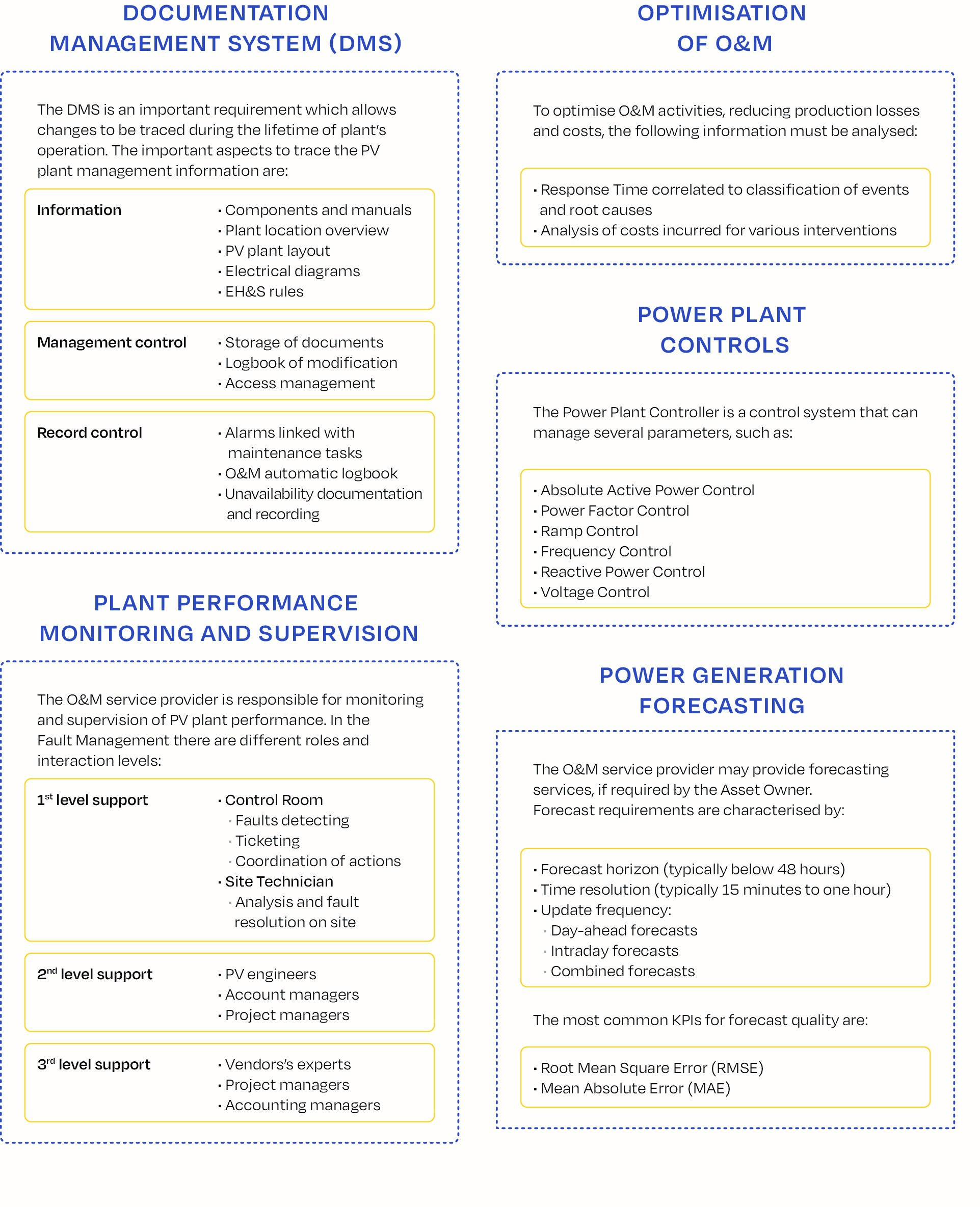
*It is worth noting that there are several mature industries that have standards (such as ISO 19650:1:2018) for information management repositories and work needs to be done to adopt these.
Documentation Management System (DMS)
Solar PV power plant documentation is crucial for an in-depth understanding of the design, configuration, and technical details of an asset. It is the Asset Owner’s responsibility to provide those documents and, if not available, they should, as best practice, be recreated at the Asset Owner’s cost.
Before assuming any maintenance and/or operational activities, it is important to understand in-depth the technical characteristics of the asset. There are two important aspects related to the management of this information:
· Information type and depth of detail / as-built documentation
· Management and control
Moreover, for quality / risk management and effective operations management a good and clear documentation of contract information, plant information, maintenance activities and asset management are needed over its lifetime. This is what is called here:
· Record control (or records management)
Currently, there are different types of DMS available, along with a series of standards (ISO), that can be implemented. This is an important requirement that would allow any relevant party to trace any changes during the lifetime of the plant’s operation and follow up accordingly (e.g., when the O&M service provider changes, or the teams change, or the plant is sold etc).
Information type and depth of detail / as-built documentation
The documentation set accompanying the solar PV power plant should, as a best practice, contain the documents described in Annex C. The IEC 62446 standard also covers the minimum requirements for as-built documentation.
In general, for optimum service provision and as a best practice, the O&M service provider should have access to all possible documents (from the EPC phase). The Site Operating Plan is the comprehensive document prepared and provided by the plant EPC service povider, which lays out a complete overview of its location, layout, electrical diagrams, components in use and reference to their operating manuals, HSSE rules for the site and certain further topics. All detailed drawings from the EPC service provider need to be handed over to the O&M service provider and being stored safely for immediate access in case of solar PV power plant issues or questions and clarifications with regards to permits and regulation.
When storing documents, thought must be given to accessibility. As a minimum, project documentation should be available in a searchable PDF format to facilitate the identification of key information. Moreover, project drawings, such as the as-built design, should be editable in case they need correcting, or change management processes mean they need to be updated.
Management and control
Regarding the document control, the following guidelines should be followed:
· Documents should be stored either electronically or physically (depending on permits/regulations) in a location with controlled access. Electronic copies should be made of all documents, and these should be searchable and editable
· Only authorised people should be able to view or modify the documentation. A logbook of all the modifications should be kept. As a best practice, logbooks should at a minimum contain the following information:
o Name of person, who modified the document
o Date of modification
o Reason for modification and further information, e.g., link to the work orders and service activities
· Versioning control should be implemented as a best practice. People involved should be able to review past versions and be able to follow through the whole history of the document. The easiest way to ensure this is through using an electronic document management system, which should be considered a best practice
Record control
A key point is that necessary data and documentation are available for all parties in a shared environment and that alarms and maintenance can be documented in a seamless way. Critical to the Operations team is that the maintenance tasks are documented back to and linked with the alarms which might have triggered the respective maintenance activity (work order management system log). Photographs from the site should complement the documentation (when applicable). Tickets (ticket interventions) should be stored electronically and made available to all partners. The Asset Owner should also maintain ownership of these records for future references.
To improve future performance and predictive maintenance, it is crucial to keep a record of past and ongoing O&M data, workflows and alarms. This record should seek to link these elements in a cost-effective way, following an agreed naming convention. This will improve accessibility and allow for easier tracing, facilitating comprehensive lessons learned exercises, and resulting in concrete future recommendations for the client. These analyses should also be recorded.
There should be proper documentation for curtailment periods as well as repair periods when the plant is fully or partly unavailable. This will all be recorded by the monitoring system to measure the energy lost during maintenance activities. For this, having the correct reference values at hand is crucial. For important examples of input records that should be included in the record control, see Annex D.
As in the case of the as-built documentation, all records, data and configuration of the monitoring tool, and any sort of documentation and log that might be useful for proper service provision must be backed up and available when required. This is also important when the O&M service provider changes.
Plant performance monitoring and supervision
The Operations team of the O&M service provider is responsible for continuously monitoring and supervising of the solar PV power plant conditions and its performance. This service is done remotely using monitoring software systems and/or plant operations centres. The O&M service provider should have full access to all data collected from the site to perform data analysis and provide direction to the Maintenance service provider/team. For more information on monitoring tools please refer to SolarPower Europe’s Monitoring Best Practice Checklist (available at www.solarbestpractices.com).
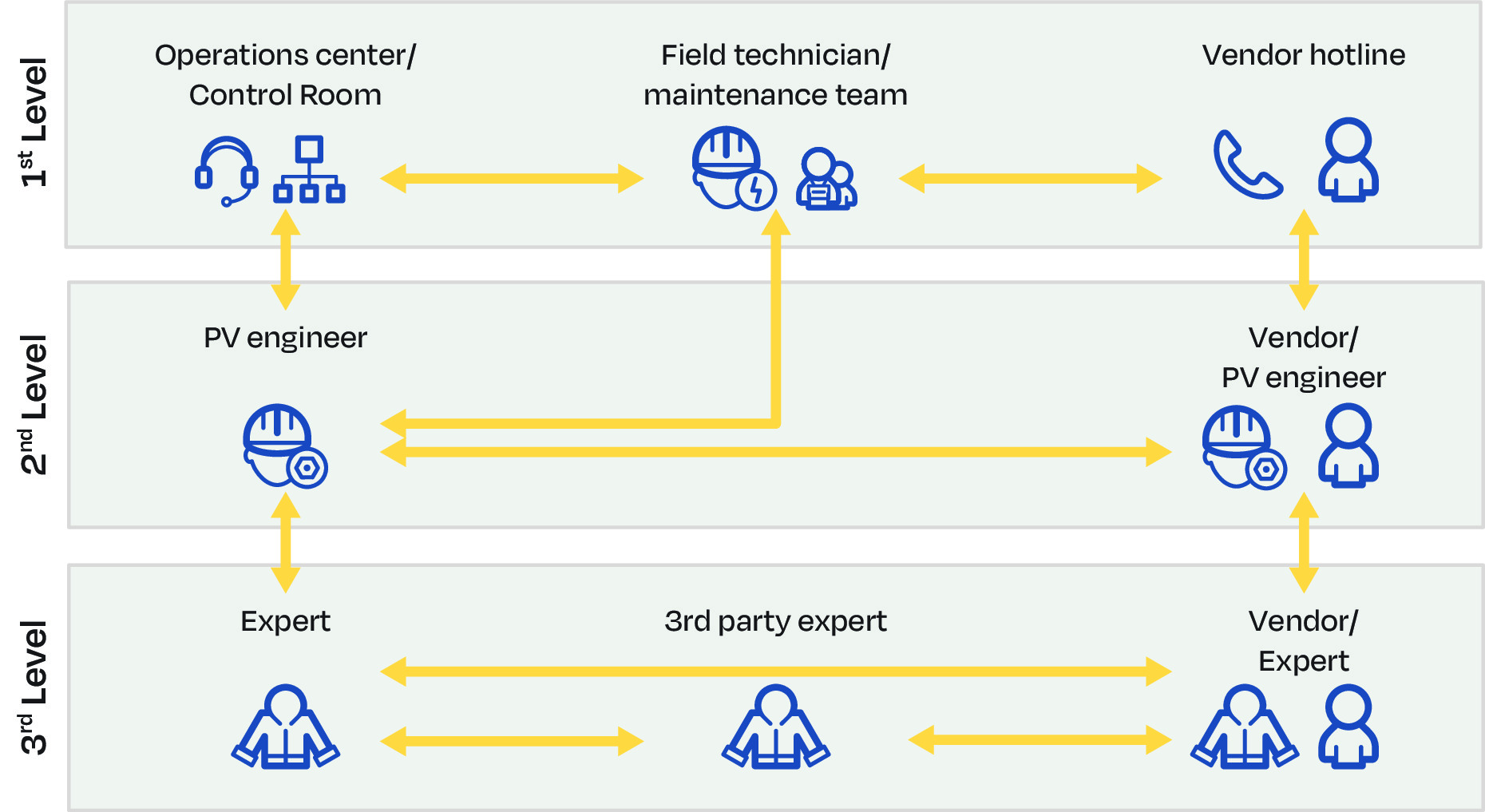
Normally, in Fault Management (Incident Management) several roles and support levels interact:
· With the help of monitoring and its alarms the Operations Center (Control Room) detects a fault. It is responsible for opening a “ticket” and coordinating troubleshooting actions. It collects as much information and diagnostics as possible to establish initial documentation, tries to categorise the issue and, where possible, to resolve it instantly. This is known as 1st Level Support. Then it tracks the incidents until their resolution
· If the fault cannot be sufficiently categorised, the Operations Center may call out a field technician who can be a local electrician or member of the maintenance team. This person will analyse and try to resolve the fault on-site (1st Level Support). Their knowledge and access rights may be not sufficient in some situations, but they can fix most faults to an adequate level. They may also contact the vendor’s hotline to help them with the diagnosis
· If 1st Level Support is not able to resolve the incident right away, it will escalate it to 2nd Level Support. This consists of solar PV engineers or Project/Account Managers who have greater technical skills, higher access permissions, and enough time to analyse the fault in depth. They may be internal or of the vendor’s staff
· If an incident requires special expertise or access, 2nd Level engineers might need to contact experts (in-house or from the vendor or a third party). This is known as 3rd level support. In some organisations the Project/Account Managers can cover both 2nd and 3rd Level Support, based on their seniority and experience
· When the fault is solved, the Operations Center closes the ticket
Besides the data from the site, if a CCTV system is available on-site, the O&M service provider should, as a best practice, be able to access it for visual supervision and also have access to local weather information.
The O&M service provider is responsible for being the main interface between the plant Owner, the grid operator, and the regulator (if applicable) over the lifetime of the O&M contract regarding production data. The Asset Owner should be able to contact the Operations team via a hotline during daytime, when the system is expected to generate electricity. The Operations team is also responsible for coordinating accordingly with the Maintenance service provider/team.
Performance analysis and improvement
The O&M service provider ensures that the performance monitoring is done correctly.
In general, the data should be analysed at the following levels:
1. Portfolio level (group of plants) under control of the O&M service provider (minimum requirement)
2. Plant level (minimum requirement)
3. Inverter level (minimum requirement)
4. String level (as a recommendation)
The analysis should show the required data on the levels listed above and for different time aggregation periods from the actual recording interval up to monthly and quarterly levels.
The analysis should also include the option for having custom alarms based on client specific thresholds such as business plan data or real-time deviations between inverters on-site.
In particular, the agreed KPIs should be calculated and reported. Special attention should be paid to the fact that KPI calculations should take into consideration the contractual parameters between O&M service provider and Asset Owner, to provide an accurate and useful calculation for evaluation and eventually liquidated damages or bonuses.
Optimisation of O&M
An essential part of Operations is the analysis of all the information generated throughout O&M, such as Response Time, and how this correlates to the various classifications of events and root causes. Another vital part of Operations is the analysis of costs incurred for various interventions, categorised into materials and labour. Having such information helps to further optimise the asset by reducing production losses and the cost of O&M itself.
Power plant controls
If applicable, the Operations team can be the point of contact for the grid operator for plant controls. The Operations team will control the plant remotely (if possible) or instruct the qualified maintenance personnel to operate breakers/controls on site. The O&M service provider is responsible for the remote plant controls or emergency shutdown of the plant (if possible) and in accordance with the respective grid operator requirements, regulations and the aggregator’s requirements. The plant control function varies from country to country and in some cases from region to region. The respective solar PV power plant control document for the area details regulations issued by the grid operator and (energy market) regulator.
The Power Plant Controller itself is a control system that can manage several parameters such as active and reactive power and ramp control of solar PV power plants. The set points can normally be commanded either remotely or locally from the Supervisory Control And Data Acquisition system (SCADA). Moreover, the system should be password protected and log all the executed commands. Any executed commands should release real-time notifications to the Operations team.
The following list shows typically controlled parameters in a solar PV power plant:
· Absolute Active Power Control
· Power Factor Control
· Ramp Control (Active and Reactive Power if needed)
· Frequency Control
· Reactive Power Control
· Voltage Control
Power Generation Forecasting
Forecasting services for solar PV power generation are generally offered by operators of solar PV monitoring services. However, external services can also provide this function. When the Asset Owner requires Power Generation Forecasting from the O&M service provider, they could opt for a service level agreement with the forecast provider. Forecasting may have an influence on the contract agreement for electricity dispatching between the Asset Owner and a trading service provider.
The requirements for forecasts may differ from country to country and also depend on the contract agreement for electricity dispatching between the Asset Owner and a trading service provider. Forecast requirements are characterised by the forecast horizon, the time resolution, and the update frequency, all depending on the purpose. For power system or power market related purposes, forecast horizons are typically below 48 hours and the time resolution is 15 minutes to one hour, in line with the programme time unit of the power system or the market. Common products are day-ahead forecasts, intra-day forecasts and combined forecasts. Day-ahead forecasts are typically delivered in the morning for the next day from 0 to 24 and updated once or twice during that day. Intraday forecasts are delivered and updated several times per day for the rest of the day and should be delivered automatically by the forecast provider.
For long-term planning of unit commitment and maintenance decisions, forecasts with longer time horizons are used, typically one week or more.
Solar PV Power Generation Forecasts rely on numerical weather predictions, satellite data and/or statistical forecasting and filtering methods. Most products combine several of these techniques. Good practice requires numerical weather predictions for day-ahead forecasting and a combination with satellite data for intra-day forecasts. In all cases, good practice requires statistical filtering which in turn requires a near-real-time data feed from the monitoring system to the forecast provider. For best practice, the forecast provider should also be informed about scheduled outages and the expected duration of forced outages.
The most common KPIs for forecast quality are the Root Mean Square Error (RMSE) and the Mean Absolute Error (MAE). They are normalised to peak power and not to energy yield.
Grid code compliance
The O&M service provider, and in particular the Operations team is responsible for operating the solar PV power plant in accordance with the respective national grid code. The operator of the grid to which it is connected (either low voltage grid or medium voltage grid or high voltage grid) provides the requirements for power quality, voltage regulation and management of active and reactive power. In some countries (and/or regions) specific grid codes for renewable energy generators have been issued.
Depending on the voltage level of the grid the plant is connected to, the specificities and quality requirements for the solar PV power plant change. Grids with a higher voltage level usually have more specific and demanding requirements.
Most of the grid-connected utility scale solar PV power plants in Europe must undergo an external test to meet the grid operator requirements. These plant tests allow the grid operator to adjust the power output from the solar PV power plant according to the grid capacity and power frequency requirements.
The O&M service provider is expected to be familiar with all the details of the grid code and grid operator requirements. Depending on the regulations, either the grid operator themselves is steering the solar PV power plant controller (with remote signals) or the Operations team is managing the plant controller under the direction of the grid operator.
Management of change
If the design of a solar PV power plant needs to be adjusted after the Commercial Operation Date, the O&M service provider should, as a best practice, be involved by the Asset Owner and the EPC service provider. They can even be a main contributor, if not the leader, of this change process. Reasons for such changes can be motivated by non-compliance of the solar PV power plant with the capacity predicted by the EPC service provider, by regulation change (introduction of new solar PV power plant controls regulations), by the unavailability of spare parts or components, or for an upgrade to the solar PV power plant. These events can trigger new design works, procurement and installation of new equipment and adjustment of O&M procedures and/or documentation. It may also impact certain performance commitments or warranties provided by the O&M service provider, which will need to be adjusted.
The O&M service provider should be involved in changes to the solar PV power plant from the beginning. Concepts, design works, and execution need to be coordinated with ongoing O&M activities. Any changes should also be reflected in the plant SCADA and monitoring systems. For data continuity and long-term analysis, the monitoring system should be able to trace all changes of electrical devices. This should include documentation of inverter replacement date, manufacturer and type, and serial number in a structured way for further analysis (e.g., spare part management, Predictive Maintenance analysis). The monitoring of replaced devices will also help the O&M service provider verify that the new component is correctly configured and is sending high quality data. Adjustments to the Site Operating Plan, the Annual Maintenance Plan and the Annual Maintenance Schedule need to be applied and the O&M service provider needs to familiarise the O&M staff with the operating manuals of the new equipment. These types of changes will have an impact on Spare Parts Management and inventory (replacement). Depending on the significance of the change, the O&M annual fee might need to be adjusted.
It is advisable that the O&M service provider lead these sorts of change processes. The O&M service provider is the trusted partner of the Asset Owner and should advise the Owner when they are making decisions on changes to the plant. In the case of major changes, the Owner should also consider informing lenders about the decision process and provide concepts, proposals, calculations and updates.
The fixed O&M fee does not usually cover change services. The Asset Owner and the O&M service provider should manage changes in a formalised way. This procedure should include the following steps: description of proposed change (including time plan, costs, consequences, and alternatives), authorisation of the change by the Asset Owner, realisation of the change, documentation by the O&M service provider and acceptance.
Power plant security
It is important that the solar PV power plant, or key areas of it, are protected from unauthorised access. This serves the dual purpose of protecting the plant’s equipment and keeping members of the public safe. Unauthorised access may be accidental with people wandering into the plant without realising the dangers, or it may be deliberate for the purposes of theft or vandalism.
Together with the O&M service provider and the security service provider, the Asset Owner must put in place a Security Protocol in case an intrusion is detected.
In most countries there are strict legal requirements for security service providers. Therefore, solar PV power plant security should be ensured by specialised security service providers subcontracted by the O&M service provider. The security service provider will be responsible for the proper functioning of all the security equipment including intrusion and surveillance systems. They are also responsible for processing alarms from the security system by following the Security Protocol and the use of the surveillance systems installed on site. The security system provider will be also responsible for any site patrolling or other relevant services. The security service provider should also assume liability for the security services provided. The O&M service provider will coordinate with the security service provider and may choose to act as an intermediary with the Asset Owner.
A security system may be formed of simple fencing or barriers but may also include alarm detection and alerting systems and remote closed-circuit television (CCTV) video monitoring. If solar PV power plants have CCTV systems in place, an access protocol would be required when reactive and planned works are carried out. This will ensure that authorised access is always maintained. This can be done by way of phone with passwords or security pass codes, both of which should be changed periodically.
For additional security and in high-risk areas it is advisable to have a backup communication line installed (often, the first thing that gets damaged in case of vandalism is communication with the surveillance station) as well as an infrastructure for monitoring connectivity and communication with the security system. As well as any remote monitoring, it is likely that provision for onsite attendance is required when significant events occur. Processes for liaising with local emergency services should be considered.
Within the solar plant, there may also be additional areas with restricted access, for example locations containing High Voltage equipment. When authorising access to the parks it is important that all workers and visitors are appropriately informed of the specific access and security arrangements and where they should or should not be. Warning signs and notices can form an important part of this and may be compulsory depending on local regulations.
As well as the general security of the site over the lifetime of the park, particular attention should be made to periods of construction or maintenance when usual access arrangements may be different. It is important that security is always maintained particularly when there are activities that may be of more interest to members of the public or thieves.
The Asset Owner will likely have insurance policies in place directly or indirectly and these will be dependent on certain levels of security and response being maintained. Failure to meet these may have important consequences in the case of an accident or crime.
Reporting and Technical Asset Management
The Operations team is responsible for providing periodic reporting to the AM or directly to the Asset Owner. In many cases, the Operations team also assumes further TAM responsibilities.
Power Plant Maintenance
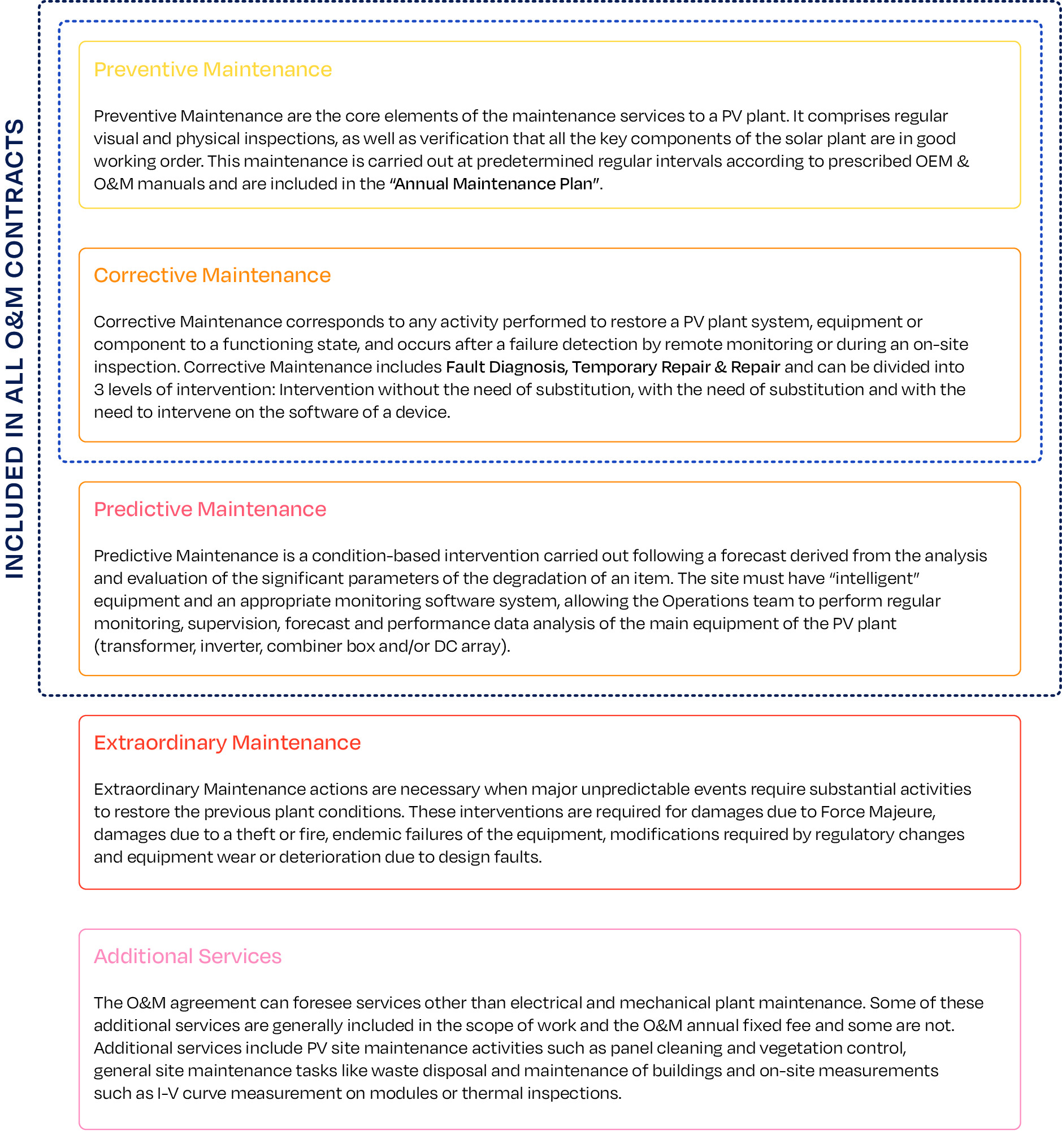
Maintenance is usually carried out on-site by specialised technicians or subcontractors, in close coordination with the Operations team’s analyses. In modern solar PV power plants, automation of maintenance tasks is becoming more prevalent. However, this practice is still developing and is not widespread currently. The following figure provides an overview of the four main types of power plant maintenance.
Preventive Maintenance
Preventive Maintenance activities are the core element of the maintenance services to a solar PV power plant. It comprises regular visual and physical inspections, as well as verification activities.
The maintenance of all key components is carried out at predetermined intervals or at least according to prescribed OEM and O&M manuals. These are included in a detailed Annual Maintenance Plan which provides an established time schedule with a specific number of iterations for carrying out the maintenance.
It must also maintain the equipment and component warranties in place and reduce the probability of failure or degradation. The activities must also be consistent with respective legal issues such as national standards for periodic inspection of certain electrical components. It should be noted that the various maintenance activities that an O&M service provider is expected to carry out require personnel qualified to carry them out. The O&M service provider must ensure that they have the appropriate range of skills available to fulfil their contractual obligations (for more information on maintenance activities and the skills they require, see Annex B of the O&M Guidelines and Annex A of the Lifecycle Quality Guidelines). The O&M contract should include this scope of services and each task frequency.
It is the responsibility of the O&M service provider to prepare the task plan, according to the time intervals in the contract.
The “Annual Maintenance Plan” (see Annex E or download it from www.solarpowereurope.org) developed as an attachment of this report includes a list of regular inspections per equipment (e.g., module, inverter etc) and per unit of equipment (e.g., sensors, fuses etc).
An example of Preventive Maintenance is thermographic inspection which aims to identify defective panels on a solar PV power plant. Indeed, several categories of anomalies (hot spots, hot strips, moisture ingress, soling, etc.) can occur, significantly reducing the whole plant productivity. Relevant inspection procedures are performed either by operators with handheld cameras or using remotely piloted drones or piloted aircraft equipped with dedicated thermal and optical payloads.
Preventive Maintenance also includes ad-hoc replacement of parts of inverters or sensors. In general, it is important to follow detailed Preventive Maintenance procedures, which are agreed upon in the Annual Maintenance Plan.
In cases where downtime is necessary to perform Preventive Maintenance, its execution during the night would be considered best practice as the overall power generation is not affected.
Corrective Maintenance
Corrective Maintenance covers the activities performed by the Maintenance team to restore a solar PV power plant system, equipment or component to a status where it can perform the required function. Corrective Maintenance takes place after a failure detection either by remote monitoring and supervision or during regular inspections and specific measurement activities (see Annex E).
Corrective Maintenance includes three activities:
1. Fault Diagnosis also called troubleshooting to identify and locate the cause of the fault
2. Temporary Repair, to restore the required function of a faulty item for a limited time, until a full repair is carried out
3. Full repair, to restore the required function permanently
In cases where the solar PV power plant or segments thereof need to be taken offline, Corrective Maintenance should be performed at night or during periods of low irradiation as the overall power generation is not affected.
A key aspect of corrective maintenance is to be able to track failures to their root cause. This is most often a problematic manufacturer/model/serial number but may also be linked to installation errors or environmental conditions such as temperature inside enclosures. Corrective Maintenance processes should also track the efficacy of responses to problems (what fixes the problem reliably?).
Corrective Maintenance can be divided into three levels of intervention to restore the functionality of a device, that could be included in the O&M agreement or billed separately on hourly rates:
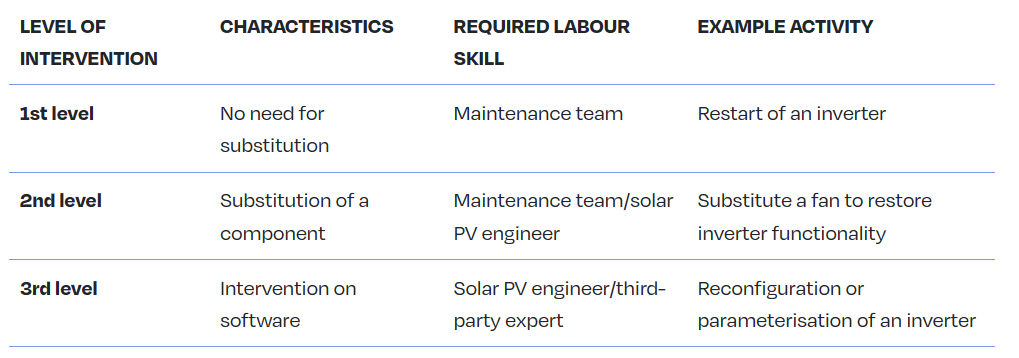
3rd level activities could be included in the O&M agreement or billed separately to it, depending on the specific scope of work agreed between the parties. Generally, however, this intervention is excluded by the contractual scope of work, especially when the device manufacturers’ maintenance team or third-party licensed company needs to intervene.
Interventions for reconditioning, renewal, and technical updating, save for the cases where those actions are directly included in the scope of the contract, should be excluded from Corrective Maintenance, and included in the Extraordinary Maintenance.
The scope of Corrective Maintenance activities and its “border” or definition with respect to Preventive Maintenance requires specific attention and it should be properly defined in the Maintenance contract. For an easier comprehension, an example is presented below:
· A cable termination tightening activity using a torque device for correct fixation should be under the Preventive Maintenance scope of works, but depending on the quantity and/or frequency, it could be considered a Corrective Maintenance activity. The Annual Maintenance plan therefore states the extent of each planned activity.
Usually, Corrective Maintenance work must be accomplished within the contractually agreed minimum Response Times.
Contractual agreements can foresee that the included Corrective Maintenance will be capped on a per year basis. Depending on whether the Asset Owner is a purely financial investor or an energy producer (e.g. utility or IPP) the requirements for coverage under the Corrective Maintenance will vary.
Predictive Maintenance
Predictive Maintenance is a special service provided by O&M service providers who follow best practices principles. It is defined as a condition-based maintenance carried out following a forecast derived from the analysis and evaluation of the significant parameters of the degradation of the item (according to EN 13306). A prerequisite for a good Predictive Maintenance is that the devices on-site can provide information about their state, in such a way that the O&M service providers can evaluate trends or events that signal deterioration in a device. As a best practice, the device manufacturer should provide a complete list of status and error codes produced by the device, together with the detailed description of their meaning and their impact on the functioning of the device. Additionally, a standardisation of status and error codes through inverters and dataloggers from the same brand should be followed and, in the future, this standardisation should be common to all manufacturers.
Stakeholders who want to benefit from Predictive Maintenance should, as a best practice, select “intelligent” equipment set with sufficient sensors, and opt for a monitoring software system that provides basic trending and comparison (timewise or between components and even between solar PV sites) functionalities (minimum requirement).
The Operations team of the O&M service provider enables Predictive Maintenance thorough continuous or regular monitoring, supervision, forecast and performance data analysis (e.g., historical performance and anomalies) of the solar PV power plant (at the DC array, transformer, inverter, combiner box or/and string level). This can identify subtle trends that would otherwise go unnoticed until the next round of circuit testing or thermal imaging inspection and that indicate upcoming component or system failures or underperformance (e.g., at solar PV modules, inverters, combiner boxes, trackers, etc. level).
Before deciding which Predictive Maintenance actions to recommend, the Operations team should implement and develop procedures to effectively analyse historical data and faster identify behaviour changes that might jeopardise systems performance. These changes of behaviour are usually related to the pre-determined or unpredicted equipment degradation process. For this reason, it is important to define and to monitor all significant parameters of wear-out status, based on the sensors installed, algorithms implemented into the supervision system and other techniques.
Following such analysis, the Maintenance team can implement Predictive Maintenance activities to prevent any possible failures which can cause safety issues and energy generation loss.
For efficient Predictive Maintenance, a certain level of maturity and experience is required, which is at best a combination of knowledge of the respective system’s performance, related equipment design, operation behaviour, and relevant the service provider’s track record. Normally it is a process that starts after the implementation of an appropriate monitoring system and the recreation of a baseline. This baseline will then represent the entire solar PV system operation, how different pieces of equipment interact with each other, and how the system reacts to “environmental” changes.
Predictive Maintenance has several advantages, including:
- Optimising the safety management of equipment and systems during their entire lifetime
- Helping to anticipate maintenance activities (both corrective and preventive)
- Delaying, eliminating and optimising some maintenance activities
- Reducing time for repairs and optimising maintenance and Spare Parts Management costs
- Reducing spare parts replacement costs
- Increasing availability, energy production and performance of equipment and systems
- Reducing emergency and non-planned work
- Improving predictability
The following two specific examples show how Predictive Maintenance might be implemented.
Example 1 – An O&M service provider signs a new contract for a solar PV power plant equipped with central inverters. Analysing its backlog of maintenance, the O&M service provider knows that these inverters showed signs of power loss due to overheating at several points in the past. This might be related to problems in the air flow, filter obstructions, fans, or environmental changes (high temperature during summer). A decision was taken to monitor the temperature of IGBTs (Insulated-Gate Bipolar Transistors). An “air flow inspection” was performed, prior to any emergency action being required, to determine whether power loss was related to air flow. This type of activity is a condition-based inspection performed after the detection of a change in a significant parameter. It is also considered as a type of Predictive Maintenance. The final purpose is to identify if, for example, the ventilation systems will need some upgrade, replacement, or if there is any type of air flow obstruction or even if a filter replacement or cleaning is required.
Example 2 – Predictive Maintenance for optimised hardware replacement cycle relying on big data analytics or artificial intelligence. For more information on this innovation.
Extraordinary Maintenance
Extraordinary Maintenance actions are necessary when major unpredictable events take place in the plant that require substantial activities and works to restore the previous plant conditions (or any maintenance activity generally not covered or excluded from the O&M Contract).
“Force Majeure” events affecting solar PV power plants include high winds, flooding, hurricanes, tornados, hail, lightning, and any number of other severe weather events. Extraordinary Maintenance associated with severe weather include safety shutdown, inspection to document damage, electrical testing (integrity of circuits and grounding), remove/repair/replace decisions, and recommissioning confirming proper operation and documenting changes made during repairs.
Generally, these activities are billed separately in the O&M contract and are managed under a separate order. It is advisable that the O&M contract includes the rules agreed among the parties to prepare the quotation and to execute the works. Both a “lump sum turn-key” or a “cost-plus” method can be used for such purposes.
Extraordinary Maintenance interventions are required for:
· Damages that are a consequence of a Force Majeure event
· Damages resulting from theft or fire
· Serial defects or endemic failures on equipment, occurring suddenly and after months or years from plant start-up
· Modifications required by regulatory changes
In cases where the O&M service provider and the EPC service provider are different entities, the following occurrence should also be considered as Extraordinary Maintenance:
· Major issues that the O&M service provider becomes aware of during its ordinary activity. These could be defects or other problems that are not a consequence of equipment wear or deterioration and can be reasonably considered to have been caused by design mistakes (e.g., “hidden” defects that require re-engineering)
Although not necessarily maintenance interventions, revamping and repowering can also be included in the Extraordinary Maintenance list in the O&M agreement, or at least managed with the same rules.
After the approval by the Asset Owner of the O&M service provider’s proposal, activities may commence, subject to availability of the required equipment and special machinery (if required).
The potential loss of energy between the event occurrence and full repair is very difficult to determine in the SPV financial model. However, many of the above events can be reimbursed to the Asset Owner by the insurance company under any “All Risk Insurance” coverage that is in place. Relevant conditions and requirements according to the insurance policies of the Asset Owner need to be shared with the O&M service provider.
Best Practices of O&M agreements regarding Extraordinary Maintenance activities include:
· General rules to quantify price and to elaborate a schedule to perform repair activities, and the right of the Asset Owner to ask for third party quotations to compare to the quotation of the O&M service provider. In this case a “right-to-match” option should be granted to the O&M service provider
· The obligation for the Asset Owner to have in place a consistent “All Risk Property” Insurance including loss of profit
Additional services
The O&M agreement can foresee services other than those pertaining to electrical and mechanical plant maintenance as per the above sections. Some of these additional services are generally included in the scope of work and the O&M annual fixed fee and some are not.
Additional services not included in the O&M contract scope of work can be requested on demand and can either be priced per service action or based on hourly rates applicable to the level of qualification of staff required to perform the works. These hourly rates usually escalate at the same rate as the O&M Service fee. In some cases, a binding price list for the delivery of some of these additional services can be included in the O&M contract as well.
Module Cleaning
Regular module cleaning is an important part of solar maintenance and the problems associated with soiled modules are often underestimated. Prolonged periods of time between cleans can result in bird droppings etching modules and lichen growth, both of which can be extremely difficult to remove. The intensity and type of soiling depend heavily on the location of the solar PV system (e.g., its proximity to industrial areas, agricultural land, or railway lines).
Module cleaning methods therefore vary from manual, to robotic and mechanical and each have their own advantages and disadvantages. The frequency of cleaning should be decided on a site-by-site basis, and it may be that certain parts of a site will need cleaning more often than other parts of the same site.
When choosing a module cleaning company, Asset Owners and O&M service providers should check the following:
· The suggested method of cleaning is fully in-line with the module manufacturer’s warranty and according to specifications from IEC 61215 (e.g., maximum pressure load)
· The modules should be cleaned with high quality, ultra-pure water, not tap, mains or borehole water. Detergents must be biodegradable and comply with local environmental regulations
· H&S considerations should be made with regard to keeping staff safe on site. This should include some form of H&S accreditation and specific training for solar module cleaning, including working at height, if cleaning roof mounted modules
The table below presents a non-exhaustive list of Additional services.

Some of these items can be considered as a part of Preventive Maintenance. This depends on the agreement between the Asset Owner and the O&M service provider.
From a technological point of view, the usage of aerial inspections is beneficial to efficiently (time and costs) obtain a context awareness needed to perform better planning of site maintenance activities as well as execution of on-site measurements (specifically thermographic inspections).
Advanced aerial thermography
While thermographic inspections have become well established as a tool in preventive and corrective maintenance scheduling, the amount of effort and manual labour required for data gathering in the field has posed financial and operational challenges for their widespread use.
Using thermographic cameras mounted on drones (Remotely Piloted Aircrafts, RPAs or Unmanned Aerial Vehicles, UAVs) or purpose-modified piloted aircraft, instead of handheld devices, the operator flies over the solar PV modules to capture thermographic images or videos. This data is then analysed to create inspection reports which can be used to form the basis of Preventive and Corrective Maintenance tasks. If deployed properly, aerial thermography can provide several operational and financial advantages. It also reduces H&S risks involved in manual inspections, such as prolonged field exposure in dangerous working environments, and the hazards involved in moving around the site, particularly on rooftop installations. Aerial inspections can also pinpoint anomalies to precise locations, thus focusing and reducing the time required for repair work.
Please refer to the Aerial Thermography Checklist of the Solar Best Practices Mark for a synthesis of the most important best practices and recommendation with respect to aerial thermography.[2]
Data acquisition
In this stage a flyover is performed where raw infrared (IR) thermographic images and visual photos or videos are recorded. Depending on the solution, additional geolocation services and 3D modelling of the entire plant may be offered. Some other solutions provide additional sensors to record weather variables (usually irradiance and ambient temperature) during the flyover. The drone is typically pre-programmed with a flight path designed to cover the entirety of the solar PV asset being inspected. The pre-programmed flight path allows for precise and repeatable flights to be performed, increases the accuracy of results, and ensures that the same parameters are used during each subsequent aerial inspection.
With the advent of aerial inspections, resources required for data collection can be significantly reduced. For instance, a 12MWp solar PV power plant can be inspected in a single day. Aerial IR thermography must always be conducted following a set of minimum technical requirements (described in IEC TS 62446-3:2017). Otherwise, it is of little value for effective plant maintenance. In that context, high-quality IR images captured by an aerial platform and their proper post-processing allow for a detailed solar PV module failure analysis that could trigger conclusive maintenance decisions. Furthermore, field interventions can be optimised, and solar PV power plant underperformance can be better understood and addressed (e.g., faulty modules that need to be replaced can be identified with precision and high-quality IR images can be used as proof in warranty claims or in correlation with solar PV monitoring data). Additionally, since images are taken from the air, the data yields a helpful overview for checking whether plant layout, its electrical/physical configuration and other documents are correct.
As with any form of thermography, the inspection method and its diagnostic efficiency are significantly limited by and dependent on meteorological conditions. For the inspection data to be of value, a minimum radiation of 600 W/m2 is required. For drone inspections, to control the RPA safely wind speeds should not exceed 28 km/h (this is dependent on the type of RPA used).
Post-processing
The post-processing activities consist of all the data processing and analysis techniques used to produce the final report and all the related deliverables. These activities can be done manually or automatically with specialised software.
The activities comprised in this stage are described as a series of subtasks in the following table.

There are many companies offering high-quality industrial aerial flights in the market. These are typically referred to as Drone Service Providers (DSPs). While there are companies using drones in a variety of situations (IR inspections of solar PV power plants, wind turbines, oil ducts, offshore oil extraction platforms, and infrastructure etc.), DSPs are emerging that focus solely on the solar solar PV segment. Therefore, this data acquisition stage is an activity that could be easily outsourced by O&M service providers, mitigating the risks related to technology obsolescence and avoiding the costs and complexities of regular drone maintenance. This is particularly beneficial given the rapid rate of development and innovation in the drone technology space. Selecting a DSP with specialisation in solar solar PV inspections gives O&M service providers the additional advantage of relevant expertise and experience, which can equip them with superior insights from the data captured.
There are some companies which utilise specially modified piloted aircraft, flying at a higher altitude, in lieu of drones for inspections of large sites and portfolios. These aircraft are able to cover ground quicker than drones (up to 150MW/hr) while maintaining high resolution due to the higher quality of cameras which can be used. However, these systems are prohibitively expensive for individual sites due to the large mobilisation costs.
Most companies today still rely on manual data processing, which represents a major drawback for large portfolios as human-error (and user-dependence) drives down the accuracy and “consistency” of thermal imaging assessments. This means that companies with automated solutions have a huge advantage in this regard. The advent of AI and machine learning algorithms built into automated data processing solutions also provides customers with significantly greater processing speed and inspection accuracy, and analyses that improve over time.
Aerial inspections and their associated post-processing activities are evolving very rapidly, and the adoption of such new technologies is of significant strategic importance in today’s highly competitive O&M market. As the playing field moves towards a post-subsidy era, such additional services as advanced aerial thermography that can save O&M service providers time and money, seeing them become a standard practice out of necessity.
Pilots
Any aerial thermography or other solar PV module and plant monitoring application involving drones or piloted aircrafts must be carried out by a licensed and insured operator and in accordance with all local and EU-level civil aviation regulations. Before any such operations can take place, each flight must be thoroughly planned from a logistics, regulatory and safety perspective, and a comprehensive on-site risk assessment conducted, with findings recorded in a flight log. In addition to the collected inspection data, each flight should also be fully recorded in terms of date, time, wind speed and direction and battery levels.
Vegetation Management
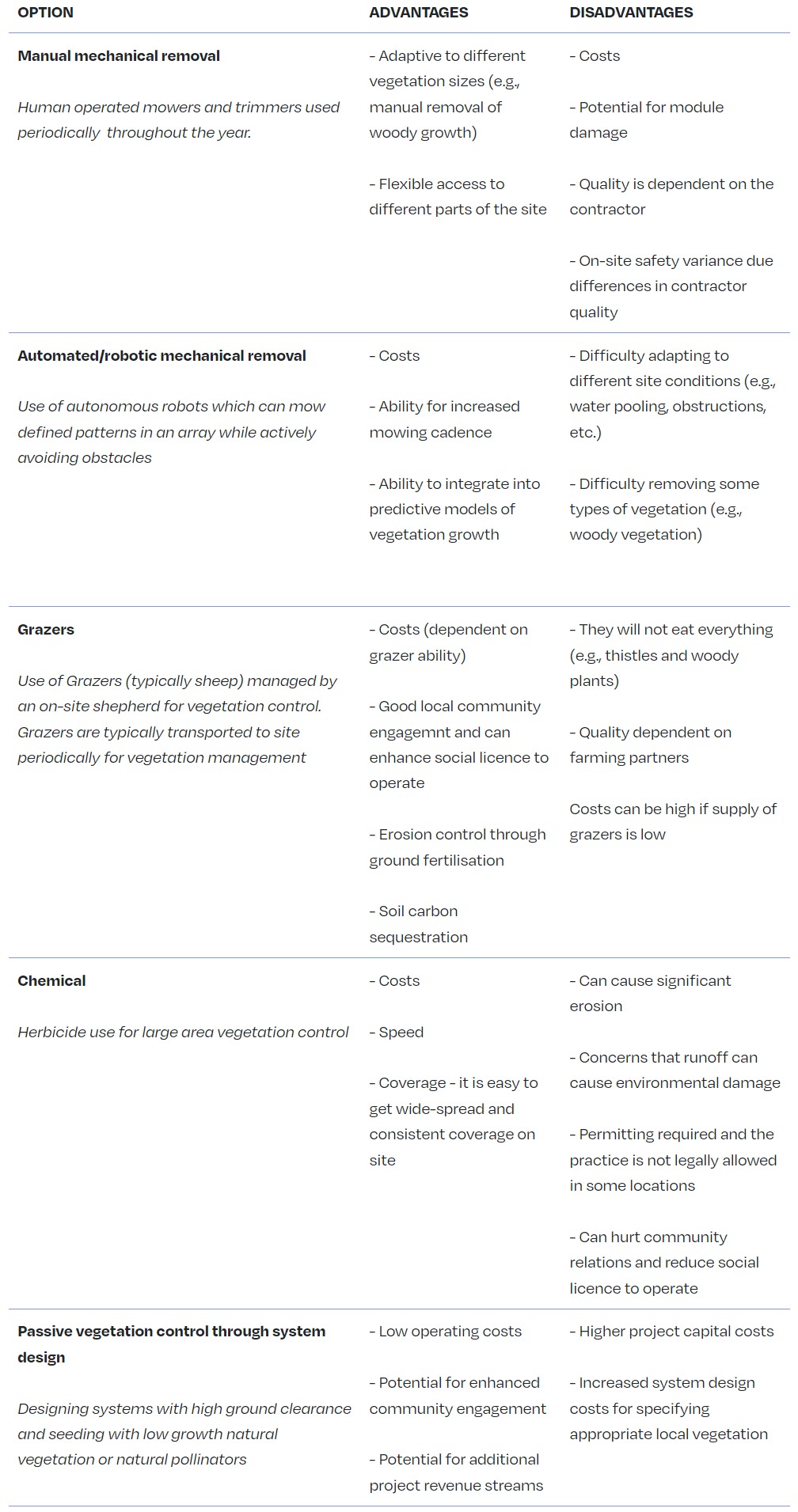
Vegetation management can represent a significant portion of the operations costs of a solar PV system. Some key items to consider in vegetation management:
- Damage Reduction: Vegetation management can reduce direct mechanical damage caused by vegetation - especially woody vegetation - growing into modules and structures. Damage can also be caused by direct shading causing hot-spot formation on modules, potentially leading to long-term module damage
- Performance Enhancement: Vegetation can cause module shading, which leads to degraded module performance. This effect is disproportionate to the amount of shading, so a small amount of shading can cause a significant amount of power loss
- Erosion Control: Vegetation is critical for soil stabilisation and avoidance of erosion damage on sites. Uncontrolled erosion can cause significant structural damage on a project over time
- Carbon Sequestration: Continuous vegetation management can assist in increasing soil carbon sequestration, especially with the use of grazing animals, who are able to fertilize the soil while enhancing soil carbon capture
- Biodiversity Enhancement: The use of natural pollinators and native vegetation can enhance local biodiversity. This can improve community engagement, lead to reduced vegetation management costs, and in some cases add revenue streams to a project
- Community engagement and social license to operate: Vegetation management can be one of the most visible maintenance activities for local communities and can affect aesthetics, noise pollution, erosion, runoff, and chemical contamination concerns. Vegetation management done well can enhance relations with the community and local councils and improve the social license to operate. Done poorly, vegetation management can cause conflict with local communities and planning councils and can lead to potential legal concerns
Some options for vegetation management are outlined in the table below:
Spare Parts Management
It is important to differentiate between Consumables and Spare Parts.
Consumables are items which are intended to be depleted or worn out relatively quickly and then replaced. They are necessary for the regular operation of the solar PV power plant and O&M service providers should always have consumables on stock and maintenance crews should carry consumables with them, together with the relevant tools.
Spare Parts are all the items (materials and equipment such as modules or inverters) listed on the Spare Parts List, not in use or incorporated in the solar PV power plant, intended to replace similar items in the solar PV power plant.
Spare Parts Management is an inherent and substantial part of O&M that should ensure that spare parts are available in a timely manner for Corrective Maintenance to minimise the downtime of (part of) a solar PV power plant. to the following considerations have to be made in Spare Parts Management:
- Ownership and responsibility of insurance
- Stocking level
- Location of storage
- Proximity to the plant
- Security
- Environmental conditions
Although it is best practice for the O&M service provider to be responsible for replenishing the spare parts stock, it is not necessarily responsible for the full cost of doing so. Some Asset Owners require O&M service providers to be fully responsible for the cost of all spare parts within the O&M fee, however, the more cost-effective approach is to agree a set of Included Spare Parts and Excluded Spare Parts. Similarly, a financial limit for Included Spare Parts can be negotiated.
Included Spare Parts are those which the O&M service provider is to be responsible for within the O&M fee. Excluded Spare Parts are those which the Asset Owner is responsible for the cost of replenishing and do not fall within the O&M service provider’s O&M fee. This is a flexible approach allowing the Asset Owner and O&M service provider to agree which spare parts fall into which category. It enables both parties to have a level of cost certainty whilst balancing this with the Asset Owner's appetite for risk. The contract should contain provisions on who is liable in the event that a spare part is unavailable. The various parties are responsible for their replenishment and bear the associated production loss.
Ownership of spares is often with the Asset Owner from delivery to site or placement in the spares stock. In the case of excluded spare parts, ownership transfers to the Asset Owner from the date that the O&M service provider receives payment for the same.
Maintenance, storage, and replenishment are the responsibility of the O&M service provider. Besides ownership matters, it is very important to make sure, upon mutual agreement, that one of the parties undertakes the responsibility of insuring the spares: as a recommendation spare parts stored on-site should be insured by the Asset Owner and spare parts stored off-site should be insured by the O&M service provider.
For a new solar PV power plant, the initial spare parts for two years from COD are procured by the Asset Owner, or the EPC service provider on behalf of the Asset Owner. However, it is best practice for the EPC and O&M service providers to have agreed upon the list. The O&M service provider should, as a best practice, recommend additional spares that they deem them necessary to meet the contractual obligations (e.g. availability guarantees).
Generally, it is not economically feasible to stock spare parts for every possible failure in the plant. Therefore, the O&M service provider together with the Asset Owner should define the stocking level of specific spare parts that make economic sense (Cost-Benefit Analysis). For example, if a specific part in a solar PV power plant has a frequency of failure at least of once every year or more and the loss of revenues due to such failure is greater than the spare part cost, it is important to have such a spare part kept available. This can also apply for parts with a long replenishment period. Similarly, one must consider the management risk that a fault can cause. For example, if a component of a SCADA system stops working, there is no resultant power loss. However, there is a risk of not being able to detect future power loss if this part is not replaced. Some very large O&M service providers now propose using the spare parts in their different warehouses in place of, or in addition to the Asset Owner’s spares stock. Since they operate many sites, they limit the shortage of unusual spare parts by maintaining a small stock.
Regarding the stocking level, due to the very different configurations and sizes of solar solar PV power plants, it is very difficult to define a hard number for stocking specific spare parts, however 0.2% of total module quantity is often found in commercial contracts. Furthermore, the regional portfolio of the O&M service provider might also influence this and, as mentioned above, the determination of spare items and quantity is also driven by the O&M service provider’s contractual commitments and guarantees. To define the stocking levels of Spare Parts and Consumables, the following parameters should be taken into consideration:
- Frequency of failure
- Impact of failure
- Cost of Spare Part
- Degradation over time
- Possibility of consignment stock with the manufacturer
- Equipment reliability
- Replenishment time
- Management risk
However, for any given utility scale solar solar PV system there are certain spare parts that could be considered as essential to have – no matter the cost.
Table 38 below summarises a minimum list. This list is not exhaustive and system requirements and technology developments can lead to this list being updated following discussion with manufacturers, amongst others.

Regarding the storage and warehousing, this should be done in locations where the spare parts cannot be damaged (e.g., by humidity or high temperature variations) and are easily identifiable as being owned by the Asset Owner. Additionally, the storage sites should have appropriate security measures.
The decision to have either an on-site or an off-site warehouse facility or just an agreement with the suppliers to provide the spare parts, depends on many factors, including the kind of part, the commercial agreement, and the facilitation of the service provision. If the spare parts owned by the Asset Owner are stored off-site, such spares should be stored separately and be clearly identified as the property of the Asset Owner. If the O&M service provider exchanges spare parts, an agreement should be drawn up with the supplier that ensures the warranty is not voided.
While proximity to the plant is a parameter that needs to be evaluated on a case-by-case basis, security and environmental conditions are very important as they could lead to a loss of property either through thefts or damage.
Data and Monitoring Requirements
In general, monitoring systems should allow follow-up on the energy flows within a solar PV system. In principle, it reports on the parameters that determine the energy conversion chain. These parameters, along with the most important energy measures in terms of yields and losses, are illustrated in Figure 39. These yields and losses are always normalised to installed solar PV power at standard test conditions in kilowatt-peak (kWp) for ease of performance comparison.
All components and different aspects of technical data management and monitoring platforms are described in the following paragraphs. Reference should also be made to the Monitoring Checklist of the Solar Best Practices Mark for a synthesis of the most important best practices and recommendation with respect to these points.[1]

Data loggers
The main purposes of a datalogger are:
· Collecting data of relevant components (inverters, meteorological data, energy meter, string combiners, status signals) with every device registered separately
· Basic alarm functionality (e.g., Field Communication issues, time critical events like AC Off)
· Providing a temporary data backup (in case of missing internet connection)
· Supporting the technicians during commissioning (e.g., checking whether all inverters work and feed-in)
In addition to this, some dataloggers can also provide the following functions:
· Power Plant Controller (Monitoring & Control should be managed by one instance to avoid communication issues regarding concurrent access). The Power Plant Controller can be integrated in the datalogger or can be a separate device using the communication channel of the datalogger or even a separate one with preferential bandwidth
· Solar Energy Trading Interface (control the active power by a third-party instance like energy trader)
As best practice, dataloggers should be selected following a list of criterion by the operating party as listed below. For example, an EPC service provider will choose and install the data logger used to monitor the site. This datalogger should be selected:
· for its compatibility with the inverters and auxiliary equipment present on site. Preference for inverter-agnostic dataloggers
· for any command functionality that may be needed (this is site type and country specific)
· for its connectivity strength to the internet
· for its robustness (longevity of life and durability for the environmental conditions it will be kept in)
· for its cyber security measures (and those of the cloud server to which it is connected), namely the possibility to set up a VPN tunnel at least
· for its capability to store data during internet communication outages
The recording interval (also called granularity) of the datalogging should range from 1 minute to 15 minutes. Within one monitoring environment granularity should be uniform for all the different data collected.
As a minimum requirement, data loggers should store at least one month of data. Historical data should be backed up constantly by sending it to external servers and, after every communication failure, the data logger should automatically send all pending information. Moreover, data transmission should be secure and encrypted. There should also be a logbook to track configuration changes (especially relevant when acting as Power Plant Controller).
As a best practice, the data logger should store a minimum of three months of data locally and a full data backup in the cloud. Moreover, the operation of the data logger itself should be monitored. This should be done remotely and from an independent server, delivering information on the data loggers’ operating status at Operating System (OS) and hardware level. It should also provide alerts to the Operations room in case of failures and communication loss.
Best practice is to have dataloggers and routers constantly monitored by a watchdog device on-site. In case of no response to the control unit, the power supply will be interrupted by the watchdog unit, performing a hard reset on the stopped equipment. In cases where it is not possible to have an external watchdog it can be useful to have an automatic reboot function.
The entire monitoring installation should be protected by an uninterruptable power supply (UPS). This includes data loggers, network switches, internet modems/routers, measurement devices and signal converters.
Data Quality & Curation
The main purpose of the monitoring system is to collect data from all the relevant components (energy meters, meteorological sensors, inverters, string combiner boxes, etc.) which are typically installed across the field and connected to the plant SCADA through the local network by using various technologies (serial links, cable, fiber, wireless, etc.). Moreover, renewable plants, and solar plants, are often situated in remote environments, and sometimes in harsh places. As such, equipment and systems are subject to difficult conditions and are often subject to data quality issues.
The data quality issues that equipment may face may be categorised as follow:
· False negative values
· Outliers
· Spikes
· Data gaps
· Junk values
These data quality issues can provoke situations that vary extremely depending on the plant, type of measurement, or systems in place. As such, it is very difficult to implement an overall and systematic data quality strategy for renewable Asset Owners as each case is unique.
The data quality issues mentioned above are obvious and may impact many KPIs which are calculated on this basis. More challenging to identify, are slight and progressive data deviations overtime.
Biased KPIs lead to unnecessary operations costs (unrequired on-site intervention) and performances losses, as defects may remain undetected.
As a best practice, the monitoring solution and system should be capable of filtering these values in the most automated and personalised way to cater for each specific case.
Most effective techniques for data validation are based on the analysis of data over relatively long timespans (i.e., daily data validation), with a granularity between 1 and 15 minutes.
Monitoring (web) portal
The main purposes of the monitoring portal are:
· Reading any type of raw data coming from any type of data logger or other solar PV platforms with no preference on brands or models
· Creating a long-term archive for all raw data provided by the asset
· Modelling each solar PV asset using all available information regarding the actual set up and devices (type of devices, installation/replacement date, modules-string-inverter system layout, modules inclination, orientation, type of installation etc.)
· Visualising aggregated data in the highest possible granularity (1 to 15 min is a best practice for most of the indicators)
· Visualising data in standard and specific diagrams
· Computing and visualising dashboards and views of KPIs. For the list of indicators to be computed, see Chapter 10. Indicators computational inputs might be selectable by the user
· Validating data quality (e.g., through calculation of data availability)
· Detecting malfunctions as well as long term degradations with customisable alarms
· Handling alerts from field devices like dataloggers or inverters
· Calculating typical KPIs (such as PR and Availability) with the possibility to adapt parameters
· Providing consistent and easy to use aggregated KPIs for customisable reports for single plants and portfolios
· Making data available via a standardised interface for use in other systems
The monitoring portal should fulfil the following minimum requirements:
· Accessibility level of at least 99% across the year
· Interface and/or apps dedicated to use cases (on-site service, investor etc)
· Customisable user Access Level
· Graphs of irradiation, energy production, performance, and yield
· Downloadable tables with all the registered figures
· Alarms register
As best practice, the following features will also be included in the Monitoring Portal:
· Configurable User Interface to adjust the views depending on the target group (e.g., O&M service provider, EPC service provider, Investor, Asset Manager)
· User configurable alarms
· User configurable reports
· Ticket system to handle alarm messages
· Plant specific KPIs
· Integrate Third Party Data (e.g., solar power forecast, meteorological data, satellite data for irradiance)
· Granularity of data should be adaptable for downloads of figures and tables
The above lists are not exhaustive. For a comprehensive overview of recommended functionalities, refer to the Monitoring Checklist of the Solar Best Practices Mark.[3]
Data format
The data format of the recorded data files must respect standards such as IEC 61724 and must be clearly documented. Data loggers should collect all inverter alarms in accordance with original manufacturer’s format so that all available information is obtained.
Configuration
The configuration of the monitoring systems and data loggers needs to reflect the actual layout of plant details (hardware brand, model, installation details such as orientation, wiring losses, set up date, etc.) to better perform expected performances simulations and obtain consistent insight about a plant’s actual status. If this has not been done during the plant’s construction phase, it should be done at the commissioning phase or when a new O&M service provider takes over (recommissioning of the monitoring system).
During commissioning, each single piece equipment monitored should be checked to make sure it is properly labelled in the Monitoring System. This can be done by temporarily covering insolation sensors or switching off others such as string boxes or inverters.
It is best practice to have a Monitoring System capable of reading and recording all IDs from all sensors and equipment it monitors. This will reduce the possibility of mislabelling elements and improve the tracing of equipment and sensor replacement during the life of the facility. Some Monitoring Systems have even an auto-configuration feature (plug-and-play) that reduces start-up time and potential mistakes. This it is done by automatically capturing device IDs and configuration information. This also allows for automatic detection of inverter or sensor replacement.
Interoperability
As a best practice, the system should ensure open data accessibility (both for sending and receiving data bilaterally) to enable easy transition and communication between monitoring platforms. Table 6 shows some examples of data integration options. Due to the lack of unifying standards, every Monitoring System provider has their own method of storing and retrieving data. The best systems can retrieve data by using open interfaces such as RESTful, providing interoperability between different systems.
Another important aspect of interoperability is the ability to aggregate data from different platforms that serve a range of areas in the solar PV business, such as administration, accountancy, planning & on-site intervention, and stock management applications. This way, information can be exploited by the central monitoring platform without affecting the external applications. For example, an O&M service provider works with several types of ticketing systems for different clients. The monitoring platform should be able to collect data from all of them. Likewise, information about tickets managed from the central monitoring system should be automatically transferable to the dedicated ticketing application.

Internet connection and Local Area Network
The O&M service provider should make sure to provide the best possible network connectivity. As a minimum requirement, the bandwidth needs to be adequate enough to transfer data in a regular way.
Whenever a fibre connection is available within the solar PV-site area, this should be used to connect to the internet, with industrial routers considered as standard. Where a fibre connection is unavailable, 4G or Wi-Fi communication is preferred. Satellite connection is the least preferred communication type. An additional back-up system is best practice. Any subscription should allow for the data quantity required and should foresee the amount (e.g., Closed-Circuit Television (CCTV) or not)granularity of the data.
For solar PV power plants larger than 1MW it is advised to have a WAN connection and as an alternative to an industrial router, that allows for mobile or satellite communication back-up in case the WAN connection fails. A system with a reset capability in case of loss of internet connection is recommended. A direct connection to a monitoring server with an SLA guarantees continuous data access. If data passes via alternative monitoring servers without an SLA, (e.g., monitoring portal of the inverter manufacturer), the SLA can no longer be guaranteed. The automatic firmware updates of the data logger should be disabled. Firmware updates are subject to a change management procedure with the monitoring service.
All communication cables must be shielded. Physical distances between (DC or AC) power cables and communication cables should be ensured, and communication cables should be shielded from direct sunlight. Furthermore, cables with different polarities must be clearly distinguishable (label or colour) for avoiding polarity connection errors.
Pros and cons of different types of monitoring connections:
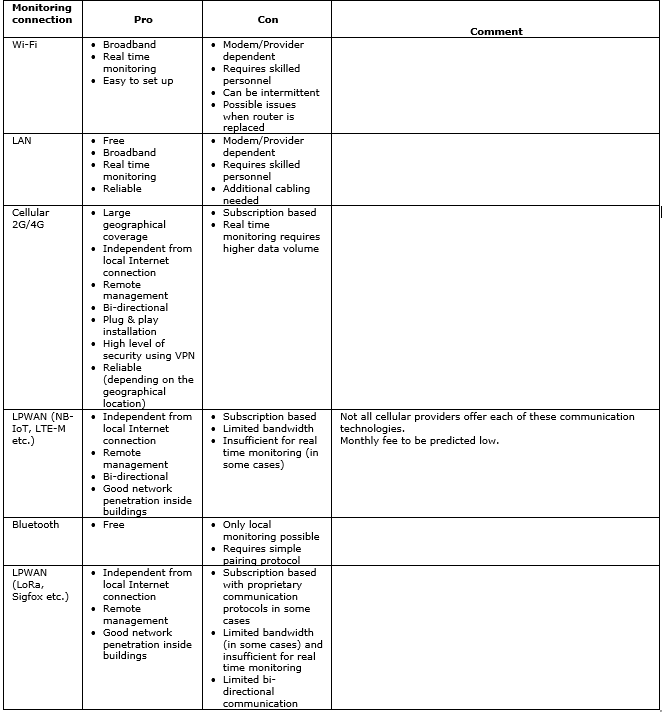
Data ownership and privacy
The data from the monitoring system and data loggers, even if hosted in the cloud, should always be owned by and accessible to the Asset Owner (or SPV). Stakeholders such as the O&M service provider and the Asset Manager need the data to perform their duties and should be granted access. In addition to this, auditors working in the due diligence phases of a project should also have access. It is important to have at least two access levels (read-only, full access).
The monitoring system hardware can be provided by the O&M service provider or a third-party monitoring service provider (but the monitoring system hardware remains the property of the Asset Owner as part of the installation):
· If the O&M service provider is the monitoring service provider, they have full responsibility for protecting and maintaining the data, and ensuring the proper functioning of the monitoring system
· Where there is a third-party monitoring service provider, responsibility for protecting and maintaining the data resides with them. The O&M service provider should endeavours to make sure performance monitoring is correct and takes the best practices mentioned in the previous paragraphs into consideration. The O&M service provider’s ability to properly maintain and use the monitoring system should be evaluated. If necessary, the O&M service provider should be appropriately trained to use the monitoring system. Data use by third-party monitoring providers should be extremely limited, i.e., for correcting bugs and developing additional functions to their systems.
Cybersecurity
As solar PV power plants have inverters and power plant controllers (and monitoring systems) that are connected to the internet to enable surveillance and remote instructions by operators, there are significant cybersecurity risks.
Cybersecurity comprises technologies, processes and controls that are designed to protect systems, networks, and data from cyber-attacks. Effective cyber security reduces the risk of cyber-attacks and protects organisations and individuals from the unauthorised exploitation of systems, networks, and technologies.[4]
Cybersecurity is a vast area and multiple measures are possible. The following hints may help as a starting point:
· Keep it simple: If possible, reduce the type of network devices to a minimum
· As a recommendation, traffic of the network devices may be monitored to detect abnormally high use of bandwidth
· Secure physical access to the network devices and implement a secure password policy. Avoid the use of standard passwords and change all factory setting passwords
· Control access from Internet via strict firewall rules:
- Port forwarding should not be used because this is a big security gap. Only router ports that are necessary should be opened
- Reduce remote access to the necessary use cases
- The use of VPNs (Virtual Private Networks – a secure connection built up from the inside of the private network) is necessary
- VPN access to the site from outside is a minimum requirement
- A VPN server or VPN service which works without requiring a public IP on-site is preferred
- Each solar PV power plant should have different passwords
- Keep your documentation up to date to be sure that no device has been forgotten
- Use different roles to the extent possible (e.g., read only user, administration access)
- Use professional (industrial grade) hardware; only this hardware provides the security and administration functions your plant needs to be secure
· Implement vulnerability management (i.e., identifying and fixing or mitigating vulnerabilities, especially in software and firmware):
- Improve insecure software configurations
- The firmware and software of devices should be kept up to date
- Use anti-virus software if possible and keep it up to date
- Avoid wireless access if it is not necessary
- Audit your network with the help of external experts (penetration tests)
· Keep your company safe:
- Do not store passwords in plain text format, use password manager (e.g., 1Password, Keepass, etc.)
- Train your employees on IT security awareness
- Do not share access from all plants to all employees. Give access only to those who need it. This way damage can be limited if an individual employee is hacked
- Management of leaving and moving employees; change passwords of plants which are overseen by an employee who has left the company or moved to another department
It is therefore best practice that installations undertake a cyber security analysis, starting from a risk assessment (including analysis at the level of the system architecture) and implement a cybersecurity management system (CSMS) that incorporates a plan-do-check-act cycle. The CSMS should start from a cybersecurity policy, and definition of formal cybersecurity roles and responsibilities, and proceed to map this onto the system architecture in terms of detailed countermeasures applied at identified points (e.g., via analysis of the system in terms of zones and conduits). These will include the use of technical countermeasures such as firewalls, encrypted interfaces, authorisation and access controls, and audit/detection tools. They will also include physical and procedural controls, for example, to restrict access to system components and to maintain awareness of new vulnerabilities affecting the system components.
As a minimum requirement, data loggers should not be accessible directly from the internet or should at least be protected via a firewall. Secure and restricted connection to data servers is also important.
The manufacturer of the datalogger and the monitoring platform should provide information on penetration tests for their servers, any command protocol activation channels, and the results of security audits for their products. Command functions should be sent using a secure VPN connection to the control device (best practice). Double authentication would be an even more secure option.
For further information, beyond the scope of this document, please look at the EU Cybersecurity Act (EC, 2019) and the European Parliament’s study “Cyber Security Strategy for the Energy Sector” (EP, 2016).
Types of data collected through the monitoring system
Irradiance measurements
Irradiance Sensors
Solar irradiance in the plane of the solar PV array (POA) is measured on-site by at least one irradiance Class A quality measurement device and ISO 9060:2018 (ISO 9060 2018). The higher the quality of the pyranometer, the lower the uncertainty will be. Best practice is to apply at least two pyranometers in the plane of the solar PV array. In case of different array orientations within the plant, at least one pyranometer is required for each orientation. It should be ensured that the pyranometers are properly assigned to the different arrays for the calculation of PR and Expected Yield.
Class A Pyranometers are preferred over silicon reference cells because they allow a direct comparison between the measured performance of the solar PV power plant and the performance figures estimated in the energy yield assessment. For plants in Central and Western Europe, measuring irradiance with silicon cells yields approximately 2 to 4% higher long-term PR than with a thermopile pyranometer (N. Reich et al. 2012).
Irradiance sensors must be placed in the least shaded location. They must be mounted and wired in accordance with manufacturers’ guidelines. Preventive Maintenance and calibration of the sensors must follow the manufacturers’ guidelines.
The irradiance should be recorded with a granularity of up to 15 minutes (minimum requirement).
Further information on the categorisation of plant sizes and the use of appropriate measuring technology is provided in IEC 61724-1.
Satellite-based Irradiance Measurements
In addition to irradiance sensors, complementary irradiance data from a high-quality satellite-based data service can be acquired after a certain period to perform comparisons with data from ground-based sensors. This is especially useful in case of data loss or when there is low confidence in the data measured onsite by the Monitoring System and it can be considered as best practice. In particular, high-quality satellite-based data should be used for irradiation sensor data quality assessments. The longer the period considered the lower the error will be for satellite-based irradiation data. For daily irradiation values, the error is relatively high, with root-mean-square error (RMSE) values of 8 to 14% in Western Europe. For monthly and annual values, it decreases below 5 and 3%, respectively, which is in line with an on-site sensor (Richter et al. 2015).
When satellite-based irradiance data is used, hourly granularity or less (15 minutes if possible) is recommended. The data must be retrieved once per day at least.
Module temperature measurements
Module temperature can be measured for performance analysis in KPIs such as the temperature-corrected PR.
The accuracy of the temperature sensor, including signal conditioning and acquisition done by the monitoring system hardware, should be < ±1 °C.
The temperature sensor should be attached to the middle of the backside of the module in the middle of the array table, in the centre of a cell, away from the junction box with appropriate and stable thermally conductive glue (Woyte et al. 2013). The installation should be in accordance with manufacturer guidelines (e.g., respecting cabling instructions towards the data logger).
Varying solar PV module temperature in a plant is mainly due to different wind exposure. Therefore, in large plants more sensors will be required across the site because module temperature should be measured at different representative positions (e.g., for modules in the centre of the plant and for modules at edge locations where temperature variation is expected).
The granularity of module temperature data should be at least 15 minutes to perform a correct PR calculation.
Local meteorological data
It is best practice to measure ambient temperature, wind speed, rain fall and other site relevant meteorological measurement with the installation of a local meteorological station in accordance with the manufacturers’ guidelines. Ambient temperature is measured with a shielded thermometer, such as a PT100. The shield protects the sensor from radiative heat transfer. Wind speed is measured with an anemometer, at 10m above ground level.
Wind and ambient temperature data are normally not required for calculating PR unless this is a contractual requirement/agreement (e.g., according to specific recommendations such as those from the National Renewable Energy Laboratory in the USA). However, they are required when the solar PV power plant is modelled in operation or retrospectively.
Additionally, whenever the module temperature measurements are not available or not suitable, wind speed and ambient temperature coupled with installation specifications can be used to retrieve a good estimation of module temperature. In this case, 15 minutes granularity of measurement is still the best practice.
For plants larger than 10 MWp, having automated collection of hourly meteorological data (ambient temperature, wind speed, snow coverage, rainfall) from independent sources is recommended. The reason for this is that on-site meteorological stations are subject to local phenomena and installation-specific results. Data from an independent weather-station is less subject to this, while being also more stable and robust with respect to long-term drift. They can therefore be used to evaluate the quality, and eventually replace, the on-site measurement.
Therefore, for both performance assessment and detailed analysis purposes, automated, local meteorological data is recommended. However, for performance assessment the most important measurement remains the in-plane irradiation (see Chapter 10. Key Performance Indicators).
Solar resource data derived from satellite image processing is available from several services at a nominal per-site and per time-segment (such as one week) fee. The measurement error in satellite data might be greater than that of an on-site instrument but is often more reliable than a mis-aligned, inadequate or dirty on-site pyranometer, and less susceptible to soiling or tampering.
String measurements
Individual string current measurements may be deployed when not supported by the inverters. String level monitoring allows for more precise trouble-shooting procedures than at inverter level. Depending on the module technology used in a plant, strings can be combined (in harnesses) which can help reduce operation costs.
To detect problems quickly and to increase plant uptime, installing string monitoring equipment is recommended. This will constantly measure the current of every string and register those measurements in intervals of up to at 15 minutes. To reduce costs, the current sensor can be used to measure more than one string. However, no more than two strings should be measured in parallel.
Inverter measurements
Inverters have a large set of variables that are constantly measured by their hardware, and that can be registered and investigated from the monitoring system. The data sent from the inverter to the monitoring system should be in cumulative values to allow the monitoring of the overall electricity generation of the inverter, even in case of outages of the monitoring system.
Recommended variables to be monitored are:
- Cumulative Energy generated (kWh)
- Instant Active Power injected (kW)
- Instant Reactive Power injected (kVAr)
- Instant Apparent Power injected (kVA)
- AC Voltage per each phase (V)
- AC Current per each phase (A)
- Power Factor / Cos Phi
- Frequency for each phase (Hz)
- Instant DC Power for each MPPT (kW)
- Instant DC Current for each MPPT (A)
- Instant DC Voltage for each MPPT (V)
- Total instant DC Power for all MPPTs (kW)
- Total instant DC Current for all MPPTs (A)
- Average instant DC Voltage for all MPPTs (V)
- Internal temperature (ºC)
- Conversion components temperature (ºC)
- Inverter failure signals
It should be noted that the precision of inverter-integrated measurements is not always documented by the manufacturers and can be imprecise. For example, energy or AC power measurements taken by inverters may differ substantially from the values recorded by the energy meter. Monitoring systems and reporting should specify and be transparent about the devices used to acquire each measurement.
It is also very useful to have the monitoring system collecting data from all the inverter alarms as they are a valuable source of information for fault detection. Also, low importance alarms or warnings can be used for the organisation of maintenance activities and even setting up Preventive Maintenance actions.
In certain cases, grid connections have limits that must be always respected, such as the maximum AC power that can be injected. For these cases there are two possibilities, one is to set limits using inverter parameters, the second one is to install Power Plant Controller that will change inverter parameters dynamically. In both cases it could be useful to monitor inverter parameters and to program alarms so that the O&M service provider is notified when there is a parameter that has been changed wrongly and does not respect a given limit.
Best practice dictates that the sample size for the measurement of inverter-based variables is 15 minutes at one minute interval. For ad-hoc performance analysis purposes such as allowing the analysis of solar PV array performance, root cause analysis or possible MPP-tracking problems, the input DC voltage and current need to be measured and stored separately.
In general, and as best practice, all common inverter parameters should be logged by the data loggers, since there are a lot of additional important parameters, such as internal temperature, and isolation level, etc. that could be useful for O&M services.
Inverters should be capable of detecting when their conversion components are overheating, to protect themselves under extreme or abnormal operating conditions. Therefore, it is advisable to record the temperature as provided by the inverter so that ventilation performance can be assessed.
Energy meter
One of the most important features of a monitoring system is the automated collection of energy meter data with a granularity of up to 15 minutes. Gathering energy meter data is required for invoicing purposes but it is also the best reference for measuring energy and calculating plant PR and Yield. It is also much more accurate than using inverter data.
Using a high accuracy energy meter to measure energy produced and consumed by the plant is normally required by the Utility. When this is not the case it is a best practice to install a meter with a maximum uncertainty of ± 0.5%, especially for plants > 100 kWp.
To allow data acquisition via the monitoring system, it is recommended to have a meter with two communication bus ports as well as Automatic Meter Reading (AMR) service from the Utility or Meter Operator.
For meters that can store historical data it is a best practice to have a Monitoring System capable of retrieving historical data to avoid any production data loss in case of Monitoring System outages.
Control settings
It is important to monitor all control settings of the plant at inverter- and grid injection-level (if available). Many plants apply control settings for local grid regulation (injection management) or optimisation of the market value of the solar PV generation portfolio (remote control). These settings need to be monitored for contractual reporting reasons and performance assessment.
Alarms
As a minimum requirement, the Monitoring System shall be able to generate the following alarms and, at the user’s discretion, send them by email:
· Loss of communication
· Plant stops
· Inverter stops
· Plant with Low Performance
· Inverter with Low Performance (e.g., due to overheating)
As best practice, the following alarms will also be sent by the monitoring system:
· String without current
· Plant under operation
· Discretion Alarm
· Alarm Aggregation
As a best practice, the following alarms should also be tracked by the O&M service provider. However, these alarms are sent by separate systems:
· Intrusion detection
· Fire alarm detection
The above lists are not exhaustive. For a comprehensive overview of recommended functionalities, refer to the Monitoring Checklist of the Solar Best Practices Mark.[5]
AC circuit / Protection relay
Monitoring the status of MV switch gear and important LV switches through digital inputs is recommended. Whenever possible, it can also be useful to read and register the alarms generated by the protection relay control unit via communication bus.
Data collected by specialised solar PV module field inspections
Not all types of data are collected automatically through the monitoring system. Certain data are collected via on-site measurements and field inspections manually or with aerial inspections.
solar PV modules are engineered to produce electricity for 25-30 years and nowadays are being deployed in ever more and ever larger solar PV power plants. Quality assurance is the cornerstone for long-term reliability and maximising financial and energy returns. This makes tracking down the source of failures once modules have been installed vital. For that reason, field technical inspections, such as infrared (IR) thermography, electroluminescence (EL) imaging and I-V curve tracing, are being put into practice to assess the quality and performance of solar PV modules on-site.
Field inspections like these can be part of contractual Preventive Maintenance tasks or could be offered as additional services, triggered by the O&M service provider in cases where, for example, plant underperformance is not clearly understood just by looking at monitoring data.
Infrared thermography (IR)
Infrared (IR) thermographic data provides clear and concise indications about the status of solar PV modules and arrays and are used in both predictive and corrective maintenance.
Depending on its temperature, every object (e.g., a solar PV module) emits varying intensities of thermal radiation. As explained by Max Planck’s theories, this radiation measurement can be exploited for the determination of the actual temperature of objects. Thermal radiation – invisible to the human eye – can be measured using an infrared camera and is presented in the form of a thermal image. If abnormalities in solar PV modules occur, this typically leads to higher electrical resistance and thus a change in temperature of the affected module or cell. Based on the visual form and quantifiable temperature differences over the thermal image of a solar PV module, abnormalities such as hotspots, inactive substrings or inactive modules can be identified.
For thermographic data to be usable, a number of minimum requirements have to be met. Irradiance shall equal a minimum of 600 W/m2 and shall be continuously measured on-site, ideally orthogonally to the module surface. Infrared cameras need to possess a thermal resolution of at least 640 x 512 pixels and a thermal sensitivity of at least 0.04 K. Measurements shall be taken at a distance which ensures that the resolution of the infrared image equals 5 x 5 pixels per solar PV cell. Further requirements are to be found in IEC TS 62446-3 Part 3: Photovoltaic modules and plants – outdoor infrared thermography.
IR thermographic data can be captured with specialised IR thermographic cameras mounted either on manual hand-held devices or on drones. There are significant advantages in time and cost savings, speed and accuracy of data analysis and reporting, and worker health and safety that come with drone-enabled IR thermography as opposed to traditional manual inspection methods. The larger-scale the solar PV asset, the greater the advantages become. For more information, please refer to Chapter 6.6. Advanced Aerial Thermography.
Besides solar PV modules, IR thermography can also be used to inspect other important electrical components of a solar PV power plant, such as cables, contacts, fuses, switches, inverters, and batteries. For more information, see IEC TS 62446-3 Part 3: Photovoltaic modules and plants – outdoor infrared thermography and IEA-PVPS T13-10:2018 report: review on infrared and Electroluminescence imaging for solar PV Field applications.
The use of IR thermography alone is sometimes not enough to reach a conclusive diagnosis on the cause and the impact of certain solar PV module failures. Therefore, it is usually combined with the following complementary field tests.
I-V curve tracing on-site
Measurements of the I-V curve characteristic determine the power, short-circuit current, open-circuit voltage and other relevant electric parameters (shunt and series resistance, fill factor) of single solar PV modules or strings. The shape of the curve provides valuable information for identifying failures and it also provides a quantitative calculation of power losses. A typical outdoors I-V curve measurement setup consists of a portable I-V curve tracer. In combination with an irradiance sensor (a reference cell usually) and a thermometer this can be used to measure the solar PV modules electrical behaviour. As on-site ambient conditions differ greatly from those in a standardised lab, the measured results should be translated into STC.
Electroluminescence (EL) imaging on-site
EL images are typically taken of every module when leaving the factory production line and are a very useful baseline for the health of the module before leaving the factory. An EL image will show cell level imperfections and cracks which are invisible to the naked eye. EL imaging can be used on-site to better understand module quality post installation as well as further investigation following the identification of anomalies by thermography.
During the EL testing a material emits light in response to the passage of an electric current. This is applied in order to It is used to check integrity of solar PV modules. Here, a current flows through the solar PV-active material, and as a result, electrons and holes in the semiconductor recombine. In this process the electrons release their energy as light. EL imaging detects the near infrared radiation (NIR), i.e., wavelengths between 0.75 and 1.4 μm. The EL is induced by stimulating single solar PV modules or strings with a DC current supplied by an external portable power source. The NIR emissions then are detected by a silicon charge-coupled device (CCD) camera.
EL is usually done in a dark environment because the amount of NIR emitted by the solar PV modules is low compared to the radiation emitted by the background light and from the sun. This requires that EL imaging conducted on-site has to be done during the night, while covering the solar PV modules with a tent, or in a purpose-built mobile test lab. A typical setup consists of a modified single-lens reflex (SLR) camera, a tripod, a portable DC power supply and extension cables. Additionally, a high pass edge filter at 0.85 μm may be used to reduce interfering light from other sources. The resolution of the camera should be at least high enough so that the fingers of the solar cells in the module can be clearly identified. The noise of the camera output must be as low as possible (lowest ISO number possible) and the camera should be as steady as possible in order to avoid blurry images. Exposure times of 15 seconds are common.
High volume approaches to EL testing such as using drones are being offered by some niche service providers. See chapter 12 for further information.
Magnetic Field Imaging (MFI)
Magnetic field imaging (MFI) is a new and innovative method for quantitatively analysing flowing electric currents non-destructively, and without contact.
The underlying physics are very simple: every electric current generates a magnetic field. A magnetic field sensor creates an image of this by being moved over the current-carrying component. Strength and direction of the electric current can be inferred from this.
Current-carrying components such as solar cells, modules or batteries have a characteristic current distribution. If components have defects that influence the electrical current distribution significantly, the resulting magnetic field also changes. These changes can be detected by MFI and thus traced back to the defects.
The fields of application are manifold. In solar PV, defects relevant for the operation of solar modules can be detected reliably (Lauch et al, 2018; Patzold et al, 2019). These are, for example, broken connectors or ribbons (see Figure 40), missing solder joints or defective bypass diodes in the junction boxes of the modules.
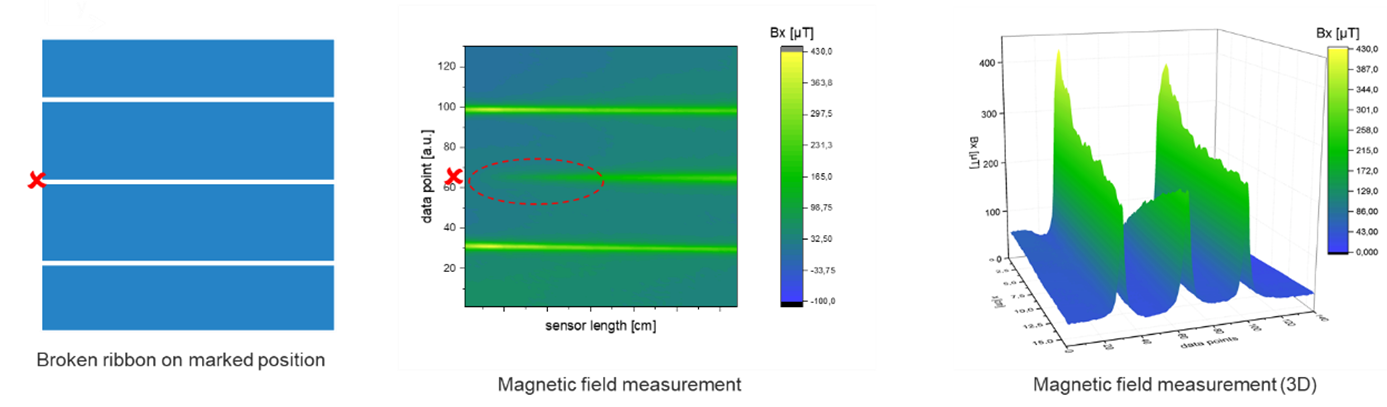
The advantages of the measurement technique that it is non-destructive, fast, and quantitative (the measurement signal is proportional to the underlying electric current). A disadvantage of using magnetic fields is that the distance to the sample must be in the millimeter range to produce high quality imaging results. The measurement cannot resolve microscopic structures (< 100 µm), yet.
Soiling measurements
The operational efficiency of modules is affected by soiling accumulation. Soiling limits the effective irradiance and, therefore, the output of the solar PV module. Measuring soiling I recommended as it can help optimise cleaning schedules and thus revenues. Several methodologies exist for soiling monitoring, the most basic being human inspections. A widely used soiling measurement method is using ground-based soiling reference modules consisting of a module that remains soiled, a cleaned reference cell, an automatic washing station and measurement electronics. There are several variations using different principles to measure the effect of soiling. Digital solutions for soiling monitoring that are currently under development include the analysis of satellite imagery with remote sensing techniques, machine intelligence algorithms and statistical methods. Possible soiling analyses include taking a swab of the soil to an analytical laboratory to determine its nature (diesel soot; pollen; organic soil; inorganic dust) and the appropriate cleaning solution.
Key Performance Indicators
The Key Performance Indicators (KPIs) provide the Asset Owner with a quick reference on the performance of the solar PV power plant. The KPIs in this section are divided into the following categories:
· Solar PV power plant KPIs, which directly reflect the performance of a solar PV power plant. They are quantitative indicators.
· O&M service provider KPIs, which reflect the performance of the service provided by the O&M service provider. O&M service provider KPIs are both quantitative and qualitative indicators.
· Solar PV power plant/O&M service provider KPIs, which reflect solar PV power plant performance and O&M service quality at the same time.

The O&M service provider (or the Technical Asset Manager) is generally responsible for the calculation of the KPIs and reporting to the Asset Owner.
It is important to underline that the O&M service provider is not responsible for providing contractual guarantees for all the KPIs listed in this chapter.
When there are warranties in place it is strongly advised that the party liable for the warranties is not the only one calculating the KPIs.
Solar PV power plant data
Solar PV power plant data can be split into two groups:
1. Raw data measurements: data obtained directly from the solar PV power plant and used for performance calculation
2. Solar PV power plant KPIs: using the raw data from the solar PV power plant to give a more balanced overview of its operation
Raw data measurements for performance calculation
The following is a list of raw data measurements that can be used to calculate KPIs:
· AC Apparent Power produced (kVA)
· AC Active Power (kW)
· AC Energy produced (kWh)
· AC Energy metered (kWh)
· Reactive power (kVAR)
· Irradiance[1] (reference for the plant or the sub-plants) (W/m2)
· Air and module temperature (Celsius degrees)
· Alarm, status code and duration
· Outages, unavailability events
This is a basic list, and it is non-exhaustive.
Solar PV power plant KPIs
Calculated KPIs give a more balanced view of the operation of a solar PV power plant as they take into account the different operating conditions for each plant. Suggestions for calculated KPIs, along with relevant formulas, can be found below. These KPIs can be calculated over different time periods, but often they are computed on an annual basis. When comparing different KPIs or different solar PV power plants’ KPIs, it is important to be consistent in the time period used in computation.
Reference Yield
The Reference Yield Yr represents the energy obtainable under standard conditions, with no losses, over a certain period i. It is useful to compare the Reference Yield with the final system yield.
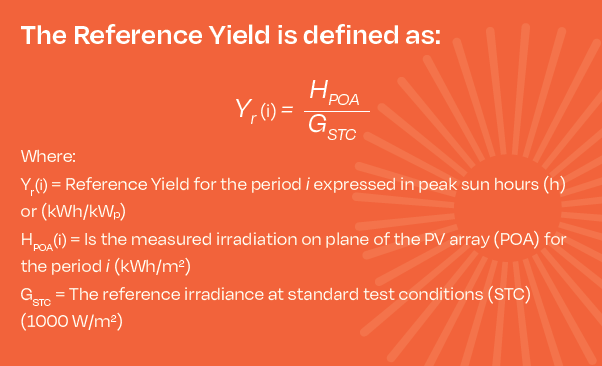
Specific Yield
Specific Yield, also called final yield, Yf is the measure of the total energy generated, normalised per kWp installed, over a certain period i.
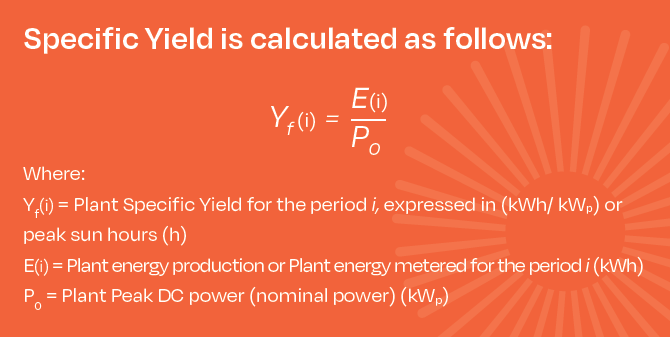
This measurement integrates plant output over a chosen time frame, and since it normalises to nominal power, comparison of the production of plants with different nominal power or even different technologies (e.g., solar PV, wind, biomass etc) is possible. For example, the Specific Yield of a solar PV power plant can be compared against the Specific Yield of a wind plant for the purposes of making an investment decision. Moreover, the Specific Yield of a 5 MWp ground mounted solar PV power plant can be compared directly to that of a 1 MWp double tracker power plant, for example.
Calculating Specific Yield on the inverter level also allows a direct comparison between inverters that may have different AC/DC conversion rates or different nominal powers. Moreover, by checking inverter level Specific Yield within a plant, it is possible to detect whether an inverter is performing worse than others.
Performance Ratio (PR)
PR is a quality indicator of the solar PV power plant. As the ratio between the actual Specific Yield and the theoretically possible Reference Yield, PR captures the overall effect of solar PV system losses when converting from a nameplate DC rating to AC output. Typically, losses result from factors such as module degradation, temperature, soiling, inverter losses, transformer losses, and system and network downtime. The higher the PR is, the more energy efficient the plant is.
PR, as defined in this section, is usually used to report on longer periods of time according to the O&M contract, such as month or year. Based on PR, the O&M service provider can provide recommendations to the plant Owners on possible investments or interventions.
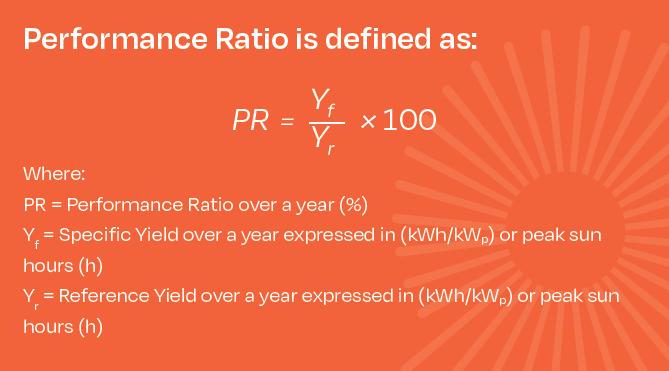
These definitions are based on (Woyte et al. 2014) in line with IEC 61724-1:2017 and are common practice.
PR is measured for available times at the inverter or plant level.
Note that special attention is needed when assessing the PR of overrated plants, where the output of the plant is limited by the inverter’s maximum AC output. In such situations, and for the period that overrating takes place, PR will calculate lower than normal although there is no technical problem with the plant. Stakeholders should be careful assessing PR values for overrated plants, although the amount of overrating is normally statistically constant or with negligible differences on a yearly basis.
Temperature-corrected Performance Ratio
In some situations, such as a commissioning test or solar PV power plant handover from one O&M service provider to another, PR needs to be measured over a shorter period, such as two weeks or a month. In such situations, using a PR formula corrected with temperature factor is recommended. This can help neutralise short-term PR fluctuation due to temperature variations from STC (25°C). As a best practice, temperature should be registered with a granularity of up to 15 minutes (referred to as period j below) and the average temperature for the time period i should be calculated by weighting the mean temperatures of the time periods j according to Specific Yield of this time period.[2]
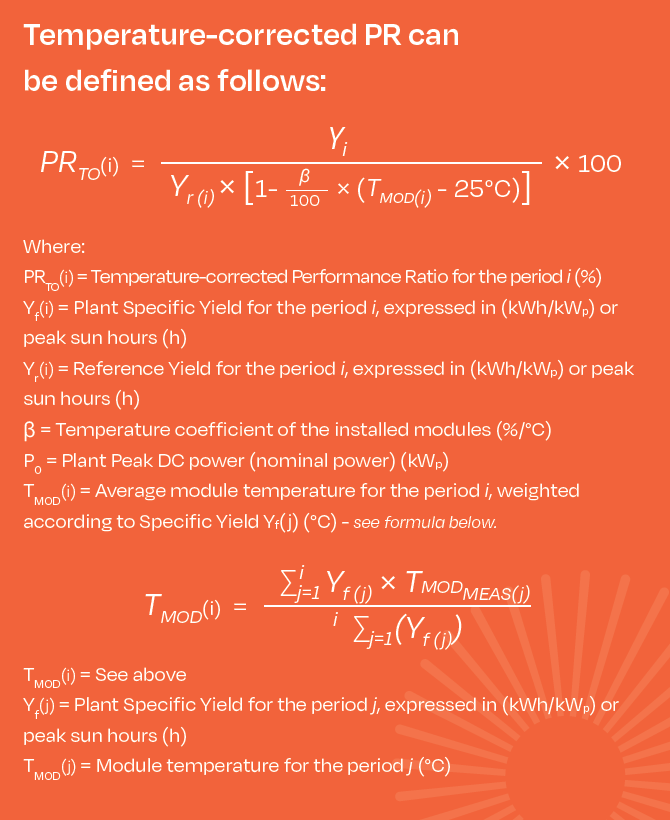
Interpreting Performance Ratio
Careful attention needs to be paid when interpreting PR, because there are several cases where it can provide misleading information about the status of the solar PV power plant:
Seasonal variation of PR (lower PR in the hot months, higher in colder months)
The calculation of PR presented in this section neglects the effect of solar PV module temperature on its power. Therefore, the performance ratio usually decreases with increasing irradiation during a reporting period, even though energy production increases. This is due to an increasing solar PV module temperature that results in lower efficiency. This gives a seasonal variation, with higher PR values in the cold months and lower values in the hot months. It may also give geographic variations between systems installed in different climates.
This seasonal variation of PR can be significantly reduced by calculating a temperature-corrected PR to STC, which adjusts the power rating of the plant at each recording interval to compensate for differences between the actual solar PV module temperature and the STC reference temperature of 25 °C (taking into account the temperature coefficient of the modules, given as % of power loss per °C).
Interpretation of PR for overrated plants (lower PR as designed)
Special attention is needed when assessing the PR of overrated plants. In these plants installed DC power is higher than inverter AC power (DC/AC ratio higher than 1), as a consequence, during sunny periods the output of the plant may be limited by inverter maximum AC output. In such situations, when derating takes place, PR will be lower than normal although there is no technical problem with the plant – lower PR in high-production periods is in fact the consequence of a design decision. Stakeholders should be careful assessing PR values for overrated plants, although the amount of derating is normally statistically constant or with negligible differences on a yearly basis.
Calculation of PR using GHI instead of POA (misleading higher PR)
Calculation of the PR using the Global Horizontal Irradiance (GHI) instead of in-plane (POA) irradiance is an alternative in situations where only GHI measurements are available. The PR calculated with GHI would typically show higher values which may even exceed unity. These values cannot necessarily be used to compare one system to another but can be useful for tracking the performance of a system over time and could also be applied to compare a system’s measured, expected, and predicted performance using a performance model that is based only on GHI.
Soiled irradiance sensors (misleading higher PR)
Special attention is needed when assessing the PR using data from soiled irradiance sensors. In this case, PR will present higher values and will give the false impression that the solar PV power plant is performing better than expected and even some underperformance issues could remain hidden.
Expected Yield
Expected Yield Yexp(i) is the Reference Yield Yr(i) multiplied by the expected PR and thus expresses the Specific Yield that has been expected for a certain period i.
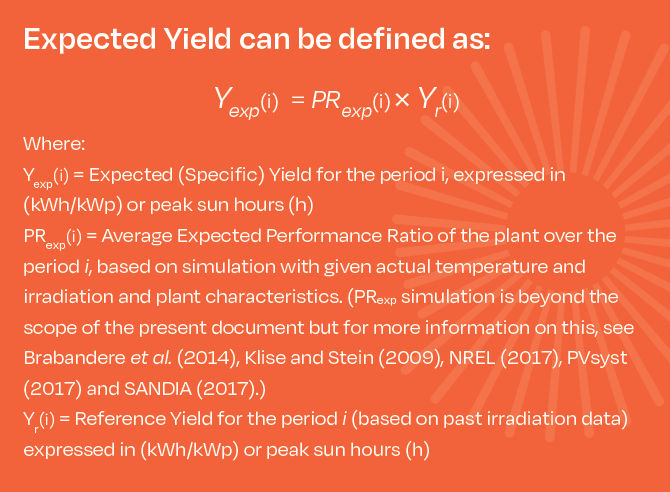
Note that Expected Yield is based on past values of irradiation data. Predicted Yield is based on forecasted data, from day ahead and hour ahead weather reports.
Energy Performance Index
The Energy Performance Index (EPI) is defined as the ratio between the observed Specific Yield Yf(i) and the Expected Yield Yexp(i) as determined by a solar PV model. The EPI is regularly recalculated for the respective assessment period (typically day/month/year) using the actual weather data as input to the model each time it is calculated. This concept was proposed in Honda et al. 2012.
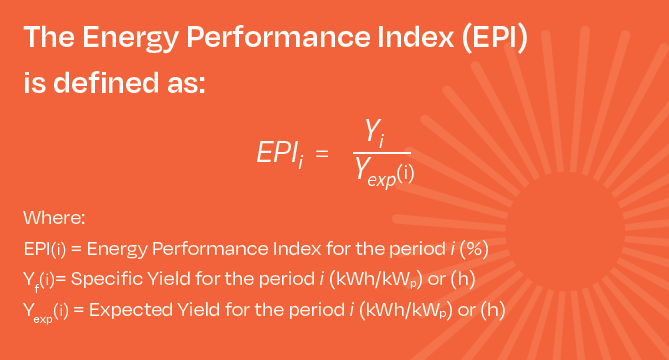
The advantage of using the EPI is that its expected value is 100% at project start-up and is independent of climate or weather. This indicator relies on the accuracy of the model. Unfortunately, there is more than one established model for calculating the Expected Yield of solar PV systems in operation and not all of them are transparent. Therefore, the use of EPI is recommended mainly for the identification of performance flaws and comparison of plants.
Technical Availability or Uptime
Technical Availability (or Uptime), Contractual Availability and Energy-based Availability are three closely related indicators to measure whether the solar PV power plant is generating electricity.
Technical Availability is the parameter that represents the time during which the plant is operating over the total possible time it can operate, without taking any exclusion factors into account. The total possible time is considered as the period when the plant is exposed to irradiation levels above the generator’s Minimum Irradiance Threshold (MIT). Technical Availability is covered extensively in IEC TS 63019:2019.
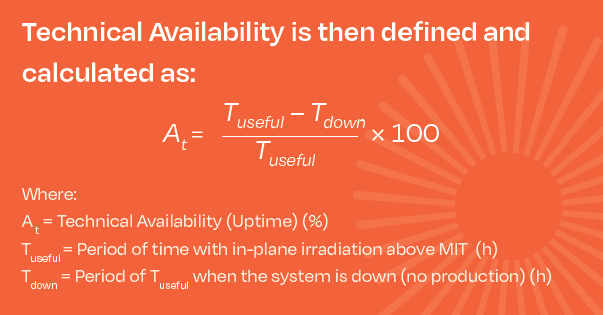
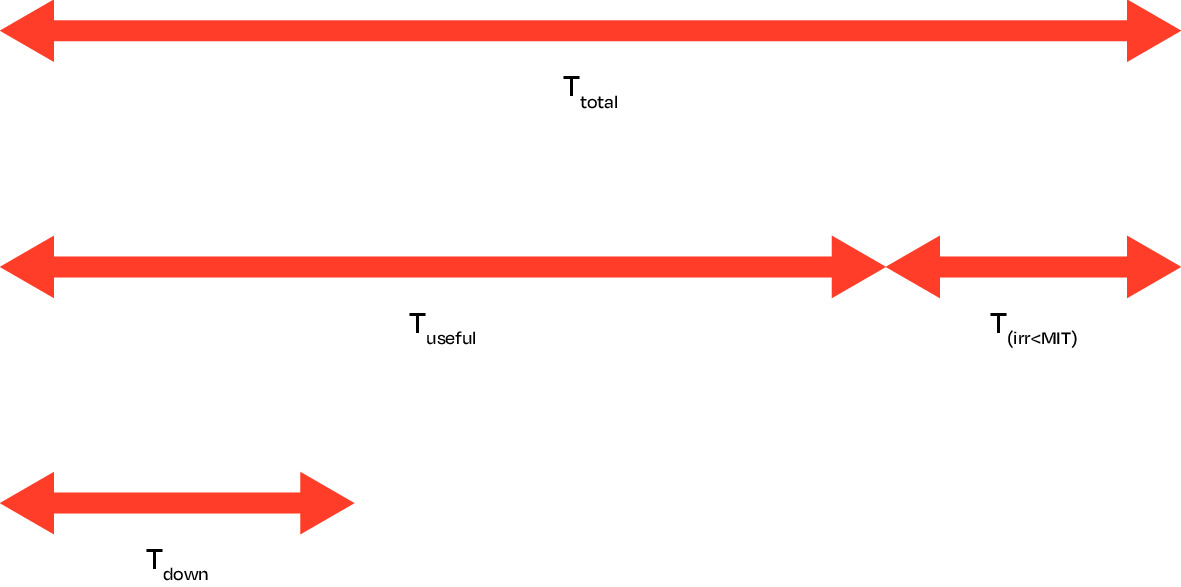
Normally, only the time where irradiance is above the MIT is considered and this is noted above as Tuseful,, where Tuseful = Ttotal – T(irr<MIT). Typical MIT values are 50 or 70 W/m2. MIT should be defined according to site and plant characteristics (e.g. type of inverter, DC/AC ratio etc).
Technical Availability should be measured also at inverter level. Individual inverters’ Technical Availability At_k should be weighted according to their respective installed DC power Pk. In this case, the Technical Availability of the total solar PV power plant At_total with a total installed DC power of P0 can be defined as follows:
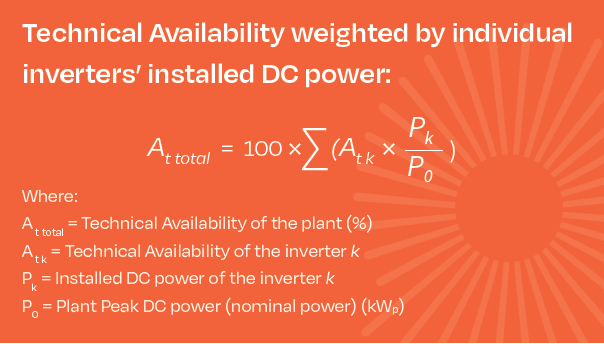
For the calculation of Technical Availability, typically up to 15 minutes of irradiation and power production data should be taken as a basis if granularity of components remains at the level of inverter or higher. Anything below the level of inverter is then captured with the PR calculation presented above.
Technical Tracker Availability or Tracker Uptime
Similar to Technical Availability, Technical Tracker Availability is simply a ratio of the useful time compared to the uptime or downtime of the tracker. This measurement is a purely technical parameter and would not allow for any agreed exclusions in the availability. To calculate the technical tracker availability, the following formula can be used:
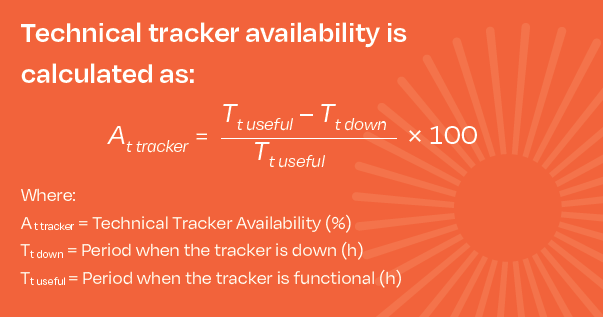
Tracking Performance Availability
Functional failure of a tracker can count as inaccurate, or out of sync tracking compared to the set point. This failure can often lead to shading or small performance deviations, based on the deviation from the sun path. The formula for the tracker’s performance availability is like the technical availability. is defined as the period during which deviation of the tracker’s tilt is higher than the accepted deviation angle. This metric can help to improve single-or dual-axis tracking performance.
O&M service provider KPIs
As opposed to power plant KPIs, which provide the Asset Owner with information about the performance of their asset, O&M service provider KPIs assess the performance of the O&M service.

Acknowledgement Time
The Acknowledgement Time (also called Reaction Time) is the time between detecting the problem (receipt of the alarm or noticing a fault) and the acknowledgement of the fault by the O&M service provider by dispatching a technician. The Acknowledgement Time reflects the O&M service provider’s operational ability.
Intervention Time
The Intervention Time is the time between the acknowledgment of a fault and the arrival of a service technician or a subcontractor at the plant. Intervention Time assesses the capacity of the O&M service provider, and how fast they can mobilise and be on site. It is worth noting that, in certain cases remote repair is possible, or the O&M service provider is not able to repair the fault and third-party involvement is necessary.
Response Time
The Response Time is the Acknowledgement Time plus the Intervention time. Used for contractual purposes, minimum Response Times are guaranteed based on fault classes, classified on the basis of the unavailable power, the consequent potential loss of energy generation, and the relevance of the failure in terms of their safety impact.
Resolution Time
Resolution Time (or Repair Time) is the time taken to resolve a fault, starting from arrival at the solar PV power plant. Resolution Time is generally not guaranteedas resolution often does not fully controlled by the O&M service provider.
Reporting
It is very important for the O&M service provider to comply with reporting requirements and reporting timelines. Content and timing of the reporting is generally agreed by the parties in the Contract agreement. Content of the reporting is expected to be consistent and any change in content or format needs to be explained by the O&M service provider. Delivery of reports per the agreed upon timeline is an important indicator for reliability and process adherence within the O&M service provider’s organisation.
O&M service provider experience
Experience of the O&M service provider with solar PV power plants in a particular country, region, grid environment and/or with solar PV power plants equipped with certain technology or size can play an important role. This is relevant for the selection of the O&M service provider and can be tracked by the Owner over time (track record).
Schedule Attainment
Schedule Attainment (or Schedule Compliance) is the ability of the O&M service provider to execute the Preventive Maintenance schedule within the required timeframes (typically across a period of a week or month).
O&M service providers who adhere to the schedule ensure accomplishing as much preventive maintenance and other timely corrective work as possible. Schedule Attainment provides a measure of accountability.
Low Schedule Attainment can provide key warning signs to the Asset Owner regarding the O&M service provider:
· That preventive maintenance is not done which will lead to equipment failures over time
· The O&M service provider might not have sufficient numbers of qualified technical staff to performance maintenance
· The O&M service provider systems such as the management of stores and spares, procurement processes are not effective
· There may be high levels of corrective maintenance work – which could be due to unsolved technical issues
Best practice requires > 90%, based on the following formula:

Preventive vs Corrective Maintenance ratio
This metric measures the reactive nature of the plant maintenance work. Asset Owners and AMs prefer a higher proportion of Preventive maintenance than Corrective Maintenance. This indicator is based on the actual hours technicians spend on jobs. The actual hours are measured regardless of the originally estimated hours of the planners.
When the O&M service provider has control over the equipment, the O&M service provider decides when to take certain actions to preserve equipment. When the equipment has control over the O&M service provider, the equipment drives the efforts of maintenance. A more reactive plant environment has more circumstances of the equipment experiencing problems and causing the O&M service provider to break the weekly schedule. A more proactive one experiences few circumstances of sudden equipment problems interrupting scheduled work.
Best practice requires that the ratio of Preventive vs Corrective Maintenance is 80/20.
Solar PV power plant/O&M service provider KPIs
Contractual Availability
Contractual Availability is Technical Availability with certain contractually agreed exclusion factors (see below) applied in the calculation; It is used as a basis for evaluating the general Contractual Availability guarantees provided by the O&M service provider and included in the O&M Contract. A best practice is a Minimum Guaranteed Contractual Availability of 98% over a year.
Contractual Availability is the parameter that represents the time in which the plant is operating over the total possible time it is able to operate, taking into account the number of hours the plant is not operating for reasons contractually not attributable to the O&M service provider (listed below in the same section).
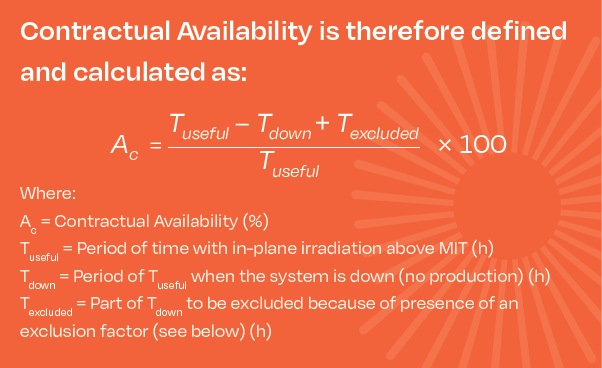
The figure below illustrates the various periods in time mentioned above.
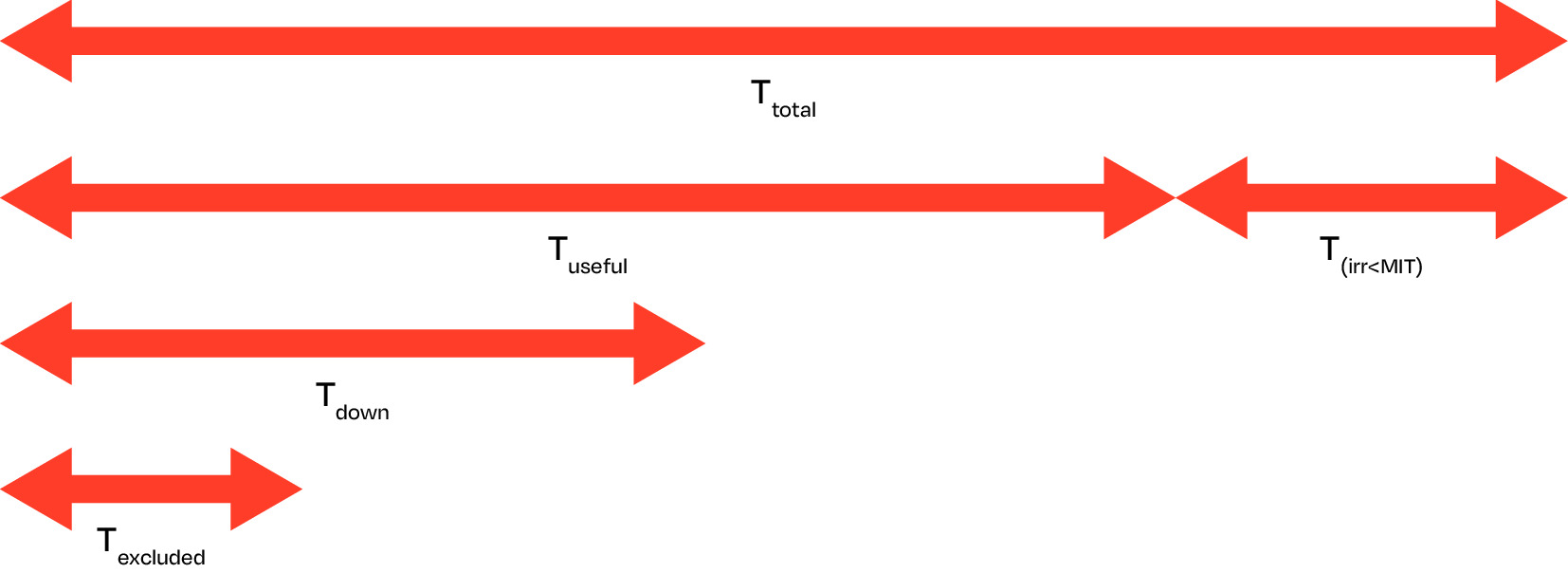
Like Technical Availability, Contractual Availability is also calculated for irradiance levels above the MIT and measured at inverter level. Individual inverters’ Contractual Availabilities ACk should be weighted according to their respective installed DC power Pk. In this case the Contractual Availability of the total solar PV power plant AcAc total with an installed total DC power of P0 can be defined as follows:
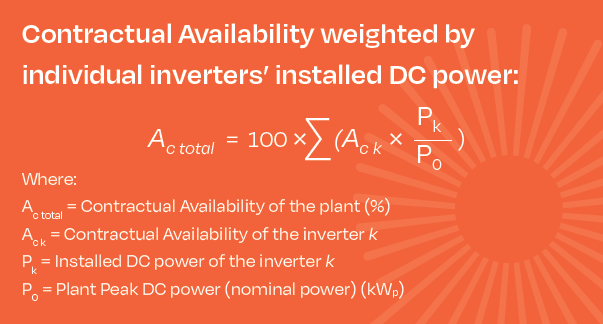
For the calculation of Contractual Availability, typically up to 15 minutes of irradiation and power production data should be taken as a basis if granularity of components remains at the level of inverter or higher. Anything below the level of inverter is then captured with the PR calculation presented earlier.
As Contractual Availability is used for contractual purposes, any failure time should only begin to run when the O&M service provider receives the error message. If the data connection to the site was not available due to an external issue that is beyond the O&M service provider’s responsibility, failure time should only begin after reestablishment of the link. However, if the data connection was lost due to the unavailability of the monitoring system, the failure time should count. In general, the O&M service provider should immediately look at the root cause of the communication loss and resolve it.
The Asset Owner and the O&M service provider should agree on certain failure situations that are not included (exclusion factors) in the calculation of Contractual Availability. Evidence should be provided by the O&M service provider for any exclusion factor and the reason for excluding the event must not be due to an O&M service provider fault. Some good examples for exclusion factors are:
· Force majeure
· Snow and ice on the solar PV modules
· Damage to the solar PV power plant (including the cables up to the feed-in point) by the customer or third parties who are not sub-contractors of O&M service provider, including, but not limited to, vandalism
· Disconnection or reduction of energy generation by the customer or as a result of an order issued to the customer by a court or public authority
· Operational disruption by grid disconnections or disruptions caused by the grid operator
· Disconnections or power regulation by the grid operator or their control devices
· Downtimes resulting from failures of the inverter or MV voltage components (for example, transformer, switchgear), if this requires
o Technical support of the manufacturer and/or
o Logistical support (for example supply of spare parts) by the manufacturer
· Outages of the communication system due to an external issue that is beyond the O&M service provider’s responsibility. Any failure time only begins to run when the O&M service provider receives the error message. If the data connection to the site was not available, failure time shall only begin after reestablishment of the link
· Delays of approval by the customer to conduct necessary works
· Downtimes for implementation of measures to improve the solar PV power plant, if this is agreed between the parties
· Downtimes caused by the fact that the customer has commissioned third parties with the implementation of technical work on the solar PV power plant
· Downtimes caused by Serial Defects on Plant components
· Depending on the O&M contract, time spent waiting for some spare parts to arrive can be excluded from the calculation of Contractual Availability. However, this is not considered a best practice.
Contractual Tracker Availability
Like Contractual Availability, Contractual Tracker Availability also makes allowance for pre-defined exclusions, like maintenance, panel cleaning, etc. A similar formula is used to the technical availability with provision made for any predefined contractual exclusions (see above). The formula can be seen below.
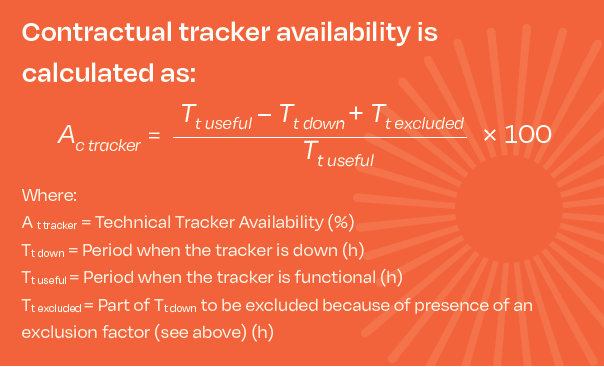
Energy-based Availability
Energy-based Availability takes into consideration that an hour in a period of high irradiance is more valuable than in a period of low irradiance. Therefore, its calculation uses energy (and lost energy), instead of time, for its basis:
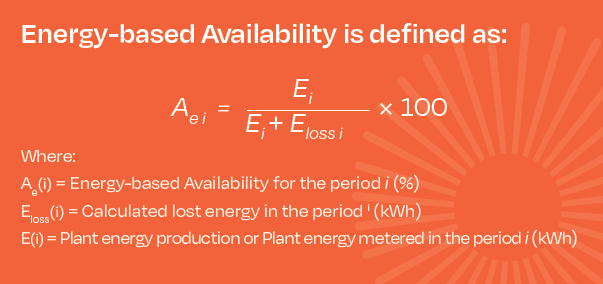
Generally, the Energy Based Availability is used within the O&M Contract in the Availability guarantee chapter and the exclusion factors defined for Contractual Availability tend to apply for Energy-based Availability too.
The following table provides an overview of different types of KPIs and their main purposes.

*Qualitative data is concerned with descriptions, i.e. information that can be observed but not computed (e.g. service experience). In contrast, quantitative is measured on a numerical scale (e.g. Performance Ratio).
Contractual framework
This section contains a set of considerations for the contractual framework of O&M services for the utility scale segment, and more specifically, systems above 1 MWp. A complement to the technical specifications detailed in the previous chapters, the contractual framework described in this chapter is considered best practice.
We recommend using the O&M template contract developed as part of the Open Solar Contracts suite of template contracts. Formerly known as the Global Solar Energy Standardisation Initiative (SESI) this is a joint effort of the Terrawatt Initiative and the International Renewable Energy Agency (IRENA). SolarPower Europe contributed to the drafting of the template O&M contract. There are a total of six templates in a suite of contracts, designed to be used as a package to streamline the procurement of solar projects and make it simpler to aggregate projects using standard terms. Aside from the O&M contract, the other templates include:
- Implementation Agreement
- Power Purchase Agreement
- Finance Facility Agreement term sheet
- Supply Agreement
- Installation Agreement
- Asset Management Agreement
Copies of each contract and explanatory guidance can be found at the Open Solar Contracts website: www.opensolarcontracts.org.
A common contractual framework for solar PV O&M is the “fixed price” model for a specified scope of work that can include administrative, operational, and Preventive Maintenance tasks. A “cost plus” element can then be added for Corrective Maintenance or additional services. The “cost plus” element requires, labour rates, equipment markup, overheads and profits to be negotiated in the contract and added to the actual equipment costs incurred in correcting unexpected problems.
Contractual risk allocation
The O&M contract is a project agreement between the Asset Owner and the O&M service provider for the purpose of managing, operating, and maintaining the solar PV power plant. The O&M contract, together with the EPC contract, is a key document in any project finance transaction. Its provisions should stem financial risks associated with the failure of the O&M service provider to keep the solar PV power plant operating properly. In general, an O&M contract should minimise financial risks through appropriate operational risk allocation. Financial risks posed to the Asset Owner from operational failures include (i) shortage of actual revenues in comparison with expected ones - displayed in the base case, (ii) inability of the Asset Owner to meet their debt service obligations to the lenders, (iii) Asset Owner’s liabilities under other agreements with third parties, including any PPA; and ultimately, (iv) the risk of depreciation of the project assets.
As for the EPC contracts, the Asset Owner may choose between entering into a fully wrapped O&M agreement, which provides the lenders with a single recourse party for fulfilment of all obligations and responsibilities in relation to the O&M of the Plant. Another option is to have several agreements that, together, cover the O&M of the plant. If some of the O&M services are allocated to third-parties under different agreements, the Asset Owner should clearly define the obligations and responsibilities of each contractual party to ensure the absence of risk allocation "gaps".
A balance between the lenders’ demands and the Asset Owner’s interests can be struck by aligning key clauses in the contract regarding timing, cost and quality of the works, and market standards. In this regard, the main drivers are:
· A detailed list of Ordinary and Extraordinary services to be performed by the O&M service provider, both before and after commercial operation of the project. To prevent confusion over risk allocation the operator’s obligations may be defined as general performance requirements and closely linked to performance results
· Availability or Performance Guarantees: in a power project, performance requirements typically include availability, output, outages, emissions, and other performance-related standards. Penalties for non-fulfilment of the performance obligations should also be included. At their most severe, this can mean termination of the O&M contract. These performance guarantees are usually supported by Bonus Schemes and backed-up by Liquidated Damages (LDs)
· Spare Parts warranties: management and availability of spare parts is a key aspect of minimising the impact of both scheduled and unscheduled outages on the project's revenue stream
· O&M service provider’s limited liability in respect of consequential loss, loss of revenue, loss of profit and other financial losses
Scope of the O&M contract
Services to be provided by the O&M service provider include:
- TAM (either O&M service provider or AM)
Reporting to Asset Owner (referred to in the Open Solar Contracts templates as "Monitoring Services", although the detail is to be determined by the parties)
o Reporting on solar PV power plant performance
o Reporting on O&M performance
o Reporting on incidents
· Ensuring regulatory compliance
o Legal requirements for solar PV power plant operation
o PPAs and Interconnection Agreements
o Power generation licence agreements
o Building permits and environmental permits
· Warranty management
· Insurance claims
· Contract management
- Power Plant Operations
· Plant documentation management
· Plant supervision
o Performance monitoring and documentation
o Performance analysis and improvement
o Issue detection/diagnostics
o Service dispatch/supervision
o Security monitoring interface (optional)
· Plant operation
o Plant controls
o Power Generation Forecasting (optional)
o Grid operator interface, grid code compliance
o Maintenance scheduling
· Management of change (optional)
· Reporting to Technical Asset Manager (in case O&M service provider is not the Technical Asset Manager)
- Power Plant Maintenance
- Preventive Maintenance (which is referred to in the Open Solar Contracts as "Scheduled Maintenance").
- Corrective Maintenance in accordance with agreed Response Time guarantees (some types of maintenance activities may be beyond the scope of the contract, see section 6.2. Corrective Maintenance)
- Extraordinary Maintenance (generally not included in the O&M fixed fee but it is advisable that the O&M contract includes the rules to prepare the quotation and to execute Extraordinary Maintenance works, see section 6.4. Extraordinary maintenance).
- Additional maintenance services (optional, see section 6.5. Additional services). In the Open Solar Contracts O&M template, this would fall within “Additional Services”.
Below is a non-exhaustive list of Additional services and general market trends with regards to whether these Additional services are generally included in the O&M agreement or not.

All the services not included in the scope and in the fixed fee such as Extraordinary Maintenance (see section 6.4. Extraordinary Maintenance) and Additional services (see section 6.5. Additional services) should be regulated within the contract. A dedicated clause should indicate the procedure and should include: (i) a proposal by the O&M service provider within a fixed time frame, (ii) a fixed period for the Asset Owner to accept it or request modification, (iii) a final approval. Pre-agreed tariffs for personnel, machinery renting etc. could be agreed and a specific table could be attached as Contract Annex. This is provided for in the Open Solar Contract O&M template, with reference to "Standard Rates", which can be pre-agreed for Additional services.
- Spare Parts Management (See also Chapter 8. Spare Parts Management)
- Spare parts maintenance
- Spare parts replenishment
- Spare parts storage (optional)
O&M contract fee
As a best practice, O&M services should be provided on a fixed fee plus escalation basis. See section 11.11. of the OM Best Practice Guidelines which discusses how spare parts management may impact on the contract fee.
Contractual guarantees and price adjustments
Although some O&M service providers still provide PR guarantees, recent developments, including the recommendations of the Open Solar Contracts initiative, show that eliminating PR guarantees and only using Availability guarantees and Response Time price adjustments has several advantages.
PR is to a large extent a result of equipment choice, design and construction, over which a (third-party) O&M service provider has little influence, beyond vegetation control and module cleaning. Moreover, removing PR as an O&M service provider KPI makes power plant handover between EPC and O&M service providers or between O&M service providers simpler. Generally, the PR warranties are applied on projects where the O&M and EPC service providers are the same company (or an affiliate). Here the O&M service provider carries forward the risk of the technology made by its sister company.
Availability guarantees and Response Time price adjustments protects Asset Owners from poor performance on the part of O&M service providers. Availability is the KPI that best reflects an O&M service provider’s service. Thanks to the Response Time price adjustment, the O&M service provider has to intervene within a pre-agreed timeframe (dependant on the fault) when events that effect plant performance are not covered by the Availability guarantee. Moreover, the O&M service provider is obliged to intervene during incidents that do not affect performance, referring to good industry practices in general. A further upside is that it makes the transition to a new O&M service provider much smoother and allows Lenders and Owners to pick a service provider based solely on of quality of services. Availability guarantees and Response Time price adjustments avoid burdensome change management processes resulting from the need to recalculate the guaranteed PRon the event of a plant handover.
PR warranties are no longer standard in the independent/third-party O&M market. However, it is possible to set a PR target that, if not fulfilled, can trigger a joint analysis between the Asset Owner and the O&M service provider, to identify causes and agree on possible corrective actions, including revamping projects.
Availability guarantee
A best practice is a Minimum Guaranteed Contractual Availability of 98% over a year at least at inverter level. In certain jurisdictions, such as in Mexico, where labour legislation and the requirements of the network operator stipulate the presence of full-time technical staff on-site, a Minimum Guaranteed Availability of 99% can be provided. This should be reflected in the O&M agreement’s price.
For contractual KPI reasons, Availability should be calculated at inverter level, on an annual basis. For more information on this, see section 10.5.1. Contractual Availability.
The Availability achieved by the O&M service provider is translated into Bonus Schemes and LDs. For more information on this, see section 11.7. Bonus Schemes and Liquidated Damages.
Response time price adjustment
The O&M service provider should be obliged to react to alarms received from the plant within a certain period, 7 days a week. This translates in a minimum guaranteed Response Time with the consequence of an adjustment to the contract price (the O&M fee) payable to the O&M service provider in the event of failure to meet the Response Times. For a definition of Response Time, see section 10.4.3. Response Time.
When setting a Response Time price adjustment, periods with high and low irradiance levels, and fault classes should be differentiated. This accounts for the (potential) loss of energy generation capacity or relevance in terms of safety impact of the failure.
An example for response times according to fault classes can be seen below.
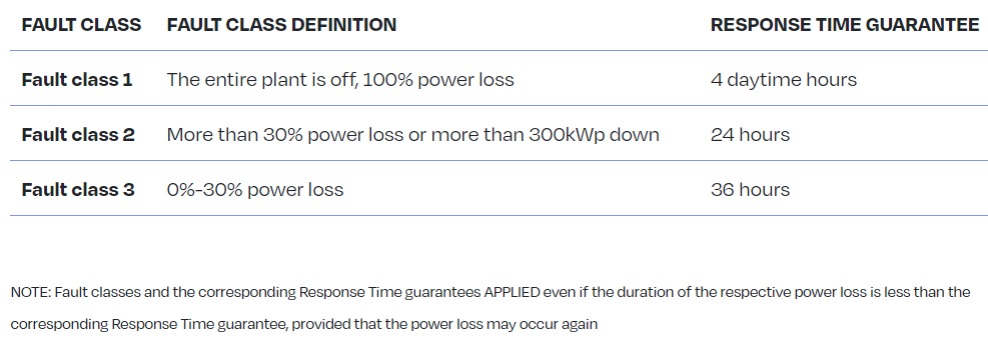
In case an equipment replacement is needed, the O&M service provider should commit to doing this within 8 business hours from the end of the Response Time, if the spare part is included in the portfolio of minimum spare parts list. If the spare part is not included in the minimum spare parts list, the O&M service provider should commit to ordering the spare part within 8 business hours from the end of the Response Time and to carrying out the replacement as soon as possible.
In case the fault cannot be fixed by the O&M service provider and the equipment supplier's intervention is required, the following actions are necessary:
- If the intervention requires spare parts beneath the O&M cost responsibility, the O&M service provider may proceed without separate approval (insurance aspects to be considered).
- If the costs exceed the budget limit mentioned above, the O&M service provider should communicate the issue in writing to the Asset Owner within 8 business hours from the end of the Response Time.
Force Majeure events are excluded from Response Time obligations.
In the Open Solar Contracts O&M template, failure to comply with a Response Time guarantee by more than five business days entitles an Asset Owner to terminate the O&M contract.
Bonus schemes and liquidated damages (LDs)
The Availability guarantees provided by the O&M service provider can be translated into Bonus Schemes and LDs. The Bonus Scheme concept is referred to in the Open Solar Contract O&M template as the "Availability Bonus". These ensure that the Asset Owner is compensated for losses due to lower-than-guaranteed Availability and that the O&M service provider is motivated to improve their service to achieve higher Availability. Higher Availability usually leads to higher power generation and an increase of revenues for the Owner. Hence, the Bonus Scheme agreements lead to a win-win situation for both parties and ensures that the O&M service provider is highly motivated. The Open Solar Contracts O&M template provides for a list of "Excusable Events".
Since the O&M service provider’s responsibility are the O&M works for the solar PV asset, they should be exempted from other influencing factors like force majeure events, grid operator activities to reduce the plant output, grid instability, or offline periods, and any related LDs. (See exclusion factors in section 10.5.1. Contractual Availability.)
An example for Availability Bonus Schemes and LDs can be found below:
- Bonus Schemes: if the measured availability exceeds the Minimum Guaranteed Availability, the additional revenue will be divided between the Asset Owner and the O&M service provider per previously agreed shares. In this case additional revenue should be calculated against the expected annual revenue in the base case scenario. Targets for overall plant production constitute minimum thresholds for bonuses
- Liquidated Damages: if the Minimum Guaranteed Availability is less than the measured availability, all the revenue lost due to the availability shortfall should be reimbursed to the Asset Owner by the O&M service provider. In this case revenue lost should be calculated against the expected annual revenue in the base case scenario. This is usually invoiced by the Asset Owner to the O&M service provider
- Bonuses can be offset against LDs and vice versa
- The amount of yearly LDs should be capped at 100% of the O&M annual fee. Reaching this cap usually results in termination rights for the Asset Owner and the O&M service provider. In the Open Solar Contracts O&M template, the right is only given to the Asset Owner
Service standards
The O&M service provider must act in accordance with all laws, authorisations, good industry practice, planning consents, manufacturer's warranties and operating manuals, and to the standard of a reasonable and prudent operator. Compliance with adequate H&S standards, is also a critical requirement and expectation within the standard of the services.
The Asset Owner should be entitled to instruct a third-party to provide any services that the O&M service provider cannot at the O&M service provider’s cost. This entitlement should only be triggered if the O&M service provider fails to follow a corrective maintenance programme.
O&M service providers' qualification
The O&M service provider must have the means, skills and capabilities to operate and maintain the plant in accordance with the contractual obligations. Experience and professionalism, H&S capabilities, skilled teams, and access to spare parts are criteria for the selection of the O&M service provider. As O&M services are a combination of remote operations services and local maintenance activities, the Asset Owner should make sure that both components are well managed and interfaces between the two are well defined. This is especially important should the O&M service provider subcontract any aspect of the work, as each entity will need to be held accountable for the overall O&M performance.
Responsibility and accountability
The responsibility of the O&M service provider is usually defined in the Scope of work, which forms a part of the O&M contract. In the Open Solar Contract O&M template, this is set out in the O&M Services Schedule. A detailed description of the O&M scope items ensure clarity on what the O&M service provider will do during the term of the contract. In addition to the Scope of work, the Annual Maintenance Plan (AMP) and Annual Maintenance Schedule (AMS) (please refer to Annex E “Annual Maintenance Plan”) outline the granularity and frequency of (predominantly) Preventive Maintenance works. The execution of the activities should be regularly reported to the Asset Owner– this forms the minimum requirements. Best practice in reporting is to compare the executed activities with the AMP and AMS, and outlines deviations and reasoning.
Corrective Maintenance activities performed in cases of component failure or energy generation shortfall, are controlled by performance commitments signed by the O&M service provider. In the Open Solar Contracts O&M template, these are set out as "Corrective Maintenance Services".
Moreover, the Availability Guarantee and Response Time price adjustment explained in section 11.4. Contractual Guarantees and price adjustments of the present chapter also represent a level of accountability for the O&M service provider.
In most countries there are strict legal requirements for security service providers. Therefore, solar PV power plant security should be ensured by specialised security service providers, directly contracted by the Asset Owner or, exceptionally, subcontracted by the O&M service provider. The security service provider should also assume liability for the services provided. For more information on this, see section 5.8. Power plant security.
Power plant remote monitoring
The O&M service provider should operate and maintain the metering system according to local regulations and norms. In some countries there are two metering systems: one that measures power injection in the grid, owned and operated by the grid operator, and one that measures power production, owned by the Asset Owner and operated by the O&M service provider.
The O&M service provider will also make sure that performance monitoring and reporting is operated and maintained according to the monitoring specifications and best practices (see Chapter 9. Data and monitoring requirements).
The Asset Owner has the right to carry out the verification of the metering system to evaluate and control the exactness of the measured data
Reporting
Reporting should be done periodically, as contractually agreed between the O&M service provider (the Technical Asset Manager) and the Asset Owner. The Asset Owner should have the right to contest the report within a certain timeframe.
For more information on industry best practices regarding reporting, see section 4.1. Technical reporting.
Key Performance Indicators
There are different types of Key Performance Indicators (KPIs) relevant to EPC, depending on project phase and relevant stakeholders. KPIs related to EPC can be grouped into three categories:
- Ex-ante KPIs allow the (future) Asset Owner (or project developer) to decide whether to invest in a project that is being developed and trust a particular EPC service provider. They also help lenders to assess projects for financing.
- Project performance KPIs help all stakeholders to track project progress, and EPC service providers to optimise their processes.
- Ex-post KPIs deliver a final assessment on a built project. For EPC service providers these KPIs may also be helpful when presenting their references to potential new clients.
The number of criteria to be looked at depends on the value of the project: big projects need to be examined in more detail.
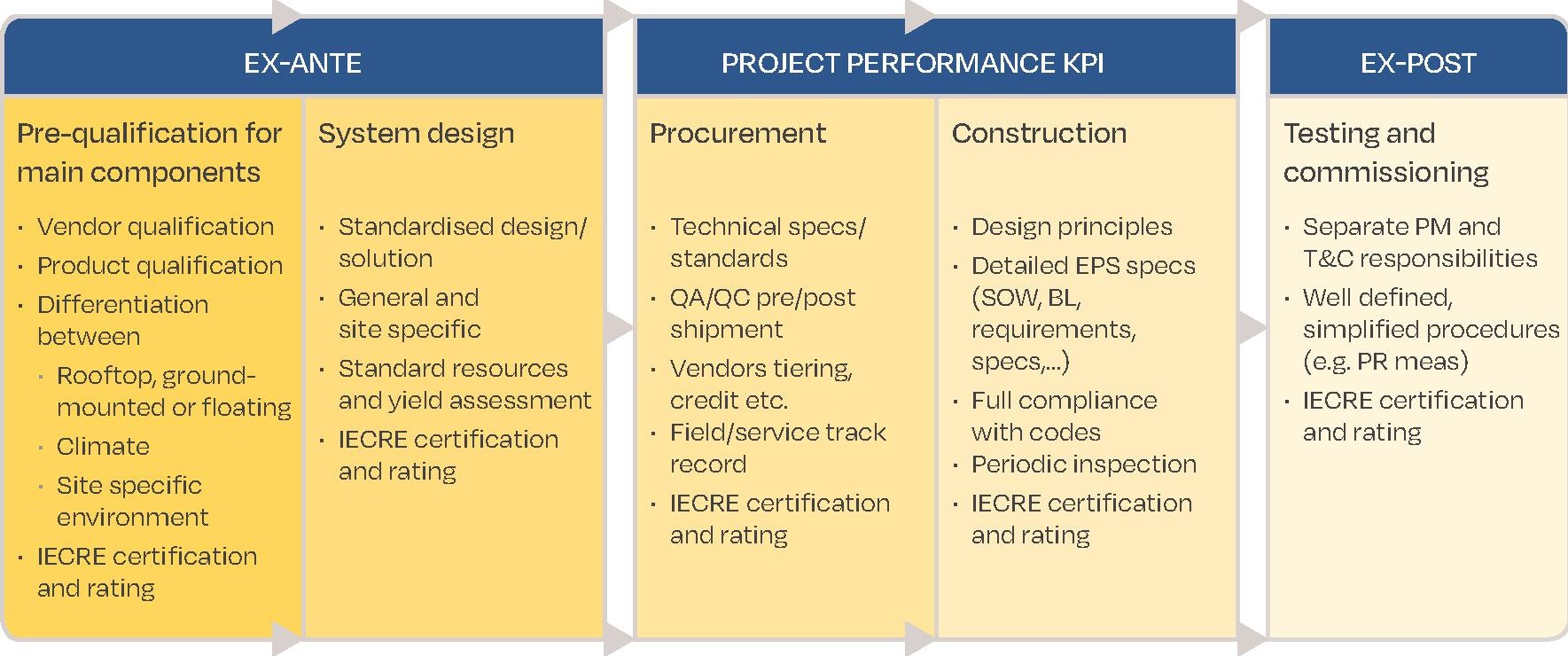
Project performance KPIs
During the construction phase, the performance of the project should be tracked closely. There are available project management standards for this, such as ISO 21500, or publications of associations like the German Association for Project Management (GPM), or the Project Management Institute (PMI). In principle, project management tracks deadlines, budget, and quality, to achieve planned results.
There exist multiple KPIs for project performance. Here we focus on those which track the three essential elements of the ‘project management triangle’: (1) time, (2) budget, (3) quality. To achieve customer satisfaction, the planned goals concerning these elements have to be respected. The sections below discuss KPIs related to these aspects in more detail.
Deviation in Time
Milestones are used in project management to mark specific points along the project timeline. These points may signal anchors such as project start and end date, or the need for external review, input, and budget checks. Therefore, one important KPI concerning time is the Deviation in Time expressed as percentage of milestones missed:
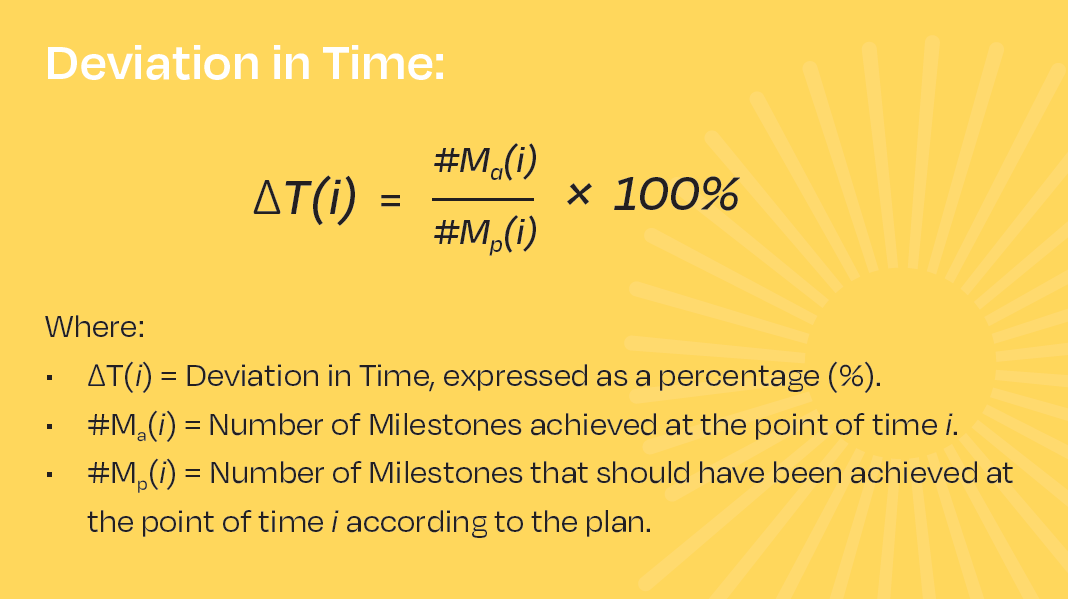
The value of this KPI increases if the granularity of milestones becomes finer and milestones are well distributed over the whole construction phase.
On the contractual side, Liquidated Damages may be linked to Deviation in Time – see section 12.5. Limitation of liability and Liquidated Damages.
Since the importance of different milestones may differ, another KPI should be introduced: the number of Critical Milestones Missed (CMM). A critical milestone is one that must not be missed, because of its significance to the project. Examples include the date of receipt of construction permits or of grid connection. In a normal project CMM should be 0. Additional KPIs may include Deviation of Planned Hours of Work.
Deviation in Budget
At defined moments in the project, usually at milestones and after (or even before) purchase of important components (like modules) or services, current accumulated costs Cca(i) should be compared to costs according to the business plan Cpa(i). The resulting KPI Deviation in Budget can be defined as:
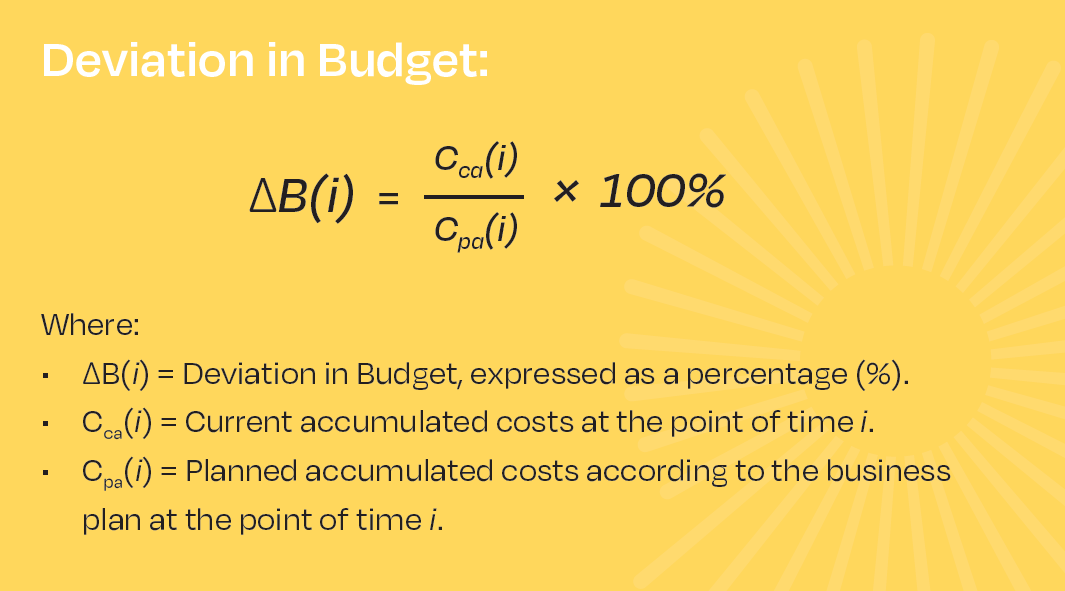
In this case the value of the KPI depends again on the choice of the measurement points i, their granularity and distribution over the period of the project.
Deviation in Quality
Quality KPIs measure the quality of construction as well as the construction process and are therefore quite technical. A general KPI for quality tracking is the Deviation in Quality, which can be defined as:
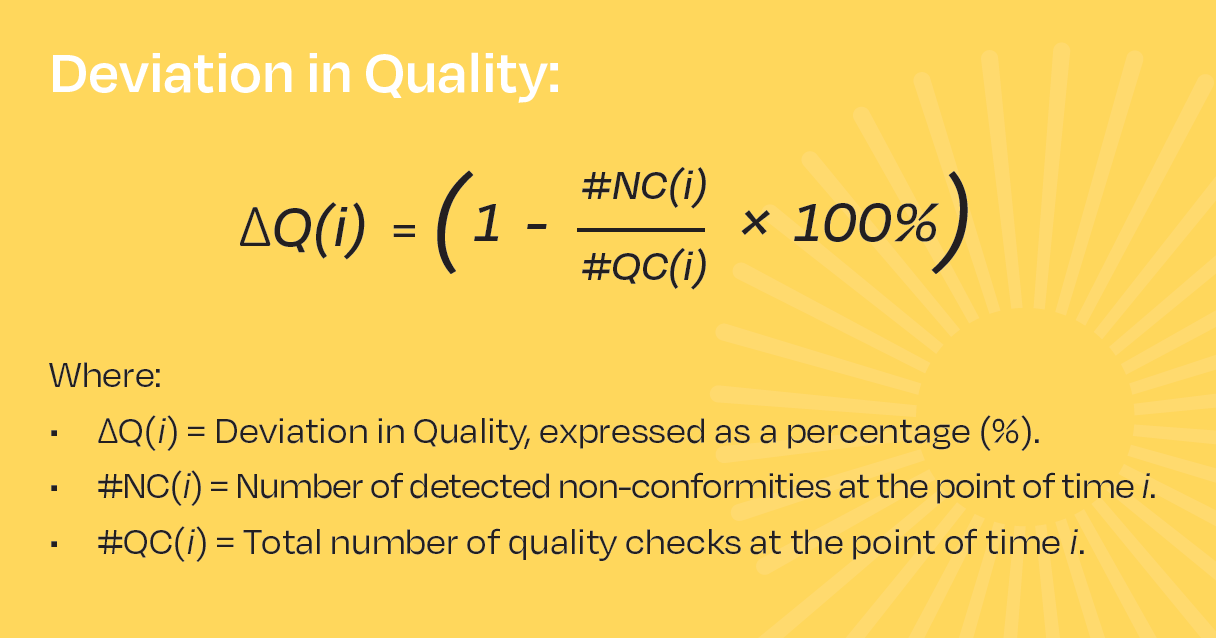
The value of this KPI depends on the definition of quality checks, their number, and distribution over the project period. Non-conformities may include:
- Deviations from execution plans
- Construction defects
- Deviations from norms, standards, grid code, and industrial best practice (the documents to be considered should be listed in the tender document)
- Deviations from permits
Tracking certain quality aspects separately, like conformity with HSSE protocols, is recommended. In this case we would count non-conformities in HSSE and only compare it to the number of all HSSE checks.
Since the importance of different quality aspects may differ, it is best practice to assign a weighting factor for each conformity check.
Other aspects of project quality may be examined, for example:
- The number of change requests (indicates the quality of project development and preparation)
- KPIs describing the quality of communication between the stakeholders (surveys)
- The completeness of required documents for the O&M phase (see
This list should be completed according to the necessities of the specific project.
It is also important to establish feedback loops to create an atmosphere where continuous improvement can flourish.
Ex-post KPIs
Ex-post KPIs are the KPIs that help evaluate EPC projects after the construction phase.
Performance Ratio
There are several KPIs that can be used to evaluate overall plant performance, such as PR, and overall Availability of the PV plant.
PR describes the efficiency of the energy conversion system of a PV plant. When calculating PR, one must bear in mind that the efficiency of PV modules also depends on temperature. For a detailed explanation and formulas, please refer to section 10.3.4. Temperature-corrected Performance Ratio of the O&M Best Practice Guidelines.
Availability focuses on the time that a plant spends generating electricity. For a detailed explanation and formulas please refer to Chapter 10. Key Performance Indicators in the O&M Best Practice Guidelines.
Overall project performance
KPIs regarding overall project performance are, in most cases, identical to the Project performance KPIs described in section 11.1., with i being the concluding milestone of the project.
Warranty KPIs
Additional ex-post KPIs after FAC measure the handling of warranty claims by the EPC service provider, for example:
- Number of broken components / Total number of components
- Number of broken components replaced in warranty procedure / Total number of broken components
Technical Asset Management
Technical Asset Management (TAM) encompasses support activities to ensure the best operation of a solar power plant or a portfolio, i.e. to maximise energy production, minimise downtime and reduce costs. It comprises the activities presented in this chapter.
It is not easy to draw a sharp line between the high-level tasks of the operations team and the more technical responsibilities of the Asset Manager. A simple way to provide some clarity would be that Asset Managers are policing the activities of the O&M providers and reassure compliance and contractual conformity. In many cases, the O&M Contractor assumes some tasks related to Technical Asset Management such as KPI reporting. The below tasks can be regarded as Technical Asset Management and can be performed by the O&M Contractor or the Asset Manager. In line with this, this chapter is also featured in SolarPower Europe’s O&M Best Practice Guidelines. In cases where the Technical Asset Manager and the O&M Contractor are separate entities, a close coordination and information sharing between the two entities is indispensable. This involves integral knowledge about how much a project should be producing for any given time, considering factors such as weather, seasons, or degradation of assets, and ensuring long-term energy infrastructure reliability. It represents the entire value chain from investors to Asset Managers and service providers.
Technical reporting
The Technical Asset Manager is responsible for preparing and providing regular reporting to the Asset Owner and other stakeholders defined in the agreement between the Asset Owner and the Technical Asset Manager.
The frequency of the reporting can be set daily, weekly, monthly, quarterly or annually (with monthly being the most common and considered a best practice), with specifically defined content for each of these reports. Generating a report for any specific time range in the past can also be possible. Detailed time-series data should also be reported or at least archived in the reporting system in order to improve the correct availability calculations. The spatial resolution of reports should be on the level of each inverter to better detect under-performing sections of the plants managed.
The following table includes some proposed quantitative and qualitative indicators which should be in reports as a minimum requirement, a best practice or a recommendation. For more details on the individual indicators, see Chapter 10. Key Performance Indicators of SolarPower Europe’s O&M Best Practice Guidelines.
A new trend in the industry is to extend the reporting beyond the pure PV plant indicators and to incorporate reporting on the actual activities. This means that both the Asset Manager and the O&M Contractor can operate with a CMMS (Computerised Maintenance Management Systems) in order to measure various O&M KPIs (e.g. Acknowledgement Time, Intervention Time, Reaction Time, Resolution Time) and equipment performance (e.g. Mean Time Between Failures). The Technical Asset Manager should also report on Spare Parts Management and in particular on spare parts stock levels, spare parts consumption, in particular PV modules on hand, spare parts under repair. With the emergence of Predictive Maintenance, the Technical Asset Manager can also report on the state of each individual equipment. Furthermore, the periodic reporting can include information on the status of the security and surveillance system. In this case, the security service provider is responsible for providing the relevant input to the Technical Asset Manager.
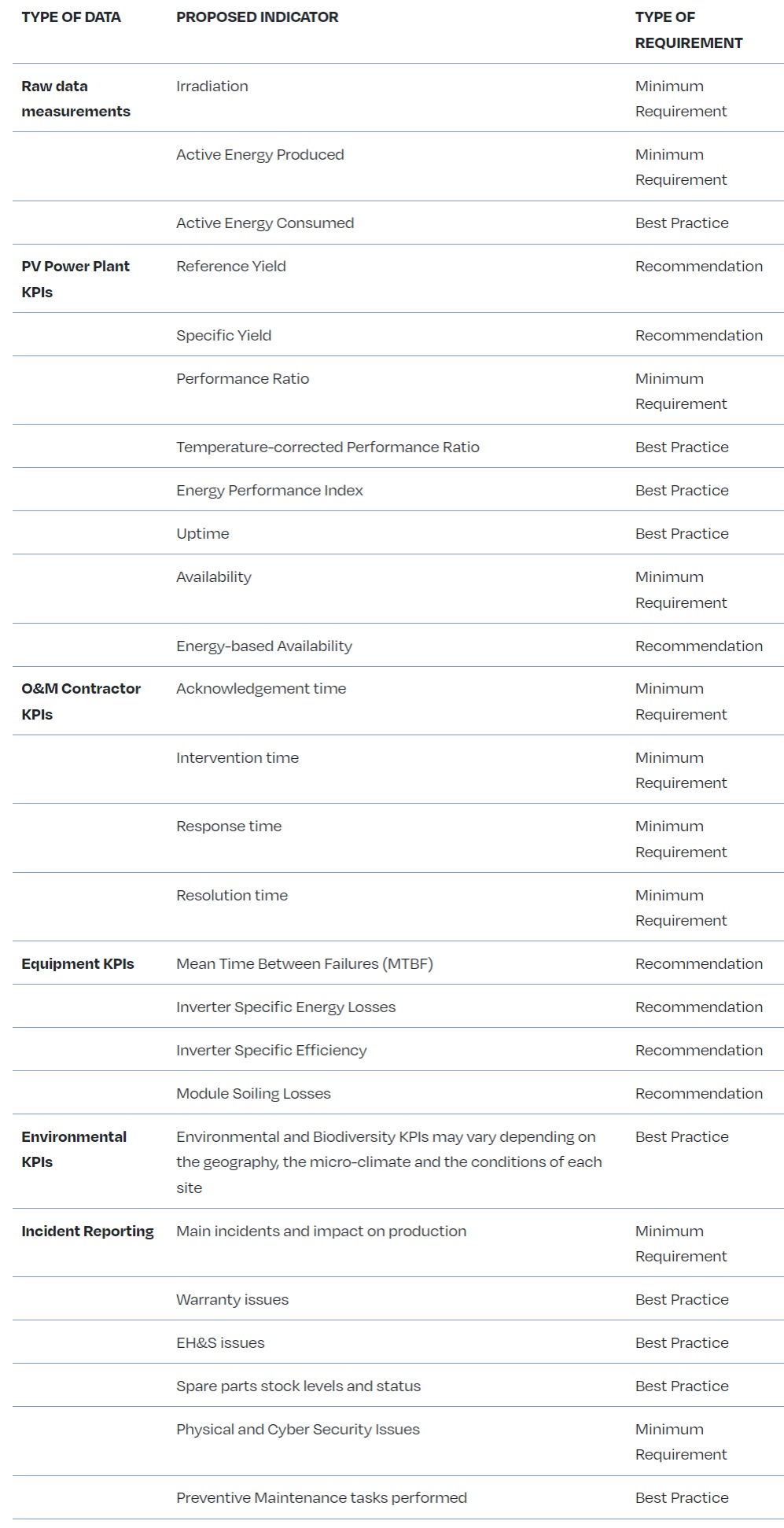
On top of the periodical standard reports (monthly, quarterly or yearly) where operations activities are reported by the Technical Asset Manager to the Asset Owner, it is a best practice for the Technical Asset Manager to provide an intermediate operation report when a fault is generating a major loss. A loss due to a fault is considered major when PR and availability are affected by more than a certain threshold throughout the ongoing monitoring (or reporting) period. A best practice is to set this threshold to 1% of Availability or 1% PR within a reporting period of one month. The report should be sent as soon as the fault is acknowledged or solved and should contain all the relevant details related to the fault together with recommendations for Extraordinary Maintenance when the necessary operations are not included in the maintenance contract.
- Typically, this maintenance report should contain: Relevant activity tracks (alarm timestamp, acknowledge time, comments, intervention time, operations on site description, pictures etc)
- The estimated production losses at the moment of writing the report
- The estimated production losses for the total duration of the period, counting on the estimated resolution time if the issue is not solved yet
- The device model, type and Serial Number when the fault is affecting a device
- The peak power of the strings connected to the device(s)
- The alarm and status log as provided by the device
- The resolution planning and suggestions. Eventual replacement needed
- Spare parts available
- Estimated cost for the extra-ordinary maintenance
Site visits and non-intrusive inspections
As a best practice, the Technical Asset Managers should undertake a bi-annual site visit in coordination with the O&M provider to perform a non-intrusive visual inspection, address current maintenance issues and plan out in cooperation with the O&M contractor and the ancillary service providers (if different) a maintenance improvement plan. It is becoming a best practice for Technical Asset Managers to commission aerial inspections, such as thermography. Using independent providers of these services can be a fast and low-cost way to assess O&M performance and general asset health.
Management of ancillary service providers
When the O&M Contractors do not have an all-inclusive contract, Technical Asset Managers may be responsible for managing providers of ancillary (additional) services related to PV site maintenance such as panel cleaning and vegetation management; general site maintenance such as road management, site security; or on-site measurement such as meter readings and thermal inspections. For more information on additional services, please refer to SolarPower Europe’s O&M Best Practice Guidelines Section 6.5, Additional services.
This requires managing a process which spans from tendering for those services all the way to assessing the deliverables and reassuring in coordination with the O&M compliance with environmental, health and safety policies.
Interface with local energy authorities & regulatory compliance
The Technical Asset Manager is responsible for ensuring that the operation of the PV plant is in compliance with the regulations. Several levels of regulation have to be considered:
- Many countries have a governing law for the operation of energy generating assets or renewable energy and PV plants in particular. This is something the O&M Contractor should be aware of in any case, even if the O&M Contractor and the Technical Asset Manager are separate entities.
- Power Purchase Agreements (PPA) and Interconnection Agreements must also to be known and respected by the Technical Asset Manager.
- Power generation license agreements need to be made available by the Asset Owner to the Technical Asset Manager so that the Technical Asset Manager can ensure compliance with the regulations of these licenses.
- Further to the regulatory compliance, Technical Asset Manager will be responsible to ensure corporate compliance especially on the new post-subsidy environment, which is dictated by corporate PPAs and stricter contractual obligations by the owner.
- Specific regulation for the site such as building permits, environmental permits and regulations can involve certain requirements and the need to cooperate with the local administration. Examples include restrictions to the vegetation management and the disposal of green waste imposed by the environmental administration body, or building permits restricting working time on site or storage of utilities.
- It is the O&M Contractor’s responsibility to ensure grid code compliance.
- The Technical Asset Manager plays an important role in supporting the cooperation between the aggregator and the grid operator by informing the aggregator about plant production data, unavailable times, transferring network unavailability information from the grid operator, assuming discussions with the grid operator about the attachment to the balancing portfolio of the respective aggregator, and executing plant shutdown requests (in case of negative prices identified in the day-ahead market).
- Other issues requiring formal compliance include reporting of safety plans and incidents, historic/cultural resource protection, noise ordinances that may limit work at night, and any other regulations imposed by an authority having jurisdiction.
As a minimum requirement the agreement between the Technical Asset Manager and the Asset Owner should list all the relevant permits and regulations and specify that the Asset Owner makes relevant documents available to the Technical Asset Manager.
As a best practice, all regulations, permits and stipulations should be managed within the electronic document management system. This allows the Technical Asset Manager to track reporting and maintenance requirements automatically and report back to the Asset Owner or the administration bodies.
Warranty management
The Technical Asset Manager can act as the Asset Owner’s representative for any warranty claims vis-à-vis the OEM manufacturers of PV plant components. The agreement between the Asset Owner and the Technical Asset Manager should specify warranty management responsibilities of the Technical Asset Manager and the Asset Owner and set thresholds under which the Technical Asset Manager can act directly or seek the Asset Owner’s consent. The Technical Asset Manager or the Operations team will then inform the Maintenance team to perform warranty related works on site. Usually the warranty management scope is limited by Endemic Failures (see definition below in this section). Execution of warranty is often separately billable.
For any warranty claims the formal procedure provided by the warranty provider should be followed. All communications and reports should be archived for compliance and traceability reasons.
Objectives of Warranty Management:
- Improve the efficiency in complaining processes
- Help to reduce the warranty period costs
- Receive and collect all the warranty complaints
- Support the complaint process
- Negotiate with manufacturers more efficient complaint procedures
- Study the behaviour of the installed equipment
- Analyse the costs incurred during the warranty period
Types of warranties on a PV Plant:
- Warranty of Good Execution of Works
- Warranty of Equipment (Product Warranty)
- Performance Warranty
Warranty of good execution of works and equipment warranties
During the warranty period, anomalies can occur in the facility, which the EPC provider is liable for. The anomalies must be resolved according to their nature and classification, in accordance to what is described in the following sections.
The anomalies or malfunctions that might occur within the facility warranty period might be classified in the following way:
- Pending Works
- Insufficiencies
- Defects
- Failure or malfunction
Anomalies Handling
During the Warranty Period, all the Anomaly processing should, as a best practice, be centralised by the Technical Asset Manager/O&M Contractor, who is responsible for the first acknowledgment of the problem and its framework according to its type and is the main point of contact between the internal organisational structure and the client in accordance to the criteria defined below.
Pending Works, Insufficiencies and Defects
In the case of anomalies of the type “Pending Works”, “Insufficiencies” or “Defects”, the Technical Asset Manager must communicate the occurrence to the EPC provider, who shall be responsible to assess the framework of the complaint in the scope of the EPC contract, determining the action to be taken.
Resolution of failures in the case of anomalies of the type “Failures”
The Technical Asset Manager should present the claim to the equipment supplier and follow the claims process.
Endemic Failures
Endemic failures are product failures at or above the expected failure rates resulting from defects in material, workmanship, manufacturing process and/or design deficiencies attributable to the manufacturer. Endemic failure is limited to product failures attributable to the same root cause.
Performance Warranty
EPC Contractors usually provide a 2-year performance warranty period after the Commercial Operation Date (COD). During the warranty period, it is the responsibility of the Technical Asset Manager to monitor, calculate, report and follow-up the values of Performance Ratio and other KPIs guaranteed by the EPC Contractor.
Within this scope, it is the responsibility of the Technical Asset Manager to:
- Manage the interventions done within the scope of the warranty in order to safeguard the performance commitments undertaken under the contract;
- Periodically inform the Asset Owner about the condition of the contracted performance indicators;
Immediately alert the Asset Owner whenever the levels of the indicators have values or tendencies that could indicate a risk of failure.
Warranty Enforcement
A warranty may be voided by mishandling or not observing instructions or conditions of the warranty. For example, storing modules improperly onsite, such that the packaging is destroyed by rain, may void a warranty. In another case, partial shading of a thin-film module voids the warranty. Failure to provide adequate ventilation may void an inverter warranty. The manufacturer’s warranty might cover replacement but not labour to remove, ship, and re-install an underperforming module. A warranty often gives the manufacturer the option to “repair, replace, or supplement,” with “supplement” meaning to provide modules to make up the difference in lost power. For example, if a system has 10,000 modules that are underperforming by 5%, the guarantor could satisfy the performance warranty by providing 500 additional modules to make up for the lost power, rather than replacing the 10,000 modules. However, increasing the plant size by 500 modules to restore guaranteed power might not be possible due to lack of rack space or electrical infrastructure. Also, expanding the system “nameplate” capacity would generally trigger a new interconnect agreement and permitting. Manufacturers also often have the option of paying a cash-value equivalent to the lost capacity of under-performing modules, but as the price of modules declines, this might be less than originally paid for the modules. Given the complications described above, this option is often preferred by system owners unless there is a required level of performance that must be maintained.
Insurance claims
The agreement between the Technical Asset Manager and the Asset Owner should specify the insurance management responsibilities of the Asset Owner and the Technical Asset Manager. The Technical Asset Manager will at least be responsible for the coordination of site visits by an insurance provider’s representative or technical or financial advisors in connection with the information collection and damage qualification, as well as for the drafting of technical notes to support the reimbursement procedure. The coordination of the insurance claim and the liaison with the insurers, brokers and loss adjusters, as well as finding the best insurance providers, is usually with the Commercial/Financial Asset Manager (see section 7.14. Suppliers account management).
For any insurance claims, the formal procedure presented by the insurance provider should be followed. All communications and reports should be archived for compliance and traceability reasons.
Types of insurance related to PV plant operations and maintenance include:
- Property insurance, hazard insurance: coverage commensurate with the value of equipment and other improvements to a property; may also cover against other risks if included or unless excluded.
- Commercial general liability insurance: in a form covering all actions by owner or contractors, written on an occurrence basis, including coverage for products and completed operations, independent contractors, premises and operations, personal injury, broad form property damage, and blanket contractual liability. Liability of a fire started by the PV system has increased required liability coverage levels for PV systems. A liability policy should cover negligence claims, settlements, and legal costs too.
- Inland insurance or marine insurance: insures against loss of equipment in shipping or not on the property premises. Inland insurance is often covered under property insurance policy.
- Workmen's compensation: covers costs for employee accidents.
- Professional liability insurance: insures against errors and omissions often required by board of directors.
- Commercial vehicle insurance: insurance for owned and rented vehicles or personal vehicles used on company business
- Warranty insurance: equipment warranty issued by manufacturer but backed up by an insurance company in the event that the manufacturing company goes out of business. Many insurance companies do not offer warranty insurance but rather cover such risk under property insurance.
- Business interruption insurance covers lost revenue due to downtime caused by covered event – this can be important in PPAs where revenue is essential for debt service and O&M expenditures.
- Energy production insurance covers cases when energy production is less than previously specified, which can improve access to debt financing and reduce debt interest rate.
The procedure for making claims described in the insurance policy should be followed to the letter, keeping copies of all submittals and correspondence with the insurance company. The insurance company (claims adjuster) will need to have access to the site provided to them in order to assess damage and to collect the information needed to process the claim.
Contract management (operational contracts)
Contract management encompasses both technical and commercial/financial aspects. This section looks at contract management from a TAM point of view. Section 7.13. Contract management (financial contracts) takes the perspective of the Commercial/Financial Asset Manager.
The Technical Asset Manager is in charge of ensuring compliance with the operational contracts in place, such as contracts related to O&M services, land lease, insurance, site security, communications and in some cases ancillary (additional) services such as panel cleaning and vegetation control or component procurement. (For more information on procurement, please refer to chapter 8. Procurement).
Indeed, the oversight of and coordination with the O&M Contractor is one of the key responsibilities of the Technical Asset Manager. Thus, the Technical Asset Manager is responsible for performance supervision too: proper oversight of O&M, detecting when systems are underproducing, and quickly and accurately diagnosing an under-performing plant.
The Technical Asset Manager oversees various contractual parameters, responsibilities and obligations of the Asset Owner and the contractual partners linked to the respective solar power plant. Contract management responsibilities depend largely on factors such as geographic location, project size, construction and offtaker arrangements.
As a minimum requirement, the initial step in this process is a comprehensive analysis of the contracts followed by a well-defined Division of Responsibility (DOR) matrix that clearly delineates which entity is responsible for which action on both the short and long term. Upon mutual agreement between the parties, the DOR can serve as the driving and tracking tool for term of life contractual oversight.
As a form of best practice, the Contract Manager’s responsibilities often also extend to functioning as the initial contact for all external questions. This allows the Asset Owner optimal access to all areas of the service provider’s organisation and adherence to the contractual responsibilities. The Contract Manager also assumes the responsibility for invoicing of the O&M fees to the Asset Owner.
For quality purposes, the Technical Asset Manager should also track their own compliance with the respective contract, either O&M contract or Asset Management contract, and report to the Asset Owner in full transparency.
Asset optimisation (technical)
Technical Asset Managers also start being responsible for providing data and information analysis on assets they manage, as well as to provide asset optimisation solutions, primarily based on the following key areas:
- Plant performance
- Operation cost reduction
- Technology adaptation and upgrades (e.g. Revamping and repowering
- Technical People management and training
It is the role of the Technical Asset Manager to initiate and coordinate discussions with both the Owners and the O&M Contractors to future-proof the assets and come up with a financial proposal based on data analysis which can assist the owners in making informed decisions, aiming at enhance production and revenues generation for each site
Note that asset optimisation has commercial and financial aspects too, such as contract optimisation, presented in chapters 7. Commercial and Financial Asset Management and 8. Procurement.
Revamping & repowering
Revamping and repowering are considered market trend optimisation strategies due to their main drivers: component failure or underperformance; ageing of solar assets; unavailability of spare parts and support; technological improvements; higher efficiency production rates due technological evolution; decreasing prices and additional benefits (such as new warranty terms). The increased efficiency and declining component prices of solar technology translates in an opportunity to boost asset performance, optimise operation cost and increase the revenue stream.
For the Asset Manager and Asset Owner a revamping or repowering project needs to be considered as a commercial and financial re-investment case. Thus, a revamping or repowering case starts under at least one of the following conditions:

In order to evaluate the business case, the Technical Asset Manager should perform a complete assessment of equipment preservation and correspondent performance levels (actual versus budget/expected).
The focus of revamping or repowering considerations is on PV modules and inverters when either all, or parts of these components get replaced. Other parts of the PV plant may undergo revamping as well, usually this is a by-product of the replacement of the main components.
The following dimensions need to be evaluated when considering plant repowering
a. Regulatory aspects
b. Commercial viability
c. Technical feasibility
There are implications from decisions made along one dimension to the other dimension, thus the commercial planning of a repowering projects is an iterative process.
a. Regulatory aspects
Regulatory aspects can only be covered very briefly in this context, as they are highly specific to the type of power plant and the jurisdiction it operates in. It is not unusual that a repowered power plant needs to fulfil current regulation whereas the existing power plant only needs to fulfil regulation as required at the time of commissioning. This may result in additional technical requirements with severe commercial implications, if omitted.
The following regulatory fields heavily influence the feasibility of a power plant repowering project:
Technical regulation
Many jurisdictions have tightened the technical requirements a power plant needs fulfil over time. The most important considerations are:
- Conformity with regulations regarding the power network. This may include technical quality parameters of the feed-in power, remote power control, protection equipment, among others
- Certification of the components used
- Emission control (EMV emission, acoustic emission)
Feed-in tariff regulation, off-take agreements
Power plants operated based on a feed-in tariff (or that are otherwise subsidized) need to take in account the details of the subsidy scheme the plant is intended to operate. Replacing major components risks losing the feed-in tariff as a worst-case scenario. This is especially important if the nominal power of the plant is changed. A detailed legal opinion is advisable if PV modules are replaced. Private off-take agreements need to be reviewed as well, to eliminate risk of contractual breach.
Building permits, municipal and environmental regulation
Building permits may include obligations to the plant operator that may impede or influence repowering projects. The operator should revisit the corresponding documentation in detail.
b. Commercial viability
Most repowering initiatives arrive from commercial ambitions, aiming at higher future revenues or offsetting production losses. Even in cases revamping or repowering is motivated by technical improvement, such as eliminating safety issues, the asset manager should search for opportunities of commercial improvement as side-effect.
Asset Managers target older PV plants, to perform revamping and repowering projects, as they have higher incentives and potential for higher IRRs (internal rate of return) associated with FIT (feed-in-tariff) subsidy regimes. These PV plants have a higher probability of problems with components defects and plant underperformance, due component ageing and quality issues arising from the rush to meet FIT deadlines. Consequently, the opportunity for site optimization is higher in projects with more than ten years of age and FIT subsidy regimes. Hence, Asset Managers have a clear incentive to target this type of solar assets for site optimization.
It is the Asset Manager responsibility to build a solid business case to assess project viability. The analysis must contain historical asset performance, future performance, revenues, costs, extended life span, changes in maintenance requirements (O&M contract revision), changes in land lease requirements (contract revision) and changes in PV Plant technical layout in order to be able to forecast future income streams. Additionally, a risk assessment and sensibility analysis must be made.
The following commercial parameters should be considered in the calculations during the decision-making process:
- Investment cost
- Plant downtime and production loss during repowering project
- Yield improvement by increased component efficiency or increased nominal power
- Changes in expected operating downtime with improved equipment
- Changes in maintenance cost (preventive and reactive)
- Financing cost
- Cost of equity capital
- Forecast future revenues
In addition, following factors need to be included in the decision-making process. When quantification is not reliably possible, the commercial effect needs to be based on the judgement of the operator:
- Project risk (delay, excess cost)
- Operation risk (safety)
- Compatibility with existing processes of plant operation
- Changes in component warranty
c. Technical feasibility
See Chapter 7. Revamping and repowering of the O&M Best Practice Guidelines for considerations of technical feasibility (SolarPower Europe, 2020).
Environmental management
Depending on local and international environmental regulations, as well as on the Asset Owner’s CSR and Environmental internal policies, the Asset Owner may have incentives to reduce or control negative environmental impacts.
An increasing body of scientific evidence indicates that well-designed and well-managed solar energy can support wildlife habitats and contribute significantly to national biodiversity targets. In fact, solar parks can have several additional advantages over other agricultural landscapes, in that they are secure sites with minimal human and technical disturbance from construction, require little or no use of chemical pesticides, herbicides or fertilizers, and typically incorporate ecological features such as drainage ponds and hedgerows, which can be designed to maximise the value of their habitat.
The approach to managing biodiversity will be different for every solar park, and it is recommended that a site-specific plan be devised in each case.
Therefore, the Asset Manager is obliged to assess the impact or limitations of environmental legislation on the supplier’s existing contracts. Furthermore, the Asset Manager is required to develop an action plan to address existing problems and minimise their impact.
As an example, the Asset Manager must oversee the O&M provider’s operational field work to ensure compliance with local environmental regulation (use of chemicals to control vegetation, use of diesel cutting machines, etc.); the security contract must be adapted, if possible, according to the wild life existing around the photovoltaic plant and the appropriate security equipment, such as loudspeakers, spotlights and fences, must also be adapted.
Long-term environmental requirements can also include water tank installation, tree clearing, installation of drainage systems, amphibian follow-up, edge plantation, and installation of reptile rock shelters. As a best practice, the Technical Asset Manager’s (or the O&M Contractor’s) environmental preservation activities should go beyond legal obligations.
Health & Safety management
The Technical Asset Manager should oversee that the solar asset and the relevant suppliers comply with health & safety (H&S) requirements. If necessary, the Technical Asset Manager should hire an H&S expert to ensure compliance. For more information, see chapter 2. Environment, Health & Safety of the O&M Best Practice Guidelines.
Challenges of multi-jurisdictional and global portfolios
The principles of a robust technical management should be deployed consistently across markets, jurisdictions and territories to ensure efficiency and effectiveness of asset management activities. However, the key tasks carried out as part of the technical asset management may require adaptation to the peculiarities of different markets and jurisdictions. The approach to successfully managing assets across varied territories must start with centralized strategies which are underpinned by company policy and standards. The aim is to create economies of scale and consistency to approach which still allow the AM service to be adaptable to the nuances of the territory.

Data management and high-level monitoring
Asset Managers have the responsibility of monitoring and overseeing the activities performed by the O&M service providers as well as managing the ongoing obligations of the plant to ensure its longevity and profitability, as detailed in the previous chapters.
All different positions borne by the Asset Manager can benefit from new digital instruments, which allow for more efficient data management and ensure the best, most cost-effective power plant operation. These instruments include plant performance advanced data analysis and management, O&M site activity supervision, contract management, administrative follow-up and optimisation. Ideally, an Asset Manager should make use of an Asset Management Platform that can undertake all of the digital aspects or can link to external specific digital tools to consolidate all relevant information. There is tendency in a maturing industry to opt for solutions that integrate the functionalities of Monitoring Systems, Computerised Maintenance Management Systems (CMMS), Digital Twins and Enterprise Resource Planning Systems (ERP) in one software. Such integrated solutions allow Asset Managers (and O&M Contractors) to analyse all parameters including plant technical data, maintenance activities related information (including all costs associated to it) and contractual data in one central platform. Such integrated solutions can be considered a recommendation.
Advanced data analysis services come in many forms, with the most sophisticated using special algorithms including machine learning for exploring big data to surface value and enable predictive analytics. Service providers with experience and knowledge in the solar industry can combine this with digital analytics to transform data into intelligence and thus develop decision support systems. Hidden problematic areas in a solar asset can be identified and concrete actions for performance maximisation provided. In addition, strategies for reducing O&M costs, based on comprehensive plant data, can be devised. Another aspect which is increasingly being offered to make operations more efficient is the automation of monitoring, also possible in combination with, and as a side benefit of, advanced data analysis. The latter also simplifies the overall reporting documentation side for Asset Managers. Many suppliers offer web-based dashboards to simplify integration and allow for Results-as-a-Service. There is also a further trend towards the use of autonomous platforms providing advanced data analysis to allowing the Asset Manager to integrate this as a product as opposed to a consulting service. The remote nature of the service also means that it can be integrated into a Monitoring System & Asset Management Platform and no hardware or software installations are necessary.
Additionally, the Asset Managers must have access to all data that the O&M service providers have at their disposal and the technical and operational data generated from the O&M service providers’ activities. Asset Managers are further responsible for capturing all data related to their various activities, such as cost and financial data, commercial data, compliance data, contractual & regulatory data as well third-party data, necessary for the Asset Owners. Asset Managers are required to provide regular status reports to Asset Owners and require access to data provided by the O&M service provider relating to the monitoring of the plant, O&M service repair activities, and all data related to necessary compliance processes.
A reliable and fast internet connection is key to enable the above. 5G is the next wireless standard for Internet connectivity. It is presented as an opportunity to enable the energy transition by facilitating the management of distributed, variable and unpredictable energy generation such as solar PV. The reason for this lies in 5G properties, amongst which increased data flow capacity and lower latency of signals are key for an efficient distributed energy generation. The increased data flow capacity will enable the communication from, to and between the large number of devices and sensors that are needed to master the operations of smart grids in a robust and reliable way, especially with respect to self-consumption and storage technologies management. This is relevant for example to determine the best cycling of batteries for their life improvement or to ensure that critical load appliances power supply is always made available with the highest priority. In an effort to avoid congestion to the grids that might be caused by unpredictable renewable energy generators, the low-latency capability of 5G is crucial. It is said to be in the order of 20ms for remote sites, which can be considered a nearly real-time signal capability. This is also made available by dedicating some bandwidth, the so-called “network slicing” to specific crucial activities such as commanding power plants to turn off or derating their power generations within the shortest, near-real-time delay.
Asset Managers should comply with the following guidelines regarding data and data management to ensure the most efficient operation of their power plants. To be able to achieve this, the Asset Managers should use an Asset Management Platform.
Asset Management platform functionalities
An Asset Management Platform is a software package or suite of tools that is used by the Asset Manager to store and manage technical and non-technical data and information collected from and relating to the solar asset, portfolio or SPV. It combines the abilities of a Computerised Maintenance Management System (CMMS) and an Enterprise Resource Planning System (ERP) into an Enterprise Service Management System.
It is the Asset Management Platform that makes it possible for the solar industry to transition to an asset-centric, information-based management approach, which addresses three key challenges: (1) loss of generation and income, (2) loss of time, and (3) lack of transparency. This is in contrast to the traditional linear Asset Management approach, where information flows from the asset through the O&M Contractor to the Asset Manager and ultimately to the Asset Owner. This linear approach means that the Asset Owner does not have direct access to data from the solar power plant and, rather, information is filtered before reaching the asset owner, creating a lack of transparency and mistrust between the three key stakeholders.

This section presents how Asset Management Platforms support the Asset Managers in their roles and responsibilities.
Reporting
The Asset Manager should collect and share with their clients all key data/deadlines to demonstrate compliance with the expected deliverables set out in the Asset Management contracts. In some cases, based on a client’s requests and SLA, delays or failures associated with the fulfilment of such obligations may result in the Asset Management company having to pay penalties (consider referring to the chapter on contractual framework).
The key data/deadlines should be identified based on the client’s priorities and agreed scope of work. However, some typical areas are identified and summarised in the table below:
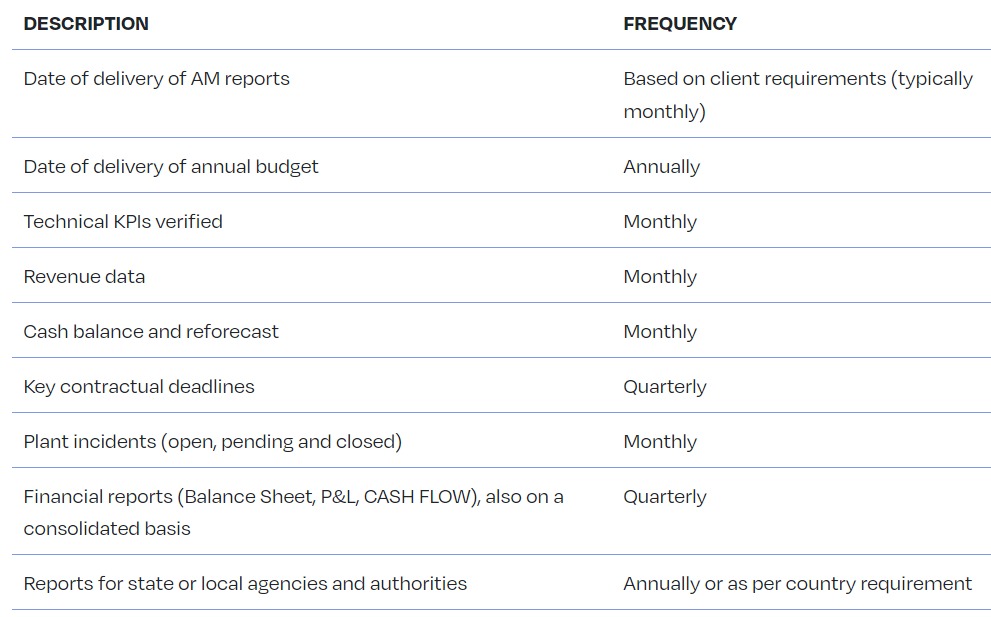
Once identified, these requirements and activities must be calendarised in the Asset Management Platform. Apart from simple calendar entries, the platform should also include escalation features, for example for overdue items, to ensure that important tasks are not neglected. Such escalation should ideally involve multiple team members, depending on their role and position in the hierarchy.
Site construction due diligence
The Asset Manager should perform due diligence on the knowledge and expertise of the EPC contractor. All documentation and certification should be digitalised in the Asset Management Platform’s Documentation Management System (DMS). Re-certifications and training schedules should be calendarised. It is essential that the Asset Manager sources impartial and independent testing, inspection and oversite during the key milestone reviews.
Optimisation of energy production
Power plant KPIs and O&M Contractor KPIs, as defined in chapter 10. Key Performance Indicators of the O&M Best Practice Guidelines, should be calculated automatically by the monitoring platforms and should be integrated in the Asset Management Platform and used as a reference for contract compliance. It is important that these KPI calculations take various contractual clauses (exclusions) into consideration, for example in periods of force majeure events.
Regular updates and software reliability
Asset managers should be involved and interested in further developing the capabilities of the Asset Management Platform they utilise. This can be done through typical feedback mechanisms with the chosen software vendors utilised, but this can also mean using broader parts of the Platform to further digitalise operations as the Asset Manager evolves with functionalities.
The implementation of an Asset Management Platform can often serve as a great opportunity to continuously review internal activities and processes to ensure that Asset Managers are focusing on value added activities rather than data entry.
The Asset Management Platform must be updated continuously and during every update performed, it must be able to continue collecting the technical data from the monitoring systems within which it is integrated.
Asset Managers should also take steps to ensure the reliability and bankability of their software vendors as this may impact data continuity in their operations. See section 10.7. Data Portability, Backup and Disaster Recovery below.
Lifecycle data collection
To ensure investment durability, it is recommended that the Asset Manager is involved in the project from the development and construction phases, collecting and managing all related data at each phase for easy and comprehensive reporting. This task can be streamlined through collaborations, incorporating advanced digital twins and data analysis into the traditional AM structure – something that is increasing in popularity. Moreover, the AM should, as a best practice, utilise data and lessons learnt across project portfolios.
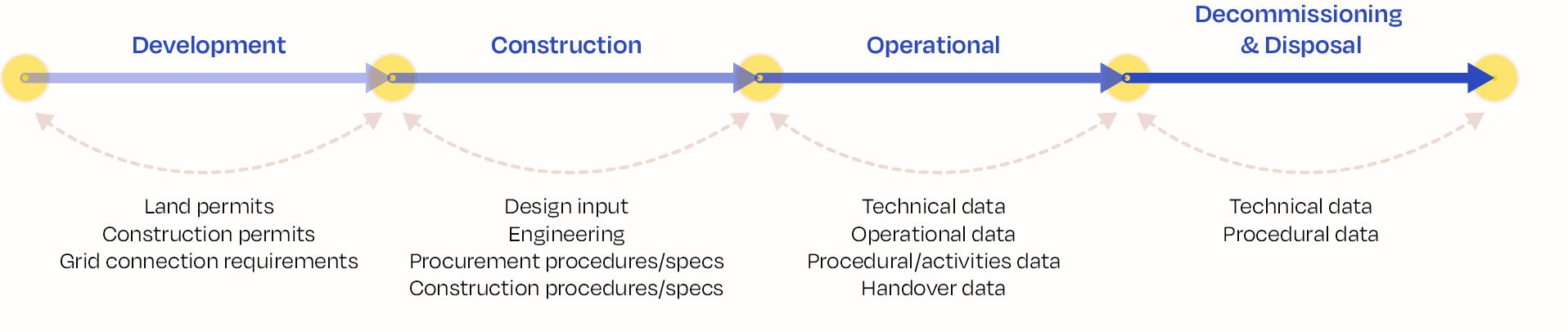
Operational risk management
The Asset Management Platform should collect and monitor relevant data in order to mitigate the major risks which may arise during the life of the assets, in particular:
- Keep track of serial numbers of components replaced to ensure the required communications to relevant authorities have been submitted (to avoid risks related to the authorisations in place)
- Monitor and record all relevant maintenance interventions, including cost data, conducted in order to ensure that the plants are kept in an efficient status. It is becoming more common for Asset Managers to commission annual aerial thermographic inspections to better understand the overall health of an asset.
- Ensure key terms of insurance policies (e.g. deductibles, maximum reimbursable amounts) are consistent with the existing level of risks
- Calculate and monitor relevant covenants (D/E, DSCR, LCCR) related to the financing in place (if any).
Procurement process management
The Asset Management Platform should enable the activities explained in chapter 8. Procurement by collecting relevant data to properly manage the procurement process in relation to key suppliers (i.e. number of plants with similar features to benefit from scale effects, contractual deadlines, warranty termination dates).
Deadlines management
In order to be fully compliant with regulatory requirements, an Asset Management Platform should support the Asset Manager in tracking and keeping under control the relevant deadlines for the required communications and collect the information that needs to be provided (e.g. annual production data requested by municipalities).
Health & Safety records
The Asset Manager must ensure that adequate records are kept in the Asset Management Platform to ensure and demonstrate that relevant H&S standards and requirement are set and maintained. It is expected that a set of metrics will be agreed between parties to allow the reporting of events on site and encourage and judge adherence to standards and incremental improvements to the systems and associated standards.
Incidents records
To manage incidents and dysfunctions, the Asset Manager needs to record and have access to all data related to the solar asset, portfolio or SPV. Such data includes technical, operational, financial and market data.
Types of data collected through the Asset Management Platform
To ensure a full picture of the performance of a project, Asset Managers rely on several sources of data or information. Typical data sources include:
- Monitoring service providers
- Inverter data providers
- Data acquisition solutions
- Meter operators
- Aerial inspection data providers
- Satellite data providers
- Weather forecast data providers
- Energy exchanges
- CMMS solutions
- Exchange rate data providers
- Accounting solutions and ERP systems
For each source, it is important what data the Asset Managers are collecting, at what frequency and when. Beyond this, it is also important to understand the necessity and relevance of collecting and aggregating such data. Data is analysed and collected to enable good decision-making. To do so consistently requires good quality and reliable data. Data reliability can be enhanced through a data cleansing and data quality checking process via external data analysis services, should this not be possible or covered in the O&M scope.
It is important that the Asset Management Platform can generate consolidated reports with much of the data listed below. There are reports, for example technical reports, that are needed on Plant level, but some high-level reports, like financial statements, are needed both on Plant as well as Portfolio level. Here are some key types of data that an Asset Management Platform should have access to:
Technical data
Refers mostly to PV power plant data as referenced in chapter 10. Key Performance Indicators of the O&M Best Practice Guidelines:
- Raw data measurements: data obtained directly from the PV plant and used for performance calculation.
- PV power plant KPIs using the raw data from the PV plant to give a more balanced overview of the operation of the PV plant.
Operational data
Operational data goes beyond the technical data to encompass other relevant interpretations of the technical data as well as activities performed or logged by the O&M contractor:
- Alerts driven or identified by the monitoring systems.
- Decisions made by Technical Asset Managers based on alerts or technical data, including the overall timeliness of such a decision or response.
- “On- or Off-site” actions taken by the O&M contractor, including (a) he overall timeliness of such decision or response (see
- Updated forecasts or performance projections. Its important that the Asset Manager understands and has confidence in the asset Yield and PR calculations.
- Records of maintenance, repairs and updates to the system.
- Compliance with technical permits or agreements (interconnection, water, environmental).
Financial and commercial data
Also, financial and commercial data should be integrated into the Asset Management Platform and be linked to technical and operational data when possible (e.g. costs of a specific maintenance intervention, cost of an insurance claim) and seen holistically should include, at the very least, budgeted and actual figures on:
- Revenue (including any incentive programs)
- Billings, payments & collections
- Expenses (including financing costs, with a focus on planned vs. unplanned expenses)
- Financing information and expectations (debt, equity, etc.)
- Financial statements (balance sheet, profit & loss, and cash flow statements)
- SPV administration (signatories, authorisations, structures, requirements)
- Tax status, filing timings, etc.
- Insurance (status, conditions, claims, etc.)
- Documentation (requirements, key documents, etc.)
- Compliance records
Contractual and regulatory data
Solar projects are usually constrained by several agreements and regulations. Asset Managers need to have all relevant information at their fingertips to be effective and efficient, as they are often responsible for the contractual administration and regulatory compliance of their projects.
Data related to contract management:
- Amendments
- Updates
- Renewals
This goes beyond simple contract administration and management to include:
- Legal compliance
- PPA administration with all that they entail (calculations, frequency, escalators, terms & conditions, etc.)
- Power Generation License
- Building & environmental permits
- Stakeholder engagement requirements
- And any other contractual requirements
Third-party data
Asset Managers not only need to understand and aggregate data that come from their projects and their operations, but also, more and more Asset Managers need to understand how to deal with and manage data and information coming from third parties.
Market data
With more and more solar projects starting to have exposure to market conditions and trading opportunities, electricity market information is becoming increasingly important. This can include nodal prices, spot prices, future prices, price forecasts, etc. Ultimately, the structure of the agreement surrounding the market dispositions of a project will clearly dictate what to monitor, log and watch. This can be grid measurements, rates, schedules, etc.
Weather data
This is often lumped in with technical data through an on-site pyranometer or weather station, but more and more third parties offer reliable data feeds that can be incorporated into an Asset Manager’s overview or simply as a validation point for on-site equipment.
Other data
Additional types of data sources can be accessed. The important point is to understand why these sources matter and the business objective behind them.
Data format
The data format of the recorded data files must respect standards such as IEC 61724 and must be clearly documented. Data loggers should collect all inverter alarms in accordance with the original manufacturer’s format, to ensure all available information is obtained.
To improve data quality, standardisation of data sources would help avoiding any need for manual data processing of normalisation and reformatting before any aggregation. In this way, data exchange – before or after aggregation – between stakeholders will happen with increased transparency and reduced time.
This is especially important for PV plant metadata (e.g. location, number of components, nominal power, electrical drawings, position of components in the field, etc) which is of fundamental importance for the creation of a PV digital twin and for the calculation of metrics needed in decision support systems.
A best practice is that all data are stored in the same database before any processing.
Aggregating data
Data collected from the site shall follow a rigorous normalisation and aggregation process where the most accurate site data model is taken into account. The data model shall be shared between AM and O&M in such a way that the same rules of data processing are applied. As an example, a thorough data cleaning, the process of recognizing and interpreting wrong signals, is the basis for a correct data aggregation in the small scale before aggregating at larger time and object levels. Using the same photovoltaic model including loss computations and performance formula will result in an increased transparency and an easier communication between parties and an in general will allow smoother and cost-effective reporting and communication processes.
Often the information gleaned from any data source is of relevance at the individual asset level; however, it can increase in value across multiple projects. At an aggregate level, looking at trends or precursors, we can see the compounding effect of variances and quantify/identify systematic risks that would not be as visible on a single project. A definitive best practice is the ability to view and interact with different types of data at the portfolio and asset level. Third-party data analysis providers are being increasingly integrated into the traditional Asset Manager/O&M structure for exactly this purpose in the case of larger portfolios with disparate O&M providers.
Often enough different data types will have different taxonomies, definitions and formats. And in a similar fashion they may “live” in different systems. Thereby the best practice of aggregating this information is in a primary Asset Management system.
Interoperability
A central asset management platform should gather together all information available from several digital tools and hardware and provide a centralized working interface accessible to any stakeholder internal and external to the asset management company. The asset manager shall be able to attribute to any user an access with restricted data and functionality visibility depending on the degree of confidentiality and the function of the stakeholder.
This way, the same set of data can be easily accessed from different angles allowing the best efficiency, quality and transparency of information exchange.
A versatile asset management platform shall be able to embrace information coming from any existing and future digital service by supporting all protocols listed in the table below and having a flexible model that could easily interpret a new set of parameters and KPI that could appear to be relevant for the business.
As a best practice, the system should ensure open data accessibility, to enable an easy transition to Asset Management Platforms. The table below shows some examples of data integration options. Due to the lack of unifying standards, this is normally not the case and every Monitoring System provider has their own method to store and retrieve data. Best practice systems have the possibility to retrieve data by using open APIs such as RESTfull, providing interoperability between different systems.
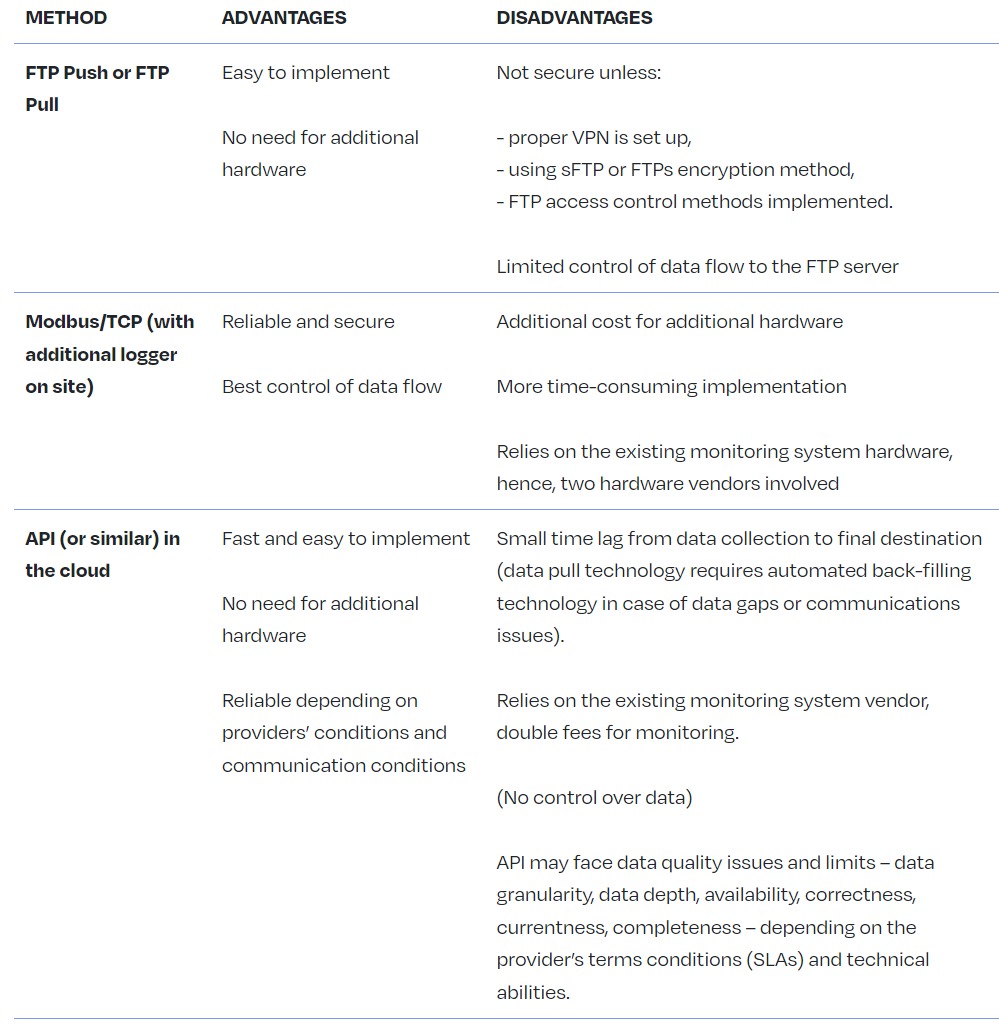
Cybersecurity
In order to enhance cybersecurity, the Asset Manager typically performs also periodic audits on the main suppliers (the O&M contractors in particular) who have access to relevant data and connectivity of the plants. The audit mainly aimed at ensuring that the personnel is properly trained in relation to procedures for data protection (e.g. policies related to passwords, protection of access to relevant devices) and can detect and avoid possible cyber-attacks.
In addition (as clarified in chapter 8. Procurement), as part of the risk mitigation activity, the asset managers support plant owners in identifying and activating insurance policies that also cover the risks of indirect damages (i.e. missed productions) deriving from cyber-attacks. Since such attacks, in some extreme circumstances, can even determine plant outages that may require a long period of time before being solved, an insurance coverage is particularly relevant to avoid the exposure to significant revenues losses.
Ultimately the role of the Asset Manager is often to raise awareness about the importance of cybersecurity as it relates to the management of the plants.
Since PV plants will at least include inverters and power plant controllers (and monitoring systems) and these are expected to be accessible from (i.e. connected to) the internet to enable surveillance and remote instructions by operators, they have significant exposure to cybersecurity risks.
Cybersecurity comprises technologies, processes and controls that are designed to protect systems, networks and data from cyber-attacks. Effective cyber security reduces the risk of cyber-attacks and protects organisations and individuals from the unauthorised exploitation of systems, networks and technologies. [4]
Cybersecurity is a vast area and multiple measures are imaginable. The following hints may help as a starting point:
→ Keep it simple: If possible, the number of network devices should be reduced to a minimum.
→ As a recommendation, traffic of the network devices may be monitored in order to detect abnormally high use of bandwidth.
→ Physical access to the network devices should be secured and a secure password policy should be implemented. The use of standard passwords should be especially avoided, and all factory setting passwords should be changed.
→ Access from the Internet should be controlled via strict firewall rules:
- Port forwarding should not be used because this is a big security gap. Only router ports that are necessary should be opened.
- Remote access should be limited to the necessary use cases.
- The use of VPNs (Virtual Private Networks – a secure connection built up from the inside of the private network) is necessary.
- VPN access to the site from outside is a minimum requirement.
- A VPN server or VPN service which works without requiring a public IP on-site should be preferred.
- Each PV plant should have different passwords.
- Documentation should be kept up to date to be sure that no device was forgotten.
- Different roles should be used to the extent possible (e.g. read only user, administration access).
- Professional (industrial grade) hardware should be used; only such hardware provides the security and administration functions plants need to be secure.
→ Vulnerability management should be implemented (i.e. identifying and remediating or mitigating vulnerabilities, especially in software and firmware) by:
- Improving insecure software configurations.
- Keeping the firmware and software of devices up to date.
- Using anti-virus software if possible and keeping it up to date.
- Avoiding wireless access if it is not necessary.
- Auditing the network with the help of external experts (penetration tests).
→ Keeping companies safe:
- Passwords should not be stored in plain text format, password managers should be used (e.g. 1Password, Keepass etc).
- Employees should be trained on IT security awareness.
- Not all employees should have access to all plants. Only those should have access who need it. This way damage can be prevented in case one employee is hacked.
- Management of leaving and moving employees: in case a plant overseeing employees changes positions or leaves the company, the respective plants’ passwords should be changed.
It is therefore best practice that installations undertake a cyber security analysis, starting from a risk assessment (including analysis at the level of the system architecture) and implement a cybersecurity management system (CSMS) that incorporates a plan-do-check-act cycle. The CSMS should start from a cybersecurity policy, and definition of formal cybersecurity roles and responsibilities, and proceed to map this onto the system architecture in terms of detailed countermeasures applied at identified points (e.g. via analysis of the system in terms of zones and conduits). These detailed countermeasures will include the use of technical countermeasures such as firewalls, encrypted interfaces, authorisation and access controls, and audit/detection tools. But they will also include physical and procedural controls, for example, to restrict access to system components and to maintain awareness of new vulnerabilities affecting the system components.
As minimum requirements, loggers should not be accessible directly from the internet or should at least be protected via a firewall. Secure and restrictive connection to the data server is also important.
The manufacturer of the datalogger and the monitoring platform should provide information on penetration tests for their servers, any command protocol activation channels and security audits for their products. Command functions should be sent using a secure VPN connection to the control device (best practice). Double authentication would be an even more secure option.
For further information, beyond the scope of this document, please look at the EU Cybersecurity Act (EC, 2019) and the European Parliament’s study “Cyber Security Strategy for the Energy Sector” (EP, 2016).
Data portability backup and recovery
The data from the Asset Management Platform, or component systems, should always be legally owned by, and be accessible to, the Asset Owner (SPV). Stakeholders such as the O&M Contractor, the Asset Manager or auditors, during due diligence phases, that need the data to perform their duties should be able to be granted access.
Depending on whether you rely on an in-house built platform or rely on external vendors, these specific considerations should be key requirements that are passed on and included as part of the scope of the Asset Management Platform.
Consideration should be given to how the data contained within the Monitoring Systems, Asset Management Platform, and that is generally collected by the Asset Manager, is protected to ensure the long-term availability in the case of change of provider either through:
- Managed change of Asset Manager, O&M provider or Monitoring System/Asset Management Platform
- Unexpected change of Asset Manager, O&M provider or Platform (e.g. insolvency)
- Transfer of ownership of the SPV.
Key to the above is a full understanding of the data being collected at all levels and having agreements in place to make it accessible and ensure it is continuously backed up.
An important consideration in these matters is to understand what underlying system is the “system of record” for any given type of information as it will inform the backup strategy required for each initial “source” of data. It is recommended that the Asset Management Platform should keep a copy and log of all data saved if other systems feeding information into the Platform encounter problems.
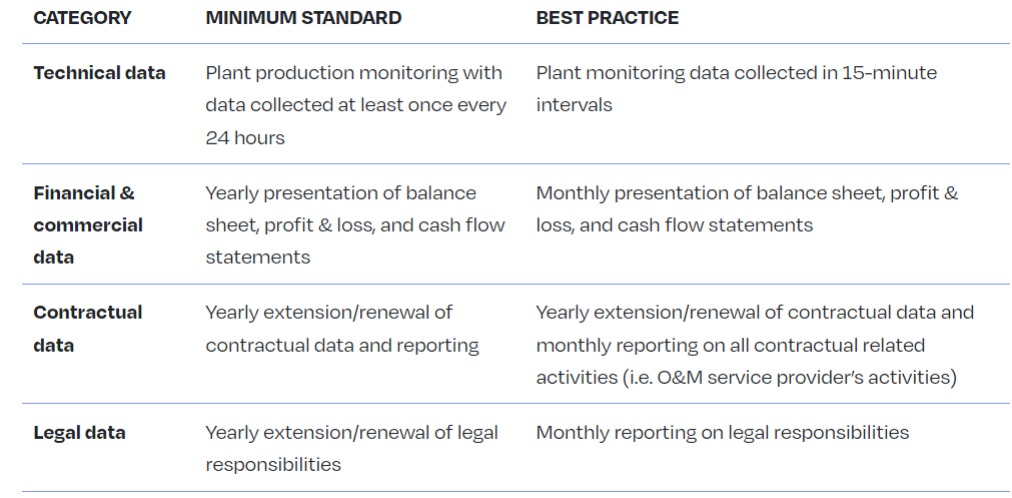
The Asset Manager should endeavour to make sure that all data contained within the Asset Management Platform is correct and up to date, to the extent possible. The Asset Manager’s ability to properly maintain the Platform should be evaluated regularly. It is expected that the Asset Manager’s staff and any other users of the Platform should be appropriately trained in how to use it.
As a best practice, software vendors should be able to offer a variety of failsafe and backup options to Asset Managers. They should have as per the Information Systems Audit and Control Association (ISACA):
- Developed a comprehensive backup plan – How and at what frequency are backups done and what are the possibilities for rollback and data recovery?
- Perform effective backup management – Are they hosting their own servers or relying on cloud service providers?
- Perform periodic databases restore testing – Have they performed restores of their backups?
- Have backup and recovery Service Level Agreements (SLAs) drafted and communicated to all stakeholders – What are the severity levels, what are the guarantees, what are their remedies? What business interruption clauses exist?
- Have the disaster recovery plan (DRP) database portion drafted and documented. Has this all been documented by the vendor?
Asset Managers, as customers of these software companies, can further increase their security by asking for:
- Specific SLAs that refer to their own backup strategy
- Dedicated instances of the application
- Code Escrow agreements to secure against bankruptcy.
Ultimately, data portability, security and recovery are everyone’s prerogatives and should be discussed with all technology providers.
They should also test the ease of data export/API connectors of their software vendors for more commercial reasons.
Handover of data and documents
For detailed information on the handover of data and documents, please refer to chapter 5. Handover of solar assets.
Key Performance Indicators
The baseline of the Asset Manager’s work is confidence. The Asset Owner trusts the Asset Manager to manage their asset, assuring the best operational performance and financial optimisation. For that, the Asset Manager should outline effective, rigorous and well-defined processes and procedures according to each geography’s needs. This will ensure that the Asset Manager complies with the best guidelines and working practices for daily customer-oriented work.
Close monitoring of Asset Management procedures is required to ensure the effectiveness and efficiency of AM service provision. This can be achieved through the definition of clear and objective KPIs which need to be continuously assessed.
The benefit of using solid and high-standard KPIs to assess performance is assuring the quality and stability of the Asset Manager work. This enables the Asset Manager to monitor their work and learn through experience in order to evolve continuously, which translates into providing a high-quality service for the Asset Owner.
The following sections present the most important KPIs to measure the performance of Asset Managers. (Note that the KPIs used by the Asset Manager to evaluate suppliers are presented in chapter 8. Procurement).
Asset Manager experience
The Asset Manager’s track record and experience can be very important to enable the identification of critical subjects or situations lacking intervention – which translates into work efficiency, based on organising and prioritising the most urgent subjects. Additionally, the return of experience has an important role in the creation and/or redefinition of Asset Management procedures. The Asset Manager’s experience can be quantified by indicators such as the number of tender processes managed, OPEX reduction achieved and historical KPI of the key suppliers.
Quality of service based on periodic Asset Owner surveys
It is important to obtain Asset Owner’s feedback to understand if the Asset Manager’s work is aligned with the Asset Owner’s needs. This can be achieved through the elaboration of periodic surveys. This helps the Asset Manager to identify critical areas of the Asset Management’s process and to define different operating strategies, in accordance with market trends or technological innovations, to be more effective.
Reports Compliance Rate (RCR)
This KPI is intended to measure the capability of delivering the periodic reports to the Asset Owner on time. Periodic reporting is the most important responsibility of the Asset Manager’s work, because it is the most comprehensive way to deliver the operational and financial position of the PV Plant or Portfolio to the Asset Owner on time.
Therefore, it is imperative to monitor this indicator closely and continuously.
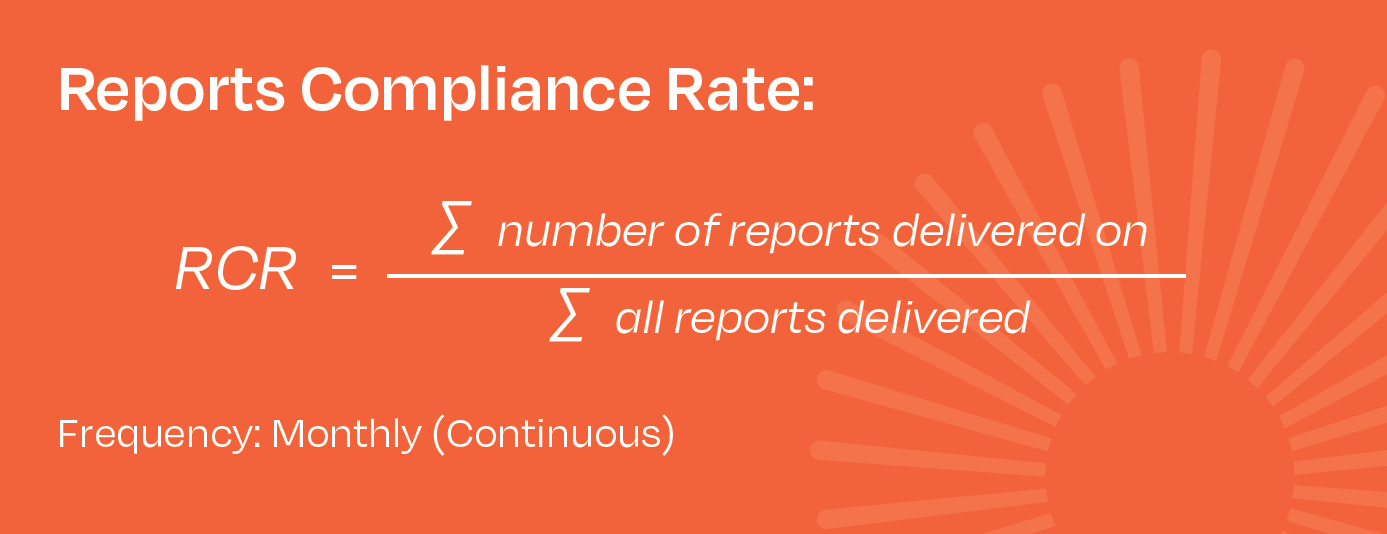
Invoicing Compliance Rate (ICR)
This KPI is intended to measure the capability of issuing the invoices to the Asset Owner on time.
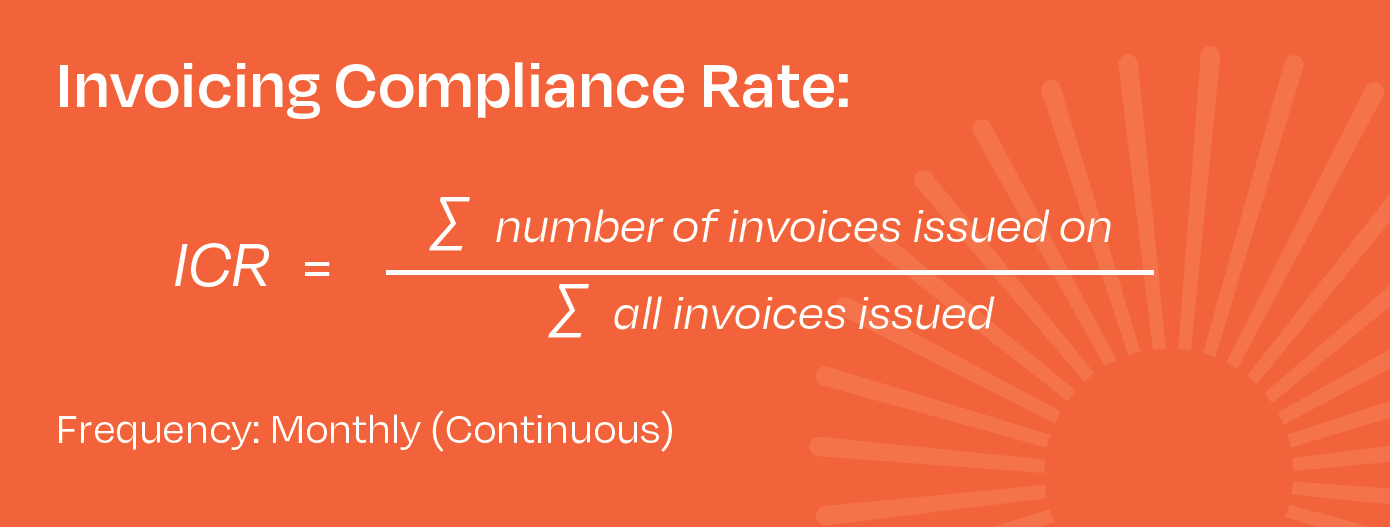
Contracts Optimisation Rate (COR)
This indicator is relevant to assess the Asset Management work of optimising the asset’s cost structure and quality of service. COR KPI measures contracts’ optimisations.
However, this indicator should be analysed carefully depending on the assumptions considered by the Asset Manager. This means that it is necessary to understand the computation of this indicator in order to make assertive/valid conclusions.
There are contracts that cannot be renegotiated by the Asset Manager either because they are locked by project finance requirements or they are initially negotiated for long periods based on an annual fixed fee and indexed to annual CPI. Usually, these contracts represent about 70 – 80% of the OPEX costs – predicted in the KPI’s denominator. For example, Land Lease, Asset Management and O&M.
Although the number of renegotiable contracts has a residual weight in the OPEX structure, they should be reviewed annually to achieve global contract optimisation.
Nevertheless, from the Asset Owner’s perspective, the most important thing is to achieve a COR > 0%, meaning that the Asset Manager was able to optimise one or more contracts (which is always positive) no matter how small the saving(s) was (were).
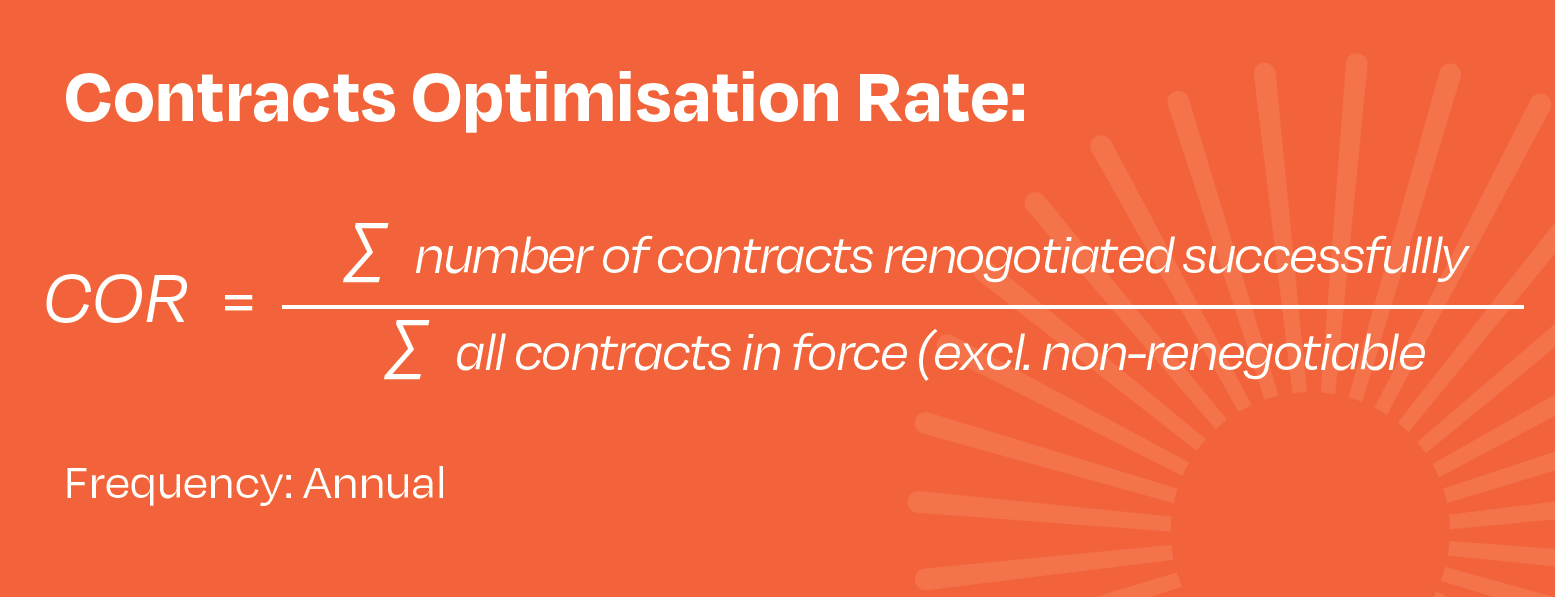
Requests Treated (RT)
RT indicator is intended to assess the Asset Manager’s efficiency during a specific period.
This KPI is to assess Asset Manager performance level, based on the number of replied requests. Additionally, it allows the Asset Manager to identify which requests were not followed-up.
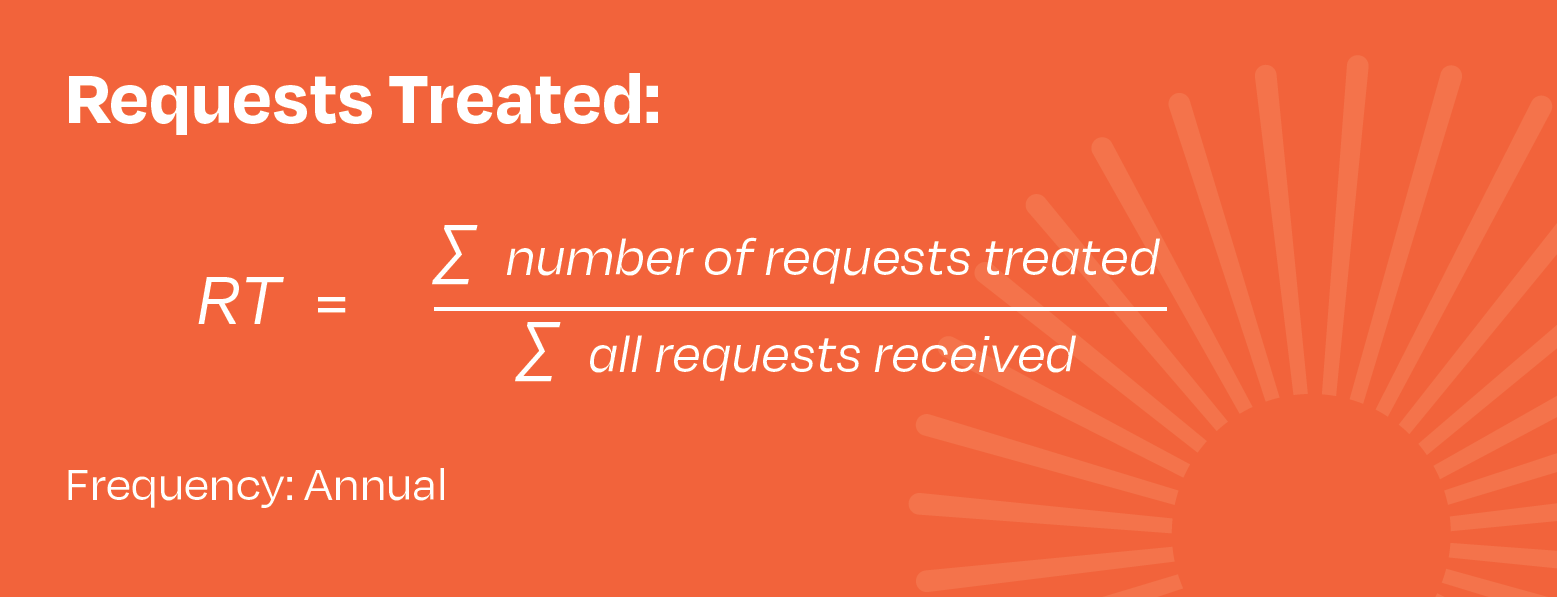
Timely Response Rate (TRR)
Response Time is useful to monitor the compliance of contractual deadlines. As mentioned above, periodic reporting is one of the most important deliverables under the scope of the AM contract.
This indicator is useful to identify weaknesses and strengths in the Asset Management procedures.
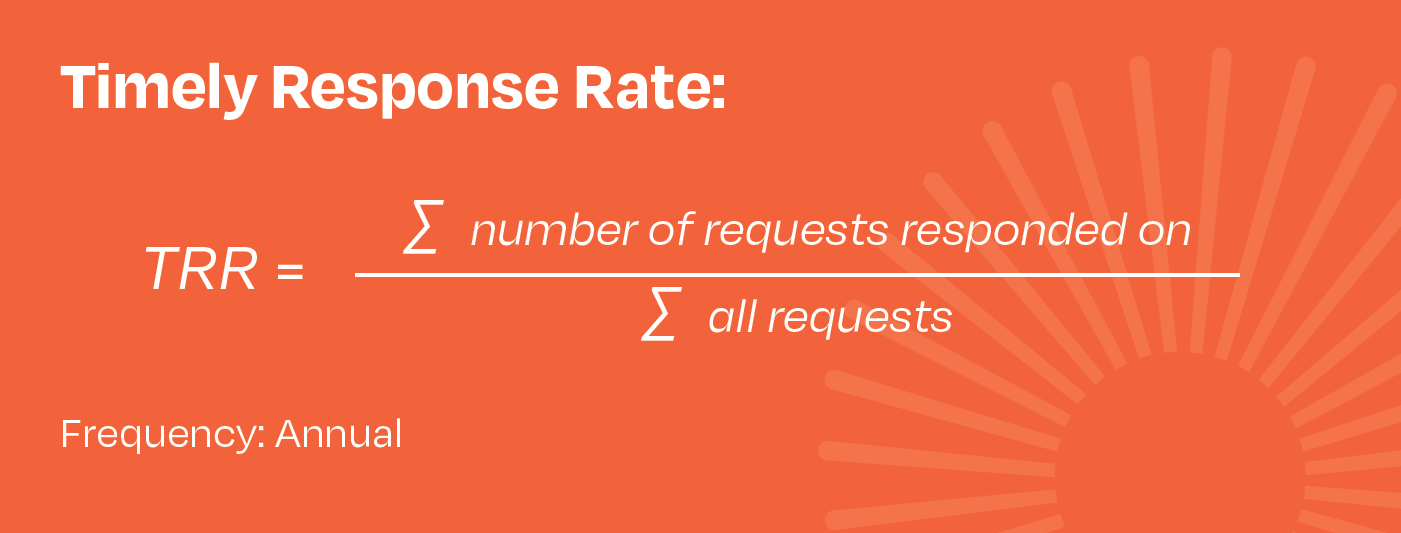
Quality of the tender process
The quality of the tender process is a KPI related to the procurement capabilities of the Asset Manager, which is reflected in the clarity and comprehensiveness of the requests of proposals, as well as in the number of potential suppliers invited to the organisation of the data-room/Q&A process with the potential buyers.
O&M contractor compliance
The extent to which O&M Contractors managed by the Asset Manager comply with their contractual obligations is also a KPI that measures AM service quality.
Fundamentals of Lifecycle Project Management
Effective Lifecycle Project Management (LPM) ensures that all the necessary actions throughout the development, EPC, O&M, and decommissioning/disposal phases are performed. Therefore, LPM has two different focuses: on the one hand, it has to ensure the timely and cost-effective progress of the project through each of the lifecycle phases; on the other hand, it has to ensure that this progress is not impeded by avoidable problems that could affect the profitability of the project.
While there are other definitions for risk and risk management, in these guidelines we see Risk Management (RM) as the overarching management system which ensures that project progress, throughout its lifecycle, is timely and cost-effective, with a reasonable trade-off between risk and cost. To achieve this, RM includes the following areas:
- Risk Analysis
- Health, Safety, Security & Environment (HSSE)
- Due Diligence
- Quality Management
The four areas can each be divided into four sub-areas, explained below.

Risk Analysis
RM starts with the Risk Analysis (RA), for which we define the following steps:
- Risk Identification (RI)
- Risk Assessment (RAss)
- Risk Prevention & Mitigation (RP)
- Risk Plan Communication & Implementation (RC)
a) Risk Identification
RI is the beginning of RM. As a minimum, it is important to identify and define all major risks with a significant chance of occurrence. If this does not happen or happens too late, the whole project could be jeopardised.
b) Risk Assessment
Once a risk is identified, an assessment must take place to determine how likely it is to occur, what the impact would be, and estimate the costs of eliminating or reducing the risk.
c) Risk Prevention & Mitigation
Once the RAss has been conducted a decision must be made on the best way to prevent (by establishing barriers) or mitigate the risk and/or its consequences.
d) Risk Plan Communication & Implementation
Once a decision has been made on how to prevent or mitigate the risk, a plan on how to do so must be communicated.
Health, Safety, Security and Environment (HSSE)
HSSE are priorities throughout an asset’s lifecycle. There are legal requirements in most countries, and internationally accepted standards, such as the IFC Performance Standards and the Equator Principles, to ensure that solar projects do not negatively impact the environment and guarantee a healthy and safe workplace. Furthermore, international financial institutions also use HSSE, and social requirements when assessing projects. Security is often a requirement in insurance policies, otherwise claims can be void.
Good HSSE coordination is fundamental to achieving all HSSE objectives, which can be summarised as follows:
- Establish an HSSE culture within the organisation and the relevant project team
- Establish, implement, and maintain an effective integrated HSSE management system
- Ensure compliance with applicable health, safety, and environmental legislation, codes, and standards and, whenever possible, with higher standards and best practices
- Ensure surveillance of the project site, especially of high-value products, as well as components which are difficult to replace quickly
- Ensure that intrinsically safe design is achieved by monitoring progress and preparation of results and systematically reviewing the design process, if necessary
- Manage risks in the design, procurement, construction, installation, commissioning, operation, and maintenance activities
- Ensure appropriate levels of skills for all staff engaged in carrying out critical HSSE activities and provide training where necessary
- Check for any potential HSSE impacts in the project area and ensure that these are minimised
- Make sure that the site surveillance is in line with the insurance requirements
- Ensure that a complete inventory of all waste and discharges is maintained and that all waste is disposed of in an environmentally acceptable way, in compliance with the relevant regulations
- Review lessons learned, performance and any opportunities to continuously improve, to update safe design.
For this purpose, it is important that Asset Owner, the EPC, and other service providers meet to align on procedures to follow to avoid risks, especially when different service providers are working on the site simultaneously.
Due Diligence
Over the lifetime of a project, the asset, and its operating company – typically a special purpose vehicle (SPV) – move through a number of defined stages.
These stages are typically marked by changes in contractual liability and obligation, and the transitions or ‘stage-gates’ between phases are usually accompanied by contractual documentation. This could be in the form of a new contract starting with a different service provider, or third-party certification, with supporting documents, as defined in an ongoing contract.
A very important step of each due diligence assessment is the collection of the relevant documentation. An advisor should have comprehensive documentation check lists and conduct a “gap analysis” in the data-room. Within this context, the role of the Asset Manager (AM) is also very important as they can ensure that a structured data-room is properly built at all stages of a project.
The Due Diligence (DD) process can be divides into four sub-areas:
- Legal DD
- Technical DD
- Financial DD
- Political DD
Financial DD consists of the Insurance DD, Accounting DD, and Taxation DD.
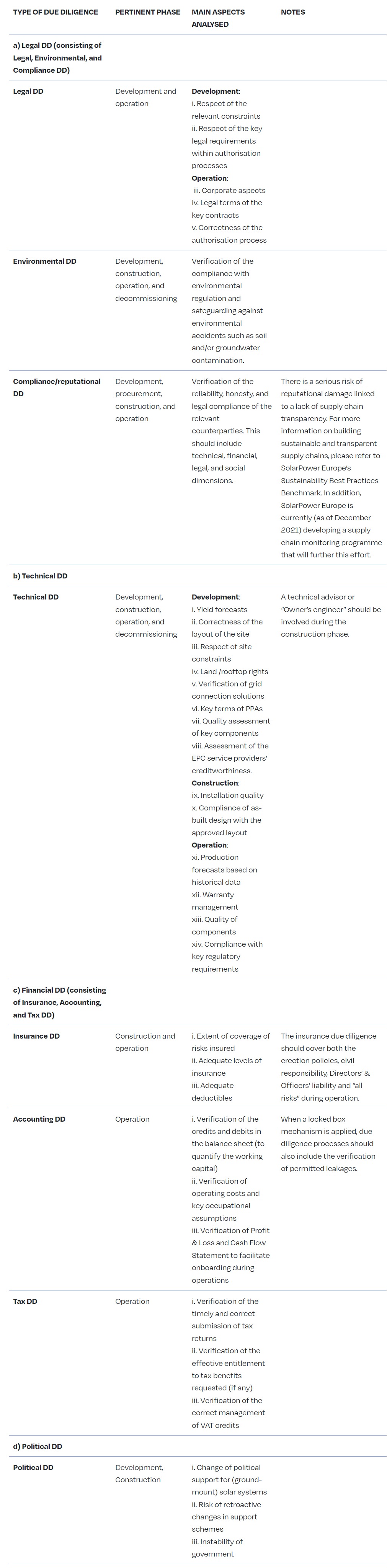
Challenges and opportunities in due diligence processes
An effective due diligence process requires a structured methodology to assess key elements of risks and communicate the related outcomes to decision-makers, in a timely manner. This can result in changes to the structure of a project or the way that investments are monitored.
Relying on a weak methodology, unqualified or inexperienced assessors, or a poorly defined project plan to conduct due diligence, results in a cumbersome and ineffective process that does not produce the key information needed for effective decision-making.
There are numerous challenges in the due diligence process:
- The scope of work may not be well-defined, leaving key questions unanswered
- Information requested may be poorly communicated, leading to more time spent gathering new or different data
- Transaction responsibilities and timelines may not be well-understood; critical matters uncovered during due diligence may not be communicated to the appropriate counterparty.
At the same time, there are many benefits to conducting effective due diligence as it can help stakeholders:
- Objectively understand the assets and their underlying historical performance, including deviations from historical and recent trends
- Identify key risks faced by the lender/investors and establish a communication framework to address these risks, including potential mitigation efforts. This could also result in deal-structuring alternatives such as pricing considerations, collateral requirements, or enhancements to required periodic reporting
- Develop an understanding of critical policies and procedures used to prepare information used for decision-making and identify potential areas of information weakness.
Market confidence relies on and will improve with more effective and frequent due diligence. Increasing the cost-competitiveness of solar PV in the future will rely heavily on quality due diligence services can help avoid asset underperformance, or non-performance.
Quality Management
Quality – if not set by clear criteria and measurements – is a perceptual, conditional, and somewhat subjective attribute and may be understood differently by different people. In general, it can be defined as a commitment to customers in the market or as fitness for intended use, in other words, how well the product performs its intended function. Quality also encompasses the reduction of harm that a product may cause to the environment or human society.
Quality management is key in all phases of LPM, from development to decommissioning. When done robustly, it ensures that a PV power plant works at its maximum efficiency for longer, lowering the levelized cost of electricity (LCOE) and making PPAs cheaper and more competitive. This is crucial to maintaining the growth of solar PV and attracting the necessary commitments and investments to support this. Taking a strong approach to QM will enable the industry to move on from past mistakes and confidently deliver solar plants as part of Europe’s critical energy infrastructure.
Key to effective QM is a strong Quality Management System (QMS). Like QM, a QMS must always be present in LPM, from site selection to the end-of-Life phase and actions should always be flanked by good documentation. A sound QMS can form an important prerequisite for accessing project financing from banks and investors as it minimises the risks of a project. To further boost access to project finance, it is also important to ensure the power plants conform, and are certified to, international standards throughout their lifecycle. There a several international certification schemes and conformity assessment systems available for this. For more information see the Risk management in the operational phase chapter of the Asset Management Best Practice Guidelines and the Risk management in the EPC phase of the EPC Best Practice Guidelines (available at www.solarbestpractices.com).
The four pillars of the QMS as defined in these guidelines are:
- Quality Review (QR)
- Quality Control & Assurance (QC)
- Quality Planning (QP)
- Quality Improvement (QI)
Quality Review
QR consists of a Quality Audit (QAu) and Quality Monitoring (QMo) of component and equipment suppliers. As a recommendation, this pillar should be supported by third-party audit/test firms. The QAu shall take place before a contract is signed. It should ensure that a supplier is capable of delivering on the terms of a contract. The QMo takes place once a contract has been signed and provides an ongoing review of a supplier’s quality management processes. This might be in the form of pre-shipment testing, the commissioning (of parts) of the power plant, or the analysis of the plant performance. The QMo is necessary because an EPC service provider is not in control of a supplier’s quality management processes. It is limited to reviewing the quality performance of the supplier and rejecting or accepting their components based on whether they conform to quality standards within the contract between the two parties.
Quality Control & Assurance
Another pillar of the QSM is the Quality Control & Assurance (QC). This applies more to suppliers as they need sound QC to avoid financial losses from rejections, or claims, and to fulfill their duties towards banks and insurers. It must be ensured that all standards and agreed criteria in a contract are met.
Quality Planning
While QI starts with the supplier selection process, QP will have already started before. While QI is designed to help a supplier improve their processes, QP is designed to help select the right component type. For example, it might be possible to improve the service promise from the supplier for central inverters in remote areas during the QI process. However, it might be a better decision, to design the project with string inverters, as they can be easily replaced with locally stored spare inverters. This shows that an optimised design is of utmost importance. QP begins with site selection, since they can impose significant limitations on project designers’ choices, either through natural or regulatory environments.
Quality Improvement
Using the QAu and drawing on their own experience can help service providers identify possible problems. These issues need to be addressed and actions must be agreed with the supplier, such as implementing better processes, and giving improved (narrower, clearer, more detailed) specifications. This is another pillar of the QSM, QI. This pillar has large cost saving potential, as it helps avoid quality issues.

Lifecycle lessons learnt and feedback loop
Projects that have reached the operational stages of the lifecycle represent a significant learning opportunity from a technical, contractual, and financial perspective.
The experience and available operational data available can help stakeholders improve their services in two ways:
- Providing realistic, tested, and proven assumptions (both from a technical-operational perspective and from a financial-commercial one)
- Identifying areas of improvement that have created a positive impact on the overall return on investment and plant performance.
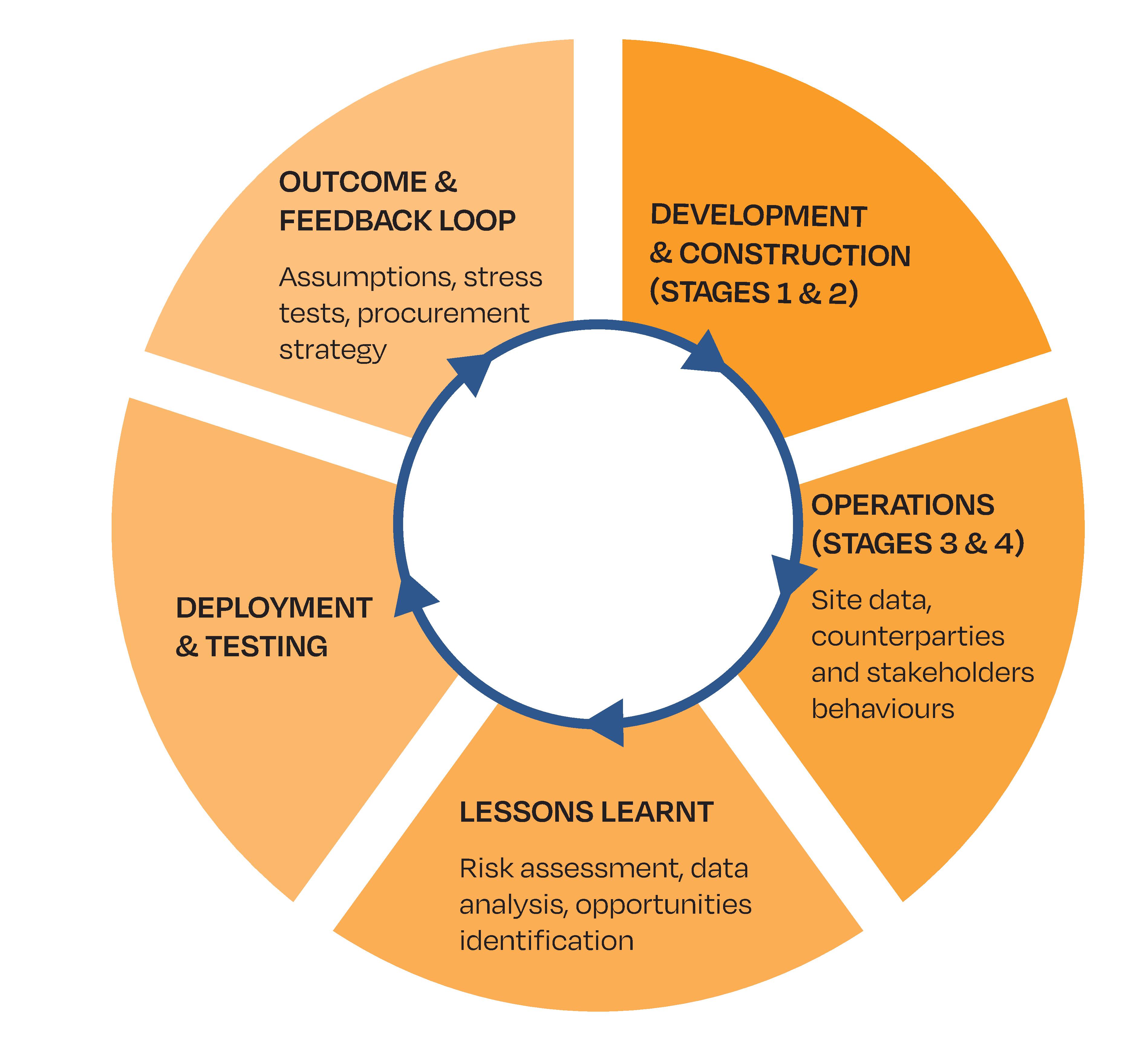
Carrying out lessons learned from the operational phases is a key tool in identifying ways of improving the efficiency of PV plants. More specifically the feedback loop has proven effective in identifying added value opportunities such as:
- Repeating the yield assessment based on reliable site data, aimed at improving the overall production expectations
- Fine tuning the contracting strategy (simplification of complex or redundant processes set forth in complex contracts, for instance the final acceptable processes)
- Re-defining the scope of work of the main service providers, rebalancing pricing, and risk allocation between stakeholders
- Strengthen the criteria for the selection of key component suppliers and manufacturers
- Increasing the sophistication and appropriateness of the spare parts strategy on a site- and portfolio-basis.
To take full advantage of the knowledge created by the operational phases of the lifecycle, a data driven, and analytical approach must be used from the very early stages of operation of the PV plants. This data is vital to establishing and carrying out a meaningful risk assessment and overall review of the PV plant as an investment. This risk driven approach is the foundation of stable operations and reduces the overall volatility of investments in PV plants.
Stage-Gates and Due Diligence
Introduction: discontinuity points across the lifecycle of solar assets
In the lifecycle of a PV plant, there are specific events that represent discontinuity points. They should be handled carefully to keep risks under control, ensure that the appropriate stakeholders and skillsets are involved, and avoid “gaps” in the transition phase.
In particular, the most relevant discontinuity events can be summarised as follows:
→ Change of phase of a project:
- Development, engineering, procurement
- Construction
- Operation under EPC warranty
- Operation under ownership
- Decommissioning & disposal
→ Change of ownership between Asset Owners
→ Change of financing structure, such as closing new financing or refinancing
The fundamentals of LPM are described in the previous section of these Guidelines. The present chapter focuses on the relevance of due diligence to ensuring continuity as a project transitions through the phases of its lifecycle.
Change of phase
When transitioning between project phases, it is crucial to conduct appropriate assessments to ensure the quality of a project, identify potential issues that could impact a project in the medium- and long-term, and ensure that the forecasted financial returns can be achieved.
A thorough assessment of solar assets typically requires a multi-disciplinary and holistic approach. The relevant assessments can be conducted by in-house teams if the right expertise is available. However, using an external advisor is recommended (especially for technical and legal due diligence assessments) to ensure a fully impartial view. In addition, an external advisor can provide a wealth of benchmarking experience from other projects or assets they have analysed. Information obtained via objective and independent due diligence is a critical component of the investment and lending process, and such efforts directly affect the confidence that key parties, in particular service providers, lenders, and investors, have in the solar markets.
Depending on the size of the PV portfolio involved, the standardisation level of some contracts (e.g., insurance policies) and the geographical focus, some due diligence tasks can be skipped.
The results of the various assessments provide the rate and reliability in terms of performances for the lifetime of a PV plant.
Development, engineering, procurement
This phase covers all the tasks undertaken to get the project ‘shovel-ready’ or ‘ready to build’. Usually, this is focused on the technical and financial development of the project, with a series of transactional milestones, such as investment committee approval, execution of EPC contracts and financial close.
It is important to assess the quality of the developed project to reach a final decision to build the project and sign the relevant contracts. In particular, the following aspects need to be analysed and it is recommended that they are properly investigated with legal and technical due diligence:
- Yield estimates
To estimate the energy yield potential of a PV plant, technical advisers typically use simulation software based on models that use the best available data and methods. The result of the modelling is the P50 estimate, or in other words, the “best estimate”. P50 is essentially a statistical level of confidence suggesting that the predicted solar resource/energy yield may be exceeded with 50% probability. P50 level of confidence may represent too high a risk for some investors. Therefore, other probabilities such as P90 (estimate exceeded with 90% probability) or P75 (estimate exceeded 75% of the time) might be considered. Lenders and investors might use P90 estimates in uncertain, or high-risk profile projects to be confident that sufficient energy is generated to comfortably repay the debt.
- Land rights
Ideally, the site on which the project is located should be free of obstacles. If these do exist, they must be considered during the design phase and the relevant consents or permits for the works must be obtained then (if required). If the site is affected by restrictive covenants which preclude solar PV (limitation to solely agricultural use can sometimes affect rural properties), then a release needs to be negotiated with the beneficiary of the covenant. Alternatively, defective title insurance can be put in place. This must be at a level which would fully compensate the project company for wasted capital costs, and loss of future income, arising from the project being decommissioned earlier than anticipated. Lenders will also want to see that insurance is in place where a site is affected by rights to run service media in unidentified locations, or where mineral rights are excepted from the title.
- Consistency of the authorisation process:
- Planning permission in respect of the PV plant which is clear from the risk of judicial review
- Planning permission for cable route works which is clear from the risk of judicial review
- All relevant conditions imposed on the permissions (in particular those required to be discharged prior to commencing works on site) to have been discharged
- Quality of the layout
A review of conceptual design is required in relation to the selected components, as well as infrastructures to ensure the plant design is in line with market standard and respect relevant constraints / prescription of the relevant permits
- Verification of the key terms of the PPAs: including, when applicable, the creditworthiness of the counterparty
- Connection to the grid: In most cases, solar PV projects require the right to connect to the grid. Therefore, a key part of the property due diligence is to check that both the site and project company have the rights to lay a cable to the point of connection to the grid.
Construction and operation under EPC warranty
If technical problems are not detected early during the construction of the plant, or at least within the two-year acceptance period, they can affect future performance and long-term operation. An Asset Owner/project developer will need the professional view of a technical advisor to check the overall quality of the plant. This will include a detailed review of components used on site, future yield estimations and site visits during and after construction. From the Owner’s perspective, it is crucial for the technical advisor to identify any major issues prior to the acceptance period commencing, or at the latest, before the acceptance period is complete. Some crucial steps in the operation of the plants are the acceptance. The role of technical advisor becomes crucial during the PAC and FAC tests (whose recommended protocol has been described under Chapter 9 of the EPC guidelines).
Operation under ownership
In addition to periodic technical verifications, other important areas of evaluation for plants in operation are accounting and tax matters. It is the responsibility of SPV directors to verify all relevant documentation, especially when dedicated tax benefits have been obtained, to ensure legal compliance and avoid significant penalties. It is best practice to include a third-party auditor in this process to ensure transparency.
Effective tax and accounting due diligence may also reveal key indicators of potentially fraudulent activity. These can range from unusual transactions, discrepancies in accounting records, activities/transactions outside the normal course of business, and changes in important credit and underwriting policies and procedures.
Decommissioning
During the decommissioning phase, the role of technical advisor is to confirm that the components of the plant have been dismissed/recycled according to the relevant regulatory framework and that the land/roof has been restored to its original conditions. This work is particularly relevant for local authorities, landlords, and building owners.
Change of ownership
If ownership a PV plant or portfolio changes hands, it is very important for the potential buyer to collect the relevant information and to learn as much as possible about the “history” of a plant and the SPV. In addition, due diligence may also benefit the seller as a rigorous assessment and examination may reveal market value that is higher than expected. Hence why it is not uncommon to also have a “vendor due diligence”, commissioned by the Seller prior to starting a selling process.
Financing or refinancing
The introduction of debt financing within a project’s capital structure or refinancing at any phase of the lifecycle of a PV plant, typically requires detailed verification. To satisfy lenders’ requirements for approving initial or further financing, all aspects of the project must be aligned and quality assured. Ensuring sufficient protection of an investor’s capital requires a fully functioning, and revenue-generating project, with all the required permits.
Accordingly, a solar project finance transaction is not a mere negotiation of financial structuring but also involves an analysis of real property rights, construction and development contracts, equipment warranties, power purchase and interconnection agreements, PV power plant performance, cash management, environmental permitting, energy regulatory matters, and, of course, tax analysis.
The key rule for project finance is risk mitigation: the transaction structure must allocate risks that could affect the project’s cash flow to a creditworthy party, with the ability to mitigate them . Much of the tension in negotiating solar project financing derives from each participant’s efforts to properly identify risks and shift them to others while retaining the benefits from the transaction. For example, the project sponsor usually seeks to shift technology risks to the equipment manufacturer and EPC service provider, while preserving as much of the cash flow and appreciation in project value as possible for itself. The lender will usually seek to shift risk to the Owner by taking paramount positions in the project revenues and assets. They will also seek to guarantee the loan repayment schedule by placing contractual obligations and risks related to warranties onto third parties, such as equipment manufacturers and EPC service providers.
Risk shifting can be done through various legal procedures, including (i) grants of liens on the project assets, revenues, and key project agreements; (ii) warranties and contractual requirements for the equipment and for the maintenance services performed; (iii) requirements for various types of insurance products to cover certain adverse events; (iv) and guaranties of each participant’s obligations from creditworthy entities. During a project financing transaction, the relevant advisor focuses on the calculation of risk magnitude, and the negotiation of risk-shifting devices. This normally results in substantial and complex documentation that must be effectively stored and closely evaluated.
[1] Although irradiance and irradiation are often used as synonyms, they do not express the same physical quantities and should not be used interchangeably (see IEC 61724-1:2017):
• Irradiance is the power of the sunlight at a specific moment per unit of area, usually expressed in Watt per square meter (W/m2).
• Irradiation is the power of the sunlight integrated over a period of time (e.g., an hour, a day or a year). In other words, irradiation is the energy per unit of area, calculated as the sum of irradiances over a period of time. It is commonly expressed in kilowatt-hour per square meter (kWh/m2).
[2] The temperature-corrected PR calculation is not consistently applied. Therefore, this note clarifies in brief the best practice for calculating PR using the formulas provided above. There are 2 methods to apply the formula:
• In the time-weighted method, PR is weighted over a period by the time interval. An example would be if the SCADA system provides data in 1 min / 5min / 10 min average values. PR is then calculated for that 1 min / 5min / 10 min period and the resulting PR values are then averaged. This method will generally yield higher PR values in the morning, while production is low and lower PR values mid-day, but with high energy production. Therefore, low PR value are given the same with as the high PR values and the use of an average value of the PR does not take into account the different weight that PR may have over the day. This can artificially increase the PR by up to a couple of percentage points.
• In the irradiance-weighted method, irradiance as a sum counts higher irradiance values as more impactful on the total PR for any given period. This eliminates the weighting effect and provides a more accurate PR. Therefore, all relevant measured parameters should be summed above and below the line over the calculation period before any division and calculation of PR is performed.
[3] The Tdown represents the whole downtime, before the exclusions are applied. Therefore, Texcluded is a part of Tdown in the diagram. In practice you often first see that a plant is down (= measurement of Tdown) and only in the course of troubleshooting one gets the information whether you can exclude part of the downtime.
[4] Definition: https://www.itgovernance.co.uk/what-is-cybersecurity.
12.2. Health and safety
Risk assessment and managing contractors
Health, Safety, Security, and Environment
The Asset Owner has ultimate legal and moral responsibility for ensuring the health and safety of people in and around the solar plant, the security of the site, and the protection of the surrounding environment. The practical implementation is normally subcontracted to the O&M service provider. In some cases, the Asset Manager can provide or prescribe the systems, which are then implemented by the O&M service provider. This chapter will investigate specific areas of Health, Safety, Security, and Environmental (HSSE) policy and coordination that relate to O&M service providers. For a general overview of the fundamentals of HSSE coordination, please refer to SolarPower Europe’s Lifecycle Quality Guidelines V 1.0.
Healthy, Safety and Security
Managing the risks that solar plants pose to the health and safety (H&S) of people, both in and around the plant, is a primary concern of all stakeholders. Solar plants are electricity generating power stations and pose significant hazards which can result in permanent injury or death. Risks can be mitigated through proper hazard identification, careful planning of works, briefing of procedures to be followed, and regular and well documented inspection and maintenance (see also 5.8. Power plant security).
The dangers of electricity are well known and can be effectively managed through properly controlled access and supervision by the O&M service provider. Any person accessing a solar PV power plant should expect some form of introduction to ensure they are briefed on any hazards and risks. Staff working on electrical equipment must be appropriately trained, have sufficient experience, and be supervised. It is also key that others working around the equipment - for example panel cleaners - are equally aware of the potential risks and have safe methods of working around HV and LV electricity.
Hazardous areas and equipment should carry appropriate markings to warn personnel of possible hazards and wiring sequence. Such markings should be clear and evident to all personnel and third parties (and intruders) entering the plant premises.
As well as the inherent dangers of a typical solar plant, every site will have its own set of individual hazards which must be considered when working on the plant. An up-to-date plan of hazards is important for the O&M service provider to manage their own staff and provide third party contractors with adequate information. It is usually the case that the O&M service provider holds the authority and responsibility for reviewing and, where necessary, rejecting works taking place in the plant. Failure to carry this out properly has important consequences for general safety.
Besides workers on the solar plant, it is not unusual for other parties to require access to it. This may be the Asset Owner, or their representative, the landowner, or, in some situations, members of the public. It is important that the plant access control and security system keeps people away from areas of danger and that they are appropriately supervised and inducted as necessary.
The Asset Owner is ultimately responsible for compliance with H&S regulations within the site/plant. The Asset Owner must make sure that the installation and all equipment meet the relevant legislations of the country and, that all contractors, workers, and visitors respect the H&S Legislation by strictly following the established procedures, including the use of established personal protective equipment (PPE).
At the same time, the O&M service provider should prepare and operate their own safety management systems, previously agreed with the Asset Owner, that take into account site rules relating to H&S and the potential hazards involved in the works. The O&M service provider should ensure that they, and all subcontractors, comply with H&S legislation.
The Asset Owner will expect the O&M service provider to assume the role and duties of the principal contractor under the relevant national regulations governing H&S. This involves the O&M service provider proving that they are competent and are able to allocate enough resources to fulfil these duties.
Before starting any activity on-site, the Asset Owner will deliver a risk assessment and method statements to the O&M service provider who will provide a complete list of personnel training certifications and appoint a H&S coordinator. During the whole duration of the contract the O&M service provider will keep the H&S file of each site up to date.
The O&M service provider must have their personnel trained in full compliance with respective national legal and professional requirements. This generally includes obtaining certification necessary for working in a variety of environments, such as MV and/or HV electrical plants. Within Europe, referral to European Standards is not sufficient (examples of standards used today are ISO 14001, OHSAS 18001 etc).
To achieve a safe working environment, all work must be planned in advance. Normally written plans are required.
Risk assessments which detail all the hazards present and the steps to be taken to mitigate them need to be produced.
The following dangers are likely to exist on most solar plants and must be considered when listing hazards and identifying risks. The severity of any injuries caused are exacerbated by the terrain on which solar plants are built and their remoteness.
- Medical problems
- Slips, trips, and falls
- Collisions
- Strains and sprains
- Electrocution
- Fire
- Mud and water
- Mechanical injury
- Weather
- Wildlife and livestock
Everyone entering a solar farm, for whatever reason, should have been trained in the dangers present on solar farms and be trained for the individual task that they will be performed. They should have all the PPE and tools necessary to carry out the work in the safest way possible. The work should be planned, and everyone concerned should have a common understanding of all aspects related to the safe execution of their task. Different countries will mandate written and hard copy paperwork to meet legislation, but best practice is to exceed the minimum requirements and to embrace the spirit of all relevant legislation.
Best practice in H&S sees the ongoing delivery of training and sharing of lessons learned. By increasing the skills of persons involved in the industry, we can make the industry safer and more productive.
Environment
Renewable energies are popular because of their low environmental impact, and it is important that solar plants are operated and maintained to minimise any adverse effects. Environmental problems can normally be avoided through proper plant design and maintenance – for example, bunds and regular inspection of HV transformers will reduce the chances of significant oil leaks – but where issues do occur the O&M service provider must detect them and respond promptly. Beyond the environmental damage there may be financial or legal penalties for the Owner of the plant.
Legal obligations to be fulfilled by the O&M service provider (or the Technical Asset Manager) may include long-term environmental requirements to be implemented either onsite or off-site. Typical requirements can be, amongst others, water tank installation, tree clearing, drainage system installation, amphibian follow-up, edge plantation, and reptile rock shelter installation. Such requirements should be implemented and managed by the O&M service provider to comply with the relevant regulations. As a best practice, the O&M service provider’s environmental preservation activities can go beyond legal obligations.
Other aspects that need to be considered as best practice, are recycling of broken panels and electric waste so that glass, aluminium and semiconductor materials can be recovered and reused, and hazardous materials disposed of in a safe manner, complying with legal requirements. In areas with water scarcity, water use for module cleaning should be minimised.
In many situations, solar plants offer an opportunity, where managed sympathetically, to provide opportunities for agriculture and a valuable natural habitat for plants and animals alongside the primary purpose of generation of electricity. A well thought out environmental management plan can help promote the development of natural habitats, as well as reduce the overall maintenance costs of managing the plant’s grounds. It can also ensure the satisfaction of any legal requirements to protect or maintain the habitat of the site. In any case, environmental requirements from building permits should be complied with. Maintenance services should comply with things such as the proper application of herbicides, pesticides, and poisons used to control rodents. The use of solvents and heat-transfer fluids should also be controlled. Cleaning agents (soap) should be environmentally friendly (no chlorine bleach) and applied sparingly to avoid over-spray and run-off.
For more information, see: www.lancaster.ac.uk/SPIES and www.energyenvironment.co.uk.
The SolarPower Europe Solar Sustainability Best Practice Benchmark discusses how to make sure that biodiversity is increased on a solar PV power plant:
- Local best practices should be considered
- Decision frameworks and decision support tools should be used
- Local experts should be consulted
By doing this and after discussion of various management methods, a management plan should be decided, which defines certain objectives concerning biodiversity and describes the activities by which to achieve them. Some typical measures are:
- Categorically forbidding the use of herbicides
- Reducing the frequency of vegetation cutting to the necessary minimum (not all areas need the same frequency)
- Cut vegetation in different phases to make sure that there are always untouched parts
- Limit the number of sheep per hectare to avoid over-grazing (if sheep are part of the management plan)
- Planting hedges with local species at the borders of the plant
- Creating piles of stones as microbiotopes for reptiles
- Arranging heaps of dead wood
- Keeping specific surfaces vegetation-free
- Removing cut grass in specific areas
These activities should be accompanied by regular surveys by local experts, to control evolution of biodiversity. They shall propose changes to the management plan if this is necessary for achieving the objectives.
End-of-Life (EoL) management optimisation - solar PV O&M for circularity
Based to the latest available (2019) figures reported on the growth of solar PV installations, we can estimate that about 1-1.2 million solar PV modules are installed every day around the world. With this in mind and with an estimated average annual failure rate of 0.2% in the field, we may anticipate today ~8 million solar PV modules to fail every year, corresponding to a weight of 144 kt of potential annual solar PV waste from solar PV failures only. Adding also other solar PV waste sources and streams, such as the decommissioning of solar PV modules due to end of service lifetime, repowering, insurance claims, etc., the cumulative solar PV waste is expected to reach up to 8 Mt by 2030.
Reported field experiences show that, most solar PV modules with diagnosed/classified failures that are decommissioned, follow a linear EoL management approach: they enter the waste stream and are either disposed as waste (the majority of the time) or recycled. Currently less than 10% of decommissioned modules are recycled. However, experts from the IEA PVPS Task 13 and the CIRCUSOL project estimate that 45%-65% of them, can be diverted from the disposal/recycling path, towards repair and second life solar PV (re-use) or, as aforementioned, revamping.
To ensure the technical-economical bankability of solar PV re-use and second life solar PV, within the O&M framework and the overall solar PV value chain, it is important to:
- Identify the addressable “target volume”, i.e., the failed solar PV modules (or strings), the repair of which is technically feasible, and the occurrence or distribution of such failures
- Determine the post-repair efficiency and/or post-revamping reliability of these modules
- Integrate optimal sorting-repair-reuse and logistics procedures in the current solar PV O&M value chain, embracing the circular economy business model.
On this basis, we identify certain future R&D pathways and challenges to be addressed, to support the development, growth, and bankability of second life solar PV and circular solar PV O&M business:
- Industrialisation and qualification of new solar PV module designs-for-circularity: including “repair-friendly” solar PV components, modular designs, and deployment of repair technology solutions in upscaled re-manufacturing lines
- Identification and tracking solutions (e.g., RFID) at solar PV components/modules/system level, to facilitate reverse logistics, sorting/inventory of solar PV and warehouse operations
- (Automated) detection, diagnostics, and classification (incl. recommendation) of repair or re-use operations in solar PV asset management tools for solar PV plants
- Standardisation/technical specifications for on-site quality control and sorting, as well as off-site design qualification and type approval protocols, towards solar PV reuse-repurposing-recycling
- Synergies of solar PV Asset Owners and O&M service providers, with innovators in supply chain / reverse logistics technologies, also leveraging AI/machine learning aided logistics, sorting, warehouse operations, inventory management for circular solar PV economy.
Environmental management
Depending on local and international environmental regulations, as well as on the Asset Owner’s Corporate Social Responsibility (CSR) and Environmental internal policies, the Asset Owner may have incentives to reduce or control negative environmental impacts. For more information on effective environmental and biodiversity management, please refer to chapter 2. Health, Safety, Security, and Environment of the OM Guidelines.
A part of the Technical Asset Managment role is to assess the impact or limitations of environmental legislation on the supplier’s existing contracts and to develop an action plan to address existing problems and minimise their impact.
As an example, the Technical Asset Manager oversees the operational field work to ensure compliance with local environmental regulation (use of chemicals to control vegetation, use of diesel cutting machines, etc.); the security contract must be adapted, if possible, according to the wildlife existing around the solar PV power plant and the appropriate security equipment, such as loudspeakers, spotlights and fences, must also be adapted. As a best practice, the Technical Asset Manager’s (or the O&M service provider’s) environmental preservation activities should go beyond legal obligations.
Health & safety management
The Technical Asset Manager should ensure that the solar PV power plant and the relevant suppliers comply with health & safety (H&S) requirements. If necessary, the Technical Asset Manager should hire an H&S expert to ensure compliance. For more information, see chapter 2. Health, Safety, Security, and Environment of the OM Guidelines.
Technical risk management
To effectively manage technical risks, the Technical Asset Manager should accurately quantify appearing degradation modes and other performance impairing effects in operating solar PV power plants. Typical methods used in risk management are: Failure Mode and Effect Analysis (FMEA), Failure Mode, Effects & Criticality Analysis (FMECA), Fault Tree Analysis, Reliability Block Diagrams. Reliability practices for technical risk management for the operation of photovoltaic power systems are included in emerging standardisation activities, such as IEC TR 63292:2020 (active) and the IEC TS 63265 (undergoing the approval phase). One of the methods that allows this type of assessment is the Cost Priority Number (CPN) methodology first developed in the H2020 project Solar Bankability. This methodology assesses the economic impact based on factors such as performance reduction and downtime, in the form of the metric CPN (Cost Priority Number), expressed in €/kWp/year. The methodology helps to identify and classify technical risks and their economic impact by assigning a cost metric that, based on collected statistics, supports preventive and corrective measures, which would then lower the impact of failures on the availability and performance of a solar PV power plant.
Monitoring data should be used in combination with the information contained in maintenance tickets in order to calculate the parameters needed for the determination of the CPN4.
For the correct and cost-effective determination of the CPN, the information flow from monitored data, ticketing platform and solar PV power plant metadata needs to be fully automated (key parameters must be extracted from digital documents or databases)
Once the CPN metric is calculated for each event, it is possible to use the metric to benchmark assets within a portfolio, to determine effective O&M strategies and to further optimise them.
Power Plant Maintenance
Maintenance is usually carried out on-site by specialised technicians or subcontractors, in close coordination with the Operations team’s analyses. In modern solar PV power plants, automation of maintenance tasks is becoming more prevalent. However, this practice is still developing and is not widespread currently. The following figure provides an overview of the four main types of power plant maintenance.
Preventive Maintenance
Preventive Maintenance activities are the core element of the maintenance services to a solar PV power plant. It comprises regular visual and physical inspections, as well as verification activities.
The maintenance of all key components is carried out at predetermined intervals or at least according to prescribed OEM and O&M manuals. These are included in a detailed Annual Maintenance Plan which provides an established time schedule with a specific number of iterations for carrying out the maintenance.
It must also maintain the equipment and component warranties in place and reduce the probability of failure or degradation. The activities must also be consistent with respective legal issues such as national standards for periodic inspection of certain electrical components. It should be noted that the various maintenance activities that an O&M service provider is expected to carry out require personnel qualified to carry them out. The O&M service provider must ensure that they have the appropriate range of skills available to fulfil their contractual obligations (for more information on maintenance activities and the skills they require, see Annex B of the O&M Guidelines and Annex A of the Lifecycle Quality Guidelines). The O&M contract should include this scope of services and each task frequency.
It is the responsibility of the O&M service provider to prepare the task plan, according to the time intervals in the contract.
The “Annual Maintenance Plan” (see Annex E or download it from www.solarpowereurope.org) developed as an attachment of this report includes a list of regular inspections per equipment (e.g., module, inverter etc) and per unit of equipment (e.g., sensors, fuses etc).
An example of Preventive Maintenance is thermographic inspection which aims to identify defective panels on a solar PV power plant. Indeed, several categories of anomalies (hot spots, hot strips, moisture ingress, soling, etc.) can occur, significantly reducing the whole plant productivity. Relevant inspection procedures are performed either by operators with handheld cameras or using remotely piloted drones or piloted aircraft equipped with dedicated thermal and optical payloads.
Preventive Maintenance also includes ad-hoc replacement of parts of inverters or sensors. In general, it is important to follow detailed Preventive Maintenance procedures, which are agreed upon in the Annual Maintenance Plan.
In cases where downtime is necessary to perform Preventive Maintenance, its execution during the night would be considered best practice as the overall power generation is not affected.
Corrective Maintenance
Corrective Maintenance covers the activities performed by the Maintenance team to restore a solar PV power plant system, equipment or component to a status where it can perform the required function. Corrective Maintenance takes place after a failure detection either by remote monitoring and supervision or during regular inspections and specific measurement activities (see Annex E).
Corrective Maintenance includes three activities:
1. Fault Diagnosis also called troubleshooting to identify and locate the cause of the fault
2. Temporary Repair, to restore the required function of a faulty item for a limited time, until a full repair is carried out
3. Full repair, to restore the required function permanently
In cases where the solar PV power plant or segments thereof need to be taken offline, Corrective Maintenance should be performed at night or during periods of low irradiation as the overall power generation is not affected.
A key aspect of corrective maintenance is to be able to track failures to their root cause. This is most often a problematic manufacturer/model/serial number but may also be linked to installation errors or environmental conditions such as temperature inside enclosures. Corrective Maintenance processes should also track the efficacy of responses to problems (what fixes the problem reliably?).
Corrective Maintenance can be divided into three levels of intervention to restore the functionality of a device, that could be included in the O&M agreement or billed separately on hourly rates:
3rd level activities could be included in the O&M agreement or billed separately to it, depending on the specific scope of work agreed between the parties. Generally, however, this intervention is excluded by the contractual scope of work, especially when the device manufacturers’ maintenance team or third-party licensed company needs to intervene.
Interventions for reconditioning, renewal, and technical updating, save for the cases where those actions are directly included in the scope of the contract, should be excluded from Corrective Maintenance, and included in the Extraordinary Maintenance.
The scope of Corrective Maintenance activities and its “border” or definition with respect to Preventive Maintenance requires specific attention and it should be properly defined in the Maintenance contract. For an easier comprehension, an example is presented below:
· A cable termination tightening activity using a torque device for correct fixation should be under the Preventive Maintenance scope of works, but depending on the quantity and/or frequency, it could be considered a Corrective Maintenance activity. The Annual Maintenance plan therefore states the extent of each planned activity.
Usually, Corrective Maintenance work must be accomplished within the contractually agreed minimum Response Times.
Contractual agreements can foresee that the included Corrective Maintenance will be capped on a per year basis. Depending on whether the Asset Owner is a purely financial investor or an energy producer (e.g. utility or IPP) the requirements for coverage under the Corrective Maintenance will vary.
Predictive Maintenance
Predictive Maintenance is a special service provided by O&M service providers who follow best practices principles. It is defined as a condition-based maintenance carried out following a forecast derived from the analysis and evaluation of the significant parameters of the degradation of the item (according to EN 13306). A prerequisite for a good Predictive Maintenance is that the devices on-site can provide information about their state, in such a way that the O&M service providers can evaluate trends or events that signal deterioration in a device. As a best practice, the device manufacturer should provide a complete list of status and error codes produced by the device, together with the detailed description of their meaning and their impact on the functioning of the device. Additionally, a standardisation of status and error codes through inverters and dataloggers from the same brand should be followed and, in the future, this standardisation should be common to all manufacturers.
Stakeholders who want to benefit from Predictive Maintenance should, as a best practice, select “intelligent” equipment set with sufficient sensors, and opt for a monitoring software system that provides basic trending and comparison (timewise or between components and even between solar PV sites) functionalities (minimum requirement).
The Operations team of the O&M service provider enables Predictive Maintenance thorough continuous or regular monitoring, supervision, forecast and performance data analysis (e.g., historical performance and anomalies) of the solar PV power plant (at the DC array, transformer, inverter, combiner box or/and string level). This can identify subtle trends that would otherwise go unnoticed until the next round of circuit testing or thermal imaging inspection and that indicate upcoming component or system failures or underperformance (e.g., at solar PV modules, inverters, combiner boxes, trackers, etc. level).
Before deciding which Predictive Maintenance actions to recommend, the Operations team should implement and develop procedures to effectively analyse historical data and faster identify behaviour changes that might jeopardise systems performance. These changes of behaviour are usually related to the pre-determined or unpredicted equipment degradation process. For this reason, it is important to define and to monitor all significant parameters of wear-out status, based on the sensors installed, algorithms implemented into the supervision system and other techniques.
Following such analysis, the Maintenance team can implement Predictive Maintenance activities to prevent any possible failures which can cause safety issues and energy generation loss.
For efficient Predictive Maintenance, a certain level of maturity and experience is required, which is at best a combination of knowledge of the respective system’s performance, related equipment design, operation behaviour, and relevant the service provider’s track record. Normally it is a process that starts after the implementation of an appropriate monitoring system and the recreation of a baseline. This baseline will then represent the entire solar PV system operation, how different pieces of equipment interact with each other, and how the system reacts to “environmental” changes.
Predictive Maintenance has several advantages, including:
- Optimising the safety management of equipment and systems during their entire lifetime
- Helping to anticipate maintenance activities (both corrective and preventive)
- Delaying, eliminating and optimising some maintenance activities
- Reducing time for repairs and optimising maintenance and Spare Parts Management costs
- Reducing spare parts replacement costs
- Increasing availability, energy production and performance of equipment and systems
- Reducing emergency and non-planned work
- Improving predictability
The following two specific examples show how Predictive Maintenance might be implemented.
Example 1 – An O&M service provider signs a new contract for a solar PV power plant equipped with central inverters. Analysing its backlog of maintenance, the O&M service provider knows that these inverters showed signs of power loss due to overheating at several points in the past. This might be related to problems in the air flow, filter obstructions, fans, or environmental changes (high temperature during summer). A decision was taken to monitor the temperature of IGBTs (Insulated-Gate Bipolar Transistors). An “air flow inspection” was performed, prior to any emergency action being required, to determine whether power loss was related to air flow. This type of activity is a condition-based inspection performed after the detection of a change in a significant parameter. It is also considered as a type of Predictive Maintenance. The final purpose is to identify if, for example, the ventilation systems will need some upgrade, replacement, or if there is any type of air flow obstruction or even if a filter replacement or cleaning is required.
Example 2 – Predictive Maintenance for optimised hardware replacement cycle relying on big data analytics or artificial intelligence. For more information on this innovation.
Extraordinary Maintenance
Extraordinary Maintenance actions are necessary when major unpredictable events take place in the plant that require substantial activities and works to restore the previous plant conditions (or any maintenance activity generally not covered or excluded from the O&M Contract).
“Force Majeure” events affecting solar PV power plants include high winds, flooding, hurricanes, tornados, hail, lightning, and any number of other severe weather events. Extraordinary Maintenance associated with severe weather include safety shutdown, inspection to document damage, electrical testing (integrity of circuits and grounding), remove/repair/replace decisions, and recommissioning confirming proper operation and documenting changes made during repairs.
Generally, these activities are billed separately in the O&M contract and are managed under a separate order. It is advisable that the O&M contract includes the rules agreed among the parties to prepare the quotation and to execute the works. Both a “lump sum turn-key” or a “cost-plus” method can be used for such purposes.
Extraordinary Maintenance interventions are required for:
· Damages that are a consequence of a Force Majeure event
· Damages resulting from theft or fire
· Serial defects or endemic failures on equipment, occurring suddenly and after months or years from plant start-up
· Modifications required by regulatory changes
In cases where the O&M service provider and the EPC service provider are different entities, the following occurrence should also be considered as Extraordinary Maintenance:
· Major issues that the O&M service provider becomes aware of during its ordinary activity. These could be defects or other problems that are not a consequence of equipment wear or deterioration and can be reasonably considered to have been caused by design mistakes (e.g., “hidden” defects that require re-engineering)
Although not necessarily maintenance interventions, revamping and repowering can also be included in the Extraordinary Maintenance list in the O&M agreement, or at least managed with the same rules.
After the approval by the Asset Owner of the O&M service provider’s proposal, activities may commence, subject to availability of the required equipment and special machinery (if required).
The potential loss of energy between the event occurrence and full repair is very difficult to determine in the SPV financial model. However, many of the above events can be reimbursed to the Asset Owner by the insurance company under any “All Risk Insurance” coverage that is in place. Relevant conditions and requirements according to the insurance policies of the Asset Owner need to be shared with the O&M service provider.
Best Practices of O&M agreements regarding Extraordinary Maintenance activities include:
· General rules to quantify price and to elaborate a schedule to perform repair activities, and the right of the Asset Owner to ask for third party quotations to compare to the quotation of the O&M service provider. In this case a “right-to-match” option should be granted to the O&M service provider
· The obligation for the Asset Owner to have in place a consistent “All Risk Property” Insurance including loss of profit
Additional services
The O&M agreement can foresee services other than those pertaining to electrical and mechanical plant maintenance as per the above sections. Some of these additional services are generally included in the scope of work and the O&M annual fixed fee and some are not.
Additional services not included in the O&M contract scope of work can be requested on demand and can either be priced per service action or based on hourly rates applicable to the level of qualification of staff required to perform the works. These hourly rates usually escalate at the same rate as the O&M Service fee. In some cases, a binding price list for the delivery of some of these additional services can be included in the O&M contract as well.
Module Cleaning
Regular module cleaning is an important part of solar maintenance and the problems associated with soiled modules are often underestimated. Prolonged periods of time between cleans can result in bird droppings etching modules and lichen growth, both of which can be extremely difficult to remove. The intensity and type of soiling depend heavily on the location of the solar PV system (e.g., its proximity to industrial areas, agricultural land, or railway lines).
Module cleaning methods therefore vary from manual, to robotic and mechanical and each have their own advantages and disadvantages. The frequency of cleaning should be decided on a site-by-site basis, and it may be that certain parts of a site will need cleaning more often than other parts of the same site.
When choosing a module cleaning company, Asset Owners and O&M service providers should check the following:
· The suggested method of cleaning is fully in-line with the module manufacturer’s warranty and according to specifications from IEC 61215 (e.g., maximum pressure load)
· The modules should be cleaned with high quality, ultra-pure water, not tap, mains or borehole water. Detergents must be biodegradable and comply with local environmental regulations
· H&S considerations should be made with regard to keeping staff safe on site. This should include some form of H&S accreditation and specific training for solar module cleaning, including working at height, if cleaning roof mounted modules
The table below presents a non-exhaustive list of Additional services.
Some of these items can be considered as a part of Preventive Maintenance. This depends on the agreement between the Asset Owner and the O&M service provider.
From a technological point of view, the usage of aerial inspections is beneficial to efficiently (time and costs) obtain a context awareness needed to perform better planning of site maintenance activities as well as execution of on-site measurements (specifically thermographic inspections).
Advanced aerial thermography
While thermographic inspections have become well established as a tool in preventive and corrective maintenance scheduling, the amount of effort and manual labour required for data gathering in the field has posed financial and operational challenges for their widespread use.
Using thermographic cameras mounted on drones (Remotely Piloted Aircrafts, RPAs or Unmanned Aerial Vehicles, UAVs) or purpose-modified piloted aircraft, instead of handheld devices, the operator flies over the solar PV modules to capture thermographic images or videos. This data is then analysed to create inspection reports which can be used to form the basis of Preventive and Corrective Maintenance tasks. If deployed properly, aerial thermography can provide several operational and financial advantages. It also reduces H&S risks involved in manual inspections, such as prolonged field exposure in dangerous working environments, and the hazards involved in moving around the site, particularly on rooftop installations. Aerial inspections can also pinpoint anomalies to precise locations, thus focusing and reducing the time required for repair work.
Please refer to the Aerial Thermography Checklist of the Solar Best Practices Mark for a synthesis of the most important best practices and recommendation with respect to aerial thermography.[2]
Data acquisition
In this stage a flyover is performed where raw infrared (IR) thermographic images and visual photos or videos are recorded. Depending on the solution, additional geolocation services and 3D modelling of the entire plant may be offered. Some other solutions provide additional sensors to record weather variables (usually irradiance and ambient temperature) during the flyover. The drone is typically pre-programmed with a flight path designed to cover the entirety of the solar PV asset being inspected. The pre-programmed flight path allows for precise and repeatable flights to be performed, increases the accuracy of results, and ensures that the same parameters are used during each subsequent aerial inspection.
With the advent of aerial inspections, resources required for data collection can be significantly reduced. For instance, a 12MWp solar PV power plant can be inspected in a single day. Aerial IR thermography must always be conducted following a set of minimum technical requirements (described in IEC TS 62446-3:2017). Otherwise, it is of little value for effective plant maintenance. In that context, high-quality IR images captured by an aerial platform and their proper post-processing allow for a detailed solar PV module failure analysis that could trigger conclusive maintenance decisions. Furthermore, field interventions can be optimised, and solar PV power plant underperformance can be better understood and addressed (e.g., faulty modules that need to be replaced can be identified with precision and high-quality IR images can be used as proof in warranty claims or in correlation with solar PV monitoring data). Additionally, since images are taken from the air, the data yields a helpful overview for checking whether plant layout, its electrical/physical configuration and other documents are correct.
As with any form of thermography, the inspection method and its diagnostic efficiency are significantly limited by and dependent on meteorological conditions. For the inspection data to be of value, a minimum radiation of 600 W/m2 is required. For drone inspections, to control the RPA safely wind speeds should not exceed 28 km/h (this is dependent on the type of RPA used).
Post-processing
The post-processing activities consist of all the data processing and analysis techniques used to produce the final report and all the related deliverables. These activities can be done manually or automatically with specialised software.
Risk Management from Ready-to-Build until COD
This chapter builds on Chapter 4 of SolarPower Europe’s Lifecycle Quality Guidelines, Fundamentals of Lifecycle Project Management by mapping out techniques for identifying and mitigating risks. Whilst risks are present throughout all stages of a project’s lifecycle, they must be mapped and mitigated in the project development phase to reduce the likelihood of their occurrence and the weight of their impact further down the line. There are always multiple points of view on the size and likelihood of a risk. To better understand the risk perspective of an Asset Owner, consult SolarPower Europe’s Asset Management Best Practice Guidelines (Version 2.0).
Quantification of risks
The typical approach in risk analysis in technical projects is to apply a classic Failure Modes and Effects Analysis (FMEA) where the various risks, belonging to a certain phase and component, can be prioritised through their Risk Priority Number (RPN). In the FMEA, each identified risk is typically evaluated for its severity (S), occurrence (O) and detectability (D); numbers are used to score each of these evaluation parameters. Typically, the RPN is then obtained by multiplying these three factors with the following formula:
RPN = SRPN x ORPN x DRPN
Technical risks are those that arise from the PV module, inverters, and other mechanical and electrical components, as well as system engineering, energy prediction, and installation. Some risks are confined to specific phases of development, such as construction risk, while others persist throughout the entire cycle from planning through operation, such as default risk. For more information on the quantification of technical risks, using FMEA, please refer to the Solar Bankability project at www.solarbankability.org.
The cost of mitigation measures needs to be included in a cost benefit analysis, which must consider the expectations of the stakeholders that are involved in a PV project. Mitigation measures must be identified along PV the value chain and assigned to various technical risks. Typical mitigation measures during the design phase are linked to the component selection (e.g., standardised products, products with known track record), O&M friendly design (e.g., accessibility of the site, state of the art design of the monitoring system), LCOE optimised design (e.g., tracker vs. fixed tilt, central vs. string inverter, quality check of solar resource data). Mitigation during transportation and installation is linked to the supply chain management (e.g., well organised logistics, quality assurance during transportation), quality assurance (e.g., predefined acceptance procedures), grid connection (e.g., knowledge of grid code). These mitigation measures positively affect the uncertainty of the overall energy yield, increase the initial energy yield, and reduce the cost of O&M during the operational phase.
It is important that risk ownership is also considered to better understand which stakeholder is responsible for mitigation of a risk. Suitable planning, supervision, and quality assurance actions are critical at all stages of a PV project to minimise the risk of damages and outages, optimise the use of warranties, and the overall performance of the PV plant. . In practice, it is important to understand the combined effect of mitigation measures to be able to calculate their impact and assess their effectiveness. The cost-benefit analysis can include the combination of various mitigation measures and derive the best strategy depending on market segment and plant typology.
Particular attention needs to be paid to technical risks which are related to Health, Safety, Security, and Environment (HSSE) issues. Some HSSE risks are not linked to any performance loss, they must however be dealt with to reduce possible harm (risks leading to electrical fault, fire, etc.).
Financial risk factors and bankability
It is usually the equity side that is significantly compromised if a PV power plant project does not perform. This is because, across a project’s lifetime, the development and the EPC phases have the highest risk. Financial risk involves market, modelling, credit, liquidity, operational and other risks (e. g. reputational, legal, IT, to name a few). In many projects, the financial modelling already poses an inherent risk, particularly when optimistic assumptions are taken, and no sufficient sensitivity scenarios with critical influencing factors are used. For the EPC part of a financial risk assessment, it is important to have an understanding of (however, not limited to) the following risks: market risks (particularly price and currency fluctuations from time of engineering/design through Commercial Operation Date (COD)) and cash related transaction risks, for example, how a pre-payment can effectively be secured against future deliveries. Examples of risk mitigation measures include performance bonds backed by internationally accepted financial institutions and escrow accounts. Another important aspect of financial risk analysis relates to solvency of the parties involved in the project and their individual business habits. Especially when it comes to a first-time interaction with a new business partner, business habits, including their value set, can have a significant impact on the financial stability of a project. There are several background checks that can help reveal the reliability of a new partner, such as references and financial health (credit) checks. One important point of consideration for financial risks is the bankability. It is important to note that different banks have different standards of assessing a project and its underlying risk. Two factors are essential from an EPC perspective: Firstly, it is essential to make sure that your own bank accepts any bonds issued by banks of your business partner. Secondly, it is important to understand the technical requirements of the lending bank (often only for the long term) of the buyer of the PV power plant and to adhere to these.
Country and regulatory risk factors
Country risk refers to the risk of investing or lending in a country. For example, financial factors such as currency controls, devaluation or regulatory changes, or stability factors such as mass riots, civil war and other potential events contribute to companies’ operational risks. This term is also sometimes referred to as political risk. A differentiated country risk classification is offered by various institutions e. g. OECD, S&P, Moody’s, Fitch, World Bank, and other institutions.
On the soft side, the cultural background in which a country is embedded also provides important hints that are usually not reflected in the country risk classification. As an example, in many countries, it may not be a general cultural exercise to admit to failing to fulfil a task.
For EPC service providers, the main tangible country risks directly affecting a project are given by customs clearance, local codes, local law (incl. labour law) and its effectiveness of enforcement (including when an EPC contract is subject to the law of a different country), local content requirements, local site conditions, currency risks (particularly also restrictions of currency trade), business habits (including bribery), and political stability (including violence). To evaluate the risk of being faced with bribery one can query a given country’s corruption index on Transparency International. It is usually also reflected in countries’ risk classification schemes mentioned above.
Contractual risk factors
Often contracts do not refer to the entire project or are not well defined, and therefore bear a significant risk of interpretation. To prevent unexpected risks and thus disputes during construction, international contractors should pay close attention to local project characteristics and contract practices. For details on this subject, refer to section 12.2. Contractual risk allocation. For an off-the-shelf O&M contract template that equally distributes risk amongst the signatories, please refer to Open Solar Contracts (available at https://opensolarcontracts.org/).
Technical risk factors
The main technical risks associated with EPC are related to using key components properly. Key components are defined as the essential components that are needed to operate a PV system safely such that it performs to a minimum acceptable standard. Under this definition, key components of a PV system are:
- Modules
- Inverters
- Mounting structure
- Cabling - including connectors
- Transformers
Generally, international, and local standards and codes (e.g., IEC standards) are supporting documents to enable a minimum set of technical risk analyses. However, there are other technical risk aspects involved in an EPC project that are not covered by such standards.
While testing the key components is recommended as part of Quality Review (QR), correct installation of those components, using state of the art techniques, is more critical to building a high-performance power plant. Studies have shown that low plant performance is most likely due to system problems.
For more details on specific requirements, see Chapter 6 on Engineering, Chapter 7 on Procurement (section 7.5. on Specific requirements per key component) and Chapter 8 on Construction.
Other risk factors
Other risk factors that play a role in an EPC project that have not yet been addressed may include:
- Availability of components
- Transportation, transportation damages
- Delays, e.g. in shipments
- Local certifications, import rules
- Import taxes
Even though the upfront cost in Quality Management may add about 2% to the cost of a PV system, if properly performed, Quality Management, including proper conformity assessment, especially during the EPC phase (or the inception phase) of a PV project, pays off in the long run. There are too many examples of non-performing assets in the field, some of which even represent safety hazards. The bill after ostensibly benefitting from saving during the inception phase can result in severe, unplanned costs for taking corrective actions in the long run. While this does not even represent the worst case, the 5 years of operation until failure represent less than 20% of a system lifetime, and the damage resulted in an additional, unplanned investment of approx. 38% in the fifth and sixth years.
Proper quality and risk management should have their place in any PV power plant project throughout its lifetime. Getting the PV power plant inspected and rated in regular intervals is always confirmation of a healthy, well performing system – so is flagging any corrective measures to be taken early-on.
Data management and high-level monitoring
Asset Managers have the responsibility of monitoring and overseeing the activities performed by the O&M service providers as well as managing the ongoing obligations of the plant to ensure its longevity and profitability.
All different positions borne by the Asset Manager can benefit from new digital instruments, which allow for more efficient data management and ensure the best, most cost-effective power plant operation. These instruments include plant performance advanced data analysis and management, O&M site activity supervision, contract management, administrative follow-up and optimisation. Ideally, an Asset Manager should make use of an Asset Management Platform that can undertake all of the digital aspects or can link to external specific digital tools to consolidate all relevant information. There is tendency in a maturing industry to opt for solutions that integrate the functionalities of Monitoring Systems, Computerised Maintenance Management Systems (CMMS), Digital Twins and Enterprise Resource Planning Systems (ERP) in one software. Such integrated solutions allow Asset Managers (and O&M Contractors) to analyse all parameters including plant technical data, maintenance activities related information (including all costs associated to it) and contractual data in one central platform. Such integrated solutions can be considered a recommendation.
Advanced data analysis services come in many forms, with the most sophisticated using special algorithms including machine learning for exploring big data to surface value and enable predictive analytics. Service providers with experience and knowledge in the solar industry can combine this with digital analytics to transform data into intelligence and thus develop decision support systems. Hidden problematic areas in a solar asset can be identified and concrete actions for performance maximisation provided. In addition, strategies for reducing O&M costs, based on comprehensive plant data, can be devised. Another aspect which is increasingly being offered to make operations more efficient is the automation of monitoring, also possible in combination with, and as a side benefit of, advanced data analysis. The latter also simplifies the overall reporting documentation side for Asset Managers. Many suppliers offer web-based dashboards to simplify integration and allow for Results-as-a-Service. There is also a further trend towards the use of autonomous platforms providing advanced data analysis to allowing the Asset Manager to integrate this as a product as opposed to a consulting service. The remote nature of the service also means that it can be integrated into a Monitoring System & Asset Management Platform and no hardware or software installations are necessary.
Additionally, the Asset Managers must have access to all data that the O&M service providers have at their disposal and the technical and operational data generated from the O&M service providers’ activities. Asset Managers are further responsible for capturing all data related to their various activities, such as cost and financial data, commercial data, compliance data, contractual & regulatory data as well third-party data, necessary for the Asset Owners. Asset Managers are required to provide regular status reports to Asset Owners and require access to data provided by the O&M service provider relating to the monitoring of the plant, O&M service repair activities, and all data related to necessary compliance processes.
A reliable and fast internet connection is key to enable the above. 5G is the next wireless standard for Internet connectivity. It is presented as an opportunity to enable the energy transition by facilitating the management of distributed, variable and unpredictable energy generation such as solar PV. The reason for this lies in 5G properties, amongst which increased data flow capacity and lower latency of signals are key for an efficient distributed energy generation. The increased data flow capacity will enable the communication from, to and between the large number of devices and sensors that are needed to master the operations of smart grids in a robust and reliable way, especially with respect to self-consumption and storage technologies management. This is relevant for example to determine the best cycling of batteries for their life improvement or to ensure that critical load appliances power supply is always made available with the highest priority. In an effort to avoid congestion to the grids that might be caused by unpredictable renewable energy generators, the low-latency capability of 5G is crucial. It is said to be in the order of 20ms for remote sites, which can be considered a nearly real-time signal capability. This is also made available by dedicating some bandwidth, the so-called “network slicing” to specific crucial activities such as commanding power plants to turn off or derating their power generations within the shortest, near-real-time delay.
Asset Managers should comply with the following guidelines regarding data and data management to ensure the most efficient operation of their power plants. To be able to achieve this, the Asset Managers should use an Asset Management Platform.
Asset Management platform functionalities
An Asset Management Platform is a software package or suite of tools that is used by the Asset Manager to store and manage technical and non-technical data and information collected from and relating to the solar asset, portfolio or SPV. It combines the abilities of a Computerised Maintenance Management System (CMMS) and an Enterprise Resource Planning System (ERP) into an Enterprise Service Management System.
It is the Asset Management Platform that makes it possible for the solar industry to transition to an asset-centric, information-based management approach, which addresses three key challenges: (1) loss of generation and income, (2) loss of time, and (3) lack of transparency. This is in contrast to the traditional linear Asset Management approach, where information flows from the asset through the O&M Contractor to the Asset Manager and ultimately to the Asset Owner. This linear approach means that the Asset Owner does not have direct access to data from the solar power plant and, rather, information is filtered before reaching the asset owner, creating a lack of transparency and mistrust between the three key stakeholders.
This section presents how Asset Management Platforms support the Asset Managers in their roles and responsibilities.
Reporting
The Asset Manager should collect and share with their clients all key data/deadlines to demonstrate compliance with the expected deliverables set out in the Asset Management contracts. In some cases, based on a client’s requests and SLA, delays or failures associated with the fulfilment of such obligations may result in the Asset Management company having to pay penalties (consider referring to the chapter on contractual framework).
The key data/deadlines should be identified based on the client’s priorities and agreed scope of work. However, some typical areas are identified and summarised in the table below:
Once identified, these requirements and activities must be calendarised in the Asset Management Platform. Apart from simple calendar entries, the platform should also include escalation features, for example for overdue items, to ensure that important tasks are not neglected. Such escalation should ideally involve multiple team members, depending on their role and position in the hierarchy.
Site construction due diligence
The Asset Manager should perform due diligence on the knowledge and expertise of the EPC contractor. All documentation and certification should be digitalised in the Asset Management Platform’s Documentation Management System (DMS). Re-certifications and training schedules should be calendarised. It is essential that the Asset Manager sources impartial and independent testing, inspection and oversite during the key milestone reviews.
Optimisation of energy production
Power plant KPIs and O&M Contractor KPIs, as defined in chapter 10. Key Performance Indicators of the O&M Best Practice Guidelines, should be calculated automatically by the monitoring platforms and should be integrated in the Asset Management Platform and used as a reference for contract compliance. It is important that these KPI calculations take various contractual clauses (exclusions) into consideration, for example in periods of force majeure events.
Regular updates and software reliability
Asset managers should be involved and interested in further developing the capabilities of the Asset Management Platform they utilise. This can be done through typical feedback mechanisms with the chosen software vendors utilised, but this can also mean using broader parts of the Platform to further digitalise operations as the Asset Manager evolves with functionalities.
The implementation of an Asset Management Platform can often serve as a great opportunity to continuously review internal activities and processes to ensure that Asset Managers are focusing on value added activities rather than data entry.
The Asset Management Platform must be updated continuously and during every update performed, it must be able to continue collecting the technical data from the monitoring systems within which it is integrated.
Asset Managers should also take steps to ensure the reliability and bankability of their software vendors as this may impact data continuity in their operations. See section 10.7. Data Portability, Backup and Disaster Recovery below.
Lifecycle data collection
To ensure investment durability, it is recommended that the Asset Manager is involved in the project from the development and construction phases, collecting and managing all related data at each phase for easy and comprehensive reporting. This task can be streamlined through collaborations, incorporating advanced digital twins and data analysis into the traditional AM structure – something that is increasing in popularity. Moreover, the AM should, as a best practice, utilise data and lessons learnt across project portfolios.
Operational risk management
The Asset Management Platform should collect and monitor relevant data in order to mitigate the major risks which may arise during the life of the assets, in particular:
- Keep track of serial numbers of components replaced to ensure the required communications to relevant authorities have been submitted (to avoid risks related to the authorisations in place)
- Monitor and record all relevant maintenance interventions, including cost data, conducted in order to ensure that the plants are kept in an efficient status. It is becoming more common for Asset Managers to commission annual aerial thermographic inspections to better understand the overall health of an asset.
- Ensure key terms of insurance policies (e.g. deductibles, maximum reimbursable amounts) are consistent with the existing level of risks
- Calculate and monitor relevant covenants (D/E, DSCR, LCCR) related to the financing in place (if any).
Procurement process management
The Asset Management Platform should enable the activities explained in chapter 8. Procurement by collecting relevant data to properly manage the procurement process in relation to key suppliers (i.e. number of plants with similar features to benefit from scale effects, contractual deadlines, warranty termination dates).
Deadlines management
In order to be fully compliant with regulatory requirements, an Asset Management Platform should support the Asset Manager in tracking and keeping under control the relevant deadlines for the required communications and collect the information that needs to be provided (e.g. annual production data requested by municipalities).
Health & Safety records
The Asset Manager must ensure that adequate records are kept in the Asset Management Platform to ensure and demonstrate that relevant H&S standards and requirement are set and maintained. It is expected that a set of metrics will be agreed between parties to allow the reporting of events on site and encourage and judge adherence to standards and incremental improvements to the systems and associated standards.
Incidents records
To manage incidents and dysfunctions, the Asset Manager needs to record and have access to all data related to the solar asset, portfolio or SPV. Such data includes technical, operational, financial and market data.
Types of data collected through the Asset Management Platform
To ensure a full picture of the performance of a project, Asset Managers rely on several sources of data or information. Typical data sources include:
- Monitoring service providers
- Inverter data providers
- Data acquisition solutions
- Meter operators
- Aerial inspection data providers
- Satellite data providers
- Weather forecast data providers
- Energy exchanges
- CMMS solutions
- Exchange rate data providers
- Accounting solutions and ERP systems
For each source, it is important what data the Asset Managers are collecting, at what frequency and when. Beyond this, it is also important to understand the necessity and relevance of collecting and aggregating such data. Data is analysed and collected to enable good decision-making. To do so consistently requires good quality and reliable data. Data reliability can be enhanced through a data cleansing and data quality checking process via external data analysis services, should this not be possible or covered in the O&M scope.
It is important that the Asset Management Platform can generate consolidated reports with much of the data listed below. There are reports, for example technical reports, that are needed on Plant level, but some high-level reports, like financial statements, are needed both on Plant as well as Portfolio level. Here are some key types of data that an Asset Management Platform should have access to:
Technical data
Refers mostly to PV power plant data as referenced in chapter 10. Key Performance Indicators of the O&M Best Practice Guidelines:
- Raw data measurements: data obtained directly from the PV plant and used for performance calculation.
- PV power plant KPIs using the raw data from the PV plant to give a more balanced overview of the operation of the PV plant.
Operational data
Operational data goes beyond the technical data to encompass other relevant interpretations of the technical data as well as activities performed or logged by the O&M contractor:
- Alerts driven or identified by the monitoring systems.
- Decisions made by Technical Asset Managers based on alerts or technical data, including the overall timeliness of such a decision or response.
- “On- or Off-site” actions taken by the O&M contractor, including (a) he overall timeliness of such decision or response (see
- Updated forecasts or performance projections. Its important that the Asset Manager understands and has confidence in the asset Yield and PR calculations.
- Records of maintenance, repairs and updates to the system.
- Compliance with technical permits or agreements (interconnection, water, environmental).
Financial and commercial data
Also, financial and commercial data should be integrated into the Asset Management Platform and be linked to technical and operational data when possible (e.g. costs of a specific maintenance intervention, cost of an insurance claim) and seen holistically should include, at the very least, budgeted and actual figures on:
- Revenue (including any incentive programs)
- Billings, payments & collections
- Expenses (including financing costs, with a focus on planned vs. unplanned expenses)
- Financing information and expectations (debt, equity, etc.)
- Financial statements (balance sheet, profit & loss, and cash flow statements)
- SPV administration (signatories, authorisations, structures, requirements)
- Tax status, filing timings, etc.
- Insurance (status, conditions, claims, etc.)
- Documentation (requirements, key documents, etc.)
- Compliance records
Contractual and regulatory data
Solar projects are usually constrained by several agreements and regulations. Asset Managers need to have all relevant information at their fingertips to be effective and efficient, as they are often responsible for the contractual administration and regulatory compliance of their projects.
Data related to contract management:
- Amendments
- Updates
- Renewals
This goes beyond simple contract administration and management to include:
- Legal compliance
- PPA administration with all that they entail (calculations, frequency, escalators, terms & conditions, etc.)
- Power Generation License
- Building & environmental permits
- Stakeholder engagement requirements
- And any other contractual requirements
Third-party data
Asset Managers not only need to understand and aggregate data that come from their projects and their operations, but also, more and more Asset Managers need to understand how to deal with and manage data and information coming from third parties.
Market data
With more and more solar projects starting to have exposure to market conditions and trading opportunities, electricity market information is becoming increasingly important. This can include nodal prices, spot prices, future prices, price forecasts, etc. Ultimately, the structure of the agreement surrounding the market dispositions of a project will clearly dictate what to monitor, log and watch. This can be grid measurements, rates, schedules, etc.
Weather data
This is often lumped in with technical data through an on-site pyranometer or weather station, but more and more third parties offer reliable data feeds that can be incorporated into an Asset Manager’s overview or simply as a validation point for on-site equipment.
Other data
Additional types of data sources can be accessed. The important point is to understand why these sources matter and the business objective behind them.
Data format
The data format of the recorded data files must respect standards such as IEC 61724 and must be clearly documented. Data loggers should collect all inverter alarms in accordance with the original manufacturer’s format, to ensure all available information is obtained.
To improve data quality, standardisation of data sources would help avoiding any need for manual data processing of normalisation and reformatting before any aggregation. In this way, data exchange – before or after aggregation – between stakeholders will happen with increased transparency and reduced time.
This is especially important for PV plant metadata (e.g. location, number of components, nominal power, electrical drawings, position of components in the field, etc) which is of fundamental importance for the creation of a PV digital twin and for the calculation of metrics needed in decision support systems.
A best practice is that all data are stored in the same database before any processing.
Aggregating data
Data collected from the site shall follow a rigorous normalisation and aggregation process where the most accurate site data model is taken into account. The data model shall be shared between AM and O&M in such a way that the same rules of data processing are applied. As an example, a thorough data cleaning, the process of recognizing and interpreting wrong signals, is the basis for a correct data aggregation in the small scale before aggregating at larger time and object levels. Using the same photovoltaic model including loss computations and performance formula will result in an increased transparency and an easier communication between parties and an in general will allow smoother and cost-effective reporting and communication processes.
Often the information gleaned from any data source is of relevance at the individual asset level; however, it can increase in value across multiple projects. At an aggregate level, looking at trends or precursors, we can see the compounding effect of variances and quantify/identify systematic risks that would not be as visible on a single project. A definitive best practice is the ability to view and interact with different types of data at the portfolio and asset level. Third-party data analysis providers are being increasingly integrated into the traditional Asset Manager/O&M structure for exactly this purpose in the case of larger portfolios with disparate O&M providers.
Often enough different data types will have different taxonomies, definitions and formats. And in a similar fashion they may “live” in different systems. Thereby the best practice of aggregating this information is in a primary Asset Management system.
Interoperability
A central asset management platform should gather together all information available from several digital tools and hardware and provide a centralized working interface accessible to any stakeholder internal and external to the asset management company. The asset manager shall be able to attribute to any user an access with restricted data and functionality visibility depending on the degree of confidentiality and the function of the stakeholder.
This way, the same set of data can be easily accessed from different angles allowing the best efficiency, quality and transparency of information exchange.
A versatile asset management platform shall be able to embrace information coming from any existing and future digital service by supporting all protocols listed in the table below and having a flexible model that could easily interpret a new set of parameters and KPI that could appear to be relevant for the business.
As a best practice, the system should ensure open data accessibility, to enable an easy transition to Asset Management Platforms. The table below shows some examples of data integration options. Due to the lack of unifying standards, this is normally not the case and every Monitoring System provider has their own method to store and retrieve data. Best practice systems have the possibility to retrieve data by using open APIs such as RESTfull, providing interoperability between different systems.
Cybersecurity
In order to enhance cybersecurity, the Asset Manager typically performs also periodic audits on the main suppliers (the O&M contractors in particular) who have access to relevant data and connectivity of the plants. The audit mainly aimed at ensuring that the personnel is properly trained in relation to procedures for data protection (e.g. policies related to passwords, protection of access to relevant devices) and can detect and avoid possible cyber-attacks.
In addition (as clarified in chapter 8. Procurement), as part of the risk mitigation activity, the asset managers support plant owners in identifying and activating insurance policies that also cover the risks of indirect damages (i.e. missed productions) deriving from cyber-attacks. Since such attacks, in some extreme circumstances, can even determine plant outages that may require a long period of time before being solved, an insurance coverage is particularly relevant to avoid the exposure to significant revenues losses.
Ultimately the role of the Asset Manager is often to raise awareness about the importance of cybersecurity as it relates to the management of the plants.
Since PV plants will at least include inverters and power plant controllers (and monitoring systems) and these are expected to be accessible from (i.e. connected to) the internet to enable surveillance and remote instructions by operators, they have significant exposure to cybersecurity risks.
Cybersecurity comprises technologies, processes and controls that are designed to protect systems, networks and data from cyber-attacks. Effective cyber security reduces the risk of cyber-attacks and protects organisations and individuals from the unauthorised exploitation of systems, networks and technologies. [4]
Cybersecurity is a vast area and multiple measures are imaginable. The following hints may help as a starting point:
→ Keep it simple: If possible, the number of network devices should be reduced to a minimum.
→ As a recommendation, traffic of the network devices may be monitored in order to detect abnormally high use of bandwidth.
→ Physical access to the network devices should be secured and a secure password policy should be implemented. The use of standard passwords should be especially avoided, and all factory setting passwords should be changed.
→ Access from the Internet should be controlled via strict firewall rules:
- Port forwarding should not be used because this is a big security gap. Only router ports that are necessary should be opened.
- Remote access should be limited to the necessary use cases.
- The use of VPNs (Virtual Private Networks – a secure connection built up from the inside of the private network) is necessary.
- VPN access to the site from outside is a minimum requirement.
- A VPN server or VPN service which works without requiring a public IP on-site should be preferred.
- Each PV plant should have different passwords.
- Documentation should be kept up to date to be sure that no device was forgotten.
- Different roles should be used to the extent possible (e.g. read only user, administration access).
- Professional (industrial grade) hardware should be used; only such hardware provides the security and administration functions plants need to be secure.
→ Vulnerability management should be implemented (i.e. identifying and remediating or mitigating vulnerabilities, especially in software and firmware) by:
- Improving insecure software configurations.
- Keeping the firmware and software of devices up to date.
- Using anti-virus software if possible and keeping it up to date.
- Avoiding wireless access if it is not necessary.
- Auditing the network with the help of external experts (penetration tests).
→ Keeping companies safe:
- Passwords should not be stored in plain text format, password managers should be used (e.g. 1Password, Keepass etc).
- Employees should be trained on IT security awareness.
- Not all employees should have access to all plants. Only those should have access who need it. This way damage can be prevented in case one employee is hacked.
- Management of leaving and moving employees: in case a plant overseeing employees changes positions or leaves the company, the respective plants’ passwords should be changed.
It is therefore best practice that installations undertake a cyber security analysis, starting from a risk assessment (including analysis at the level of the system architecture) and implement a cybersecurity management system (CSMS) that incorporates a plan-do-check-act cycle. The CSMS should start from a cybersecurity policy, and definition of formal cybersecurity roles and responsibilities, and proceed to map this onto the system architecture in terms of detailed countermeasures applied at identified points (e.g. via analysis of the system in terms of zones and conduits). These detailed countermeasures will include the use of technical countermeasures such as firewalls, encrypted interfaces, authorisation and access controls, and audit/detection tools. But they will also include physical and procedural controls, for example, to restrict access to system components and to maintain awareness of new vulnerabilities affecting the system components.
As minimum requirements, loggers should not be accessible directly from the internet or should at least be protected via a firewall. Secure and restrictive connection to the data server is also important.
The manufacturer of the datalogger and the monitoring platform should provide information on penetration tests for their servers, any command protocol activation channels and security audits for their products. Command functions should be sent using a secure VPN connection to the control device (best practice). Double authentication would be an even more secure option.
For further information, beyond the scope of this document, please look at the EU Cybersecurity Act (EC, 2019) and the European Parliament’s study “Cyber Security Strategy for the Energy Sector” (EP, 2016).
Data portability backup and recovery
The data from the Asset Management Platform, or component systems, should always be legally owned by, and be accessible to, the Asset Owner (SPV). Stakeholders such as the O&M Contractor, the Asset Manager or auditors, during due diligence phases, that need the data to perform their duties should be able to be granted access.
Depending on whether you rely on an in-house built platform or rely on external vendors, these specific considerations should be key requirements that are passed on and included as part of the scope of the Asset Management Platform.
Consideration should be given to how the data contained within the Monitoring Systems, Asset Management Platform, and that is generally collected by the Asset Manager, is protected to ensure the long-term availability in the case of change of provider either through:
- Managed change of Asset Manager, O&M provider or Monitoring System/Asset Management Platform
- Unexpected change of Asset Manager, O&M provider or Platform (e.g. insolvency)
- Transfer of ownership of the SPV.
Key to the above is a full understanding of the data being collected at all levels and having agreements in place to make it accessible and ensure it is continuously backed up.
An important consideration in these matters is to understand what underlying system is the “system of record” for any given type of information as it will inform the backup strategy required for each initial “source” of data. It is recommended that the Asset Management Platform should keep a copy and log of all data saved if other systems feeding information into the Platform encounter problems.
The Asset Manager should endeavour to make sure that all data contained within the Asset Management Platform is correct and up to date, to the extent possible. The Asset Manager’s ability to properly maintain the Platform should be evaluated regularly. It is expected that the Asset Manager’s staff and any other users of the Platform should be appropriately trained in how to use it.
As a best practice, software vendors should be able to offer a variety of failsafe and backup options to Asset Managers. They should have as per the Information Systems Audit and Control Association (ISACA):
- Developed a comprehensive backup plan – How and at what frequency are backups done and what are the possibilities for rollback and data recovery?
- Perform effective backup management – Are they hosting their own servers or relying on cloud service providers?
- Perform periodic databases restore testing – Have they performed restores of their backups?
- Have backup and recovery Service Level Agreements (SLAs) drafted and communicated to all stakeholders – What are the severity levels, what are the guarantees, what are their remedies? What business interruption clauses exist?
- Have the disaster recovery plan (DRP) database portion drafted and documented. Has this all been documented by the vendor?
Asset Managers, as customers of these software companies, can further increase their security by asking for:
- Specific SLAs that refer to their own backup strategy
- Dedicated instances of the application
- Code Escrow agreements to secure against bankruptcy.
Ultimately, data portability, security and recovery are everyone’s prerogatives and should be discussed with all technology providers.
They should also test the ease of data export/API connectors of their software vendors for more commercial reasons.
Handover of data and documents
For detailed information on the handover of data and documents, please refer to chapter 5. Handover of solar assets.
Key Performance Indicators
The baseline of the Asset Manager’s work is confidence. The Asset Owner trusts the Asset Manager to manage their asset, assuring the best operational performance and financial optimisation. For that, the Asset Manager should outline effective, rigorous and well-defined processes and procedures according to each geography’s needs. This will ensure that the Asset Manager complies with the best guidelines and working practices for daily customer-oriented work.
Close monitoring of Asset Management procedures is required to ensure the effectiveness and efficiency of AM service provision. This can be achieved through the definition of clear and objective KPIs which need to be continuously assessed.
The benefit of using solid and high-standard KPIs to assess performance is assuring the quality and stability of the Asset Manager work. This enables the Asset Manager to monitor their work and learn through experience in order to evolve continuously, which translates into providing a high-quality service for the Asset Owner.
The following sections present the most important KPIs to measure the performance of Asset Managers. (Note that the KPIs used by the Asset Manager to evaluate suppliers are presented in chapter 8. Procurement).
Asset Manager experience
The Asset Manager’s track record and experience can be very important to enable the identification of critical subjects or situations lacking intervention – which translates into work efficiency, based on organising and prioritising the most urgent subjects. Additionally, the return of experience has an important role in the creation and/or redefinition of Asset Management procedures. The Asset Manager’s experience can be quantified by indicators such as the number of tender processes managed, OPEX reduction achieved and historical KPI of the key suppliers.
Quality of service based on periodic Asset Owner surveys
It is important to obtain Asset Owner’s feedback to understand if the Asset Manager’s work is aligned with the Asset Owner’s needs. This can be achieved through the elaboration of periodic surveys. This helps the Asset Manager to identify critical areas of the Asset Management’s process and to define different operating strategies, in accordance with market trends or technological innovations, to be more effective.
Reports Compliance Rate (RCR)
This KPI is intended to measure the capability of delivering the periodic reports to the Asset Owner on time. Periodic reporting is the most important responsibility of the Asset Manager’s work, because it is the most comprehensive way to deliver the operational and financial position of the PV Plant or Portfolio to the Asset Owner on time.
Therefore, it is imperative to monitor this indicator closely and continuously.
Invoicing Compliance Rate (ICR)
This KPI is intended to measure the capability of issuing the invoices to the Asset Owner on time.
Contracts Optimisation Rate (COR)
This indicator is relevant to assess the Asset Management work of optimising the asset’s cost structure and quality of service. COR KPI measures contracts’ optimisations.
However, this indicator should be analysed carefully depending on the assumptions considered by the Asset Manager. This means that it is necessary to understand the computation of this indicator in order to make assertive/valid conclusions.
There are contracts that cannot be renegotiated by the Asset Manager either because they are locked by project finance requirements or they are initially negotiated for long periods based on an annual fixed fee and indexed to annual CPI. Usually, these contracts represent about 70 – 80% of the OPEX costs – predicted in the KPI’s denominator. For example, Land Lease, Asset Management and O&M.
Although the number of renegotiable contracts has a residual weight in the OPEX structure, they should be reviewed annually to achieve global contract optimisation.
Nevertheless, from the Asset Owner’s perspective, the most important thing is to achieve a COR > 0%, meaning that the Asset Manager was able to optimise one or more contracts (which is always positive) no matter how small the saving(s) was (were).
Requests Treated (RT)
RT indicator is intended to assess the Asset Manager’s efficiency during a specific period.
This KPI is to assess Asset Manager performance level, based on the number of replied requests. Additionally, it allows the Asset Manager to identify which requests were not followed-up.
Timely Response Rate (TRR)
Response Time is useful to monitor the compliance of contractual deadlines. As mentioned above, periodic reporting is one of the most important deliverables under the scope of the AM contract.
This indicator is useful to identify weaknesses and strengths in the Asset Management procedures.
Quality of the tender process
The quality of the tender process is a KPI related to the procurement capabilities of the Asset Manager, which is reflected in the clarity and comprehensiveness of the requests of proposals, as well as in the number of potential suppliers invited to the organisation of the data-room/Q&A process with the potential buyers.
O&M contractor compliance
The extent to which O&M Contractors managed by the Asset Manager comply with their contractual obligations is also a KPI that measures AM service quality.
12.3. Administrative/commercial
Contract management, regulatory obligations, permitting processes, software, grid operator web site, feed-in-tariff portal and applications, asset handover
A. Key Performance Indicators
The Key Performance Indicators (KPIs) provide the Asset Owner with a quick reference on the performance of the solar PV power plant. The KPIs in this section are divided into the following categories:
· Solar PV power plant KPIs, which directly reflect the performance of a solar PV power plant. They are quantitative indicators.
· O&M service provider KPIs, which reflect the performance of the service provided by the O&M service provider. O&M service provider KPIs are both quantitative and qualitative indicators.
· Solar PV power plant/O&M service provider KPIs, which reflect solar PV power plant performance and O&M service quality at the same time.
The O&M service provider (or the Technical Asset Manager) is generally responsible for the calculation of the KPIs and reporting to the Asset Owner.
It is important to underline that the O&M service provider is not responsible for providing contractual guarantees for all the KPIs listed in this chapter.
When there are warranties in place it is strongly advised that the party liable for the warranties is not the only one calculating the KPIs.
Solar PV power plant data
Solar PV power plant data can be split into two groups:
1. Raw data measurements: data obtained directly from the solar PV power plant and used for performance calculation
2. Solar PV power plant KPIs: using the raw data from the solar PV power plant to give a more balanced overview of its operation
Raw data measurements for performance calculation
The following is a list of raw data measurements that can be used to calculate KPIs:
· AC Apparent Power produced (kVA)
· AC Active Power (kW)
· AC Energy produced (kWh)
· AC Energy metered (kWh)
· Reactive power (kVAR)
· Irradiance[1] (reference for the plant or the sub-plants) (W/m2)
· Air and module temperature (Celsius degrees)
· Alarm, status code and duration
· Outages, unavailability events
This is a basic list, and it is non-exhaustive.
Solar PV power plant KPIs
Calculated KPIs give a more balanced view of the operation of a solar PV power plant as they take into account the different operating conditions for each plant. Suggestions for calculated KPIs, along with relevant formulas, can be found below. These KPIs can be calculated over different time periods, but often they are computed on an annual basis. When comparing different KPIs or different solar PV power plants’ KPIs, it is important to be consistent in the time period used in computation.
Reference Yield
The Reference Yield Yr represents the energy obtainable under standard conditions, with no losses, over a certain period i. It is useful to compare the Reference Yield with the final system yield.
Specific Yield
Specific Yield, also called final yield, Yf is the measure of the total energy generated, normalised per kWp installed, over a certain period i.
This measurement integrates plant output over a chosen time frame, and since it normalises to nominal power, comparison of the production of plants with different nominal power or even different technologies (e.g., solar PV, wind, biomass etc) is possible. For example, the Specific Yield of a solar PV power plant can be compared against the Specific Yield of a wind plant for the purposes of making an investment decision. Moreover, the Specific Yield of a 5 MWp ground mounted solar PV power plant can be compared directly to that of a 1 MWp double tracker power plant, for example.
Calculating Specific Yield on the inverter level also allows a direct comparison between inverters that may have different AC/DC conversion rates or different nominal powers. Moreover, by checking inverter level Specific Yield within a plant, it is possible to detect whether an inverter is performing worse than others.
Performance Ratio (PR)
PR is a quality indicator of the solar PV power plant. As the ratio between the actual Specific Yield and the theoretically possible Reference Yield, PR captures the overall effect of solar PV system losses when converting from a nameplate DC rating to AC output. Typically, losses result from factors such as module degradation, temperature, soiling, inverter losses, transformer losses, and system and network downtime. The higher the PR is, the more energy efficient the plant is.
PR, as defined in this section, is usually used to report on longer periods of time according to the O&M contract, such as month or year. Based on PR, the O&M service provider can provide recommendations to the plant Owners on possible investments or interventions.
These definitions are based on (Woyte et al. 2014) in line with IEC 61724-1:2017 and are common practice.
PR is measured for available times at the inverter or plant level.
Note that special attention is needed when assessing the PR of overrated plants, where the output of the plant is limited by the inverter’s maximum AC output. In such situations, and for the period that overrating takes place, PR will calculate lower than normal although there is no technical problem with the plant. Stakeholders should be careful assessing PR values for overrated plants, although the amount of overrating is normally statistically constant or with negligible differences on a yearly basis.
Temperature-corrected Performance Ratio
In some situations, such as a commissioning test or solar PV power plant handover from one O&M service provider to another, PR needs to be measured over a shorter period, such as two weeks or a month. In such situations, using a PR formula corrected with temperature factor is recommended. This can help neutralise short-term PR fluctuation due to temperature variations from STC (25°C). As a best practice, temperature should be registered with a granularity of up to 15 minutes (referred to as period j below) and the average temperature for the time period i should be calculated by weighting the mean temperatures of the time periods j according to Specific Yield of this time period.[2]
Interpreting Performance Ratio
Careful attention needs to be paid when interpreting PR, because there are several cases where it can provide misleading information about the status of the solar PV power plant:
Seasonal variation of PR (lower PR in the hot months, higher in colder months)
The calculation of PR presented in this section neglects the effect of solar PV module temperature on its power. Therefore, the performance ratio usually decreases with increasing irradiation during a reporting period, even though energy production increases. This is due to an increasing solar PV module temperature that results in lower efficiency. This gives a seasonal variation, with higher PR values in the cold months and lower values in the hot months. It may also give geographic variations between systems installed in different climates.
This seasonal variation of PR can be significantly reduced by calculating a temperature-corrected PR to STC, which adjusts the power rating of the plant at each recording interval to compensate for differences between the actual solar PV module temperature and the STC reference temperature of 25 °C (taking into account the temperature coefficient of the modules, given as % of power loss per °C).
Interpretation of PR for overrated plants (lower PR as designed)
Special attention is needed when assessing the PR of overrated plants. In these plants installed DC power is higher than inverter AC power (DC/AC ratio higher than 1), as a consequence, during sunny periods the output of the plant may be limited by inverter maximum AC output. In such situations, when derating takes place, PR will be lower than normal although there is no technical problem with the plant – lower PR in high-production periods is in fact the consequence of a design decision. Stakeholders should be careful assessing PR values for overrated plants, although the amount of derating is normally statistically constant or with negligible differences on a yearly basis.
Calculation of PR using GHI instead of POA (misleading higher PR)
Calculation of the PR using the Global Horizontal Irradiance (GHI) instead of in-plane (POA) irradiance is an alternative in situations where only GHI measurements are available. The PR calculated with GHI would typically show higher values which may even exceed unity. These values cannot necessarily be used to compare one system to another but can be useful for tracking the performance of a system over time and could also be applied to compare a system’s measured, expected, and predicted performance using a performance model that is based only on GHI.
Soiled irradiance sensors (misleading higher PR)
Special attention is needed when assessing the PR using data from soiled irradiance sensors. In this case, PR will present higher values and will give the false impression that the solar PV power plant is performing better than expected and even some underperformance issues could remain hidden.
Expected Yield
Expected Yield Yexp(i) is the Reference Yield Yr(i) multiplied by the expected PR and thus expresses the Specific Yield that has been expected for a certain period i.
Note that Expected Yield is based on past values of irradiation data. Predicted Yield is based on forecasted data, from day ahead and hour ahead weather reports.
Energy Performance Index
The Energy Performance Index (EPI) is defined as the ratio between the observed Specific Yield Yf(i) and the Expected Yield Yexp(i) as determined by a solar PV model. The EPI is regularly recalculated for the respective assessment period (typically day/month/year) using the actual weather data as input to the model each time it is calculated. This concept was proposed in Honda et al. 2012.
The advantage of using the EPI is that its expected value is 100% at project start-up and is independent of climate or weather. This indicator relies on the accuracy of the model. Unfortunately, there is more than one established model for calculating the Expected Yield of solar PV systems in operation and not all of them are transparent. Therefore, the use of EPI is recommended mainly for the identification of performance flaws and comparison of plants.
Technical Availability or Uptime
Technical Availability (or Uptime), Contractual Availability and Energy-based Availability are three closely related indicators to measure whether the solar PV power plant is generating electricity.
Technical Availability is the parameter that represents the time during which the plant is operating over the total possible time it can operate, without taking any exclusion factors into account. The total possible time is considered as the period when the plant is exposed to irradiation levels above the generator’s Minimum Irradiance Threshold (MIT). Technical Availability is covered extensively in IEC TS 63019:2019.
Normally, only the time where irradiance is above the MIT is considered and this is noted above as Tuseful,, where Tuseful = Ttotal – T(irr<MIT). Typical MIT values are 50 or 70 W/m2. MIT should be defined according to site and plant characteristics (e.g. type of inverter, DC/AC ratio etc).
Technical Availability should be measured also at inverter level. Individual inverters’ Technical Availability At_k should be weighted according to their respective installed DC power Pk. In this case, the Technical Availability of the total solar PV power plant At_total with a total installed DC power of P0 can be defined as follows:
For the calculation of Technical Availability, typically up to 15 minutes of irradiation and power production data should be taken as a basis if granularity of components remains at the level of inverter or higher. Anything below the level of inverter is then captured with the PR calculation presented above.
Technical Tracker Availability or Tracker Uptime
Similar to Technical Availability, Technical Tracker Availability is simply a ratio of the useful time compared to the uptime or downtime of the tracker. This measurement is a purely technical parameter and would not allow for any agreed exclusions in the availability. To calculate the technical tracker availability, the following formula can be used:
Tracking Performance Availability
Functional failure of a tracker can count as inaccurate, or out of sync tracking compared to the set point. This failure can often lead to shading or small performance deviations, based on the deviation from the sun path. The formula for the tracker’s performance availability is like the technical availability. is defined as the period during which deviation of the tracker’s tilt is higher than the accepted deviation angle. This metric can help to improve single-or dual-axis tracking performance.
O&M service provider KPIs
As opposed to power plant KPIs, which provide the Asset Owner with information about the performance of their asset, O&M service provider KPIs assess the performance of the O&M service.
Acknowledgement Time
The Acknowledgement Time (also called Reaction Time) is the time between detecting the problem (receipt of the alarm or noticing a fault) and the acknowledgement of the fault by the O&M service provider by dispatching a technician. The Acknowledgement Time reflects the O&M service provider’s operational ability.
Intervention Time
The Intervention Time is the time between the acknowledgment of a fault and the arrival of a service technician or a subcontractor at the plant. Intervention Time assesses the capacity of the O&M service provider, and how fast they can mobilise and be on site. It is worth noting that, in certain cases remote repair is possible, or the O&M service provider is not able to repair the fault and third-party involvement is necessary.
Response Time
The Response Time is the Acknowledgement Time plus the Intervention time. Used for contractual purposes, minimum Response Times are guaranteed based on fault classes, classified on the basis of the unavailable power, the consequent potential loss of energy generation, and the relevance of the failure in terms of their safety impact.
Resolution Time
Resolution Time (or Repair Time) is the time taken to resolve a fault, starting from arrival at the solar PV power plant. Resolution Time is generally not guaranteedas resolution often does not fully controlled by the O&M service provider.
Reporting
It is very important for the O&M service provider to comply with reporting requirements and reporting timelines. Content and timing of the reporting is generally agreed by the parties in the Contract agreement. Content of the reporting is expected to be consistent and any change in content or format needs to be explained by the O&M service provider. Delivery of reports per the agreed upon timeline is an important indicator for reliability and process adherence within the O&M service provider’s organisation.
O&M service provider experience
Experience of the O&M service provider with solar PV power plants in a particular country, region, grid environment and/or with solar PV power plants equipped with certain technology or size can play an important role. This is relevant for the selection of the O&M service provider and can be tracked by the Owner over time (track record).
Schedule Attainment
Schedule Attainment (or Schedule Compliance) is the ability of the O&M service provider to execute the Preventive Maintenance schedule within the required timeframes (typically across a period of a week or month).
O&M service providers who adhere to the schedule ensure accomplishing as much preventive maintenance and other timely corrective work as possible. Schedule Attainment provides a measure of accountability.
Low Schedule Attainment can provide key warning signs to the Asset Owner regarding the O&M service provider:
· That preventive maintenance is not done which will lead to equipment failures over time
· The O&M service provider might not have sufficient numbers of qualified technical staff to performance maintenance
· The O&M service provider systems such as the management of stores and spares, procurement processes are not effective
· There may be high levels of corrective maintenance work – which could be due to unsolved technical issues
Best practice requires > 90%, based on the following formula:
Preventive vs Corrective Maintenance ratio
This metric measures the reactive nature of the plant maintenance work. Asset Owners and AMs prefer a higher proportion of Preventive maintenance than Corrective Maintenance. This indicator is based on the actual hours technicians spend on jobs. The actual hours are measured regardless of the originally estimated hours of the planners.
When the O&M service provider has control over the equipment, the O&M service provider decides when to take certain actions to preserve equipment. When the equipment has control over the O&M service provider, the equipment drives the efforts of maintenance. A more reactive plant environment has more circumstances of the equipment experiencing problems and causing the O&M service provider to break the weekly schedule. A more proactive one experiences few circumstances of sudden equipment problems interrupting scheduled work.
Best practice requires that the ratio of Preventive vs Corrective Maintenance is 80/20.
Solar PV power plant/O&M service provider KPIs
Contractual Availability
Contractual Availability is Technical Availability with certain contractually agreed exclusion factors (see below) applied in the calculation; It is used as a basis for evaluating the general Contractual Availability guarantees provided by the O&M service provider and included in the O&M Contract. A best practice is a Minimum Guaranteed Contractual Availability of 98% over a year.
Contractual Availability is the parameter that represents the time in which the plant is operating over the total possible time it is able to operate, taking into account the number of hours the plant is not operating for reasons contractually not attributable to the O&M service provider (listed below in the same section).
The figure below illustrates the various periods in time mentioned above.
Like Technical Availability, Contractual Availability is also calculated for irradiance levels above the MIT and measured at inverter level. Individual inverters’ Contractual Availabilities ACk should be weighted according to their respective installed DC power Pk. In this case the Contractual Availability of the total solar PV power plant AcAc total with an installed total DC power of P0 can be defined as follows:
For the calculation of Contractual Availability, typically up to 15 minutes of irradiation and power production data should be taken as a basis if granularity of components remains at the level of inverter or higher. Anything below the level of inverter is then captured with the PR calculation presented earlier.
As Contractual Availability is used for contractual purposes, any failure time should only begin to run when the O&M service provider receives the error message. If the data connection to the site was not available due to an external issue that is beyond the O&M service provider’s responsibility, failure time should only begin after reestablishment of the link. However, if the data connection was lost due to the unavailability of the monitoring system, the failure time should count. In general, the O&M service provider should immediately look at the root cause of the communication loss and resolve it.
The Asset Owner and the O&M service provider should agree on certain failure situations that are not included (exclusion factors) in the calculation of Contractual Availability. Evidence should be provided by the O&M service provider for any exclusion factor and the reason for excluding the event must not be due to an O&M service provider fault. Some good examples for exclusion factors are:
· Force majeure
· Snow and ice on the solar PV modules
· Damage to the solar PV power plant (including the cables up to the feed-in point) by the customer or third parties who are not sub-contractors of O&M service provider, including, but not limited to, vandalism
· Disconnection or reduction of energy generation by the customer or as a result of an order issued to the customer by a court or public authority
· Operational disruption by grid disconnections or disruptions caused by the grid operator
· Disconnections or power regulation by the grid operator or their control devices
· Downtimes resulting from failures of the inverter or MV voltage components (for example, transformer, switchgear), if this requires
o Technical support of the manufacturer and/or
o Logistical support (for example supply of spare parts) by the manufacturer
· Outages of the communication system due to an external issue that is beyond the O&M service provider’s responsibility. Any failure time only begins to run when the O&M service provider receives the error message. If the data connection to the site was not available, failure time shall only begin after reestablishment of the link
· Delays of approval by the customer to conduct necessary works
· Downtimes for implementation of measures to improve the solar PV power plant, if this is agreed between the parties
· Downtimes caused by the fact that the customer has commissioned third parties with the implementation of technical work on the solar PV power plant
· Downtimes caused by Serial Defects on Plant components
· Depending on the O&M contract, time spent waiting for some spare parts to arrive can be excluded from the calculation of Contractual Availability. However, this is not considered a best practice.
Contractual Tracker Availability
Like Contractual Availability, Contractual Tracker Availability also makes allowance for pre-defined exclusions, like maintenance, panel cleaning, etc. A similar formula is used to the technical availability with provision made for any predefined contractual exclusions (see above). The formula can be seen below.
Energy-based Availability
Energy-based Availability takes into consideration that an hour in a period of high irradiance is more valuable than in a period of low irradiance. Therefore, its calculation uses energy (and lost energy), instead of time, for its basis:
Generally, the Energy Based Availability is used within the O&M Contract in the Availability guarantee chapter and the exclusion factors defined for Contractual Availability tend to apply for Energy-based Availability too.
The following table provides an overview of different types of KPIs and their main purposes.
*Qualitative data is concerned with descriptions, i.e. information that can be observed but not computed (e.g. service experience). In contrast, quantitative is measured on a numerical scale (e.g. Performance Ratio).
B. Contractual framework
This section contains a set of considerations for the contractual framework of O&M services for the utility scale segment, and more specifically, systems above 1 MWp. A complement to the technical specifications detailed in the previous chapters, the contractual framework described in this chapter is considered best practice.
We recommend using the O&M template contract developed as part of the Open Solar Contracts suite of template contracts. Formerly known as the Global Solar Energy Standardisation Initiative (SESI) this is a joint effort of the Terrawatt Initiative and the International Renewable Energy Agency (IRENA). SolarPower Europe contributed to the drafting of the template O&M contract. There are a total of six templates in a suite of contracts, designed to be used as a package to streamline the procurement of solar projects and make it simpler to aggregate projects using standard terms. Aside from the O&M contract, the other templates include:
- Implementation Agreement
- Power Purchase Agreement
- Finance Facility Agreement term sheet
- Supply Agreement
- Installation Agreement
- Asset Management Agreement
Copies of each contract and explanatory guidance can be found at the Open Solar Contracts website: www.opensolarcontracts.org.
A common contractual framework for solar PV O&M is the “fixed price” model for a specified scope of work that can include administrative, operational, and Preventive Maintenance tasks. A “cost plus” element can then be added for Corrective Maintenance or additional services. The “cost plus” element requires, labour rates, equipment markup, overheads and profits to be negotiated in the contract and added to the actual equipment costs incurred in correcting unexpected problems.
Contractual risk allocation
The O&M contract is a project agreement between the Asset Owner and the O&M service provider for the purpose of managing, operating, and maintaining the solar PV power plant. The O&M contract, together with the EPC contract, is a key document in any project finance transaction. Its provisions should stem financial risks associated with the failure of the O&M service provider to keep the solar PV power plant operating properly. In general, an O&M contract should minimise financial risks through appropriate operational risk allocation. Financial risks posed to the Asset Owner from operational failures include (i) shortage of actual revenues in comparison with expected ones - displayed in the base case, (ii) inability of the Asset Owner to meet their debt service obligations to the lenders, (iii) Asset Owner’s liabilities under other agreements with third parties, including any PPA; and ultimately, (iv) the risk of depreciation of the project assets.
As for the EPC contracts, the Asset Owner may choose between entering into a fully wrapped O&M agreement, which provides the lenders with a single recourse party for fulfilment of all obligations and responsibilities in relation to the O&M of the Plant. Another option is to have several agreements that, together, cover the O&M of the plant. If some of the O&M services are allocated to third-parties under different agreements, the Asset Owner should clearly define the obligations and responsibilities of each contractual party to ensure the absence of risk allocation "gaps".
A balance between the lenders’ demands and the Asset Owner’s interests can be struck by aligning key clauses in the contract regarding timing, cost and quality of the works, and market standards. In this regard, the main drivers are:
· A detailed list of Ordinary and Extraordinary services to be performed by the O&M service provider, both before and after commercial operation of the project. To prevent confusion over risk allocation the operator’s obligations may be defined as general performance requirements and closely linked to performance results
· Availability or Performance Guarantees: in a power project, performance requirements typically include availability, output, outages, emissions, and other performance-related standards. Penalties for non-fulfilment of the performance obligations should also be included. At their most severe, this can mean termination of the O&M contract. These performance guarantees are usually supported by Bonus Schemes and backed-up by Liquidated Damages (LDs)
· Spare Parts warranties: management and availability of spare parts is a key aspect of minimising the impact of both scheduled and unscheduled outages on the project's revenue stream
· O&M service provider’s limited liability in respect of consequential loss, loss of revenue, loss of profit and other financial losses
Scope of the O&M contract
Services to be provided by the O&M service provider include:
- TAM (either O&M service provider or AM)
Reporting to Asset Owner (referred to in the Open Solar Contracts templates as "Monitoring Services", although the detail is to be determined by the parties)
o Reporting on solar PV power plant performance
o Reporting on O&M performance
o Reporting on incidents
· Ensuring regulatory compliance
o Legal requirements for solar PV power plant operation
o PPAs and Interconnection Agreements
o Power generation licence agreements
o Building permits and environmental permits
· Warranty management
· Insurance claims
· Contract management
- Power Plant Operations
· Plant documentation management
· Plant supervision
o Performance monitoring and documentation
o Performance analysis and improvement
o Issue detection/diagnostics
o Service dispatch/supervision
o Security monitoring interface (optional)
· Plant operation
o Plant controls
o Power Generation Forecasting (optional)
o Grid operator interface, grid code compliance
o Maintenance scheduling
· Management of change (optional)
· Reporting to Technical Asset Manager (in case O&M service provider is not the Technical Asset Manager)
- Power Plant Maintenance
- Preventive Maintenance (which is referred to in the Open Solar Contracts as "Scheduled Maintenance").
- Corrective Maintenance in accordance with agreed Response Time guarantees (some types of maintenance activities may be beyond the scope of the contract, see section 6.2. Corrective Maintenance)
- Extraordinary Maintenance (generally not included in the O&M fixed fee but it is advisable that the O&M contract includes the rules to prepare the quotation and to execute Extraordinary Maintenance works, see section 6.4. Extraordinary maintenance).
- Additional maintenance services (optional, see section 6.5. Additional services). In the Open Solar Contracts O&M template, this would fall within “Additional Services”.
Below is a non-exhaustive list of Additional services and general market trends with regards to whether these Additional services are generally included in the O&M agreement or not.
All the services not included in the scope and in the fixed fee such as Extraordinary Maintenance (see section 6.4. Extraordinary Maintenance) and Additional services (see section 6.5. Additional services) should be regulated within the contract. A dedicated clause should indicate the procedure and should include: (i) a proposal by the O&M service provider within a fixed time frame, (ii) a fixed period for the Asset Owner to accept it or request modification, (iii) a final approval. Pre-agreed tariffs for personnel, machinery renting etc. could be agreed and a specific table could be attached as Contract Annex. This is provided for in the Open Solar Contract O&M template, with reference to "Standard Rates", which can be pre-agreed for Additional services.
- Spare Parts Management (See also Chapter 8. Spare Parts Management)
- Spare parts maintenance
- Spare parts replenishment
- Spare parts storage (optional)
O&M contract fee
As a best practice, O&M services should be provided on a fixed fee plus escalation basis. See section 11.11. of the OM Best Practice Guidelines which discusses how spare parts management may impact on the contract fee.
Contractual guarantees and price adjustments
Although some O&M service providers still provide PR guarantees, recent developments, including the recommendations of the Open Solar Contracts initiative, show that eliminating PR guarantees and only using Availability guarantees and Response Time price adjustments has several advantages.
PR is to a large extent a result of equipment choice, design and construction, over which a (third-party) O&M service provider has little influence, beyond vegetation control and module cleaning. Moreover, removing PR as an O&M service provider KPI makes power plant handover between EPC and O&M service providers or between O&M service providers simpler. Generally, the PR warranties are applied on projects where the O&M and EPC service providers are the same company (or an affiliate). Here the O&M service provider carries forward the risk of the technology made by its sister company.
Availability guarantees and Response Time price adjustments protects Asset Owners from poor performance on the part of O&M service providers. Availability is the KPI that best reflects an O&M service provider’s service. Thanks to the Response Time price adjustment, the O&M service provider has to intervene within a pre-agreed timeframe (dependant on the fault) when events that effect plant performance are not covered by the Availability guarantee. Moreover, the O&M service provider is obliged to intervene during incidents that do not affect performance, referring to good industry practices in general. A further upside is that it makes the transition to a new O&M service provider much smoother and allows Lenders and Owners to pick a service provider based solely on of quality of services. Availability guarantees and Response Time price adjustments avoid burdensome change management processes resulting from the need to recalculate the guaranteed PRon the event of a plant handover.
PR warranties are no longer standard in the independent/third-party O&M market. However, it is possible to set a PR target that, if not fulfilled, can trigger a joint analysis between the Asset Owner and the O&M service provider, to identify causes and agree on possible corrective actions, including revamping projects.
Availability guarantee
A best practice is a Minimum Guaranteed Contractual Availability of 98% over a year at least at inverter level. In certain jurisdictions, such as in Mexico, where labour legislation and the requirements of the network operator stipulate the presence of full-time technical staff on-site, a Minimum Guaranteed Availability of 99% can be provided. This should be reflected in the O&M agreement’s price.
For contractual KPI reasons, Availability should be calculated at inverter level, on an annual basis. For more information on this, see section 10.5.1. Contractual Availability.
The Availability achieved by the O&M service provider is translated into Bonus Schemes and LDs. For more information on this, see section 11.7. Bonus Schemes and Liquidated Damages.
Response time price adjustment
The O&M service provider should be obliged to react to alarms received from the plant within a certain period, 7 days a week. This translates in a minimum guaranteed Response Time with the consequence of an adjustment to the contract price (the O&M fee) payable to the O&M service provider in the event of failure to meet the Response Times. For a definition of Response Time, see section 10.4.3. Response Time.
When setting a Response Time price adjustment, periods with high and low irradiance levels, and fault classes should be differentiated. This accounts for the (potential) loss of energy generation capacity or relevance in terms of safety impact of the failure.
An example for response times according to fault classes can be seen below.
In case an equipment replacement is needed, the O&M service provider should commit to doing this within 8 business hours from the end of the Response Time, if the spare part is included in the portfolio of minimum spare parts list. If the spare part is not included in the minimum spare parts list, the O&M service provider should commit to ordering the spare part within 8 business hours from the end of the Response Time and to carrying out the replacement as soon as possible.
In case the fault cannot be fixed by the O&M service provider and the equipment supplier's intervention is required, the following actions are necessary:
- If the intervention requires spare parts beneath the O&M cost responsibility, the O&M service provider may proceed without separate approval (insurance aspects to be considered).
- If the costs exceed the budget limit mentioned above, the O&M service provider should communicate the issue in writing to the Asset Owner within 8 business hours from the end of the Response Time.
Force Majeure events are excluded from Response Time obligations.
In the Open Solar Contracts O&M template, failure to comply with a Response Time guarantee by more than five business days entitles an Asset Owner to terminate the O&M contract.
Bonus schemes and liquidated damages (LDs)
The Availability guarantees provided by the O&M service provider can be translated into Bonus Schemes and LDs. The Bonus Scheme concept is referred to in the Open Solar Contract O&M template as the "Availability Bonus". These ensure that the Asset Owner is compensated for losses due to lower-than-guaranteed Availability and that the O&M service provider is motivated to improve their service to achieve higher Availability. Higher Availability usually leads to higher power generation and an increase of revenues for the Owner. Hence, the Bonus Scheme agreements lead to a win-win situation for both parties and ensures that the O&M service provider is highly motivated. The Open Solar Contracts O&M template provides for a list of "Excusable Events".
Since the O&M service provider’s responsibility are the O&M works for the solar PV asset, they should be exempted from other influencing factors like force majeure events, grid operator activities to reduce the plant output, grid instability, or offline periods, and any related LDs. (See exclusion factors in section 10.5.1. Contractual Availability.)
An example for Availability Bonus Schemes and LDs can be found below:
- Bonus Schemes: if the measured availability exceeds the Minimum Guaranteed Availability, the additional revenue will be divided between the Asset Owner and the O&M service provider per previously agreed shares. In this case additional revenue should be calculated against the expected annual revenue in the base case scenario. Targets for overall plant production constitute minimum thresholds for bonuses
- Liquidated Damages: if the Minimum Guaranteed Availability is less than the measured availability, all the revenue lost due to the availability shortfall should be reimbursed to the Asset Owner by the O&M service provider. In this case revenue lost should be calculated against the expected annual revenue in the base case scenario. This is usually invoiced by the Asset Owner to the O&M service provider
- Bonuses can be offset against LDs and vice versa
- The amount of yearly LDs should be capped at 100% of the O&M annual fee. Reaching this cap usually results in termination rights for the Asset Owner and the O&M service provider. In the Open Solar Contracts O&M template, the right is only given to the Asset Owner
Service standards
The O&M service provider must act in accordance with all laws, authorisations, good industry practice, planning consents, manufacturer's warranties and operating manuals, and to the standard of a reasonable and prudent operator. Compliance with adequate H&S standards, is also a critical requirement and expectation within the standard of the services.
The Asset Owner should be entitled to instruct a third-party to provide any services that the O&M service provider cannot at the O&M service provider’s cost. This entitlement should only be triggered if the O&M service provider fails to follow a corrective maintenance programme.
O&M service providers' qualification
The O&M service provider must have the means, skills and capabilities to operate and maintain the plant in accordance with the contractual obligations. Experience and professionalism, H&S capabilities, skilled teams, and access to spare parts are criteria for the selection of the O&M service provider. As O&M services are a combination of remote operations services and local maintenance activities, the Asset Owner should make sure that both components are well managed and interfaces between the two are well defined. This is especially important should the O&M service provider subcontract any aspect of the work, as each entity will need to be held accountable for the overall O&M performance.
Responsibility and accountability
The responsibility of the O&M service provider is usually defined in the Scope of work, which forms a part of the O&M contract. In the Open Solar Contract O&M template, this is set out in the O&M Services Schedule. A detailed description of the O&M scope items ensure clarity on what the O&M service provider will do during the term of the contract. In addition to the Scope of work, the Annual Maintenance Plan (AMP) and Annual Maintenance Schedule (AMS) (please refer to Annex E “Annual Maintenance Plan”) outline the granularity and frequency of (predominantly) Preventive Maintenance works. The execution of the activities should be regularly reported to the Asset Owner– this forms the minimum requirements. Best practice in reporting is to compare the executed activities with the AMP and AMS, and outlines deviations and reasoning.
Corrective Maintenance activities performed in cases of component failure or energy generation shortfall, are controlled by performance commitments signed by the O&M service provider. In the Open Solar Contracts O&M template, these are set out as "Corrective Maintenance Services".
Moreover, the Availability Guarantee and Response Time price adjustment explained in section 11.4. Contractual Guarantees and price adjustments of the present chapter also represent a level of accountability for the O&M service provider.
In most countries there are strict legal requirements for security service providers. Therefore, solar PV power plant security should be ensured by specialised security service providers, directly contracted by the Asset Owner or, exceptionally, subcontracted by the O&M service provider. The security service provider should also assume liability for the services provided. For more information on this, see section 5.8. Power plant security.
Power plant remote monitoring
The O&M service provider should operate and maintain the metering system according to local regulations and norms. In some countries there are two metering systems: one that measures power injection in the grid, owned and operated by the grid operator, and one that measures power production, owned by the Asset Owner and operated by the O&M service provider.
The O&M service provider will also make sure that performance monitoring and reporting is operated and maintained according to the monitoring specifications and best practices (see Chapter 9. Data and monitoring requirements).
The Asset Owner has the right to carry out the verification of the metering system to evaluate and control the exactness of the measured data
Reporting
Reporting should be done periodically, as contractually agreed between the O&M service provider (the Technical Asset Manager) and the Asset Owner. The Asset Owner should have the right to contest the report within a certain timeframe.
For more information on industry best practices regarding reporting, see section 4.1. Technical reporting.
EPC contractual framework
This section describes key contractual clauses and contractual concepts which are often seen in the market for a “full-wrap” EPC contract, under which the EPC service provider undertakes to build and deliver the plant in compliance with the agreed time-schedule. The EPC service provider also manages the supply of the necessary equipment, and all the necessary ancillary works and activities. For other approaches such as “split contracts”.
Under a standard EPC contract, the service provider will typically have to meet a precise deadline to reach the Commercial Operation Date (COD). Setting this deadline right is particularly crucial when the plant is willing to apply for feed-in tariffs (considering that, quite often, this is dependent on reaching COD within a certain date) or has to meet contractual deadlines within the terms of a corporate power purchase agreement (which might result in liquidated damages being payable to the off-takers of the Power Purchase Agreement in case such agreed deadlines are not met).
By executing a full wrap EPC contract, the Owner of a plant aims to reduce the risks derived from hiring several contractors in the construction phase. The Owner of the plant also strengthens their position by creating a single point of liability with the service provider, who will be liable and accountable for the timely and accurate execution of all the construction works carried out on-site, even when executed by sub-contractors (if allowed by the EPC contract). In this respect, all the relevant legal guarantees (e.g., time to complete the works, or performance related guarantees) associated with the execution of construction works will be issued by a sole entity, which will take full responsibility for the EPC contract. This results in one creditworthiness check rather than several and is especially useful when a parent company guarantee is chosen over bank guarantees.


Interface between EPC contract and regulatory framework
The EPC service provider’s activities are also defined by the applicable regulatory requirements and permits obtained by the developer.
The construction of a PV plant requires a myriad of permits and approvals from public authorities and other regulated bodies. In this respect, the EPC service provider is responsible for obtaining and maintaining all permits and approvals which are strictly necessary for the construction activity (and if applicable, any short term O&M performed by the EPC), for the project (e.g., filing design amendments or other requests to the competent authority). Project related permits, licences and approvals, e.g. the construction permits (zoning permits, nihil obstat from public authorities, environmental impact assessment decree) are usually procured for the Asset Owner by developers in the pre-construction phase and the Asset Owner must make sure that such authorisations will remain in full force for the entire EPC contract’s term. The termination of one of them may constitute a termination event under the EPC contract. Even if the plant’s Basic Design is not included under the scope of work of the EPC contract, the EPC service provider is obliged to faithfully comply with it, as it has been validated by the public authorities during the authorisation process. As many European countries’ grid requirements are strictly defined, the contractor has limited flexibility for altering the design and specifics of the PV power plant. Moreover, during the construction phase, the EPC service provider is also responsible for satisfying any conditions, listed under the permits, upon which the entry into the operation of the PV plant is conditional.
An example of the interaction between an EPC service provider and public bodies occurs at the end of the construction phase, when the PV plant is connected to the grid. Here, the EPC service provider is liable to the SPV and the grid operator for respecting the requirements detailed under the grid rules and concerning the technical requirements with which the PV plant must comply (i.e., voltage, reactive power to be injected into the grid).
It is not unusual that the construction of part of the infrastructure network (i.e., the segment that connects the power plant to the primary cabin) is outsourced to the EPC service provider. When this is the case, the service provider must also coordinate activities with the grid operator during the testing process.
Contractual risk allocation
The EPC contract is one of the most important elements of a solar project and it has a major impact on project financing and bankability. The EPC contract has mandatory principles and contains certain provisions which ensure the bankability of the entire transaction. The presence of these characteristics in the contractual framework makes it possible to carry out a risk allocation (both cost and technical risk allocation) between the EPC service provider(s) and the Asset Owner (or SPV). An appropriate and clear risk allocation, with a single point of reference, are the fundamental expectations of most Lenders. This makes it possible to shift the economic risk related to increasing costs directly onto the Asset Owner. The less well defined the risk allocation of a project is, the more equity support will be demanded from the Asset Owner (investor).
For achieving a balance between the Lenders’ demands, and the Asset Owner’s interests, the key clauses regarding timing, cost and quality of the works should be aligned to market standards bearing in mind that different Lenders often have different requirements. In this regard, important main drivers are:
- Single point of liability: the EPC service provider should be the only one responsible for the Engineering, Procurement, Construction and Commissioning of the PV plant. This allows a total shift of the technical risk from the Asset Owner (SPV) towards the EPC service provider who must face any claims that may arise in connection with the construction of the PV Plant, and as such a thorough and detailed description, as exhaustive as possible, in order to avoid ambiguities and potential disputes of the scope of the works is required. This principle is considered a key element as it represents the first tool for the lenders in assessing the creditworthiness of the entire project. However, with regards to the main components the Asset Owner (SPV) may enter into different agreements for the procurement and installation or the EPC service provider might assign all its (warranty) rights regarding the main components directly to the Asset Owner (SPV) to allow direct claims of the Asset Owner towards the component suppliers.
- Fixed price provision excluding or limiting price adjustments: this element prevents small technical variations, or small alterations to the design leading to a revision of the price. It allows Lenders to easily assess and define all the costs in the banking base case and the Asset Owner to transfer most of the construction cost risk to the EPC service provider.
- Fixed completion date provision which excludes any request for time extension.
- Pre-agreed construction standards and criteria: this requirement assigns the responsibility for achieving minimum standards on parameters like PR and peak power to the EPC service provider. It also makes the EPC Service provider responsible for ensuring compliance with the relevant grid regulatory framework. If a plant fails to meet the minimum guaranteed performance, the Asset Owner is usually granted the right to claim for a pre-defined financial compensation and to request the immediate rectifications of defects and other deficiencies which lead to such underperformance. If such underperformance is not rectified within a reasonable period of time the Asset Owner may have the right to reject the plant and get compensation for the suffered damages. However, performance risk shifting is mitigated through the insertion of a cap on the service provider’s maximum liability for payment of liquidated damages (“performance LDs”).
- Commercial risk shifting (procurement, inventory, and warranty of components): as the EPC service provider is the key point of contact for others involved in the construction phase, it is sometimes seen that they may provide a warranty on quality of electromechanical systems, in addition to the product warranty granted by the relevant component producer under national law.
- Issuance of securities: the kind of securities usually provided by the EPC service provider very much depends on its creditworthiness. The securities can take the form of advance payment bonds, performance bonds and warranty bonds, of 5-10 % of the contract price, to be delivered by the EPC service provider to secure the relevant payments of the relevant LDs or the performance of the relevant works.
In addition to the points above, the EPC service provider’s duty to rectify the constructed works are not generally included in all EPC contracts but limited to agreements executed to build large-scale plants. As EPC contracts tend to be tailored to the size of the project, often smaller plants are not expected to fulfil the same performance guarantees as bigger projects.
Price and payment
As for the payment, the EPC contracts typically provide for a payment schedule running in parallel with the construction milestones agreed between the parties.
It is not unusual to have a down-payment of around 10% of the full price, paid upon the execution of the contract (or upon satisfaction of specific conditions required for the contract to take effect). Afterwards, payments tend to be tranches of the full price, paid when relevant milestones have been met. Parties may also agree – in case there is no performance or warranty bond – to postpone the payment of the last 5% of the price until after completion of the works, and the expiry of the warranty period (usually 24 months after the PAC is issued) or until a Warranty Bond is provided by the ECP service provider.
EPC contracts are usually drafted including a fixed price clause which binds the parties to the total price agreed under the contracts. However, occasionally external factors, outside of anyone’s control can have a pronounced effect on a project. In these cases, a flexible approach to allocating responsibility for resolving issues should be taken, with the stakeholder most able to handle the issue taking the lead.
However, parties may negotiate specific cases and scenarios when a change in the price is allowed. In certain cases, the Asset Owner may retain the right to withdraw from the contract.
Events justifying a revision of price are generally limited to unforeseeable changes in conditions such as relevant and applicable changes in legislation, or natural events which make the execution of the works particularly burdensome on the service provider.
Every provision that could have an impact on the fixed price of the contract should always be carefully drafted and evaluated from a bankability perspective. This is because banks prefer stability in the price throughout the entire contract. Therefore, there should only be a very limited set of cases which can ideally be objectively assessed where a price adjustment is justifiable for solid reason or project specifics.
In case of delays in the execution of the works or technical defects in the operation, the Asset Owner may have the right to call for a reduction of the price and, under certain conditions, liquidated damages, provided under the contract.
In case of disputes over the payments, parties shall firstly meet to try and amicably settle the dispute. If a technical issue is the basis for a payment dispute, the parties may agree that a technical third-party – agreed before in the contract negotiations – should make a judgement regarding the technical issue. It should be noted that in the price determination, any review mechanism is generally excluded between the parties. Therefore, even in the event of an increase in the cost of materials, labour, or other unforeseeable factors, the agreed price shall not be subject to any change and no other arrangement in the payment mechanism may be adopted.
Bonds and guarantees
Depending on the creditworthiness of the EPC service provider, the EPC contract may provide for the issuance of some of the following bonds on the service provider’s side to secure its obligations under the EPC:
- Advance Payment Bond: This is generally issued upon payment of the down-payment or as a condition for making such a payment if required by the Asset Owner. The Advance Payment Bond will usually cover 10-15% of the price.
- Performance Bond: This is sometimes required by the Asset Owner and generally issued upon release of the Advance Payment Bond or issued directly upon execution of the EPC contract if no advance payment is provided and there is no issuing of an Advance Payment Bond. The Performance Bond will usually cover 10-15% of the price and will remain in full force until the PAC has been issued and the delivery of the Warranty Bond.
- Warranty Bond: This is generally issued upon release of the Performance Bond (if required by the Asset Owner) and issuance of the PAC. The Warranty Bond will usually cover 5% of the price and will remain in full force and effect until the expiry of the 24-month EPC warranty period, usually ended by the FAC being issued.
All the guarantees above are typically issued as irrevocable, autonomous guarantees by a bank, or another acceptable financial institution and/or a parent company of the EPC service provider, each with an appropriate credit ranking. Sometimes banks require that such bonds are exercisable upon first demand.
- Asset Owner’s parent company guarantee: The EPC service provider may ask for the issuance of a guarantee securing all the Owner’s payment obligations throughout the contract. This is usually done through the issuance of a parent company guarantee, provided that such parent company is sufficiently creditworthy. The Asset Owner’s parent company guarantee is generally issued upon execution of the EPC contract and will be in place for the entire duration of the EPC phase, usually covering around 60-80% of the price, depending also on whether or not a down payment is foreseen in the EPC contract.
Limitation of liability and Liquidated Damages
Under the EPC contract it is common to set general limitations on the liability applying to both parties. The EPC service provider’s liability is usually limited to a range of [●] and [●] % of the total price, with exclusion of any limitation for willful misconduct or gross negligence.
Liability for indirect damages or losses, and punitive or consequential damages is usually excluded for both parties. Under standard EPC contracts, the service provider also is usually liable for payment of specific LDs or compensations provided to remedy the damages suffered by the Asset Owner for specific violations of the contract.
Standard Liquidated Damages (LDs) are the following:
- Delays Liquidated Damages: These are often calculated on the basis of an agreed formula or as a fixed amount due per each day/week of delay on the deadline set for reaching the COD. The amount should be linked to the potential loss of revenue suffered by the Asset Owner.
- Technical Delay Liquidate Damages: these are generally linked to a failure to meet certain technical thresholds for productivity, power curve or PR, agreed between the parties, during the 24-month warranty period.
The LDs/compensation aim to reflect the anticipated loss of revenue or increase in operating costs (or both) resulting from failure to achieve the required performance over the life of the project, or in the agreed deadline.
It is worth noting that the EPC contract will state a maximum amount payable as liquidated damages/compensation for each category (which is usually a percentage of the price comprises between 5-15%, that in extraordinary cases may reach even higher amounts for the single category price). Should the agreed cap amount be reached, the Asset Owner should have the option to terminate the contract, after having granted the EPC service provider the right to reasonably increase such specific LD/compensation cap to avoid the termination of the EPC contract and to ask for full repayment of the accrued liquidated damages.
Termination, withdrawal and force majeure
Termination clauses are very sensitive and are typically negotiated over a long period between the parties. Generally, the EPC service provider has very limited contractual termination rights, which are predominantly linked to failure of payments that are not remedied within the relevant cure period.
If a bank is financing the project, a direct agreement will likely be put in place between the bank, the EPC service provider and the Asset Owner. Under the direct agreement, the EPC service provider’s termination right will be further limited. This is because the EPC service provider will have to inform the bank in advance about its intention to terminate the agreement and the bank will have the right to cure the issue.
At the same time, the Asset Owner will typically have no right to terminate for convenience but the right to terminate the EPC contract for any material failure by the EPC service provider in meeting its obligations including deadlines, payments of liquidated damages and quality standards. Typically, there is a right for the EPC service provider to cure any breach within a reasonable cure period before the Asset Owner can terminate the EPC agreement.
In case of termination for violations of the relevant obligations, the non-defaulting party will be entitled to claim for damages within the limits set forth under the contract.
Another case that may lead to the termination of an EPC contract is the occurrence of a force majeure event. This can be a natural event (or any other event) which is out of the affected party’s control and has a negative impact on the fulfilment of the affected party’s obligations. The EPC contract generally provides a sample and non-exhaustive list of force majeure events. Each party shall have a duty to mitigate the impacts of force majeure events, to minimise the suspension time and restart the performance of services as quickly as possible. However, if the force majeure clause is triggered, the affected party is exempted from any obligation and liability due to its default for the period during which the force majeure event actually prevents the affected party from fulfilling its contractual obligations. To invoke this mechanism the affected party has to inform the other of the forecasted restart day and the measures to be adopted to preserve the balance of obligations originally set forth under the contract. To protect the interests of each party, both may have the right to terminate the contract should the force majeure last for a period longer than a determined threshold (generally 90 consecutive days or 180 days in aggregate), or it jeopardises the performance of the relevant obligations.
Force majeure clauses have recently taken on particular importance following the outbreak of the COVID-19 pandemic due to its material impact on the execution and performance of services under the contracts. In response to the pandemic, many governments have adopted highly restrictive measures to reduce the spread of the contagion, such as lockdowns which led to partial or full freezing of some industrial activities. National lockdowns made travel for EPC service providers impossible in some countries and their lack of presence on the plant sites completely halted construction works. Due to the wide range of cases, a deeper analysis of a force majeure event’s impact on an EPC contract must be carried out on a case-by-case basis. In fact, a definition of force majeure is missing from European legislation and therefore the direct and indirect effects need further investigations. Fortunately, the energy sector has been considered as essential for national economies, for the most part, and no extreme measures have been directly imposed on the contractors. However, there have been some delays in construction timelines as the contractor’s obligations have been prevented or obstructed by consequential events such as strikes and discontinuation in the supply chain. For the future it should be noted that COVID-19 restrictions cannot be seen, in general, as an unforeseen event and are, therefore, unlikely to fall under force majeure events.
Another sensitive clause is the right to withdraw an EPC contract. Like termination events, withdrawal events are few and well-defined. They generally occur when a force majeure event lasts more than the agreed maximum period, or one of the parties is subject to insolvency proceedings or other similar procedures (depending on the crisis, these can range from difficulty in meeting obligations to the bankruptcy of the service provider or Owner). Other withdrawal events may occur if a change in the applicable law leads to the introduction of further compliance requirements, or other unforeseeable charges, so burdensome that they affect the contractual relationship. In these cases, the affected party must notify the other party in writing, indicating the date of effective withdrawal, and the description of the withdrawal event. This is to give the other party the necessary time to find a reliable replacement.
Ownership, expiration of warranties and transfer of risk
The Asset Owner acquires full title of ownership over the components to be installed (except the mounting system, panels, and inverters) usually upon PAC and full payment of the invoices for such components.
For the main components (PV modules, mounting system, transformers and inverters), the timing of transfer of warranty rights and guarantees against the suppliers is usually the issuance of the PAC, as they must be installed and tested by the EPC service provider, unless the EPC service provider grants an own warranty for the components for an initial warranty period of usually 2 years following PAC. Until the PAC issuance date, the EPC service provider retains full title on the main components by virtue of its role as installer and operator of the plant and until the Asset Owner fully pays the invoices for such components.
As the EPC service provider is the only responsible subject for the operation of the plant until the PAC, they also retain the risk of loss. The Asset Owner can also accept the risk of loss and damage from commissioning of the PV plant onwards, as from that date it gets the revenues of the PV plant and pays the OPEX.
After PAC, the equipment warranties remain with EPC provider until FAC is reached, at which point the warranties are assigned to the Asset Owner. However, it is also seen that module warranties and claims are already assigned to the Asset Owner upon PAC, i.e. the Asset Owner benefits from direct claims against the module supplier/manufacturer instead of against the EPC service provider.
Assignment and set-off
In general, the EPC contract should exclude each party from reassigning the contract without the prior consent of the other party. The rationale for this is maintaining the same set up as on the date of execution. This principle is based on the Owner’s interest in having a solid and reliable counterpart for the construction of the plant. The same key concept is the rationale applicable to the limitation of subcontracting. To the extent the EPC contract allows for the services to be subcontracted, the EPC service provider shall remain fully responsible for the services performed by its subcontractors.
Since solar power plants are increasingly financed through non-recourse financing schemes, the EPC service provider cannot set-off its claims and assign its rights against the Asset Owner. On the other hand, the Owner is always entitled to assign the receivables arising from the EPC contract in favour of lenders.
C. Construction
In this phase, the solar power plant is installed based on installation manuals provided by suppliers to assure the proper storage, handling and installation of mounting systems, PV modules, inverters, transformers, cabling, monitoring system/sensors and other balance of system components. It also ensures the quality of the installation as well as the long-term stability of the PV system.
A proper schedule and preparation of several activities around the construction are important and should preferably be organised according to common project management techniques. This includes clear definition of objectives, activities, and responsibilities (who does what?), time plans and milestones (when?), cost planning, and quality assurance. To achieve this, an effective and efficient communication, documentation and reporting flow between the Asset Owner, the EPC service provider and the subcontractors is necessary. This will help encourage accountability, potential construction defects are promptly identified, high standards upheld, and monitoring the EPC service provider’s performance is easier.
The overall construction activity can be divided into two phases: firstly, the preparatory phase, related to the preliminary activities and secondly, the construction implementation phase, including site preparation, civil, mechanical, and electrical works necessary to complete the plant and bring it to the production phase.
Construction preparatory phase
The construction preparatory phase includes those planning and preparatory activities that ensure the smooth realisation of the PV plant. For this purpose, it is important that the construction project is correctly set up according to project management principles: the Asset Owner and the EPC service provider define project organisation and objectives, arrange main parts of the project in a work-breakdown structure (WBS), deduce a time schedule with clearly defined work packages, including responsibilities/accountabilities (responsibility matrix, for example, a RACI matrix), interdependencies, duration and resources. This time schedule shall be the reference for monitoring the project’s progress from both a physical and cost control perspective and needs to be regularly updated.
Site survey
The site survey aims at checking that there are no physical and geographical constraints or inconsistencies with the assumptions and technical details defined in the Execution design (see Chapter 6 on Engineering). If there are inconsistencies between the execution design and the site survey, the EPC service provider should consider doing another topographical survey with a drone.
The survey is also necessary for checking the actual status of the site and for planning the preliminary activities necessary to prepare the site for the mobilisation of personnel and equipment and the start of the main construction activities.
While the effective mobilisation of the EPC service provider and their subcontractors usually takes place once contracts enter into force (in general when a notice to proceed is issued by the Asset Owner), the execution of certain early works, sometimes also called preliminary works, is a project strategy that is becoming more frequent.
With reference to construction activities set-up, the key topics to be investigated during the site survey are:
· Mapping of the construction site (allotment and boundaries, topography, etc.)
· Definition of the area for temporary facilities and storage/warehouse
· Identification and mapping (geolocalisation) of interferences to be considered during construction, for which drones can be used
· Assessment of critical elements for construction and identification of mitigating actions (technical risks, rests of bombs, hazardous waste, but also archaeological discoveries)
· Detailed survey of transportation facilities and routing and other logistic items
· Execution of the pull-out test, necessary for the final test of the selected foundation design of the mounting structures
Stakeholder management
The primary tool for understanding the context in which the project is implemented is to identify and understand the stakeholders involved in, or affected by, the project. This allows one to become aware of their expectations and to determine the effective, potential, or perceived impact that the project can have on them identifying methods for involving them.
The identification of the stakeholders and their needs and expectations requires suitable knowledge of the relationships that exist between the different actors that are present and active in a given context. For this purpose, all subjects that could influence or be influenced by the project must be considered.
It is important that the identification of the stakeholders is not limited to local and administrative authorities but should also consider people and organisations that are relevant for local communities, as they represent their interests and identity.
Construction preparation plan
Construction Planning aims at planning all construction activities properly and guaranteeing that resources are available and scheduled consistently with activities. This avoids any unplanned stops.
After definition of the project scope of work, the project management team structures the project by organising the activities in a hierarchical structure, the Work Breakdown Structure (WBS). Only the activities identified with the WBS shall be within the project scope and, therefore, can be planned and controlled. There is only one WBS per project. A well-defined WBS:
· Provides complete definition of the project scope at different levels
· Allocates tasks and responsibilities
· Defines a numbering system, which is used as reference in project plans, reports, and technical documentation
· Provides an input to integrate cost and schedule data
· Ensures the alignment with the contracting execution strategy
· Facilitates the roll up of cost, progress, and schedule performance information for reporting purposes
All parties (the Asset Owner, the EPC service provider and other service providers) involved in the project should comply with the WBS and related coding system. Clear and effective communication between the Asset Owner, the EPC service provider and other service providers (and in general, all third parties involved in the project), and constant monitoring of the construction work progress according to the WBS, are key to ensuring full alignment on scope of work, objectives, deliverables, and timing.
WBS’s lowest hierarchical items are the work packages (WP). By defining each WP in detail and considering dependencies, the project plan is created. Each WP should contain at least the following information:
· Name
· Unique number/code
· Version and status information
· Description of content and results to be obtained
· Prerequisites and dependencies (deliverables required etc.)
· Projected duration
· Resource requirements (people, material, tools, vehicles, etc.)
· Person responsible for the WP
A detailed scheduling of the activities, including milestones, is essential to completing the work in a timely manner. Proper scheduling of the works is mandatory for correctly managing and controlling the progress of the project. If the work plan has not been prepared appropriately, mistakes and delays cannot be identified, and corrections cannot be implemented. Furthermore, the project plan needs to be updated regularly.
Project managers derive subordinate plans and documents from the central project plan. For example, the EPC service provider and other service providers will have planning, scheduling, reporting, and documentation obligations, according to the stipulated contract. With reference to the WBS, contractors should be responsible for the lower-level activities schedules and plans. A typical document for this phase is the mobilisation plan, which includes:
· Construction site organisation chart: the subcontractors (civil and electro-mechanical) need to provide the construction site organisation chart which indicates all the expected positions, the staff residence times and the expected hours.
· List of site vehicles and equipment: subcontractors must provide the list of vehicles and equipment they intend to use for different kinds of work, accompanied by certificates of suitability and maintenance and/or testing sheets.
Work plan and mobilisation plan guarantee in-time arrival and accommodation of construction site personnel and assembly materials. They also ensure that the different elements of the construction phase are properly coordinated.
Based on the defined project schedule (baseline), the associated physical progress curve should be determined, to establish a reference plan for the percentage of physical completion of the project at each date. This is key for proper project monitoring.
To calculate the project’s physical progress, one must define specific calculation rules to apply to each elementary activity type, as well as determine the weighting criteria (see details in the chapter 11.1. Project Performance KPIs).
The construction plan should also define processes and procedures relating to the interface of the construction team with the rest of the project staff, in particular with the engineering, EHS and quality management teams. It should be assured, for example, that all the project changes proposed by the EPC service provider and other service providers are checked and approved by engineering department (change management). Furthermore, the construction activities should be verified in accordance with the quality control plan and HSSE procedures (quality management). Other control activities concern cost/budget, HSSE compliance, documentation, etc.
Check and finalisation of working permits
Country-specific legislation and regulations around HSSE and construction activities are continuously evolving. It is critical to be sure that all works, administrative permits, and authorisations have been obtained to avoid breach of any legal provision. Such a breach could result in severe consequences, both in terms of personal and administrative sanctions and in downtime and delay in the execution of the activities.
A useful tool to ensure full compliance is the prescription and authorisation checklist which should identify all the relevant legislation and regulations applicable to the specific project and location. It also lists all requisites necessary to start the construction activities (authorisations, particular training requirements for certain works, such as works at height, land lease agreements, etc).
Activation of external suppliers (services and materials)
Once all preliminary activities have been assessed and completed, the construction activities are ready to start. All subcontractors and suppliers must be activated according to the specific clauses of the relevant contracts and based on the scheduled activities. The scope of this phase is to ensure that all resources are present at the site in a timely manner to avoid any downtime and delay.
Construction implementation phase
Construction site activities must be supervised by the EPC service provider’s Construction Manager. They should coordinate with the Asset Owner’s Construction Manager and the Construction Supervisor on the monitoring and control of subcontractors. Throughout construction, drone construction monitoring flights should be carried out periodically to monitor, record and report on construction progress and quality. The data from these scans can also provide valuable support to H&S, stock management, and adherence to local planning and environmental regulations.
Construction site organisation
Construction site organisation refers to the preparation of the site for the start of civil, mechanical, and electrical works.
The effective mobilisation of the EPC service provider and related subcontractors usually takes place approximately 60 days from the signature of the contract. However, preliminary site preparation and executive engineering may begin immediately after signing.
In the mobilisation phase, contractors will begin to mobilise direct and indirect labour, equipment and means so that all planned activities can start as scheduled.
Site preparation main activities are:
· Opening of the construction site
· Archaeological survey may be requested by local authorities depending on the historical interest of the site
· Removal of vegetation removal and the superficial part of soil where foreseen (this kind of activity should be minimal in accordance with a positive biodiversity strategy)
· Staking and beating of the poles of the structures
· Visual mitigation works planned
Civil works
Civil works refers to excavation for the construction of cable ducts, including foundation, MV overhead line supports, preparation of the areas where inverters and DC boxes will be installed, distribution station, road construction, and any earthworks in general.
They must be planned and implemented to minimise the interference and the overlap with the electro-mechanical activities described below, which are often difficult to manage from a safety point of view.
Biodiversity issues need to be considered to minimise the impact of civil works. Where this is not possible, restoration or compensation measures should be taken, but it is always better to reduce destruction during works. Raising the awareness of personnel and clear guidelines can help to achieve this.
Electro-mechanical works
Mechanical activities mainly consist of:
· Withdrawal of materials from the Contractor warehouse
· Assembly of metal structures
· Installation of PV equipment / panels
· Package / cabin assembly
· Tests and inspections
Electrical activities mainly consist of:
· Laying ground network (equipotential bonding)
· Laying DC (LV) solar cabling and related components for connecting PV module strings to inverters using tools certified/qualified by the manufacturer for PV cable-connectors assembly. At present DC cabling configurations can vary a lot but nevertheless, laying DC cabling is a key element of the electrical works
· Laying MV cables from transformer stations to the distribution station
· Laying LV auxiliary cables
· Cabin and field connections
· Tests and inspections
Ancillary works
Ancillary works are activities that are not directly connected with the assembly of the “electric generation plant”. They refer in general to security (fencing, CCTV, lighting, …), vegetation care, internal roads, signposting, and so on and so forth.
These works, even if not prioritised, must not be underestimated because they could delay the handover of the entire plant.
Grid connection
Utility scale PV plants need to be connected to the network, usually managed by the Transmission System Operator (TSO). Connection complexity depends on the distance between the plant and the substation, its conditions and the technical solution identified for the connections. These works are the final stage of the construction activities and normally require the involvement of the TSO, which should be scheduled well in advance.
Checks and functional tests
Once the plant is completely built and connected to the grid, one must test that it works properly. It is important that tests are carried out according to a detailed procedure agreed between the EPC service provider and the Asset Owner.
To this end, the EPC service provider must send the Asset Owner a detailed plan of execution of all the work necessary to reach Start-up (Start-up Plan), before the start of the Mechanical Completion and Pre-Commissioning activities of the plant.
The plan should include the following minimum requirements:
· Definition of a start-up team
· Definition of the project functional units and related sub-units
· Definition of the plant sections that can be put into production in sequence
· Definition of the schedule and procedures for carrying out the preparatory tests for the start-up for each functional unit and plant section
· Description of how to perform the Mechanical Completion and Pre-Commissioning tests on the functional units
· Description of the execution of the Commissioning tests on the functional units and on the entire system
Mechanical completion
When the plant is completely built and connected to the grid, after a visual inspection, the Asset Owner issues the Mechanical Completion Certificate (MCC).
The aim of the visual inspection is to verify:
· That all components and materials are present and in accordance with the project documentation
· The compliance of the completed project with the project documentation, the Technical Specification, and the current legislation
· The electro-mechanical completion of the plant
· That all components are free of visible damages that could compromise the safety of the components and personnel
· That the components have been installed correctly
· The correct identification and labelling of all components such as inverters, DC boxes, cables, support structure rows, switches, communication devices, monitoring elements, etc.
· The correct execution of the connections
· An aerial survey to validate the asset against its design layout
Training of Asset Owner and O&M service provider
As soon as the plant is ready for operation, after MCC has been issued, the EPC service provider should arrange for a specific training for the Asset Owner and the O&M service provider’s personnel (that could be a third-party or the O&M division of the EPC service provider). This training can transfer the knowledge and philosophy with which the plant has been designed and constructed.
Training is important as it allow the O&M service provider’s staff to familiarise themselves with the plant and its operations. Poor training standards can result in lower performance of the plant, due to delays in detecting system malfunction signals, resulting in longer downtime as faults are resolved. This is also an opportunity for the O&M service provider to give feedback to the construction (and engineering) team, especially if both belong to the same company.
The Asset Owner’s personnel should also receive training. This will help avoid misunderstandings between the Owner and O&M service provider and make their collaboration more efficient and effective.
A comprehensive and detailed as-built documentation (Annex E), manuals and procedures (Annex C “Documentation set accompanying the solar PV plant” of the O&M Best Practice Guidelines) should be part of the training activities. For more information on the handover to a specialised O&M service provider, please refer to Chapter 10 on Handover to O&M.
D. Handover of solar assets
The journey of an AM service provider starts with a handover (or on-boarding) process. Whether an asset has just completed its construction phase or has been operational for some time, the handover process is critical to ensure the ongoing management of the asset. While the key steps and responsibilities of an AM service provider during the handover from construction is described in Chapter 3, this section will address the importance of the onboarding process when an operational asset is transferred from an Asset Manager to another or when an Asset Owner decides to internalise the AM services.
Handover processes are often cumbersome primarily due to the volume of documents and data involved and the need for the receiving AM to learn about asset’s history, nuances and current health status to ensure appropriate and continuous management is provided. Depending on the number of assets being on-boarded, the process could last from a few weeks to a few months, it is therefore important that the receiving Asset Manager ensures that appropriate project management resources are dedicated to this process.
Whilst a significant part of the workload associated to the handover process lies with the receiving Asset Manager (whether third-party service provider or within the owner’s organisation), it is critical that the receiving Asset Manager secure appropriate assistance from the incumbent AM to ensure appropriate flow of information and documents as well as a suitable transfer of the asset history and outstanding issues lists where applicable.
A thorough handover process is a key enabler for an AM service provider. As described more in detail in this document, the exchange of information and documentation is necessary to allow AM services being carried out appropriately. In this context, the on-boarding process is the cornerstone of the AM service. The key areas of any handover process are detailed below.
Site data and information
The aim of the Asset Manager is to collect and map the site static details as well as the dynamic information in an asset register (ideally in a dedicated database), effectively creating a “single source of truth” which provides continuity of management for the benefit of the Owner.
- Static data: this information comprises a full suite of site data ranging from contact details of the key contractual counterparty to identification numbers of the installation (for instance grid connection identification codes), key corporate information (from VAT numbers to company registration numbers and directorships), key equipment and components details as well as key contractual terms.
- Dynamic information: this includes information that provides the history of site. A collection of key events, incidents, inspections, tests and ad hoc studies (above characterised by a certain level of materiality) that have shaped the lifecycle of the site since commissioning as well as currently outstanding events that will require immediate action by the new AM. This type of information provides a story line and history of the site which is incredibly relevant to the AM as it constitutes the basis of the understanding of the site technical and commercial behaviour and will educate management decisions in the next phases of the site lifecycle.
The table below summarises the key categories of site information and data that should be part of the on-boarding process.
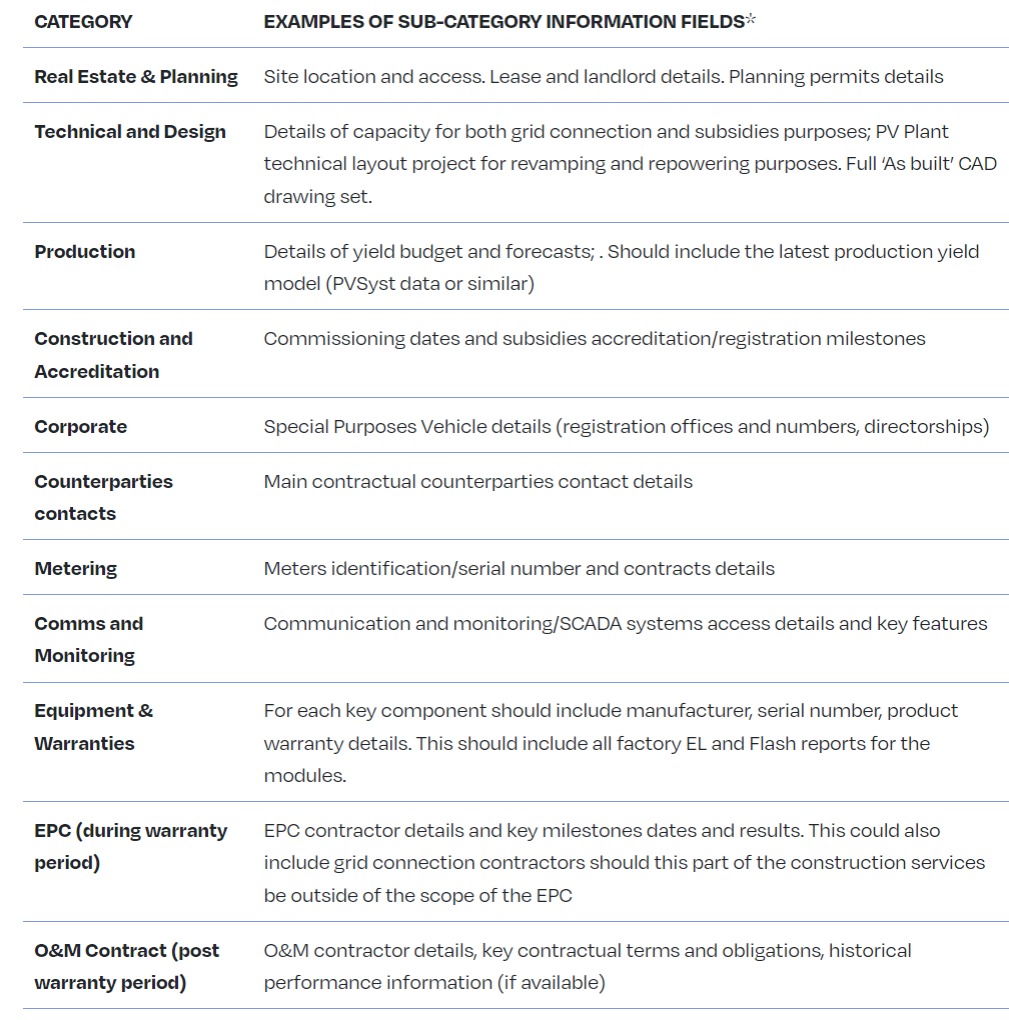
*The list is not exhaustive and provides only some examples for each category.
Document acquisition and management
The solar PV market has developed complex contracting structures for solar PV sites, often driven by the requirements of investors, lenders and funders. Documentation and contracts management is therefore at the core of any AM service as it sets the boundaries and shapes the services to be provided. During the handover process two main tasks are carried out with regards to the documentation management:
- Document checklist: The Asset Manager should be able to advise a minimum and essential set of documents required to enable the normal carrying out of the services as well as a wider selection of documents which might be considered as additional. This does not comprise contracts only but also technical documents from construction and operations documentation. The outcome of this process will identify and gaps and ensure that documentation is properly migrated in the document management system agreed between the owner and the Asset Manager.
- Document checks: The handover process should allow enough time for the Asset Manager to run through the essential documents to both (i) collect static information that will feed in the asset register; (ii) understand and map the key milestones and process required by the different contracts; and (iii) learn the history of the site.
The table below summarises some of the key documents to be collected and reviewed during the on-boarding process. These documents originate from the construction and operational phases:

System and tools
There are many software and data solution providers in the market and therefore, it is important to recognise that data might need to be migrated between systems during the on-boarding process; this activity should not be underestimated and will have a direct impact on the accessibility and usefulness of the data. This dependency could affect asset information included in an asset register and the document management system but also the financial information (bookkeeping, ledgers and financial forecasting).
The owner and receiving Asset Manager will need to decide which systems and tools to use, should they not wish to deploy the systems used by the incoming asset, or ensure appropriate data mapping and communication protocols between the systems are established. Both parties should account for significant support from the respective IT teams to ensure that the migration takes place smoothly and successfully. For more information on Asset Management Platforms, please refer to Chapter 10, Data management and high-level monitoring.
E. Commercial and Financial Asset Management
Commercial and Financial Asset Management encompasses support activities for the best operation of a business. By definition, the scope of Commercial and Financial Asset Management goes from the contact with external entities on behalf of the Asset Owner until the conversion of operational data into useful and understandable financial information. It comprises the activities presented in this section.
Financial reporting
In addition to technical reporting (see section 6.1. Technical Reporting), financial information is incorporated into the individual monthly report that is usually centred in a cost structure analysis. The individual report should also include information regarding relevant operational incidents, corrective maintenance interventions and security incidents statuses (when provided by the O&M and security supplier).
An additional consolidated report may be produced. This document should include the information disclosed in the individual monthly reports (operational and financial), as well as a set of consolidated financial information with the purpose of providing an integrated portfolio vision. The following financial information should be included in the consolidated report:
- Consolidated financial statements (income statement: balance sheet and cash flow).
- Capital structure analysis.
- Detailed OPEX items or net financial expenses breaking down analysis by type of expense, comparing with previous homologous period (when available), and highlighting material contributions per cost figure.
- Profitability analysis.
- Cash flow overview (on a backward and forward-looking perspective).
- Debt compliance and follow-up – loan administration, including settlements supervision, supervision of interest rates fixing and remuneration of current accounts.
The focus of the Asset Manager is to monitor the business and provide recommendations for improvement of overall status and performance of the photovoltaic plant. By providing specialized management based on reporting individual and consolidated figures of the Asset Owner’s portfolio (portfolio perspective) and breaking down the contribution of each SPV to compare it with the financial model assumptions and historical years (whenever available), the Asset Manager is able to differentiate their service and add value to the Asset Owner. Such analysis will comprise a concise financial interpretation and understanding of the results, and such a periodic report may be fine-tuned in accordance with the Asset Owner’s needs.
The role of the Asset Manager includes the capability of contributing to the development of new indicators and of innovative reporting solutions. The Asset Manager may contribute significantly to the improvement of the performance of the photovoltaic plant by managing all the activities which have an impact and should be reported in the periodic financial reporting.
Furthermore, the Asset Manager is in charge of coordinating a set of corporate financial services that are essential to assess the economic and financial performance of the plant. These actions are relevant for the periodic financial reporting and should be previously agreed upon with the Asset Owner.
Strategy management
The business should develop and implement a strategic framework for all its Asset Management activities. It should be based upon the business strategy, future demand patterns, stakeholder concerns and asset-related risks. The output is an AM policy or future statement of intent, an AM strategy to achieve it, various AM plans and a scorecard of AM KPIs with improvement targets. This framework should be implemented with the required change management process and monitored through regular audits and management reviews.
Management of unsubsidised projects
The solar PV industry is now at the dawn of subsidy-led market in multiple countries. The progressive reduction of subsidies and tariffs has naturally led asset owners to deploy more sophisticated revenues streams. We are therefore experiencing a substantial growth in the corporate PPA market, being these contracts physical (with private wire arrangements), virtual, sleeving and hedges. These comparatively new commercial arranges vary the risk profile of the PV plants from a counterparty and merchant risk exposure perspective, therefore it is vital to successful management of these contracts that Owners and AM service providers have developed and established data management tools and practices.
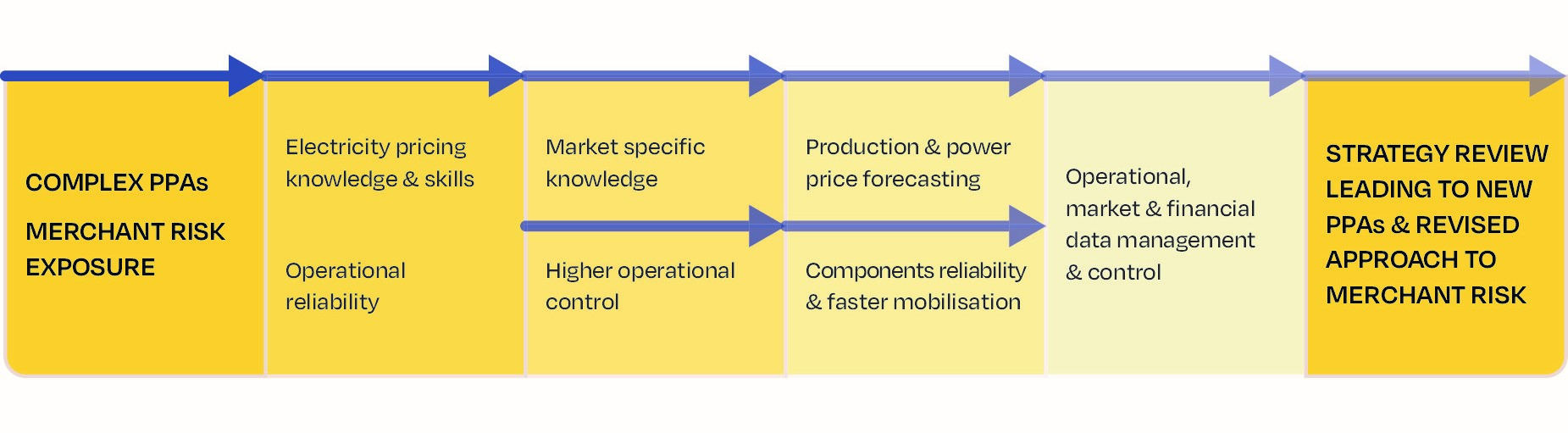
If compared to a subsidy regime or a plain vanilla utility PPA, the corporate PPAs typically require an enhanced level of information undertakings from the part of the SPV and often a minimum level of operational and production reliability, leading to stricter requirements for response time and re-establishment of PV plant availability.
The introduction of contractually binding reliability requirements (such as a minimum production or volume (MWh) guarantee) and the exposure to merchant risk, represent a substantial shift in risk allocation toward the Owners. This therefore leads Owners and AM service providers to the necessity of new skills focused on electricity price market knowledge to facilitate forecasting, whilst reinforcing operational processes particularly with maintenance providers to ensure a low medium time to repair, and key components reliability to minimize mean time between failures. This is particularly affecting distributed generation, whilst larger scale sites which can afford to be regularly manned, seem to have a higher level of operational reliability due the higher response time to failures and downtime.
As the risk paradigm associated to the operation of the PV plants shifts toward the SPV and Owners, AM service providers must prepare and equip with the new skills set forth above also considering that these might have to be specific for each market they are providing services in. Given the high impact and frequency of these risks it is also expected that a number of Owners would explore the opportunity of internalising the strategic management of these contracts.
Corporate administrative services
The Asset Manager is usually in charge of providing corporate administrative services for the managed SPV, including coordination of the board of directors' meetings, and general management services, including domiciliation of the company, operation of the bank accounts etc.
Accounting
Accounting is the support area responsible for meeting local and international legal, regulatory and tax requirements as the reporting of financial transactions pertaining to business.
In Accounting, one must ensure that the local and international accounting standards (IAS) are met and align with the international financial reporting standards (IFRS) in order to produce financial information that is in a common global language for business affairs. This way, the accounts of a company are understandable and comparable across international boundaries.
Therefore, Accounting means processing all the financial information of a business and converting it into standardized outputs that are universally understood and comparable financial statements.
The Accounting service can be included in the Asset Management contract as a provided service regardless of whether it is an internalised (Asset Manager’s responsibility) or externalised (outsourced) service. The main activities under the scope of Accounting Services are detailed in section 7.7. Accounting assistance.
Customer relationship
The main customer of the Asset Manager is the Asset Owner. Consequently, all the third-party relationship management carried out by the Asset Manager must align with the Asset Owner’s work ethic, company culture, expectations and needs.
The Asset Manager is responsible for acting on behalf of the Asset Owner in all contact and relations with external entities (third-party) in accordance with the predefined Asset Management contract. The Asset Manager should source solutions, make negotiations and present all the collected information and its critical analysis to the Asset Owner for examination and for final decision-making.
The key customer of the SPV is the final recipient of the electricity generated by the photovoltaic plant, whether it is a local utility or a final consumer. The Asset Manager must: ensure compliance with the power purchase agreement, fulfil the contract requirements and deliverables, and verify if the settled tariff is being paid correctly. Furthermore, the Asset Manager is responsible for sourcing alternatives or renegotiating, when needed, the energy sale contract.
Thus, it is the Asset Manager’s responsibility to make the bridge between the Asset Owner and the SPV (Asset/photovoltaic plant) customers.
This requires a high level of responsibility, so the Asset Manager must be able to act promptly and effectively in the best interest of the Asset Owner at every instance.
Moreover, the Asset Manager should hold periodic meetings in order to inform the Asset Owner of the status of ongoing negotiations and other relevant events. The meeting and its agenda should be proposed by the Asset Manager.
Therefore, in order to streamline all relevant processes and to avoid any undesirable delays or missed deadlines, the Asset Manager is responsible for informing the Asset Owner of important correspondence, assuring maximum control of relevant external communications (local tax authorities, banks, suppliers and others).
Although the Asset Owner’s role is not to perform operational management activities, their awareness of relevant events happening inside the plant or in its immediate vicinity is of higher importance for their decision-making process.
In this respect, it is advised that the Asset Manager follows up relevant events with the help of a “Follow-up Report”. This document will assist in monitoring occurrences that may arise in the day-to-day operation of the project, as well as in tracking serious issues and establishing action plans and priorities.
Accounting assistance
The Accounting Service is obliged to comply with local and international legal, regulatory and tax requirements in accordance with the IAS and IFRS, as mentioned in section 7.1. Financial reporting, 7.5. Accounting and 7.6. Customer relationship. Therefore, establishing processes and procedures in order to have a complete understanding of the local legal, regulatory and tax requirements applicable to the reporting of financial transactions pertaining business should be done accordingly. Consequently, the Asset Manager should be supported by an Accounting Service that is knowledgeable in local market practices.
The Asset Manager ensures that the Accounting Service meets its obligations of Book-keeping and Administration as well as Accounting Procedures. Monthly and annual activities of the Accounting Service are stated below.
Book-keeping and Administration
- Registration of book-keeping entries for the project company’s operations.
- Keeping the project company’s accounting books (general ledger, VAT registers, inventory book and depreciable assets book).
- Calculation and entering of the corresponding amortisation allowances into the project company’s books and keeping a complete record of all fixed asset balances.
- Calculation and entering of remittances, where applicable, into the project company’s books.
- Registration of the project company’s financial operations.
- Registration of time period adjustments (accruals and prepayments, including interest accruals) in the project company’s accounting books.
- Management of the project company’s correspondence.
Accounting procedures
- Establishment of Accounting and Administrative procedures.
- Preparation and assistance during tax audits.
- Preparation of monthly financial statements (balance sheet and income statement) of the project company.
- Advise on financial and accounting matters in the daily operations and matters that may impact the accounting operation of the project company.
- Elaboration of the project company’s statutory annual accounts.
Furthermore, the main outputs of the Accounting Service include the elaboration of the SPV’s (asset/PV plant) statutory annual accounts, general ledger listings, accurate financial statements (balance sheet and income statement), and the design of an appropriate chart of accounts or analytical accounting issues namely, with regards to a portfolio, to ensure the correct allocation of income and expenses across the PV plant(s).
Invoicing/billing and payments
An invoice is a commercial document that itemises a transaction between a buyer and a seller. If goods or services were purchased on credit, the invoice usually specifies the terms of the deal, and provides information on the available methods of payment. An invoice is also known as a bill or sales invoice.
Therefore, the invoice is the most important document for the Asset Manager to control the revenue. It allows the Asset Manager to verify if the invoiced amount is in accordance with the produced energy amount. This is the first step to control the SPV’s income. As a note, the invoice is a key document to control costs. The Asset Manager must ensure that all suppliers’ invoices are consistent with what was agreed in the service providers’ contracts.
One can consider that the biggest challenge of the Asset Manager is the control of revenues and expenses through rigorous invoicing monitoring.
Revenue control
The Asset Manager is responsible for confirming the reading of the meters based on the information collected on site by the O&M Team, and for validating and comparing it with the billing issued by the electricity purchaser. These activities are called Revenue Control and include:
- Calculation of revenue corresponding to energy generation using the production data downloaded from the production meters.
- Verification of the production data read and registered as well as the issuance of relevant invoices and self-billing invoices, if applicable.
- In case differences occur between the actual energy produced and the energy registered, processing of the corresponding claims and following up until the claims are completely resolved.
- If incidences that arose affected the reading of production meters, coordination of necessary actions to guarantee the accurate invoicing of the energy fed into the grid.
Cash flow management
The Asset Manager is responsible for managing the treasury activities and for monitoring the cash available in every period. Cash management is crucial for the expenditures’ decision-making process. The Asset Manager is accountable for ensuring the proper balance between income and expenses plus revenue and cost.
Adequate treasury operation allows the Asset Manager to manage and adjust payment dates in accordance with the predicted income dates. This way, the expenses can be incurred at a more appropriate timing.
Moreover, the cash flow management gains importance when one considers the variability of the revenues of a PV plant. The latter depends on:
- Weather conditions.
- Equipment status and performance.
- Tariff nature (fixed vs. variable)
- Local tariff legislation and contract in place (FiT, PPA, Pool Price).
The cost structure of a solar power plant has the opposite behaviour, which is relatively stable throughout the lifetime of the project. The highest costs are associated with operational contracts, such as Operation and Maintenance, Land Lease agreement, Asset Management and Debt Financing. These contracts are not usually negotiated by the Asset Manager as they are typically long-term, entered by the Asset Owner and sometimes tied to Project Finance terms. However, for lighter costs, such as insurance policies, communications, independent audits and security, the Asset Manager is in a position to negotiate and should strive for continuous improvement and optimisation, not only in terms of cost, but also in terms of quality of services.
The opposite behaviour of revenues and costs highlights the complexity of ensuring a stable monthly balance between them. For instance, if the monthly revenue is far below the forecast due to a decrease in the monthly irradiation levels, it may represent a risk of a decrease in liquidity for the SPV (photovoltaic plant), especially if significant expenses are required in this specific month.
An additional challenge to cash management is the few degrees of freedom the Asset Manager has to influence cash flows: Inflow of cash is dependent on external or random events as described above, whereas outflows are mostly fixed in long-term contracts. The single most powerful lever for ensuring liquidity is determining the appropriate level of investor dividends. In most cases the amount of cash paid out in an annual dividend payment model directly determines the level of cash available for the next 12 months.
Imminent to the nature of a PV plant is a 12-month cycle in cash flows, with shorter cycles of cash balance minima at times, when low production periods coincide with debt repayment (typically around March/April in the Northern Hemisphere). To continuously ensure sufficient cash balance, the Asset Manager needs a rolling cash flow model at least for the following 12 months. Extending the rolling forecast period to 18 months provides additional security and comfort to the Asset Owner.
Dividend calculation therefore should not only take into account the constraints posed on cash flow management by financing schemes (covenants) and investor expectations, but also the expected cash balance of the liquidity planning cycle.
Concluding, cash management is a crucial part of the scope of work of the Asset Manager.
From a cash management perspective, the Asset Manager is responsible for:
- Managing accounts payable/receivable (providing notice to the Asset Owner for authorisation of payments).
- Repayments of shareholder loans (interest and principal) and any other distributions to SPV’s shareholders.
- Cash flow statement (forecast vs. actual).
- Payments under SPV’s contracts (O&M, surveillance, land lease, security, monitoring and others).
- Repayments of shareholder loans (interest and principal) and within other financing schemes, as well as any other distributions of the SPV’s shareholders.
- Validation (of interest and other bank charges).
Working capital reconciliation
The revenue stream of a solar power plant is variable due to the indexation of electricity production that is mainly dependent on the weather. However, the cost structure is relatively stable. Taking that into consideration, the need for close monitoring of accounts payable and accounts receivable assumes a higher importance.
Therefore, the Asset Manager should manage accounts payable and accounts receivable through rigorous client and supplier contract negotiation, ensures that the days payable outstanding are convenient to the SPV, according to the days receivable outstanding. The days receivable outstanding should be lower than the days payable outstanding in order to ensure that the accumulated revenue generated is enough to meet the supplier’s payment (to guarantee proper availability of the cash short-term). Furthermore, in order to stabilise the revenue stream when unpredictable events happen (for example, machinery breakdown) resulting in downtime, the Asset Manager must ensure that response times of the O&M contract are being respected. Hence, it is the Asset Manager’s responsibility to guarantee a close monitoring of revenue stream, working capital and cash flow variations.
Financial control
Financial control is the set of processes, policies and procedures which enable the analysis of a company’s actual activities from different perspectives at different times, compared to its short, medium- and long-term objectives and business plan. This analysis requires control and adjustment to ensure compliance with the business plan and in the event of anomalies, irregularities or unforeseen changes. The Asset Manager is responsible for conducting such analysis in order to achieve the company’s performance optimisation and the company’s financial goals.
Financial control processes, policies and procedures must be defined according with local and international legal, regulatory and tax requirements, the Asset Managers’ experience and shareholders’ remuneration. There are different types of financial control processes and procedures, such as accounting standards, financial statements (balance sheet, income statement, cash-flow statement, statement of changes in equity), budgets, business plans, operating metrics (such as profit margins, KPIs), and external financial audits, as well as different types of policies regarding general ledger, chart of accounts, recognition of revenue, reconciliations, invoicing, payment processing, inventory, among others. The job of the Asset Manager is to ensure the SPV compliance with the defined financial control processes, policies and procedures through coordination with the teams involved (Accounting Department, Treasury Department, Tax Consultant).
The Asset Manager oversees the preparation of the annual budget forecast and updates it with actual data, analysing the deviation between the forecast and actual data. The budget forecast should be validated by the Asset Owner and used as a comparison (to the actual data) in the corresponding periodic financial reporting.
The annual budget forecast includes:
- Monthly estimation of OPEX
- Monthly estimation of production and revenues, according to the technical data or project finance
- Financial expenses
- Taxes
- Tangible fixed assets depreciation costs.
Adequate interpretation of the current year’s activity will allow the Asset Manager to adopt higher levels of certainty when elaborating the budget forecast for the following year, thus being more accurate in terms of predicting the financial efficiency of the project.
In order to complement the micro-level analysis for the upcoming year (budget), the Asset Manager should analyse the SPV’s Business Plan in order to understand if the business’ actual data is aligned with assumptions considered in the Business Plan or if there are any deviations. Should deviations happen, the Asset Manager must propose and define a strategy, along with the Asset Owner, to overcome them. The business plan is often elaborated by the Asset Owner or by the Asset Owner’s Financial Consultants.
As a final step to ensure proper financial control, the Asset Manager should advise the Asset Owner on the need to contract an external auditor to certify the accounts and to approve the annual accounts and report. The Asset Manager should assist the auditing team.
Contract management (financial contracts)
Contract management encompasses both technical and commercial/financial aspects. This section looks at contract management from a commercial/financial AM point of view. Section 6.7. Contract management (operational contracts) takes the perspective of the Technical Asset Manager.
The Commercial/Financial Asset Manager is responsible for the sourcing of service providers, contract optimisation, supervising contract compliance, relationship management, liaising with suppliers in case of non-compliance or claims, as well as coordinating with other entities.
Also, contracts not managed by the Technical Asset Management, such as FiT and PPAs, and any other support scheme reporting and accounting are managed directly by the Commercial/Financial Asset Manager due to their financial requirements and contract deliverables.
The Asset Manager must regularly conduct a comprehensive review of all contracts concluded and record them in a relevant document or software: the start and end date of the contracts, actions and deliverables (what, when and how) that must take place in order to ensure contract compliance, prices indexation and updates, the type of payment and payment dates, requirements for notification of termination of the contract, indexation to other contracts, services provided, breaches of the contract, and useful information. This will provide the Asset Manager with the proper information to manage, negotiate and comply with the contracts and their requirements. It is imperative to ensure that the contract requirements and periodic deliverables are met in a timely manner to avoid contractual penalties and therefore unforeseen expenses.
Whenever necessary and possible, the Asset Manager should actively identify and solicit alternative service providers to guarantee contract optimisation in terms of conditions, price, service and quality. (For more information, see also chapter 8. Procurement).
When it comes to PPA management, the Asset Manager should always consider the financial soundness of the counterparty, the transparency, and bankability of the contract by relying on rating reports, financial statements and warranties provided.
Contract management is a very time-consuming element of business and automation of the contract management system is an efficient tool to save time and costs allowing the allocation of resources to other pending matters.
Suppliers account management
In sections 6.7. and 7.13. on Contract management we explore the Asset Manager’s role in operational and financial contract management, contractual requirements compliance, contract monitoring and contract optimisation and negotiation. In the present topic we will emphasise the importance of regular activities performed by the Asset Manager such as: monitoring of the operational contract execution, relationship management, event accessing, decision-making and administrative management (for instance, following up an insurance claim), and evaluating financial impacts (for instance, extracontractual O&M activities).
The Asset Manager is responsible for sourcing, evaluating the financial impact, negotiating, managing and ensuring the execution of all supplier contracts. Moreover, in the occurrence of an abnormal event, it is the Asset Manager’s obligation to assess whether this event is or is not extracontractual, estimate damages and financial impact, find the adequate solution and perform the necessary administrative tasks in order to quickly establish normality in the business. Lastly, throughout the process, the Asset Manager should report to the Asset Owner.
The Asset Manager is a key player in suppliers relationship management. By having a 360º perspective of the operational business, financial performance and the supplier’s contracts in place, the Asset Manager can add value by deeply understanding the project’s needs and by trying to get individual contracts in order to ensure maximum business optimisation. It is hard to assess business improvements achieved by an experienced Asset Manager, as they go far beyond easily measured quantitative financial improvements. For more details on supplier categories and selection, see chapter 8. Procurement.
In order to clarify what the Asset Manager’s role in supplier account management is, please refer below to the most important suppliers.
O&M Suppliers
Throughout the operation phase, the main task of the Asset Manager is to supervise the O&M supplier in terms of compliance with contractual obligations such as O&M Team response times. In addition, the Asset Manager is also responsible for validating the compliance of the contracted O&M preventive maintenance plan and coordinate corrective maintenance activities.
Furthermore, depending on the type of activities assigned to the O&M Service contract, the Asset Manager may also supervise the contractual compliance related to warranties and processing of necessary claims, if applicable.
Another important role of the Asset Manager is to monitor the additional O&M services not included in the O&M contract and therefore representing additional cost for the Asset Owner and affecting the project cash flow. From this perspective, the Asset Manager is responsible for assessing the operational impact reported by the O&M provider and for evaluating the suitability and necessity of the activities.
In some cases, when specific extra works are frequently executed, representing a high weight on total OPEX costs, this may be a good opportunity to assess the O&M contract and propose to the Asset Owner a revision of the O&M contract to include the referred works under the scope of the contract.
Landowners
The land lease agreement is a long-term contract and it is one of the most important contracts in the solar power generation business. This agreement ensures that the PV Plant can be installed and can be in operation during the asset lifetime (30+ years) on the chosen land. Usually the land lease agreement is negotiated and secured by the development team before the construction phase and can be a contract signed with more than one landowner (if the chosen place to install the PV plant belongs to more than one landowner).
Therefore, the Asset Manager is responsible for managing the land lease contract made between the SPV (special purpose vehicle) and the Asset Owner. This means that the Asset Manager is responsible for:
- Managing a key long-term relationship ensuring good relations between the landowner and the Asset Owner.
- Assessing the land lease’s annual price indexation.
- Solving land lease agreement problems: for instance vegetation control issues (for instance disputes with neighbours in case of shared vegetation), manage PV plant access, inform land owner of alterations needed in the PV plant (for instance, DNO access to alter type communications), among others.
- Comply with local legislation with regards to land alterations (planning permit).
- Renegotiate contract extension if needed.
Such efforts shall comprise the procurement of technical and economical solutions and the contractual arrangements and subsequent implementation of the solution previously agreed upon with the Asset Owner.
Insurance
The Asset Manager is responsible for managing the insurance contracts made between the Asset Owner and the Insurance Company.
This means that the Asset Manager is responsible not only for the annual assessment of insured capitals and coverages depending on the evolution of market prices, but also for coordinating insurance claims and the subsequent review of claims with parties involved (Broker, Loss Adjuster, O&M supplier, security company and others).
In case of damages to the Asset which could be covered by the insurance policy, the Asset Manager will work with all parties involved to:
- Ensure the necessary contacts with insurance companies/brokers to guarantee that the operation is restored as soon as possible.
- Ensure adequate indemnities are paid in accordance with the policy conditions.
- Assist the Asset Owner with the execution of insurance contracts and their compliance with the established requirements.
- Ensure that the information required to file the claim (including material damages, business interruption and machinery breakdown) is gathered and submitted to the insurance broker and loss adjusters.
Such efforts shall comprise the procurement of technical and economical solutions and the contractual arrangements and subsequent implementation of the solution previously agreed upon with the Asset Owner.
Security services and surveillance system management
On the one hand, the Asset Manager acts on behalf of the Asset Owner on the procurement and contracting of specialised security services, including, amongst other things, daily interaction with customers, as well as with specialised suppliers (e.g. remote CCTV/alarm filtering and monitoring agreements, mobile response and on-site presence handling) in order to advise on the most suitable solutions available in the market.
On the other hand, the Asset Manager provides clear communication and dispatching protocol in accordance with the terms and conditions set forth by the Asset Manager and gathers business intelligence data on incidents and abnormal operating conditions from a security management perspective. Security information is also included in the Asset Management periodic financial reporting.
Technical consultancy
The Asset Manager acts as the interface and support for external organisations on behalf of the Asset Owner (e.g. operational assessment and technical risk analysis), available on demand, according to the rates agreed upon, as an additional service.
Throughout the operation phase, the Asset Manager may make regular periodic visits to the plants. Depending on the performance, operations, maintenance or insurance claims that may take place related to the plant, the Asset Manager may carry out additional site visits, in order to investigate specific circumstances at the request of the Asset Owner.
The Asset Manager is expected to provide recommendations on the best certified suppliers and specialised technical inspections and consultancy services.
At this level, the Asset Manager develops an integrated approach to risk management, including the development of initiatives for risk mitigation.
Legal consultancy
The Asset Manager will be an interface with the Asset Owner’s legal advisors, focused on providing effective and timely assistance and on setting forth a thorough description and understanding of requirements or feedback from legal support.
This role is very challenging and can only be met by wide knowledge of the best legal players and practices in the renewable energy sector (e.g. lawyers and consultants), as well as a deep understanding of the Asset Owner’s approach, needs, industry and market.
Whenever the complexity of any legal matter requires external, specialised advice, the Asset Manager will discuss this in advance with the Asset Owner.
Audit and Consultant Services
Whenever necessary, the Asset Manager assists the Asset Owner’s financial auditors and other advisors, especially in conducting annual financial audits, including the processing of ‘Prepared by Client’ lists, assisting the auditors in working meetings, collecting information from the Client and updating the audit progress.
The following activities are considered as an example of the relationship and interdependency between the Asset Manager and the external auditors:
- Monitoring and supporting of financial statements (Local GAAP and/or IFRS) and submission of all tax returns.
- Advice on financial and accounting matters in the daily operations and situations that may have an impact on the accounting situation of the SPV.
- Management of the relationship with the project company’s external auditors (if applicable), using best efforts so that the project companies receive audited financial statements within the established deadline: the year following the reference fiscal year.
Finally, the Asset Manager should advise the Asset Owner on the need to hire an external auditor for certifying the accounts and approving the annual accounts and report.
Electricity providers
Throughout the operational phase, the PV plant needs electricity to power auxiliary services and/or ancillary services. Auxiliary services are the services that affect production (e.g. inverters) and ancillary services are the services that are not directly linked with solar power production (e.g. CCTV system, monitoring system, illumination, among others). Electricity provision can be achieved in two ways: having an electricity supplier or using the electricity generated from the PV plant. The latter option is not always achievable due to size constrains of the PV plant.
It is important to secure a good electricity supplier since it can affect the PV plant’s core business, electricity generation. Moreover, solar power plants with storage, which will be increasingly common in the future, will need a higher stable energy stream to function properly.
The Asset Manager is responsible for negotiating and managing the electricity supplier’s contract established between the SPV and the supplier. This means that the Asset Manager is responsible for:
- Managing the long-term relationship between the Asset Owner and the service provider;
- Assessing and negotiating the annual price indexation;
- Renegotiating contract extension if needed.
Supplier penalties invoicing
It is not uncommon for EPC and O&M contracts to include penalty clauses linked to specific KPIs to protect the asset owner’s interests.
EPC contracts typically include penalty clauses for the first few years of asset operation. Underlying KPIs are highly individual and may include plant PR, plant availability, grid connection date and deadlines for completing punch list items, among others. The responsibility for tracking these KPIs and managing corresponding payments may be transferred to the Asset Manager. In this case, detailed knowledge of the EPC contract and information on any funds withheld by the SPV is crucial.
Likewise, O&M contracts may include bonus or penalty mechanisms linked to KPIs such as PR, plant availability and reaction times, among others. In case of bonus payments, the Asset Manager needs to make suitable provisions in the financial planning. In case of penalties, the Asset Manager needs to calculate and invoice the penalty amounts to the O&M provider.
Interface with banks and investors
A photovoltaic plant is considered an infrastructure investment, thus one that requires high capital volume during the construction phase and low capital volume during the operation phase. Project finance is the most common source of financing for infrastructure projects. Project finance creates value by reducing the costs of funding, maintaining the sponsors’ financial flexibility, increasing the leverage ratios, avoiding contamination risk, reducing corporate taxes, improving risk management, and reducing the costs associated with market imperfections. Therefore, project financing is a loan structure that relies primarily on the project's cash flow for repayment, with the project's assets, rights, and interests held as secondary collateral. Project finance is especially attractive to the private sector because companies can fund major projects off balance sheet. Usually the sponsors are bank consortia. A PV plant is only rarely financed by a regular commercial bank loan.
Nevertheless, project finance is a very demanding type of financing and entitles a long list of requirements and periodic deliverables that usually come with a heavy set of penalties when not complied with.
The Asset Manager is responsible for having a comprehensive understanding of the financing contract in order to ensure that the periodic deliverables and requirements are met meaning that the Asset Manager assures the elaboration of all the documentation needed to comply with the financing contract requirements. Thus, the Asset Manager is responsible for the elaboration of bank periodic reporting, financial statements, coverage ratio monitoring, escrow accounts monitoring and business plan updates, among other requirements. Additionally, the Asset Manager is responsible for monitoring the non-financing contracts that are indexed to and locked by the project finance (usually land lease, Operation and Maintenance, security).
Although this generally represents a high workload for the Asset Manager, it is their responsibility to avoid penalties raised by contract non-compliance.
Equity/debt financing management
With regards to funding an infrastructure investment, an alternative to project finance is equity investing (investment funds, private equity firms, private investors and SPV’s holding company equity, among others). Usually, a project is not entirely equity financed; in reality, the Asset Owner can opt for a mix between equity and debt.
The Asset Manager is responsible for having a comprehensive understanding of the equity agreement and the bank loan requirements in order to work for the SPV’s maximum optimisation and profitability, maximising shareholder remuneration and complying with debt service. As stated in section 7.10. Cash flow management assumes an important role to ensure liquidity to comply with debt service schedule. Therefore, the Asset Manager is responsible for loan administration (including settlements and contracted interest rates supervision, debt service coverage, and compliance with requirements and deliverables, among other administrative tasks).
This type of funding is less demanding and has less deliverables, as its periodic reporting is usually less rigorous and aligned with the Asset Management monthly reporting.
Solar PV assets are increasingly re-financed during the operational phase, allowing the owners to benefit from more stabilised operations and a lower operational risk profile, leading to better lending terms. In these circumstances, the Asset Manager can provide additional services and support to the owners by feeding the refinancing due diligence process facilitating the collection of site information and documentation, as well as lead the discussion with technical and other advisors.
Tax preparation, filing, and administration
The Tax Management Service includes tax preparation, filing and administration and can be included in the Asset Management contract.
The Tax Management Service is obliged to comply with local and international legal, regulatory and tax requirements. Therefore, a comprehensive understanding of these requirements is indispensable.
The Asset Manager is responsible for coordinating the work between the Accounting and Tax Service, complying with local tax authorities, providing simple tax support and ensuring payment of taxes, and checking if the deliverables required by the local tax authority are met. Moreover, the Asset Manager is accountable for reporting all regular and relevant information to the Asset Owner. Besides management support, the added value provided by the Asset Manager is a deep knowledge of the solar industry together with a critical analysis of the local tax authority’s requests, given the financial environment. This could result in distinctive tax legislation interpretations which could have tax exemption as an outcome. Consequently, a positive effect on the SPV’s profitability is generated.
Therefore, the Asset Manager conducts regular tax activities such as the preparation and filling of relevant tax returns (CIT, VAT, Stamp Duty, withholding taxes, among others) as well as the handling of tax authorities’ correspondence and requests. However, whenever in the presence of unconventional or irregular situations, the Asset Manager should delegate the responsibility to an external local Tax Consultant, as specific expertise and a certified worker are both required. The Asset Manager becomes responsible for providing the Tax Consultant with all the necessary SPV documentation.
A short reference of the tax management activities is presented below.
Tax management
- Regulatory compliance oversight related to tax obligations
- Calculation and filing of the project companies’ tax declarations
- Handling Corporate Tax
- VAT (registering, periodic filing and refund requests)
- Handling Property Tax
- Handling Withholding Tax
- Processing of tax payments
- Control of tax refunds
- Direct relationship with Tax Authorities.
Challenges of multi-jurisdictional and global portfolios
The principles of a sound Commercial and Financial Asset management are constant and should be deployed consistently across markets and jurisdiction to ensure efficiency and effectiveness of management as well as facilitate operational control and consolidation. However, the key tasks carried out as part of the Commercial and Financial Asset management require partial adaptation to the peculiarities of different markets and jurisdictions.
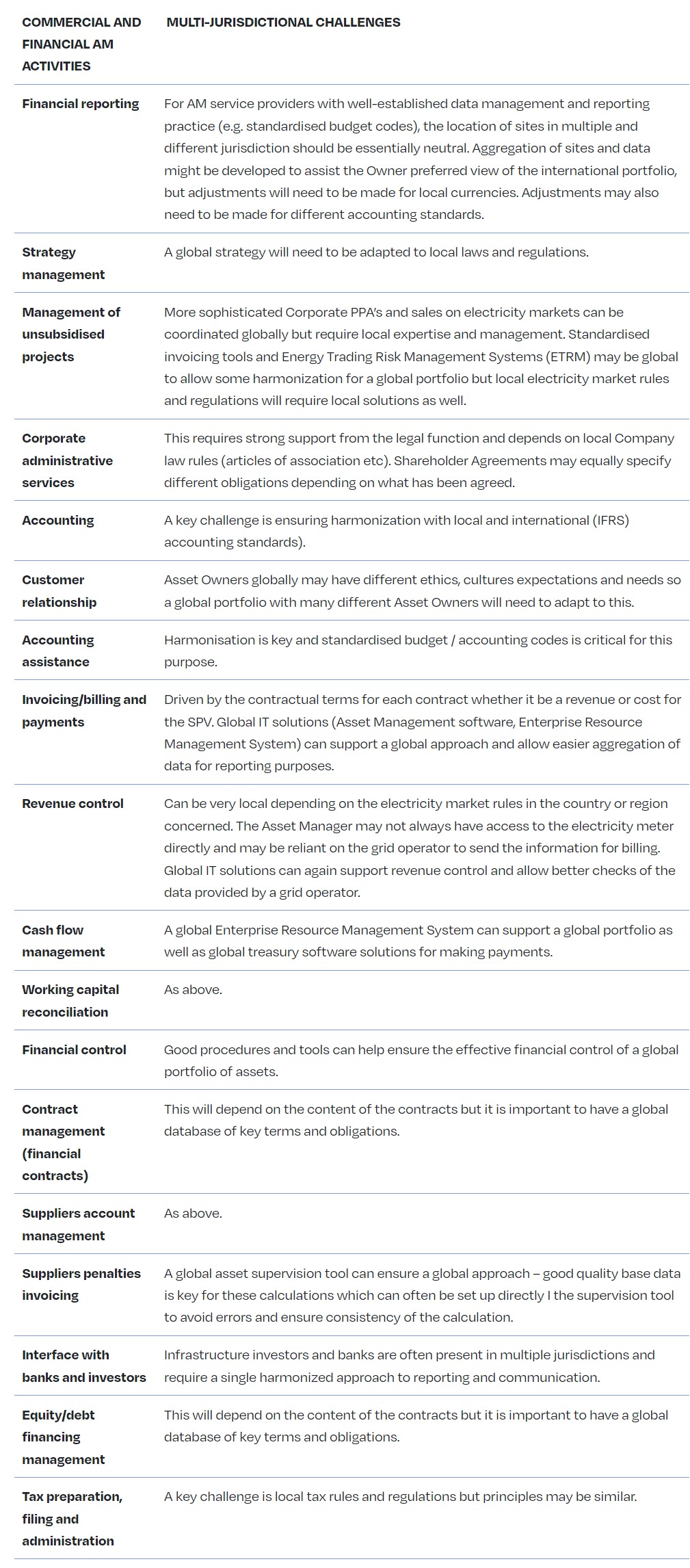
F. Asset management contractual framework
This section contains a set of considerations for the contractual framework of AM services to be executed with respect to commercial, industrial and utility-scale systems. As a complement to the technical specifications detailed in the previous chapters, the contractual framework described in this chapter is considered as a best practice.
Scope of the Asset Management contract
The services provided by an Asset Manager will include the tasks shown in Figure 16 and detailed in this document.
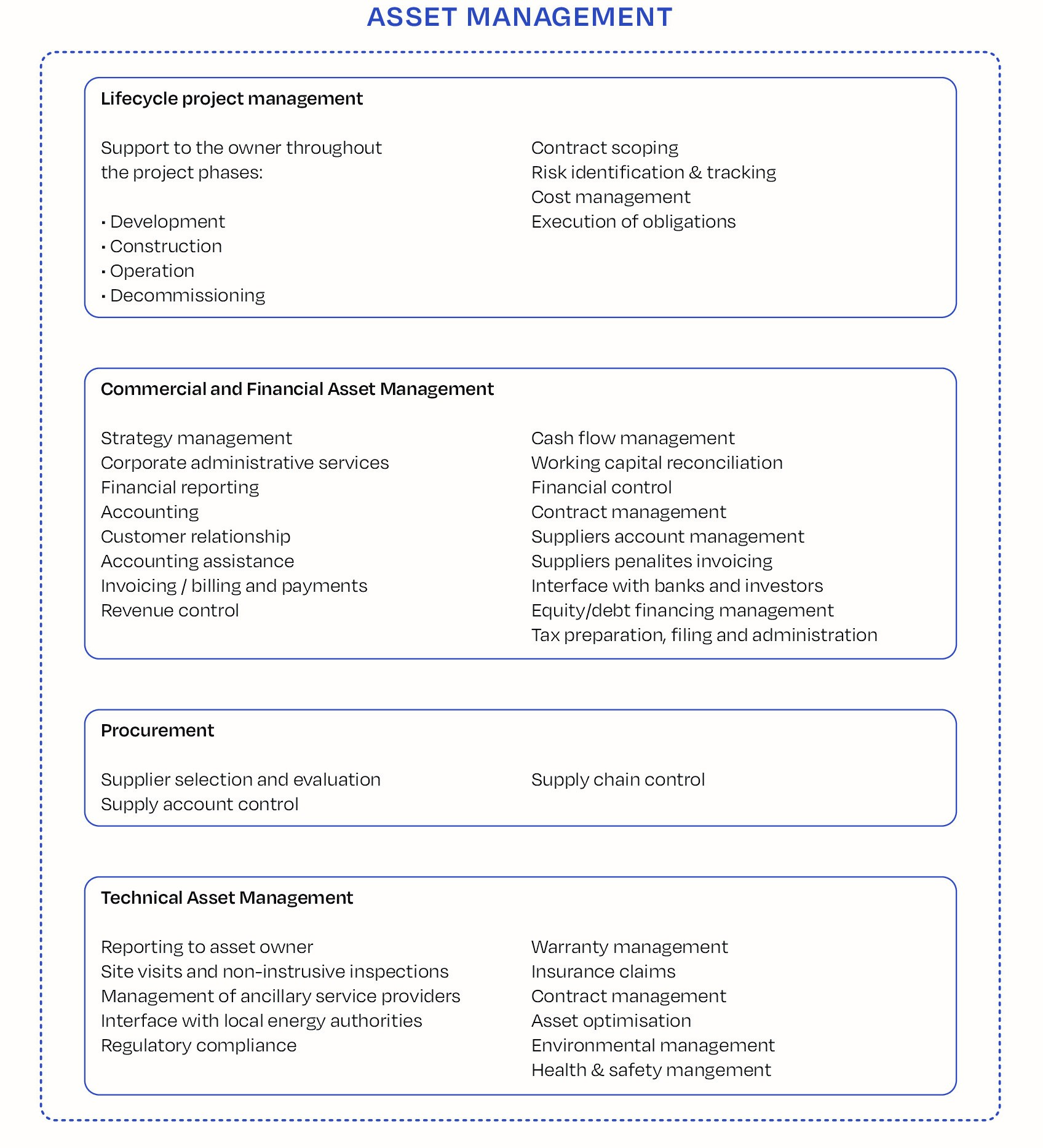
Asset Management contract fee
As a best practice, AM services should be provided on a fixed annual fee. The Asset Management fees could also be calculated according to a formula which takes into account the capacity of the power plant:
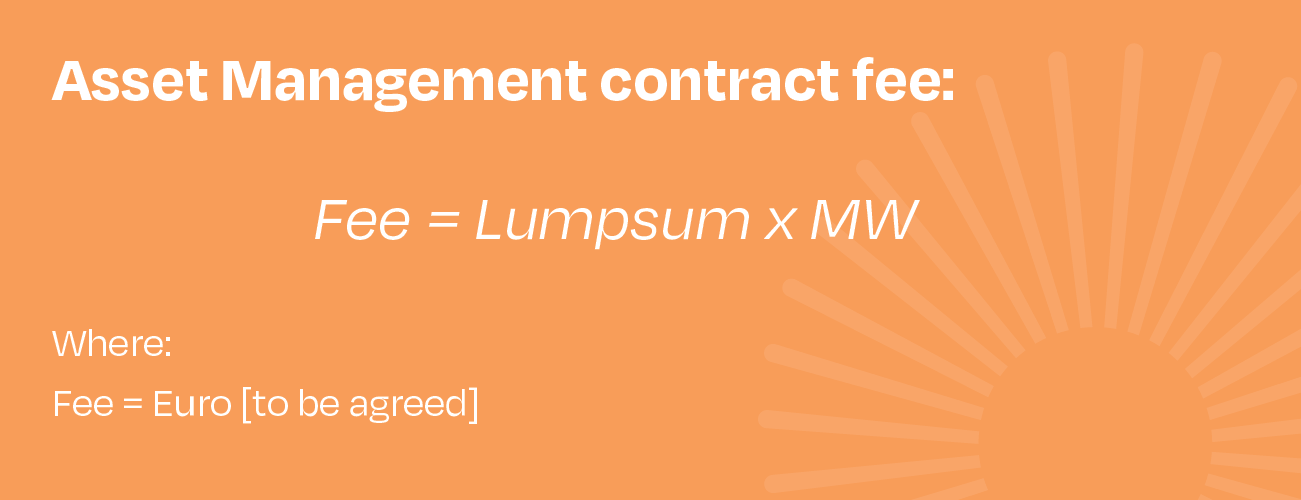
In addition to the annual fees, the Asset Manager may usually charge the client any out-of-pocket expenses within the annual maximum amount agreed between the parties.
Moreover, the parties may agree upon additional services to be executed at a predetermined price indicated under the contract.
Contractual guarantees
No contractual guarantees are generally provided under AM agreements.
Service standards
The Asset Manager will provide the services in accordance with all laws, authorisations, good industry practice and current market standard.
The services to be performed under the AM agreement and the action of the Manager shall be conducted honestly, in good faith, and in the best interest of the client.
With respect to the accounting services, the Asset Manager will keep the books and the relevant records in a proper manner and in conformity with all the required accounting principles and the applicable laws.
Reference to compliance with other project contracts' obligations may be negotiated separately and agreed between the parties to ensure that the SPV/Asset Owner is not in breach of any other relevant obligations undertaken under major contracts.
Limitation on authority
The Asset Manager shall not be entitled to sell, lease, pledge, mortgage, encumber any client's asset or grant any right or licence over the client's assets.
The Asset Manager shall perform the services in compliance with the annual business plan provided by the client.
In addition to the above, the parties may agree that the Asset Manager will not be entitled to enter into any contract having a value higher than the maximum amount identified in the AM agreement.
Moreover, with respect to any litigation that may arise between the SPV/Asset Owner and any third party, the Asset Manager will not have the power to settle any such claim or to submit to a court or an arbitration panel any such dispute.
Responsibility and accountability
The Asset Manager shall be liable towards the Asset Owner for every contractual breach or violation of any specific obligation set out under the Asset Management Agreement, including the confidentiality undertakings.
Parties may agree on a maximum liability threshold for the Asset Manager, which is usually equal to the payable annual fee.
Subcontracting
The Asset Manager could be authorised to subcontract part of the activities to be carried out under the Asset Management Agreement, provided that the subcontractor is a reputable and experienced entity or person capable of fulfilling all the subcontracted obligations and will comply with all the standards and requirements set out under the AM agreement. It is advisable to have a joint liability between the Asset Manager and the subcontractor so that the Asset Manager will remain liable for the subcontracted activities.
Reporting
Reporting should be done periodically if contractually agreed between the Asset Manager, the O&M Contractor and the Asset Owner. Should the client execute commercial agreements that require daily management and reporting, the AM agreement will also include such specifics. Please note that such activity is generally an additional service.
Continuity of operation and termination
In the event of termination or withdrawal from the AM agreement, the Asset Manager shall, if required by the client, continue to operate the assets for a specified period (i.e. 60 days) until the replacement of the manager. In such a period, the Asset Manager shall continue to act in accordance with all the provisions set forth under the AM agreement as if the agreement had not been terminated.
Termination is usually provided for general breaches of contract and obligations. Specific breaches leading to immediate termination are generally not included under this type of contract. Grounds for termination may vary a lot. They could go from a minimum of 15 days to a maximum of 90 days.
Termination for convenience may be negotiated between the parties as well as a relevant termination fee.
Force Majeure
In case of force majeure, the Asset Manager should mitigate the impact of the force majeure event on the performance of the services to be carried out under the AM agreement. The Asset Manager's obligation also includes minimising the timeframe of a suspension of services, understanding that the services must be restarted in the shortest possible time. During the suspension of services, the Asset Owner (or the lender, if a direct agreement has been executed) may have the right to step in in order to cure any default. Whether the suspension of services is forecastable or not, the Asset Manager should do its best to minimise to the extent possible the damage to the Asset Owner. The Asset Manager also has to inform the Asset Owner of the forecastable restart and the measures to be adopted for minimising the suspension. As a general remark, it should be underlined that in case of a breach of the Asset Manager's duty of care, the Asset Owner may have the right to request full compensation for the damages suffered; to this extent, compensation for indirect losses is generally excluded. Regarding the services suspension regime, it is market standard that the Asset Manager is relieved from the performance of such services as long as the force majeure event lasts. Therefore, each party may have the right to withdraw from the AM agreement upon the expiration of an agreed term or in case the force majeure event jeopardises the entire execution of the Asset Management Agreement.
Direct agreement
Should the PV plants be financed on a project finance basis, the Asset Manager, the Asset Owner and the lenders may execute a direct agreement in order to regulate lenders' step-in right in case of any default in the Asset Manager’s obligation occurs.
Moreover, regarding lenders' security, lenders may require the Asset Manager to deliver any form of agreed collateral guarantee in order to secure the performance of the AM services under the AM agreement.
Personnel
The Asset Manager should engage and deploy an adequate number of competent, suitably qualified and experienced personnel in order to perform their obligations under the AM agreement. The personnel allocated for the performance of the services should remain allocated to such activities for the entire term of the AM agreement. In case of misconduct or any other incapability in the performance of the services, the Asset Manager should remove and replace the affected personnel with a suitable and qualified replacement. The same provision should also apply to the subcontractor.
G. Fundamentals of Lifecycle Project Management
Effective Lifecycle Project Management (LPM) ensures that all the necessary actions throughout the development, EPC, O&M, and decommissioning/disposal phases are performed. Therefore, LPM has two different focuses: on the one hand, it has to ensure the timely and cost-effective progress of the project through each of the lifecycle phases; on the other hand, it has to ensure that this progress is not impeded by avoidable problems that could affect the profitability of the project.
While there are other definitions for risk and risk management, in these guidelines we see Risk Management (RM) as the overarching management system which ensures that project progress, throughout its lifecycle, is timely and cost-effective, with a reasonable trade-off between risk and cost. To achieve this, RM includes the following areas:
- Risk Analysis
- Health, Safety, Security & Environment (HSSE)
- Due Diligence
- Quality Management
The four areas can each be divided into four sub-areas, explained below.
Risk Analysis
RM starts with the Risk Analysis (RA), for which we define the following steps:
- Risk Identification (RI)
- Risk Assessment (RAss)
- Risk Prevention & Mitigation (RP)
- Risk Plan Communication & Implementation (RC)
a) Risk Identification
RI is the beginning of RM. As a minimum, it is important to identify and define all major risks with a significant chance of occurrence. If this does not happen or happens too late, the whole project could be jeopardised.
b) Risk Assessment
Once a risk is identified, an assessment must take place to determine how likely it is to occur, what the impact would be, and estimate the costs of eliminating or reducing the risk.
c) Risk Prevention & Mitigation
Once the RAss has been conducted a decision must be made on the best way to prevent (by establishing barriers) or mitigate the risk and/or its consequences.
d) Risk Plan Communication & Implementation
Once a decision has been made on how to prevent or mitigate the risk, a plan on how to do so must be communicated.
Health, Safety, Security and Environment (HSSE)
HSSE are priorities throughout an asset’s lifecycle. There are legal requirements in most countries, and internationally accepted standards, such as the IFC Performance Standards and the Equator Principles, to ensure that solar projects do not negatively impact the environment and guarantee a healthy and safe workplace. Furthermore, international financial institutions also use HSSE, and social requirements when assessing projects. Security is often a requirement in insurance policies, otherwise claims can be void.
Good HSSE coordination is fundamental to achieving all HSSE objectives, which can be summarised as follows:
- Establish an HSSE culture within the organisation and the relevant project team
- Establish, implement, and maintain an effective integrated HSSE management system
- Ensure compliance with applicable health, safety, and environmental legislation, codes, and standards and, whenever possible, with higher standards and best practices
- Ensure surveillance of the project site, especially of high-value products, as well as components which are difficult to replace quickly
- Ensure that intrinsically safe design is achieved by monitoring progress and preparation of results and systematically reviewing the design process, if necessary
- Manage risks in the design, procurement, construction, installation, commissioning, operation, and maintenance activities
- Ensure appropriate levels of skills for all staff engaged in carrying out critical HSSE activities and provide training where necessary
- Check for any potential HSSE impacts in the project area and ensure that these are minimised
- Make sure that the site surveillance is in line with the insurance requirements
- Ensure that a complete inventory of all waste and discharges is maintained and that all waste is disposed of in an environmentally acceptable way, in compliance with the relevant regulations
- Review lessons learned, performance and any opportunities to continuously improve, to update safe design.
For this purpose, it is important that Asset Owner, the EPC, and other service providers meet to align on procedures to follow to avoid risks, especially when different service providers are working on the site simultaneously.
Due Diligence
Over the lifetime of a project, the asset, and its operating company – typically a special purpose vehicle (SPV) – move through a number of defined stages.
These stages are typically marked by changes in contractual liability and obligation, and the transitions or ‘stage-gates’ between phases are usually accompanied by contractual documentation. This could be in the form of a new contract starting with a different service provider, or third-party certification, with supporting documents, as defined in an ongoing contract.
A very important step of each due diligence assessment is the collection of the relevant documentation. An advisor should have comprehensive documentation check lists and conduct a “gap analysis” in the data-room. Within this context, the role of the Asset Manager (AM) is also very important as they can ensure that a structured data-room is properly built at all stages of a project.
The Due Diligence (DD) process can be divides into four sub-areas:
- Legal DD
- Technical DD
- Financial DD
- Political DD
Financial DD consists of the Insurance DD, Accounting DD, and Taxation DD.
Challenges and opportunities in due diligence processes
An effective due diligence process requires a structured methodology to assess key elements of risks and communicate the related outcomes to decision-makers, in a timely manner. This can result in changes to the structure of a project or the way that investments are monitored.
Relying on a weak methodology, unqualified or inexperienced assessors, or a poorly defined project plan to conduct due diligence, results in a cumbersome and ineffective process that does not produce the key information needed for effective decision-making.
There are numerous challenges in the due diligence process:
- The scope of work may not be well-defined, leaving key questions unanswered
- Information requested may be poorly communicated, leading to more time spent gathering new or different data
- Transaction responsibilities and timelines may not be well-understood; critical matters uncovered during due diligence may not be communicated to the appropriate counterparty.
At the same time, there are many benefits to conducting effective due diligence as it can help stakeholders:
- Objectively understand the assets and their underlying historical performance, including deviations from historical and recent trends
- Identify key risks faced by the lender/investors and establish a communication framework to address these risks, including potential mitigation efforts. This could also result in deal-structuring alternatives such as pricing considerations, collateral requirements, or enhancements to required periodic reporting
- Develop an understanding of critical policies and procedures used to prepare information used for decision-making and identify potential areas of information weakness.
Market confidence relies on and will improve with more effective and frequent due diligence. Increasing the cost-competitiveness of solar PV in the future will rely heavily on quality due diligence services can help avoid asset underperformance, or non-performance.
Quality Management
Quality – if not set by clear criteria and measurements – is a perceptual, conditional, and somewhat subjective attribute and may be understood differently by different people. In general, it can be defined as a commitment to customers in the market or as fitness for intended use, in other words, how well the product performs its intended function. Quality also encompasses the reduction of harm that a product may cause to the environment or human society.
Quality management is key in all phases of LPM, from development to decommissioning. When done robustly, it ensures that a PV power plant works at its maximum efficiency for longer, lowering the levelized cost of electricity (LCOE) and making PPAs cheaper and more competitive. This is crucial to maintaining the growth of solar PV and attracting the necessary commitments and investments to support this. Taking a strong approach to QM will enable the industry to move on from past mistakes and confidently deliver solar plants as part of Europe’s critical energy infrastructure.
Key to effective QM is a strong Quality Management System (QMS). Like QM, a QMS must always be present in LPM, from site selection to the end-of-Life phase and actions should always be flanked by good documentation. A sound QMS can form an important prerequisite for accessing project financing from banks and investors as it minimises the risks of a project. To further boost access to project finance, it is also important to ensure the power plants conform, and are certified to, international standards throughout their lifecycle. There a several international certification schemes and conformity assessment systems available for this. For more information see the Risk management in the operational phase chapter of the Asset Management Best Practice Guidelines and the Risk management in the EPC phase of the EPC Best Practice Guidelines (available at www.solarbestpractices.com).
The four pillars of the QMS as defined in these guidelines are:
- Quality Review (QR)
- Quality Control & Assurance (QC)
- Quality Planning (QP)
- Quality Improvement (QI)
Quality Review
QR consists of a Quality Audit (QAu) and Quality Monitoring (QMo) of component and equipment suppliers. As a recommendation, this pillar should be supported by third-party audit/test firms. The QAu shall take place before a contract is signed. It should ensure that a supplier is capable of delivering on the terms of a contract. The QMo takes place once a contract has been signed and provides an ongoing review of a supplier’s quality management processes. This might be in the form of pre-shipment testing, the commissioning (of parts) of the power plant, or the analysis of the plant performance. The QMo is necessary because an EPC service provider is not in control of a supplier’s quality management processes. It is limited to reviewing the quality performance of the supplier and rejecting or accepting their components based on whether they conform to quality standards within the contract between the two parties.
Quality Control & Assurance
Another pillar of the QSM is the Quality Control & Assurance (QC). This applies more to suppliers as they need sound QC to avoid financial losses from rejections, or claims, and to fulfill their duties towards banks and insurers. It must be ensured that all standards and agreed criteria in a contract are met.
Quality Planning
While QI starts with the supplier selection process, QP will have already started before. While QI is designed to help a supplier improve their processes, QP is designed to help select the right component type. For example, it might be possible to improve the service promise from the supplier for central inverters in remote areas during the QI process. However, it might be a better decision, to design the project with string inverters, as they can be easily replaced with locally stored spare inverters. This shows that an optimised design is of utmost importance. QP begins with site selection, since they can impose significant limitations on project designers’ choices, either through natural or regulatory environments.
Quality Improvement
Using the QAu and drawing on their own experience can help service providers identify possible problems. These issues need to be addressed and actions must be agreed with the supplier, such as implementing better processes, and giving improved (narrower, clearer, more detailed) specifications. This is another pillar of the QSM, QI. This pillar has large cost saving potential, as it helps avoid quality issues.
Lifecycle lessons learnt and feedback loop
Projects that have reached the operational stages of the lifecycle represent a significant learning opportunity from a technical, contractual, and financial perspective.
The experience and available operational data available can help stakeholders improve their services in two ways:
- Providing realistic, tested, and proven assumptions (both from a technical-operational perspective and from a financial-commercial one)
- Identifying areas of improvement that have created a positive impact on the overall return on investment and plant performance.
Carrying out lessons learned from the operational phases is a key tool in identifying ways of improving the efficiency of PV plants. More specifically the feedback loop has proven effective in identifying added value opportunities such as:
- Repeating the yield assessment based on reliable site data, aimed at improving the overall production expectations
- Fine tuning the contracting strategy (simplification of complex or redundant processes set forth in complex contracts, for instance the final acceptable processes)
- Re-defining the scope of work of the main service providers, rebalancing pricing, and risk allocation between stakeholders
- Strengthen the criteria for the selection of key component suppliers and manufacturers
- Increasing the sophistication and appropriateness of the spare parts strategy on a site- and portfolio-basis.
To take full advantage of the knowledge created by the operational phases of the lifecycle, a data driven, and analytical approach must be used from the very early stages of operation of the PV plants. This data is vital to establishing and carrying out a meaningful risk assessment and overall review of the PV plant as an investment. This risk driven approach is the foundation of stable operations and reduces the overall volatility of investments in PV plants.
H. Stage-Gates and Due Diligence
Introduction: discontinuity points across the lifecycle of solar assets
In the lifecycle of a PV plant, there are specific events that represent discontinuity points. They should be handled carefully to keep risks under control, ensure that the appropriate stakeholders and skillsets are involved, and avoid “gaps” in the transition phase.
In particular, the most relevant discontinuity events can be summarised as follows:
→ Change of phase of a project:
- Development, engineering, procurement
- Construction
- Operation under EPC warranty
- Operation under ownership
- Decommissioning & disposal
→ Change of ownership between Asset Owners
→ Change of financing structure, such as closing new financing or refinancing
The fundamentals of LPM are described in the previous section of these Guidelines. The present chapter focuses on the relevance of due diligence to ensuring continuity as a project transitions through the phases of its lifecycle.
Change of phase
When transitioning between project phases, it is crucial to conduct appropriate assessments to ensure the quality of a project, identify potential issues that could impact a project in the medium- and long-term, and ensure that the forecasted financial returns can be achieved.
A thorough assessment of solar assets typically requires a multi-disciplinary and holistic approach. The relevant assessments can be conducted by in-house teams if the right expertise is available. However, using an external advisor is recommended (especially for technical and legal due diligence assessments) to ensure a fully impartial view. In addition, an external advisor can provide a wealth of benchmarking experience from other projects or assets they have analysed. Information obtained via objective and independent due diligence is a critical component of the investment and lending process, and such efforts directly affect the confidence that key parties, in particular service providers, lenders, and investors, have in the solar markets.
Depending on the size of the PV portfolio involved, the standardisation level of some contracts (e.g., insurance policies) and the geographical focus, some due diligence tasks can be skipped.
The results of the various assessments provide the rate and reliability in terms of performances for the lifetime of a PV plant.
Development, engineering, procurement
This phase covers all the tasks undertaken to get the project ‘shovel-ready’ or ‘ready to build’. Usually, this is focused on the technical and financial development of the project, with a series of transactional milestones, such as investment committee approval, execution of EPC contracts and financial close.
It is important to assess the quality of the developed project to reach a final decision to build the project and sign the relevant contracts. In particular, the following aspects need to be analysed and it is recommended that they are properly investigated with legal and technical due diligence:
- Yield estimates
To estimate the energy yield potential of a PV plant, technical advisers typically use simulation software based on models that use the best available data and methods. The result of the modelling is the P50 estimate, or in other words, the “best estimate”. P50 is essentially a statistical level of confidence suggesting that the predicted solar resource/energy yield may be exceeded with 50% probability. P50 level of confidence may represent too high a risk for some investors. Therefore, other probabilities such as P90 (estimate exceeded with 90% probability) or P75 (estimate exceeded 75% of the time) might be considered. Lenders and investors might use P90 estimates in uncertain, or high-risk profile projects to be confident that sufficient energy is generated to comfortably repay the debt.
- Land rights
Ideally, the site on which the project is located should be free of obstacles. If these do exist, they must be considered during the design phase and the relevant consents or permits for the works must be obtained then (if required). If the site is affected by restrictive covenants which preclude solar PV (limitation to solely agricultural use can sometimes affect rural properties), then a release needs to be negotiated with the beneficiary of the covenant. Alternatively, defective title insurance can be put in place. This must be at a level which would fully compensate the project company for wasted capital costs, and loss of future income, arising from the project being decommissioned earlier than anticipated. Lenders will also want to see that insurance is in place where a site is affected by rights to run service media in unidentified locations, or where mineral rights are excepted from the title.
- Consistency of the authorisation process:
- Planning permission in respect of the PV plant which is clear from the risk of judicial review
- Planning permission for cable route works which is clear from the risk of judicial review
- All relevant conditions imposed on the permissions (in particular those required to be discharged prior to commencing works on site) to have been discharged
- Quality of the layout
A review of conceptual design is required in relation to the selected components, as well as infrastructures to ensure the plant design is in line with market standard and respect relevant constraints / prescription of the relevant permits
- Verification of the key terms of the PPAs: including, when applicable, the creditworthiness of the counterparty
- Connection to the grid: In most cases, solar PV projects require the right to connect to the grid. Therefore, a key part of the property due diligence is to check that both the site and project company have the rights to lay a cable to the point of connection to the grid.
Construction and operation under EPC warranty
If technical problems are not detected early during the construction of the plant, or at least within the two-year acceptance period, they can affect future performance and long-term operation. An Asset Owner/project developer will need the professional view of a technical advisor to check the overall quality of the plant. This will include a detailed review of components used on site, future yield estimations and site visits during and after construction. From the Owner’s perspective, it is crucial for the technical advisor to identify any major issues prior to the acceptance period commencing, or at the latest, before the acceptance period is complete. Some crucial steps in the operation of the plants are the acceptance. The role of technical advisor becomes crucial during the PAC and FAC tests (whose recommended protocol has been described under Chapter 9 of the EPC guidelines).
Operation under ownership
In addition to periodic technical verifications, other important areas of evaluation for plants in operation are accounting and tax matters. It is the responsibility of SPV directors to verify all relevant documentation, especially when dedicated tax benefits have been obtained, to ensure legal compliance and avoid significant penalties. It is best practice to include a third-party auditor in this process to ensure transparency.
Effective tax and accounting due diligence may also reveal key indicators of potentially fraudulent activity. These can range from unusual transactions, discrepancies in accounting records, activities/transactions outside the normal course of business, and changes in important credit and underwriting policies and procedures.
Decommissioning
During the decommissioning phase, the role of technical advisor is to confirm that the components of the plant have been dismissed/recycled according to the relevant regulatory framework and that the land/roof has been restored to its original conditions. This work is particularly relevant for local authorities, landlords, and building owners.
Change of ownership
If ownership a PV plant or portfolio changes hands, it is very important for the potential buyer to collect the relevant information and to learn as much as possible about the “history” of a plant and the SPV. In addition, due diligence may also benefit the seller as a rigorous assessment and examination may reveal market value that is higher than expected. Hence why it is not uncommon to also have a “vendor due diligence”, commissioned by the Seller prior to starting a selling process.
Financing or refinancing
The introduction of debt financing within a project’s capital structure or refinancing at any phase of the lifecycle of a PV plant, typically requires detailed verification. To satisfy lenders’ requirements for approving initial or further financing, all aspects of the project must be aligned and quality assured. Ensuring sufficient protection of an investor’s capital requires a fully functioning, and revenue-generating project, with all the required permits.
Accordingly, a solar project finance transaction is not a mere negotiation of financial structuring but also involves an analysis of real property rights, construction and development contracts, equipment warranties, power purchase and interconnection agreements, PV power plant performance, cash management, environmental permitting, energy regulatory matters, and, of course, tax analysis.
The key rule for project finance is risk mitigation: the transaction structure must allocate risks that could affect the project’s cash flow to a creditworthy party, with the ability to mitigate them . Much of the tension in negotiating solar project financing derives from each participant’s efforts to properly identify risks and shift them to others while retaining the benefits from the transaction. For example, the project sponsor usually seeks to shift technology risks to the equipment manufacturer and EPC service provider, while preserving as much of the cash flow and appreciation in project value as possible for itself. The lender will usually seek to shift risk to the Owner by taking paramount positions in the project revenues and assets. They will also seek to guarantee the loan repayment schedule by placing contractual obligations and risks related to warranties onto third parties, such as equipment manufacturers and EPC service providers.
Risk shifting can be done through various legal procedures, including (i) grants of liens on the project assets, revenues, and key project agreements; (ii) warranties and contractual requirements for the equipment and for the maintenance services performed; (iii) requirements for various types of insurance products to cover certain adverse events; (iv) and guaranties of each participant’s obligations from creditworthy entities. During a project financing transaction, the relevant advisor focuses on the calculation of risk magnitude, and the negotiation of risk-shifting devices. This normally results in substantial and complex documentation that must be effectively stored and closely evaluated.
12.4. Financial
Financial modelling, loan agreements, ERP, budgeting and reporting, accounting, tax
A. Key Performance Indicators
There are different types of Key Performance Indicators (KPIs) relevant to EPC, depending on project phase and relevant stakeholders. KPIs related to EPC can be grouped into three categories:
- Ex-ante KPIs allow the (future) Asset Owner (or project developer) to decide whether to invest in a project that is being developed and trust a particular EPC service provider. They also help lenders to assess projects for financing.
- Project performance KPIs help all stakeholders to track project progress, and EPC service providers to optimise their processes.
- Ex-post KPIs deliver a final assessment on a built project. For EPC service providers these KPIs may also be helpful when presenting their references to potential new clients.
The number of criteria to be looked at depends on the value of the project: big projects need to be examined in more detail.
Project performance KPIs
During the construction phase, the performance of the project should be tracked closely. There are available project management standards for this, such as ISO 21500, or publications of associations like the German Association for Project Management (GPM), or the Project Management Institute (PMI). In principle, project management tracks deadlines, budget, and quality, to achieve planned results.
There exist multiple KPIs for project performance. Here we focus on those which track the three essential elements of the ‘project management triangle’: (1) time, (2) budget, (3) quality. To achieve customer satisfaction, the planned goals concerning these elements have to be respected.
Deviation in Time
Milestones are used in project management to mark specific points along the project timeline. These points may signal anchors such as project start and end date, or the need for external review, input, and budget checks. Therefore, one important KPI concerning time is the Deviation in Time expressed as percentage of milestones missed:
The value of this KPI increases if the granularity of milestones becomes finer and milestones are well distributed over the whole construction phase.
On the contractual side, Liquidated Damages may be linked to Deviation in Time – see section 12.5. Limitation of liability and Liquidated Damages.
Since the importance of different milestones may differ, another KPI should be introduced: the number of Critical Milestones Missed (CMM). A critical milestone is one that must not be missed, because of its significance to the project. Examples include the date of receipt of construction permits or of grid connection. In a normal project CMM should be 0. Additional KPIs may include Deviation of Planned Hours of Work.
Deviation in Budget
At defined moments in the project, usually at milestones and after (or even before) purchase of important components (like modules) or services, current accumulated costs Cca(i) should be compared to costs according to the business plan Cpa(i). The resulting KPI Deviation in Budget can be defined as:
In this case the value of the KPI depends again on the choice of the measurement points i, their granularity and distribution over the period of the project.
Deviation in Quality
Quality KPIs measure the quality of construction as well as the construction process and are therefore quite technical. A general KPI for quality tracking is the Deviation in Quality, which can be defined as:
The value of this KPI depends on the definition of quality checks, their number, and distribution over the project period. Non-conformities may include:
- Deviations from execution plans
- Construction defects
- Deviations from norms, standards, grid code, and industrial best practice (the documents to be considered should be listed in the tender document)
- Deviations from permits
Tracking certain quality aspects separately, like conformity with HSSE protocols, is recommended. In this case we would count non-conformities in HSSE and only compare it to the number of all HSSE checks.
Since the importance of different quality aspects may differ, it is best practice to assign a weighting factor for each conformity check.
Other aspects of project quality may be examined, for example:
- The number of change requests (indicates the quality of project development and preparation)
- KPIs describing the quality of communication between the stakeholders (surveys)
- The completeness of required documents for the O&M phase (see
This list should be completed according to the necessities of the specific project.
It is also important to establish feedback loops to create an atmosphere where continuous improvement can flourish.
Ex-post KPIs
Ex-post KPIs are the KPIs that help evaluate EPC projects after the construction phase.
Performance Ratio
There are several KPIs that can be used to evaluate overall plant performance, such as PR, and overall Availability of the PV plant.
PR describes the efficiency of the energy conversion system of a PV plant. When calculating PR, one must bear in mind that the efficiency of PV modules also depends on temperature. For a detailed explanation and formulas, please refer to section 10.3.4. Temperature-corrected Performance Ratio of the O&M Best Practice Guidelines.
Availability focuses on the time that a plant spends generating electricity. For a detailed explanation and formulas please refer to Chapter 10. Key Performance Indicators in the O&M Best Practice Guidelines.
Overall project performance
KPIs regarding overall project performance are, in most cases, identical to the Project performance KPIs described in section 11.1., with i being the concluding milestone of the project.
Warranty KPIs
Additional ex-post KPIs after FAC measure the handling of warranty claims by the EPC service provider, for example:
- Number of broken components / Total number of components
- Number of broken components replaced in warranty procedure / Total number of broken components
B. Commercial and Financial Asset Management
Commercial and Financial Asset Management encompasses support activities for the best operation of a business. By definition, the scope of Commercial and Financial Asset Management goes from the contact with external entities on behalf of the Asset Owner until the conversion of operational data into useful and understandable financial information. It comprises the activities presented in this section.
Financial reporting
In addition to technical reporting (see section 6.1. Technical Reporting), financial information is incorporated into the individual monthly report that is usually centred in a cost structure analysis. The individual report should also include information regarding relevant operational incidents, corrective maintenance interventions and security incidents statuses (when provided by the O&M and security supplier).
An additional consolidated report may be produced. This document should include the information disclosed in the individual monthly reports (operational and financial), as well as a set of consolidated financial information with the purpose of providing an integrated portfolio vision. The following financial information should be included in the consolidated report:
- Consolidated financial statements (income statement: balance sheet and cash flow).
- Capital structure analysis.
- Detailed OPEX items or net financial expenses breaking down analysis by type of expense, comparing with previous homologous period (when available), and highlighting material contributions per cost figure.
- Profitability analysis.
- Cash flow overview (on a backward and forward-looking perspective).
- Debt compliance and follow-up – loan administration, including settlements supervision, supervision of interest rates fixing and remuneration of current accounts.
The focus of the Asset Manager is to monitor the business and provide recommendations for improvement of overall status and performance of the photovoltaic plant. By providing specialized management based on reporting individual and consolidated figures of the Asset Owner’s portfolio (portfolio perspective) and breaking down the contribution of each SPV to compare it with the financial model assumptions and historical years (whenever available), the Asset Manager is able to differentiate their service and add value to the Asset Owner. Such analysis will comprise a concise financial interpretation and understanding of the results, and such a periodic report may be fine-tuned in accordance with the Asset Owner’s needs.
The role of the Asset Manager includes the capability of contributing to the development of new indicators and of innovative reporting solutions. The Asset Manager may contribute significantly to the improvement of the performance of the photovoltaic plant by managing all the activities which have an impact and should be reported in the periodic financial reporting.
Furthermore, the Asset Manager is in charge of coordinating a set of corporate financial services that are essential to assess the economic and financial performance of the plant. These actions are relevant for the periodic financial reporting and should be previously agreed upon with the Asset Owner.
Strategy management
The business should develop and implement a strategic framework for all its Asset Management activities. It should be based upon the business strategy, future demand patterns, stakeholder concerns and asset-related risks. The output is an AM policy or future statement of intent, an AM strategy to achieve it, various AM plans and a scorecard of AM KPIs with improvement targets. This framework should be implemented with the required change management process and monitored through regular audits and management reviews.
Management of unsubsidised projects
The solar PV industry is now at the dawn of subsidy-led market in multiple countries. The progressive reduction of subsidies and tariffs has naturally led asset owners to deploy more sophisticated revenues streams. We are therefore experiencing a substantial growth in the corporate PPA market, being these contracts physical (with private wire arrangements), virtual, sleeving and hedges. These comparatively new commercial arranges vary the risk profile of the PV plants from a counterparty and merchant risk exposure perspective, therefore it is vital to successful management of these contracts that Owners and AM service providers have developed and established data management tools and practices.
If compared to a subsidy regime or a plain vanilla utility PPA, the corporate PPAs typically require an enhanced level of information undertakings from the part of the SPV and often a minimum level of operational and production reliability, leading to stricter requirements for response time and re-establishment of PV plant availability.
The introduction of contractually binding reliability requirements (such as a minimum production or volume (MWh) guarantee) and the exposure to merchant risk, represent a substantial shift in risk allocation toward the Owners. This therefore leads Owners and AM service providers to the necessity of new skills focused on electricity price market knowledge to facilitate forecasting, whilst reinforcing operational processes particularly with maintenance providers to ensure a low medium time to repair, and key components reliability to minimize mean time between failures. This is particularly affecting distributed generation, whilst larger scale sites which can afford to be regularly manned, seem to have a higher level of operational reliability due the higher response time to failures and downtime.
As the risk paradigm associated to the operation of the PV plants shifts toward the SPV and Owners, AM service providers must prepare and equip with the new skills set forth above also considering that these might have to be specific for each market they are providing services in. Given the high impact and frequency of these risks it is also expected that a number of Owners would explore the opportunity of internalising the strategic management of these contracts.
Corporate administrative services
The Asset Manager is usually in charge of providing corporate administrative services for the managed SPV, including coordination of the board of directors' meetings, and general management services, including domiciliation of the company, operation of the bank accounts etc.
Accounting
Accounting is the support area responsible for meeting local and international legal, regulatory and tax requirements as the reporting of financial transactions pertaining to business.
In Accounting, one must ensure that the local and international accounting standards (IAS) are met and align with the international financial reporting standards (IFRS) in order to produce financial information that is in a common global language for business affairs. This way, the accounts of a company are understandable and comparable across international boundaries.
Therefore, Accounting means processing all the financial information of a business and converting it into standardized outputs that are universally understood and comparable financial statements.
The Accounting service can be included in the Asset Management contract as a provided service regardless of whether it is an internalised (Asset Manager’s responsibility) or externalised (outsourced) service. The main activities under the scope of Accounting Services are detailed in section 7.7. Accounting assistance.
Customer relationship
The main customer of the Asset Manager is the Asset Owner. Consequently, all the third-party relationship management carried out by the Asset Manager must align with the Asset Owner’s work ethic, company culture, expectations and needs.
The Asset Manager is responsible for acting on behalf of the Asset Owner in all contact and relations with external entities (third-party) in accordance with the predefined Asset Management contract. The Asset Manager should source solutions, make negotiations and present all the collected information and its critical analysis to the Asset Owner for examination and for final decision-making.
The key customer of the SPV is the final recipient of the electricity generated by the photovoltaic plant, whether it is a local utility or a final consumer. The Asset Manager must: ensure compliance with the power purchase agreement, fulfil the contract requirements and deliverables, and verify if the settled tariff is being paid correctly. Furthermore, the Asset Manager is responsible for sourcing alternatives or renegotiating, when needed, the energy sale contract.
Thus, it is the Asset Manager’s responsibility to make the bridge between the Asset Owner and the SPV (Asset/photovoltaic plant) customers.
This requires a high level of responsibility, so the Asset Manager must be able to act promptly and effectively in the best interest of the Asset Owner at every instance.
Moreover, the Asset Manager should hold periodic meetings in order to inform the Asset Owner of the status of ongoing negotiations and other relevant events. The meeting and its agenda should be proposed by the Asset Manager.
Therefore, in order to streamline all relevant processes and to avoid any undesirable delays or missed deadlines, the Asset Manager is responsible for informing the Asset Owner of important correspondence, assuring maximum control of relevant external communications (local tax authorities, banks, suppliers and others).
Although the Asset Owner’s role is not to perform operational management activities, their awareness of relevant events happening inside the plant or in its immediate vicinity is of higher importance for their decision-making process.
In this respect, it is advised that the Asset Manager follows up relevant events with the help of a “Follow-up Report”. This document will assist in monitoring occurrences that may arise in the day-to-day operation of the project, as well as in tracking serious issues and establishing action plans and priorities.
Accounting assistance
The Accounting Service is obliged to comply with local and international legal, regulatory and tax requirements in accordance with the IAS and IFRS, as mentioned in section 7.1. Financial reporting, 7.5. Accounting and 7.6. Customer relationship. Therefore, establishing processes and procedures in order to have a complete understanding of the local legal, regulatory and tax requirements applicable to the reporting of financial transactions pertaining business should be done accordingly. Consequently, the Asset Manager should be supported by an Accounting Service that is knowledgeable in local market practices.
The Asset Manager ensures that the Accounting Service meets its obligations of Book-keeping and Administration as well as Accounting Procedures. Monthly and annual activities of the Accounting Service are stated below.
Book-keeping and Administration
- Registration of book-keeping entries for the project company’s operations.
- Keeping the project company’s accounting books (general ledger, VAT registers, inventory book and depreciable assets book).
- Calculation and entering of the corresponding amortisation allowances into the project company’s books and keeping a complete record of all fixed asset balances.
- Calculation and entering of remittances, where applicable, into the project company’s books.
- Registration of the project company’s financial operations.
- Registration of time period adjustments (accruals and prepayments, including interest accruals) in the project company’s accounting books.
- Management of the project company’s correspondence.
Accounting procedures
- Establishment of Accounting and Administrative procedures.
- Preparation and assistance during tax audits.
- Preparation of monthly financial statements (balance sheet and income statement) of the project company.
- Advise on financial and accounting matters in the daily operations and matters that may impact the accounting operation of the project company.
- Elaboration of the project company’s statutory annual accounts.
Furthermore, the main outputs of the Accounting Service include the elaboration of the SPV’s (asset/PV plant) statutory annual accounts, general ledger listings, accurate financial statements (balance sheet and income statement), and the design of an appropriate chart of accounts or analytical accounting issues namely, with regards to a portfolio, to ensure the correct allocation of income and expenses across the PV plant(s).
Invoicing/billing and payments
An invoice is a commercial document that itemises a transaction between a buyer and a seller. If goods or services were purchased on credit, the invoice usually specifies the terms of the deal, and provides information on the available methods of payment. An invoice is also known as a bill or sales invoice.
Therefore, the invoice is the most important document for the Asset Manager to control the revenue. It allows the Asset Manager to verify if the invoiced amount is in accordance with the produced energy amount. This is the first step to control the SPV’s income. As a note, the invoice is a key document to control costs. The Asset Manager must ensure that all suppliers’ invoices are consistent with what was agreed in the service providers’ contracts.
One can consider that the biggest challenge of the Asset Manager is the control of revenues and expenses through rigorous invoicing monitoring.
Revenue control
The Asset Manager is responsible for confirming the reading of the meters based on the information collected on site by the O&M Team, and for validating and comparing it with the billing issued by the electricity purchaser. These activities are called Revenue Control and include:
- Calculation of revenue corresponding to energy generation using the production data downloaded from the production meters.
- Verification of the production data read and registered as well as the issuance of relevant invoices and self-billing invoices, if applicable.
- In case differences occur between the actual energy produced and the energy registered, processing of the corresponding claims and following up until the claims are completely resolved.
- If incidences that arose affected the reading of production meters, coordination of necessary actions to guarantee the accurate invoicing of the energy fed into the grid.
Cash flow management
The Asset Manager is responsible for managing the treasury activities and for monitoring the cash available in every period. Cash management is crucial for the expenditures’ decision-making process. The Asset Manager is accountable for ensuring the proper balance between income and expenses plus revenue and cost.
Adequate treasury operation allows the Asset Manager to manage and adjust payment dates in accordance with the predicted income dates. This way, the expenses can be incurred at a more appropriate timing.
Moreover, the cash flow management gains importance when one considers the variability of the revenues of a PV plant. The latter depends on:
- Weather conditions.
- Equipment status and performance.
- Tariff nature (fixed vs. variable)
- Local tariff legislation and contract in place (FiT, PPA, Pool Price).
The cost structure of a solar power plant has the opposite behaviour, which is relatively stable throughout the lifetime of the project. The highest costs are associated with operational contracts, such as Operation and Maintenance, Land Lease agreement, Asset Management and Debt Financing. These contracts are not usually negotiated by the Asset Manager as they are typically long-term, entered by the Asset Owner and sometimes tied to Project Finance terms. However, for lighter costs, such as insurance policies, communications, independent audits and security, the Asset Manager is in a position to negotiate and should strive for continuous improvement and optimisation, not only in terms of cost, but also in terms of quality of services.
The opposite behaviour of revenues and costs highlights the complexity of ensuring a stable monthly balance between them. For instance, if the monthly revenue is far below the forecast due to a decrease in the monthly irradiation levels, it may represent a risk of a decrease in liquidity for the SPV (photovoltaic plant), especially if significant expenses are required in this specific month.
An additional challenge to cash management is the few degrees of freedom the Asset Manager has to influence cash flows: Inflow of cash is dependent on external or random events as described above, whereas outflows are mostly fixed in long-term contracts. The single most powerful lever for ensuring liquidity is determining the appropriate level of investor dividends. In most cases the amount of cash paid out in an annual dividend payment model directly determines the level of cash available for the next 12 months.
Imminent to the nature of a PV plant is a 12-month cycle in cash flows, with shorter cycles of cash balance minima at times, when low production periods coincide with debt repayment (typically around March/April in the Northern Hemisphere). To continuously ensure sufficient cash balance, the Asset Manager needs a rolling cash flow model at least for the following 12 months. Extending the rolling forecast period to 18 months provides additional security and comfort to the Asset Owner.
Dividend calculation therefore should not only take into account the constraints posed on cash flow management by financing schemes (covenants) and investor expectations, but also the expected cash balance of the liquidity planning cycle.
Concluding, cash management is a crucial part of the scope of work of the Asset Manager.
From a cash management perspective, the Asset Manager is responsible for:
- Managing accounts payable/receivable (providing notice to the Asset Owner for authorisation of payments).
- Repayments of shareholder loans (interest and principal) and any other distributions to SPV’s shareholders.
- Cash flow statement (forecast vs. actual).
- Payments under SPV’s contracts (O&M, surveillance, land lease, security, monitoring and others).
- Repayments of shareholder loans (interest and principal) and within other financing schemes, as well as any other distributions of the SPV’s shareholders.
- Validation (of interest and other bank charges).
Working capital reconciliation
The revenue stream of a solar power plant is variable due to the indexation of electricity production that is mainly dependent on the weather. However, the cost structure is relatively stable. Taking that into consideration, the need for close monitoring of accounts payable and accounts receivable assumes a higher importance.
Therefore, the Asset Manager should manage accounts payable and accounts receivable through rigorous client and supplier contract negotiation, ensures that the days payable outstanding are convenient to the SPV, according to the days receivable outstanding. The days receivable outstanding should be lower than the days payable outstanding in order to ensure that the accumulated revenue generated is enough to meet the supplier’s payment (to guarantee proper availability of the cash short-term). Furthermore, in order to stabilise the revenue stream when unpredictable events happen (for example, machinery breakdown) resulting in downtime, the Asset Manager must ensure that response times of the O&M contract are being respected. Hence, it is the Asset Manager’s responsibility to guarantee a close monitoring of revenue stream, working capital and cash flow variations.
Financial control
Financial control is the set of processes, policies and procedures which enable the analysis of a company’s actual activities from different perspectives at different times, compared to its short, medium- and long-term objectives and business plan. This analysis requires control and adjustment to ensure compliance with the business plan and in the event of anomalies, irregularities or unforeseen changes. The Asset Manager is responsible for conducting such analysis in order to achieve the company’s performance optimisation and the company’s financial goals.
Financial control processes, policies and procedures must be defined according with local and international legal, regulatory and tax requirements, the Asset Managers’ experience and shareholders’ remuneration. There are different types of financial control processes and procedures, such as accounting standards, financial statements (balance sheet, income statement, cash-flow statement, statement of changes in equity), budgets, business plans, operating metrics (such as profit margins, KPIs), and external financial audits, as well as different types of policies regarding general ledger, chart of accounts, recognition of revenue, reconciliations, invoicing, payment processing, inventory, among others. The job of the Asset Manager is to ensure the SPV compliance with the defined financial control processes, policies and procedures through coordination with the teams involved (Accounting Department, Treasury Department, Tax Consultant).
The Asset Manager oversees the preparation of the annual budget forecast and updates it with actual data, analysing the deviation between the forecast and actual data. The budget forecast should be validated by the Asset Owner and used as a comparison (to the actual data) in the corresponding periodic financial reporting.
The annual budget forecast includes:
- Monthly estimation of OPEX
- Monthly estimation of production and revenues, according to the technical data or project finance
- Financial expenses
- Taxes
- Tangible fixed assets depreciation costs.
Adequate interpretation of the current year’s activity will allow the Asset Manager to adopt higher levels of certainty when elaborating the budget forecast for the following year, thus being more accurate in terms of predicting the financial efficiency of the project.
In order to complement the micro-level analysis for the upcoming year (budget), the Asset Manager should analyse the SPV’s Business Plan in order to understand if the business’ actual data is aligned with assumptions considered in the Business Plan or if there are any deviations. Should deviations happen, the Asset Manager must propose and define a strategy, along with the Asset Owner, to overcome them. The business plan is often elaborated by the Asset Owner or by the Asset Owner’s Financial Consultants.
As a final step to ensure proper financial control, the Asset Manager should advise the Asset Owner on the need to contract an external auditor to certify the accounts and to approve the annual accounts and report. The Asset Manager should assist the auditing team.
Contract management (financial contracts)
Contract management encompasses both technical and commercial/financial aspects. This section looks at contract management from a commercial/financial AM point of view. Section 6.7. Contract management (operational contracts) takes the perspective of the Technical Asset Manager.
The Commercial/Financial Asset Manager is responsible for the sourcing of service providers, contract optimisation, supervising contract compliance, relationship management, liaising with suppliers in case of non-compliance or claims, as well as coordinating with other entities.
Also, contracts not managed by the Technical Asset Management, such as FiT and PPAs, and any other support scheme reporting and accounting are managed directly by the Commercial/Financial Asset Manager due to their financial requirements and contract deliverables.
The Asset Manager must regularly conduct a comprehensive review of all contracts concluded and record them in a relevant document or software: the start and end date of the contracts, actions and deliverables (what, when and how) that must take place in order to ensure contract compliance, prices indexation and updates, the type of payment and payment dates, requirements for notification of termination of the contract, indexation to other contracts, services provided, breaches of the contract, and useful information. This will provide the Asset Manager with the proper information to manage, negotiate and comply with the contracts and their requirements. It is imperative to ensure that the contract requirements and periodic deliverables are met in a timely manner to avoid contractual penalties and therefore unforeseen expenses.
Whenever necessary and possible, the Asset Manager should actively identify and solicit alternative service providers to guarantee contract optimisation in terms of conditions, price, service and quality. (For more information, see also chapter 8. Procurement).
When it comes to PPA management, the Asset Manager should always consider the financial soundness of the counterparty, the transparency, and bankability of the contract by relying on rating reports, financial statements and warranties provided.
Contract management is a very time-consuming element of business and automation of the contract management system is an efficient tool to save time and costs allowing the allocation of resources to other pending matters.
Suppliers account management
In sections 6.7. and 7.13. on Contract management we explore the Asset Manager’s role in operational and financial contract management, contractual requirements compliance, contract monitoring and contract optimisation and negotiation. In the present topic we will emphasise the importance of regular activities performed by the Asset Manager such as: monitoring of the operational contract execution, relationship management, event accessing, decision-making and administrative management (for instance, following up an insurance claim), and evaluating financial impacts (for instance, extracontractual O&M activities).
The Asset Manager is responsible for sourcing, evaluating the financial impact, negotiating, managing and ensuring the execution of all supplier contracts. Moreover, in the occurrence of an abnormal event, it is the Asset Manager’s obligation to assess whether this event is or is not extracontractual, estimate damages and financial impact, find the adequate solution and perform the necessary administrative tasks in order to quickly establish normality in the business. Lastly, throughout the process, the Asset Manager should report to the Asset Owner.
The Asset Manager is a key player in suppliers relationship management. By having a 360º perspective of the operational business, financial performance and the supplier’s contracts in place, the Asset Manager can add value by deeply understanding the project’s needs and by trying to get individual contracts in order to ensure maximum business optimisation. It is hard to assess business improvements achieved by an experienced Asset Manager, as they go far beyond easily measured quantitative financial improvements. For more details on supplier categories and selection, see chapter 8. Procurement.
In order to clarify what the Asset Manager’s role in supplier account management is, please refer below to the most important suppliers.
O&M Suppliers
Throughout the operation phase, the main task of the Asset Manager is to supervise the O&M supplier in terms of compliance with contractual obligations such as O&M Team response times. In addition, the Asset Manager is also responsible for validating the compliance of the contracted O&M preventive maintenance plan and coordinate corrective maintenance activities.
Furthermore, depending on the type of activities assigned to the O&M Service contract, the Asset Manager may also supervise the contractual compliance related to warranties and processing of necessary claims, if applicable.
Another important role of the Asset Manager is to monitor the additional O&M services not included in the O&M contract and therefore representing additional cost for the Asset Owner and affecting the project cash flow. From this perspective, the Asset Manager is responsible for assessing the operational impact reported by the O&M provider and for evaluating the suitability and necessity of the activities.
In some cases, when specific extra works are frequently executed, representing a high weight on total OPEX costs, this may be a good opportunity to assess the O&M contract and propose to the Asset Owner a revision of the O&M contract to include the referred works under the scope of the contract.
Landowners
The land lease agreement is a long-term contract and it is one of the most important contracts in the solar power generation business. This agreement ensures that the PV Plant can be installed and can be in operation during the asset lifetime (30+ years) on the chosen land. Usually the land lease agreement is negotiated and secured by the development team before the construction phase and can be a contract signed with more than one landowner (if the chosen place to install the PV plant belongs to more than one landowner).
Therefore, the Asset Manager is responsible for managing the land lease contract made between the SPV (special purpose vehicle) and the Asset Owner. This means that the Asset Manager is responsible for:
- Managing a key long-term relationship ensuring good relations between the landowner and the Asset Owner.
- Assessing the land lease’s annual price indexation.
- Solving land lease agreement problems: for instance vegetation control issues (for instance disputes with neighbours in case of shared vegetation), manage PV plant access, inform land owner of alterations needed in the PV plant (for instance, DNO access to alter type communications), among others.
- Comply with local legislation with regards to land alterations (planning permit).
- Renegotiate contract extension if needed.
Such efforts shall comprise the procurement of technical and economical solutions and the contractual arrangements and subsequent implementation of the solution previously agreed upon with the Asset Owner.
Insurance
The Asset Manager is responsible for managing the insurance contracts made between the Asset Owner and the Insurance Company.
This means that the Asset Manager is responsible not only for the annual assessment of insured capitals and coverages depending on the evolution of market prices, but also for coordinating insurance claims and the subsequent review of claims with parties involved (Broker, Loss Adjuster, O&M supplier, security company and others).
In case of damages to the Asset which could be covered by the insurance policy, the Asset Manager will work with all parties involved to:
- Ensure the necessary contacts with insurance companies/brokers to guarantee that the operation is restored as soon as possible.
- Ensure adequate indemnities are paid in accordance with the policy conditions.
- Assist the Asset Owner with the execution of insurance contracts and their compliance with the established requirements.
- Ensure that the information required to file the claim (including material damages, business interruption and machinery breakdown) is gathered and submitted to the insurance broker and loss adjusters.
Such efforts shall comprise the procurement of technical and economical solutions and the contractual arrangements and subsequent implementation of the solution previously agreed upon with the Asset Owner.
Security services and surveillance system management
On the one hand, the Asset Manager acts on behalf of the Asset Owner on the procurement and contracting of specialised security services, including, amongst other things, daily interaction with customers, as well as with specialised suppliers (e.g. remote CCTV/alarm filtering and monitoring agreements, mobile response and on-site presence handling) in order to advise on the most suitable solutions available in the market.
On the other hand, the Asset Manager provides clear communication and dispatching protocol in accordance with the terms and conditions set forth by the Asset Manager and gathers business intelligence data on incidents and abnormal operating conditions from a security management perspective. Security information is also included in the Asset Management periodic financial reporting.
Technical consultancy
The Asset Manager acts as the interface and support for external organisations on behalf of the Asset Owner (e.g. operational assessment and technical risk analysis), available on demand, according to the rates agreed upon, as an additional service.
Throughout the operation phase, the Asset Manager may make regular periodic visits to the plants. Depending on the performance, operations, maintenance or insurance claims that may take place related to the plant, the Asset Manager may carry out additional site visits, in order to investigate specific circumstances at the request of the Asset Owner.
The Asset Manager is expected to provide recommendations on the best certified suppliers and specialised technical inspections and consultancy services.
At this level, the Asset Manager develops an integrated approach to risk management, including the development of initiatives for risk mitigation.
Legal consultancy
The Asset Manager will be an interface with the Asset Owner’s legal advisors, focused on providing effective and timely assistance and on setting forth a thorough description and understanding of requirements or feedback from legal support.
This role is very challenging and can only be met by wide knowledge of the best legal players and practices in the renewable energy sector (e.g. lawyers and consultants), as well as a deep understanding of the Asset Owner’s approach, needs, industry and market.
Whenever the complexity of any legal matter requires external, specialised advice, the Asset Manager will discuss this in advance with the Asset Owner.
Audit and Consultant Services
Whenever necessary, the Asset Manager assists the Asset Owner’s financial auditors and other advisors, especially in conducting annual financial audits, including the processing of ‘Prepared by Client’ lists, assisting the auditors in working meetings, collecting information from the Client and updating the audit progress.
The following activities are considered as an example of the relationship and interdependency between the Asset Manager and the external auditors:
- Monitoring and supporting of financial statements (Local GAAP and/or IFRS) and submission of all tax returns.
- Advice on financial and accounting matters in the daily operations and situations that may have an impact on the accounting situation of the SPV.
- Management of the relationship with the project company’s external auditors (if applicable), using best efforts so that the project companies receive audited financial statements within the established deadline: the year following the reference fiscal year.
Finally, the Asset Manager should advise the Asset Owner on the need to hire an external auditor for certifying the accounts and approving the annual accounts and report.
Electricity providers
Throughout the operational phase, the PV plant needs electricity to power auxiliary services and/or ancillary services. Auxiliary services are the services that affect production (e.g. inverters) and ancillary services are the services that are not directly linked with solar power production (e.g. CCTV system, monitoring system, illumination, among others). Electricity provision can be achieved in two ways: having an electricity supplier or using the electricity generated from the PV plant. The latter option is not always achievable due to size constrains of the PV plant.
It is important to secure a good electricity supplier since it can affect the PV plant’s core business, electricity generation. Moreover, solar power plants with storage, which will be increasingly common in the future, will need a higher stable energy stream to function properly.
The Asset Manager is responsible for negotiating and managing the electricity supplier’s contract established between the SPV and the supplier. This means that the Asset Manager is responsible for:
- Managing the long-term relationship between the Asset Owner and the service provider;
- Assessing and negotiating the annual price indexation;
- Renegotiating contract extension if needed.
Supplier penalties invoicing
It is not uncommon for EPC and O&M contracts to include penalty clauses linked to specific KPIs to protect the asset owner’s interests.
EPC contracts typically include penalty clauses for the first few years of asset operation. Underlying KPIs are highly individual and may include plant PR, plant availability, grid connection date and deadlines for completing punch list items, among others. The responsibility for tracking these KPIs and managing corresponding payments may be transferred to the Asset Manager. In this case, detailed knowledge of the EPC contract and information on any funds withheld by the SPV is crucial.
Likewise, O&M contracts may include bonus or penalty mechanisms linked to KPIs such as PR, plant availability and reaction times, among others. In case of bonus payments, the Asset Manager needs to make suitable provisions in the financial planning. In case of penalties, the Asset Manager needs to calculate and invoice the penalty amounts to the O&M provider.
Interface with banks and investors
A photovoltaic plant is considered an infrastructure investment, thus one that requires high capital volume during the construction phase and low capital volume during the operation phase. Project finance is the most common source of financing for infrastructure projects. Project finance creates value by reducing the costs of funding, maintaining the sponsors’ financial flexibility, increasing the leverage ratios, avoiding contamination risk, reducing corporate taxes, improving risk management, and reducing the costs associated with market imperfections. Therefore, project financing is a loan structure that relies primarily on the project's cash flow for repayment, with the project's assets, rights, and interests held as secondary collateral. Project finance is especially attractive to the private sector because companies can fund major projects off balance sheet. Usually the sponsors are bank consortia. A PV plant is only rarely financed by a regular commercial bank loan.
Nevertheless, project finance is a very demanding type of financing and entitles a long list of requirements and periodic deliverables that usually come with a heavy set of penalties when not complied with.
The Asset Manager is responsible for having a comprehensive understanding of the financing contract in order to ensure that the periodic deliverables and requirements are met meaning that the Asset Manager assures the elaboration of all the documentation needed to comply with the financing contract requirements. Thus, the Asset Manager is responsible for the elaboration of bank periodic reporting, financial statements, coverage ratio monitoring, escrow accounts monitoring and business plan updates, among other requirements. Additionally, the Asset Manager is responsible for monitoring the non-financing contracts that are indexed to and locked by the project finance (usually land lease, Operation and Maintenance, security).
Although this generally represents a high workload for the Asset Manager, it is their responsibility to avoid penalties raised by contract non-compliance.
Equity/debt financing management
With regards to funding an infrastructure investment, an alternative to project finance is equity investing (investment funds, private equity firms, private investors and SPV’s holding company equity, among others). Usually, a project is not entirely equity financed; in reality, the Asset Owner can opt for a mix between equity and debt.
The Asset Manager is responsible for having a comprehensive understanding of the equity agreement and the bank loan requirements in order to work for the SPV’s maximum optimisation and profitability, maximising shareholder remuneration and complying with debt service. As stated in section 7.10. Cash flow management assumes an important role to ensure liquidity to comply with debt service schedule. Therefore, the Asset Manager is responsible for loan administration (including settlements and contracted interest rates supervision, debt service coverage, and compliance with requirements and deliverables, among other administrative tasks).
This type of funding is less demanding and has less deliverables, as its periodic reporting is usually less rigorous and aligned with the Asset Management monthly reporting.
Solar PV assets are increasingly re-financed during the operational phase, allowing the owners to benefit from more stabilised operations and a lower operational risk profile, leading to better lending terms. In these circumstances, the Asset Manager can provide additional services and support to the owners by feeding the refinancing due diligence process facilitating the collection of site information and documentation, as well as lead the discussion with technical and other advisors.
Tax preparation, filing, and administration
The Tax Management Service includes tax preparation, filing and administration and can be included in the Asset Management contract.
The Tax Management Service is obliged to comply with local and international legal, regulatory and tax requirements. Therefore, a comprehensive understanding of these requirements is indispensable.
The Asset Manager is responsible for coordinating the work between the Accounting and Tax Service, complying with local tax authorities, providing simple tax support and ensuring payment of taxes, and checking if the deliverables required by the local tax authority are met. Moreover, the Asset Manager is accountable for reporting all regular and relevant information to the Asset Owner. Besides management support, the added value provided by the Asset Manager is a deep knowledge of the solar industry together with a critical analysis of the local tax authority’s requests, given the financial environment. This could result in distinctive tax legislation interpretations which could have tax exemption as an outcome. Consequently, a positive effect on the SPV’s profitability is generated.
Therefore, the Asset Manager conducts regular tax activities such as the preparation and filling of relevant tax returns (CIT, VAT, Stamp Duty, withholding taxes, among others) as well as the handling of tax authorities’ correspondence and requests. However, whenever in the presence of unconventional or irregular situations, the Asset Manager should delegate the responsibility to an external local Tax Consultant, as specific expertise and a certified worker are both required. The Asset Manager becomes responsible for providing the Tax Consultant with all the necessary SPV documentation.
A short reference of the tax management activities is presented below.
Tax management
- Regulatory compliance oversight related to tax obligations
- Calculation and filing of the project companies’ tax declarations
- Handling Corporate Tax
- VAT (registering, periodic filing and refund requests)
- Handling Property Tax
- Handling Withholding Tax
- Processing of tax payments
- Control of tax refunds
- Direct relationship with Tax Authorities.
Challenges of multi-jurisdictional and global portfolios
The principles of a sound Commercial and Financial Asset management are constant and should be deployed consistently across markets and jurisdiction to ensure efficiency and effectiveness of management as well as facilitate operational control and consolidation. However, the key tasks carried out as part of the Commercial and Financial Asset management require partial adaptation to the peculiarities of different markets and jurisdictions.
C. Stage-Gates and Due Diligence
Introduction: discontinuity points across the lifecycle of solar assets
In the lifecycle of a PV plant, there are specific events that represent discontinuity points. They should be handled carefully to keep risks under control, ensure that the appropriate stakeholders and skillsets are involved, and avoid “gaps” in the transition phase.
In particular, the most relevant discontinuity events can be summarised as follows:
→ Change of phase of a project:
- Development, engineering, procurement
- Construction
- Operation under EPC warranty
- Operation under ownership
- Decommissioning & disposal
→ Change of ownership between Asset Owners
→ Change of financing structure, such as closing new financing or refinancing
The fundamentals of LPM are described in the previous section of these Guidelines. The present chapter focuses on the relevance of due diligence to ensuring continuity as a project transitions through the phases of its lifecycle.
Change of phase
When transitioning between project phases, it is crucial to conduct appropriate assessments to ensure the quality of a project, identify potential issues that could impact a project in the medium- and long-term, and ensure that the forecasted financial returns can be achieved.
A thorough assessment of solar assets typically requires a multi-disciplinary and holistic approach. The relevant assessments can be conducted by in-house teams if the right expertise is available. However, using an external advisor is recommended (especially for technical and legal due diligence assessments) to ensure a fully impartial view. In addition, an external advisor can provide a wealth of benchmarking experience from other projects or assets they have analysed. Information obtained via objective and independent due diligence is a critical component of the investment and lending process, and such efforts directly affect the confidence that key parties, in particular service providers, lenders, and investors, have in the solar markets.
Depending on the size of the PV portfolio involved, the standardisation level of some contracts (e.g., insurance policies) and the geographical focus, some due diligence tasks can be skipped.
The results of the various assessments provide the rate and reliability in terms of performances for the lifetime of a PV plant.
Development, engineering, procurement
This phase covers all the tasks undertaken to get the project ‘shovel-ready’ or ‘ready to build’. Usually, this is focused on the technical and financial development of the project, with a series of transactional milestones, such as investment committee approval, execution of EPC contracts and financial close.
It is important to assess the quality of the developed project to reach a final decision to build the project and sign the relevant contracts. In particular, the following aspects need to be analysed and it is recommended that they are properly investigated with legal and technical due diligence:
- Yield estimates
To estimate the energy yield potential of a PV plant, technical advisers typically use simulation software based on models that use the best available data and methods. The result of the modelling is the P50 estimate, or in other words, the “best estimate”. P50 is essentially a statistical level of confidence suggesting that the predicted solar resource/energy yield may be exceeded with 50% probability. P50 level of confidence may represent too high a risk for some investors. Therefore, other probabilities such as P90 (estimate exceeded with 90% probability) or P75 (estimate exceeded 75% of the time) might be considered. Lenders and investors might use P90 estimates in uncertain, or high-risk profile projects to be confident that sufficient energy is generated to comfortably repay the debt.
- Land rights
Ideally, the site on which the project is located should be free of obstacles. If these do exist, they must be considered during the design phase and the relevant consents or permits for the works must be obtained then (if required). If the site is affected by restrictive covenants which preclude solar PV (limitation to solely agricultural use can sometimes affect rural properties), then a release needs to be negotiated with the beneficiary of the covenant. Alternatively, defective title insurance can be put in place. This must be at a level which would fully compensate the project company for wasted capital costs, and loss of future income, arising from the project being decommissioned earlier than anticipated. Lenders will also want to see that insurance is in place where a site is affected by rights to run service media in unidentified locations, or where mineral rights are excepted from the title.
- Consistency of the authorisation process:
- Planning permission in respect of the PV plant which is clear from the risk of judicial review
- Planning permission for cable route works which is clear from the risk of judicial review
- All relevant conditions imposed on the permissions (in particular those required to be discharged prior to commencing works on site) to have been discharged
- Quality of the layout
A review of conceptual design is required in relation to the selected components, as well as infrastructures to ensure the plant design is in line with market standard and respect relevant constraints / prescription of the relevant permits
- Verification of the key terms of the PPAs: including, when applicable, the creditworthiness of the counterparty
- Connection to the grid: In most cases, solar PV projects require the right to connect to the grid. Therefore, a key part of the property due diligence is to check that both the site and project company have the rights to lay a cable to the point of connection to the grid.
Construction and operation under EPC warranty
If technical problems are not detected early during the construction of the plant, or at least within the two-year acceptance period, they can affect future performance and long-term operation. An Asset Owner/project developer will need the professional view of a technical advisor to check the overall quality of the plant. This will include a detailed review of components used on site, future yield estimations and site visits during and after construction. From the Owner’s perspective, it is crucial for the technical advisor to identify any major issues prior to the acceptance period commencing, or at the latest, before the acceptance period is complete. Some crucial steps in the operation of the plants are the acceptance. The role of technical advisor becomes crucial during the PAC and FAC tests (whose recommended protocol has been described under Chapter 9 of the EPC guidelines).
Operation under ownership
In addition to periodic technical verifications, other important areas of evaluation for plants in operation are accounting and tax matters. It is the responsibility of SPV directors to verify all relevant documentation, especially when dedicated tax benefits have been obtained, to ensure legal compliance and avoid significant penalties. It is best practice to include a third-party auditor in this process to ensure transparency.
Effective tax and accounting due diligence may also reveal key indicators of potentially fraudulent activity. These can range from unusual transactions, discrepancies in accounting records, activities/transactions outside the normal course of business, and changes in important credit and underwriting policies and procedures.
Decommissioning
During the decommissioning phase, the role of technical advisor is to confirm that the components of the plant have been dismissed/recycled according to the relevant regulatory framework and that the land/roof has been restored to its original conditions. This work is particularly relevant for local authorities, landlords, and building owners.
Change of ownership
If ownership a PV plant or portfolio changes hands, it is very important for the potential buyer to collect the relevant information and to learn as much as possible about the “history” of a plant and the SPV. In addition, due diligence may also benefit the seller as a rigorous assessment and examination may reveal market value that is higher than expected. Hence why it is not uncommon to also have a “vendor due diligence”, commissioned by the Seller prior to starting a selling process.
Financing or refinancing
The introduction of debt financing within a project’s capital structure or refinancing at any phase of the lifecycle of a PV plant, typically requires detailed verification. To satisfy lenders’ requirements for approving initial or further financing, all aspects of the project must be aligned and quality assured. Ensuring sufficient protection of an investor’s capital requires a fully functioning, and revenue-generating project, with all the required permits.
Accordingly, a solar project finance transaction is not a mere negotiation of financial structuring but also involves an analysis of real property rights, construction and development contracts, equipment warranties, power purchase and interconnection agreements, PV power plant performance, cash management, environmental permitting, energy regulatory matters, and, of course, tax analysis.
The key rule for project finance is risk mitigation: the transaction structure must allocate risks that could affect the project’s cash flow to a creditworthy party, with the ability to mitigate them . Much of the tension in negotiating solar project financing derives from each participant’s efforts to properly identify risks and shift them to others while retaining the benefits from the transaction. For example, the project sponsor usually seeks to shift technology risks to the equipment manufacturer and EPC service provider, while preserving as much of the cash flow and appreciation in project value as possible for itself. The lender will usually seek to shift risk to the Owner by taking paramount positions in the project revenues and assets. They will also seek to guarantee the loan repayment schedule by placing contractual obligations and risks related to warranties onto third parties, such as equipment manufacturers and EPC service providers.
Risk shifting can be done through various legal procedures, including (i) grants of liens on the project assets, revenues, and key project agreements; (ii) warranties and contractual requirements for the equipment and for the maintenance services performed; (iii) requirements for various types of insurance products to cover certain adverse events; (iv) and guaranties of each participant’s obligations from creditworthy entities. During a project financing transaction, the relevant advisor focuses on the calculation of risk magnitude, and the negotiation of risk-shifting devices. This normally results in substantial and complex documentation that must be effectively stored and closely evaluated.
12.5. Portfolio management
Project management
A. Risk Management from Ready-to-Build until COD
This chapter builds on Chapter 4 of SolarPower Europe’s Lifecycle Quality Guidelines, Fundamentals of Lifecycle Project Management by mapping out techniques for identifying and mitigating risks. Whilst risks are present throughout all stages of a project’s lifecycle, they must be mapped and mitigated in the project development phase to reduce the likelihood of their occurrence and the weight of their impact further down the line. There are always multiple points of view on the size and likelihood of a risk. To better understand the risk perspective of an Asset Owner, consult SolarPower Europe’s Asset Management Best Practice Guidelines (Version 2.0).
Quantification of risks
The typical approach in risk analysis in technical projects is to apply a classic Failure Modes and Effects Analysis (FMEA) where the various risks, belonging to a certain phase and component, can be prioritised through their Risk Priority Number (RPN). In the FMEA, each identified risk is typically evaluated for its severity (S), occurrence (O) and detectability (D); numbers are used to score each of these evaluation parameters. Typically, the RPN is then obtained by multiplying these three factors with the following formula:
RPN = SRPN x ORPN x DRPN
Technical risks are those that arise from the PV module, inverters, and other mechanical and electrical components, as well as system engineering, energy prediction, and installation. Some risks are confined to specific phases of development, such as construction risk, while others persist throughout the entire cycle from planning through operation, such as default risk. For more information on the quantification of technical risks, using FMEA, please refer to the Solar Bankability project at www.solarbankability.org.
The cost of mitigation measures needs to be included in a cost benefit analysis, which must consider the expectations of the stakeholders that are involved in a PV project. Mitigation measures must be identified along PV the value chain and assigned to various technical risks. Typical mitigation measures during the design phase are linked to the component selection (e.g., standardised products, products with known track record), O&M friendly design (e.g., accessibility of the site, state of the art design of the monitoring system), LCOE optimised design (e.g., tracker vs. fixed tilt, central vs. string inverter, quality check of solar resource data). Mitigation during transportation and installation is linked to the supply chain management (e.g., well organised logistics, quality assurance during transportation), quality assurance (e.g., predefined acceptance procedures), grid connection (e.g., knowledge of grid code). These mitigation measures positively affect the uncertainty of the overall energy yield, increase the initial energy yield, and reduce the cost of O&M during the operational phase.
It is important that risk ownership is also considered to better understand which stakeholder is responsible for mitigation of a risk. Suitable planning, supervision, and quality assurance actions are critical at all stages of a PV project to minimise the risk of damages and outages, optimise the use of warranties, and the overall performance of the PV plant. . In practice, it is important to understand the combined effect of mitigation measures to be able to calculate their impact and assess their effectiveness. The cost-benefit analysis can include the combination of various mitigation measures and derive the best strategy depending on market segment and plant typology.
Particular attention needs to be paid to technical risks which are related to Health, Safety, Security, and Environment (HSSE) issues. Some HSSE risks are not linked to any performance loss, they must however be dealt with to reduce possible harm (risks leading to electrical fault, fire, etc.).
Financial risk factors and bankability
It is usually the equity side that is significantly compromised if a PV power plant project does not perform. This is because, across a project’s lifetime, the development and the EPC phases have the highest risk. Financial risk involves market, modelling, credit, liquidity, operational and other risks (e. g. reputational, legal, IT, to name a few). In many projects, the financial modelling already poses an inherent risk, particularly when optimistic assumptions are taken, and no sufficient sensitivity scenarios with critical influencing factors are used. For the EPC part of a financial risk assessment, it is important to have an understanding of (however, not limited to) the following risks: market risks (particularly price and currency fluctuations from time of engineering/design through Commercial Operation Date (COD)) and cash related transaction risks, for example, how a pre-payment can effectively be secured against future deliveries. Examples of risk mitigation measures include performance bonds backed by internationally accepted financial institutions and escrow accounts. Another important aspect of financial risk analysis relates to solvency of the parties involved in the project and their individual business habits. Especially when it comes to a first-time interaction with a new business partner, business habits, including their value set, can have a significant impact on the financial stability of a project. There are several background checks that can help reveal the reliability of a new partner, such as references and financial health (credit) checks. One important point of consideration for financial risks is the bankability. It is important to note that different banks have different standards of assessing a project and its underlying risk. Two factors are essential from an EPC perspective: Firstly, it is essential to make sure that your own bank accepts any bonds issued by banks of your business partner. Secondly, it is important to understand the technical requirements of the lending bank (often only for the long term) of the buyer of the PV power plant and to adhere to these.
Country and regulatory risk factors
Country risk refers to the risk of investing or lending in a country. For example, financial factors such as currency controls, devaluation or regulatory changes, or stability factors such as mass riots, civil war and other potential events contribute to companies’ operational risks. This term is also sometimes referred to as political risk. A differentiated country risk classification is offered by various institutions e. g. OECD, S&P, Moody’s, Fitch, World Bank, and other institutions.
On the soft side, the cultural background in which a country is embedded also provides important hints that are usually not reflected in the country risk classification. As an example, in many countries, it may not be a general cultural exercise to admit to failing to fulfil a task.
For EPC service providers, the main tangible country risks directly affecting a project are given by customs clearance, local codes, local law (incl. labour law) and its effectiveness of enforcement (including when an EPC contract is subject to the law of a different country), local content requirements, local site conditions, currency risks (particularly also restrictions of currency trade), business habits (including bribery), and political stability (including violence). To evaluate the risk of being faced with bribery one can query a given country’s corruption index on Transparency International. It is usually also reflected in countries’ risk classification schemes mentioned above.
Contractual risk factors
Often contracts do not refer to the entire project or are not well defined, and therefore bear a significant risk of interpretation. To prevent unexpected risks and thus disputes during construction, international contractors should pay close attention to local project characteristics and contract practices. For details on this subject, refer to section 12.2. Contractual risk allocation. For an off-the-shelf O&M contract template that equally distributes risk amongst the signatories, please refer to Open Solar Contracts (available at https://opensolarcontracts.org/).
Technical risk factors
The main technical risks associated with EPC are related to using key components properly. Key components are defined as the essential components that are needed to operate a PV system safely such that it performs to a minimum acceptable standard. Under this definition, key components of a PV system are:
- Modules
- Inverters
- Mounting structure
- Cabling - including connectors
- Transformers
Generally, international, and local standards and codes (e.g., IEC standards) are supporting documents to enable a minimum set of technical risk analyses. However, there are other technical risk aspects involved in an EPC project that are not covered by such standards.
While testing the key components is recommended as part of Quality Review (QR), correct installation of those components, using state of the art techniques, is more critical to building a high-performance power plant. Studies have shown that low plant performance is most likely due to system problems.
For more details on specific requirements, see Chapter 6 on Engineering, Chapter 7 on Procurement (section 7.5. on Specific requirements per key component) and Chapter 8 on Construction.
Other risk factors
Other risk factors that play a role in an EPC project that have not yet been addressed may include:
- Availability of components
- Transportation, transportation damages
- Delays, e.g. in shipments
- Local certifications, import rules
- Import taxes
Even though the upfront cost in Quality Management may add about 2% to the cost of a PV system, if properly performed, Quality Management, including proper conformity assessment, especially during the EPC phase (or the inception phase) of a PV project, pays off in the long run. There are too many examples of non-performing assets in the field, some of which even represent safety hazards. The bill after ostensibly benefitting from saving during the inception phase can result in severe, unplanned costs for taking corrective actions in the long run. While this does not even represent the worst case, the 5 years of operation until failure represent less than 20% of a system lifetime, and the damage resulted in an additional, unplanned investment of approx. 38% in the fifth and sixth years.
Proper quality and risk management should have their place in any PV power plant project throughout its lifetime. Getting the PV power plant inspected and rated in regular intervals is always confirmation of a healthy, well performing system – so is flagging any corrective measures to be taken early-on.
B. Lifecycle project management
Asset Managers can be involved in all phases of the solar power plant’s lifecycle, from development to decommissioning. Most of the content of the Guidelines focuses on Asset Management during the operational phase – the longest phase of the project lifecycle – but this chapter presents an overview of lifecycle Asset Management with roles and tasks in all project phases.
The key stages of a project
Over the lifetime of an asset, from inception to disposal, the generating plant and its operating company – typically a special purpose vehicle (SPV), which is the primary counterparty to the contracts and ownership documents that underpin the value of the plant – move through a number of definable stages.
These stages are typically marked by changes in contractual liability and obligation, and the transitions or ‘stage-gates’ between phases are usually marked by the execution of contractual documentation, such as contracts or 3rd party certification defined by the contracts and underpinned by appropriate supporting documentation.
An effective Asset Manager will ensure that at each of these ‘stage-gates’, risks are managed effectively through the transition and activities during the phases between the stage gates are well managed on behalf of the plant owner, from a financial, technical, as well as contractual perspective.
This activity may be described as ‘lifecycle project management’ and the characteristics of the stages on either side of the operational phase are outlined in this chapter. Asset Management activities covered throughout the rest of this document relate to the management of the plant and SPV during the operational phase.
Overview of the role of asset manager through the lifecycle of the project
Typically, an Asset Management team or function will draw upon, support and oversee the activities of other teams of specialists in each phase. In the case of the operational phase, this will typically mean the O&M contractor, with the Asset Manager acting in a supervisory role with responsibility for managing escalations and validating delivery.
At other stages, the Asset Manager will work with the key delivery partners shown in Table 64 to ensure that value is protected, risks managed, and contractual obligations are fulfilled.
Core competencies needed for lifecycle project management
Throughout the lifecycle of the plant and at each stage, the Asset Manager will manage six core competencies – listed below – across the technical, financial, and contractual functions of the role. In this section we focus on those competencies, which are particularly important to maintain throughout the stage-gates of the project lifecycle.

Stage-gate management The Asset Manager should ensure, at each transition between stages and at milestones (such as construction milestones or interim acceptance testing), that the required documentation associated with risk management, value protection and performance is validated and stored.
Documentation management The Asset Manager should ensure that there is an index and dynamic mechanism for the storage, version control and retrieval of static and dynamic documents which underpin the value of the plant and relate to the technical, financial and contractual management of the plant. A best practice is to utilise software which provides ‘full text indexing’ and/or meta-data tagging when storing new or onboarding information.
Information management is something the Asset Manager will develop throughout the lifecycle of the plant, through an Asset Register. Operational data also needs to be considered utilising systems such as SCADA. Inspection and testing data is ideally stored within a Digital Twin of the asset to enable the Technical Asset Manager to better understand the holistic view of asset health and performance.
Risk management The Asset Manager will have a mechanism for tracking key risks through each phase of the project lifecycle.
Ideally, this register is pre-loaded at the development phase of the project lifecycle, with key risks being identified as part of the owner’s decision to invest and through the due diligence activity of the legal and technical advisors.
It is recommended that Asset Managers consider requesting the certification of power plants through their life cycle to international standards via available international certification schemes or conformity assessment systems. See also Chapter 4. Risk management in the operational phase of the Asset Management Best Practice Guidelines and Chapter 2. Risk management from Ready-to-Build until COD of the EPC Best Practice Guidelines (SolarPower Europe, 2020).
Activities at key stages
The best practice activities for the Asset Manager at each stage are outlined below. This is an addition to the core financial, legal and technical responsibilities detailed in the rest of this document.
Crucially, there is a key role to play within the Asset Manager’s remit of tracking and managing risk throughout the lifecycle of the plant and the stage[1]gates between stages offer an opportunity for the Asset Manager to put in place controls.
Stage 1: Development, engineering and procurement (pre-construction)
This phase covers all the activity undertaken, up to the point where the project may be described as ‘shovel-ready’. Usually, the activity at this stage is focused on the technical and financial development of the project, with a series of transactional milestones such as investment committee approval, EPC execution and financial close.
Typically, this activity is driven by the developer and the transaction team of the owner, supported by legal and technical advisors. However, it is at this stage that timely contributions from the Asset Manager serve most effectively to avoid problems later in the lifecycle of the project. Invariably the AM team will be the only group with long-term involvement in the project lifecycle. An experienced AM service provider will know the issues that can emerge later in the process as a result of ambiguous drafting of EPC terms.
This might be illustrated by the example of documentation requirements associated with the earthing of the plant. Typically, a subject of little interest to the deal team and therefore might be reflected under all-encompassing, but generic terms, such as “the contractor will provide all relevant documentation relating to the earthing of the plant” and “all relevant ‘as-built’ documentation”. With timely involvement from the EPC contractor in collaboration with a sound technical advisor a full list of required documentation can be defined, making the job of the Technical Advisor at the point of post-construction acceptance much less liable to interpretation at a point where pressure to complete is high.
In addition, the Asset Manager should be involved at the transition between transaction and construction to ensure that immediate obligations can be met which might otherwise be missed as the legal teams construct and distribute the hard copy forms of the deal bible. For example, a construction bonus may have been agreed with the landowner and with lease agreement typically not requiring the landlord to issue an invoice, this type of payment can be missed during the period immediately after signing.
As a best practice, the AM provider should be able to undertake a review of all key documentation at point of signing and prior to construction starting:
- EPC documentation – requirements relating to milestone sign-off (see also the EPC Best Practice Guidelines (SolarPower Europe, 2020));
- An agreed form of project summary document including summary of key contracts in place (and t.b.d., such as insurance) and key obligations and timing therein;
- An agreed form of risk and variation register or RAID (Risks, Actions, Issues and Decisions) log (to ensure that ‘orange’ issues raised through legal, technical or commercial due diligence are flagged for monitoring as the project goes live, and any ‘red ‘flagged items have suitable mitigation actions in place);
- Contract audit – to identity timing of key obligations and expiries (for example, energy import pricing may be on a temporary tariff throughout the construction period and revert to more expensive default tariff during the first year of operation);
- Documentation Management System to allow a smooth transition from legal ‘Deal bible’ to operational documentation management.
Stage 2: Construction
During the construction phase the Asset Manager will be focused on tracking adherence to planned milestones and ensuring that documentation at each stage of build, relating to components of the plant, is in order. In addition, variations to the plan should be captured. See also the EPC Best Practice Guidelines (SolarPower Europe, 2020).

Stage-gate: Transition from construction to operations
Crucial is to ensure appropriate documentation is captured at the commissioning and testing stage. Working closely with the clients and Technical Advisor, the Asset Manager will be ensuring the comprehensive management of documentation relating to commissioning components and capturing issues emerging from audit to ensure effective triage and timely resolution.
Stage 3: Operation under EPC warranty
EPC Contractors usually provide a 2-year performance warranty period after the Commercial Operation Date (COD). During the warranty period, it is the responsibility of the Asset Manager to monitor, calculate, report and follow up the values of Performance Ratio and other KPIs guaranteed by the EPC Contractor.
Within this scope, it is the responsibility of the Asset Manager to:
- Manage the interventions done within the scope of the warranty in order to safeguard the performance commitments undertaken under the contract;
- Periodically inform the Asset Owner about the condition of the contracted performance indicators;
- Immediately alert the Asset Owner whenever the levels of the indicators have values or tendencies that could indicate a risk of failure.
As part of best practice, the Asset Manager should pre-empt issues of equipment life expectancy through the effective management of an asset register.
During the warranty period, issues can occur in the plant, which the EPC provider is liable for. The Asset Manager is in charge of resolving these issues in line with what is described in section 6.5. Warranty management.
Stage 4: Operation under ownership
The activities to be covered by the Asset Manager in the operational phase are described in chapters 6, 7 and 8 of the Asset Management Guidelines.
Stage 5: Decommissioning & disposal
Once the solar asset reaches its end of life, the Asset Manager should provide the Asset Owner with recommendations of options to do the decommissioning & disposal in line with applicable legal requirements. It is a best practice for the AM service provider to create a matrix of obligations and actions and track its fulfilment.
Lifecyle lessons learnt and feedback loop
Projects that have reached the operational stages of the lifecycle represent a significant learning opportunity from a technical, contractual and financial perspective.
The experience and operational data available to AM service providers and Asset Owners can educate the stakeholders and improve their investment decision processes in two ways:
- Providing realistic, tested and proven assumptions (both from a technical-operational perspective and from a financial-commercial one); and
- Identifying areas of improvement impacting positively the overall investment return.
Carrying out lesson learnt from the operational phases is an ultimate driver of additional value to be extracted from the PV plants. More specifically the feedback loop has proven effective in identifying added value opportunities such as:
- Re-assessment of yield assessment based on reliable site data and generally improving the overall production expectations;
- Fine tune contracting strategy (simplification of complex or redundant processes set forth in complex contracts, for instance the final acceptable processes);
- Re-definition of scope of work of main service providers rebalancing pricing and services wrap;
- Strengthen criteria for election of key component suppliers and manufacturers; and
- Increase sophistication and appropriateness of spare parts strategy on a site and portfolio basis.
To take full advantage of the knowledge created by the operational phases of the lifecycle, AM service providers and Owners must deploy a data driven and analytical approach from the very early stages of operation of the PV plants. This data is vital to establish and carry out a meaningful risk assessment and overall review of the PV plant as an investment. As described in the Introduction (see Figure 3), this risk driven approach is the foundation leading to stabilising operations and therefore reduce the overall volatility of the investment in the PV plants.

C. Risk management in the operational phase
This section focuses on the risks emerging from the commercial operation date (COD). Risks associated with the inception phase are discussed in the current version of SolarPower Europe’s EPC Best Practice Guidelines. In this context, particular attention might therefore be given when it comes to the handover of assets as discussed in Chapter 5. At that point, understanding the risk exposures from an EPC perspective is indispensable.
Furthermore, the risks discussed in this chapter can hardly be directly attributed to individual chapters, and therefore, it is highly recommended to appreciate the content in the following chapters and to relate them to the risks in this chapter as appropriate for the individual situation.
Whilst solar asset owners establish their specific risk framework, governance and guidelines based on their unique risk appetite and investment criteria, Asset Managers play a crucial in managing such risks and deploy or recommend mitigants to the owners. Based on the risk management governance established by the Owner, the Asset Managers might be called to review risks and deploy lesson learnt at different pace; an annual risk review of the key risks highlighted below is recommended as minimum standard to establish between Owner and service provider.
Definition of risk and risk management
Risk is generally defined as exposure to the possibility and the probability of damage, injury, liability, loss, or any other negative occurrence that is caused by external or internal vulnerabilities, and that may be avoided through preemptive or other action. In an attempt to standardise the terms risk and risk management, the authors refer also to ISO guide 73 and to ISO 31000:2018. ISO guide 73 defines risk more simply as “effect of uncertainty on objectives”:
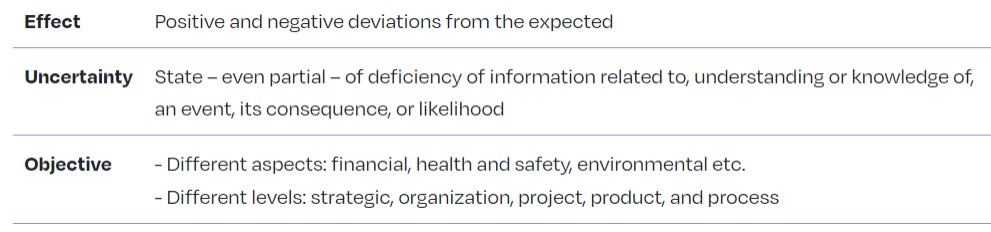
ISO 31000:2018 provides generic guidelines for the design, implementation and maintenance of risk management processes throughout an organisation, see the following figure.

To effectively manage risks, it is mandatory to analyse the risk exposure. This involves the identification of the risks at play, the measurement, most importantly by assessing the impact and the likelihood in the case of occurrence, and to evaluate the risks as a result.
Managing risk on the other hand, involves a closed loop process: As a first consideration, risks can be systematically avoided or at least reduced by mode and setting of operational parameters. Unavoidable risks can be mitigated by controlling the risk and continuous process improvements, e. g. involving a failure mode and effect analysis. Risks can be transferred by various measures, e. g. contractually by shifting the responsibility of certain processes to another party, by buying cover through an appropriate insurance, or by simply setting up a purpose specific limited liability company (so called “SPV”), to name a few. Finally, it is highly recommended to accept and to monitor and report residual risk to ensure that risk exposures remain within manageable limits.
Financial risk factors
Asset management actually starts from the very beginning of the project. The SolarPower Europe EPC Best Practice Guidelines deal with risk management until commercial operation date (COD) while this chapter deals with risks starting with COD. A selected number of financial risk factors are explained in the following table:

Regulatory and policy risk factors
This section provides a short overview of regulatory and policy risks. Regulatory risks are related to e. g. adjustments in government schemes that can possibly be imposed at any time during the lifetime of a PV power plant project, sometimes even retroactively. Such risks typically materialize when a scheme is overstretched vs. the original intent or vs. the government budget capacity or when the political intentions of energy policy change generally. The following table shows some examples:
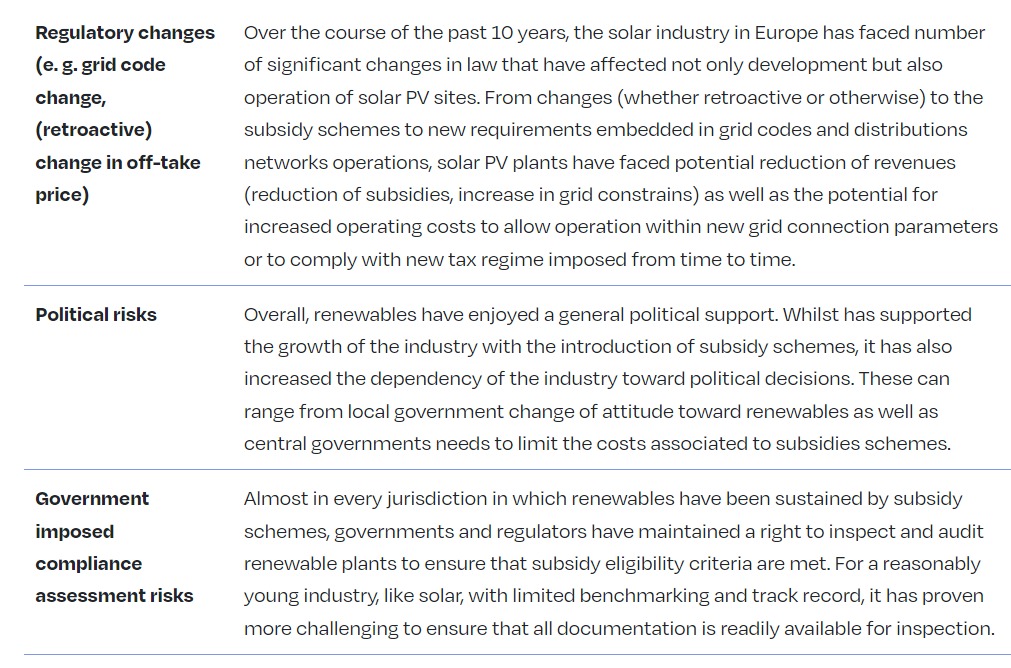
Contractual risk factors
Contractual risk is defined as the probability of a loss arising from either one of the following two situations:
- The chance of facing losses as a result of the buyer not fulfilling the terms of a contract; note that if the buyer is incapable of paying this is another risk category.
- The chance of facing losses from the deal performing poorly. Sellers face the most danger in fixed-price contracts and the least in cost-type contracts.
Practically, not all risks can be addressed and assigned in contracts. To tone down contractual risks several steps can be taken to manage contractual risks, for example:
- Discuss with people from various departments of your organization to determine risks.
- Evaluate and estimate the likelihood and severity of the risk involved in the contract.
- Consider if any high-risk work is worth taking on. If not, reject the project as necessary.
- Evaluate your business partners re financial stability and actual business conduct.
- Etc.
These steps should function like clockwork within the organization. Otherwise, one may find oneself inundated with unforeseen issues. By that point, it will be far too late to apply measures to offset the damages.
Technical risk factors
Even if PV technology is in general rather simple, there are several risks due to the rapid evolution in this sector and the exposure of PV plants to environmental risks, see the following table:

A lot of these technical risks result from improper practices during the inception phase of the project, therefore, it is recommended to refer to SolarPower Europe’s EPC Best Practice Guidelines (2020).
Commercial risk factors
Commercial risks (contract interface risks) arise predominantly when individual contracts between adjacent stakeholders are not defined “back-to-back” meaning that the interfaces are seamlessly defined in the chain of contracts. Naturally, identifying any gaps and the resulting risks for an asset manager are essential. To illustrate the risks more practically, the following table outlines exemplary commercial risks:
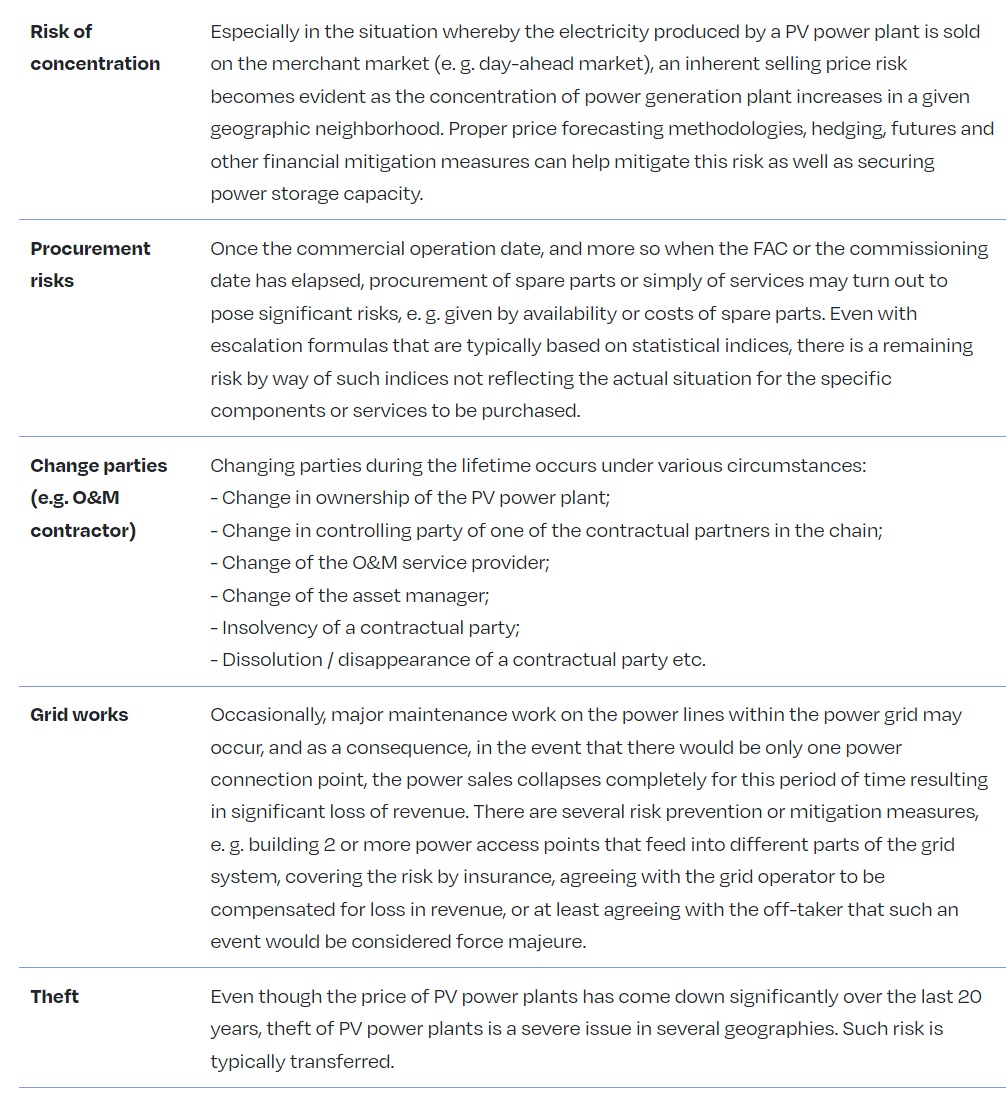
Risk transfer
Risk transfer refers to a risk management technique in which risk is transferred to a third party. In other words, risk transfer involves a party assuming the liabilities of another party. There are two common practices to transfer risks:
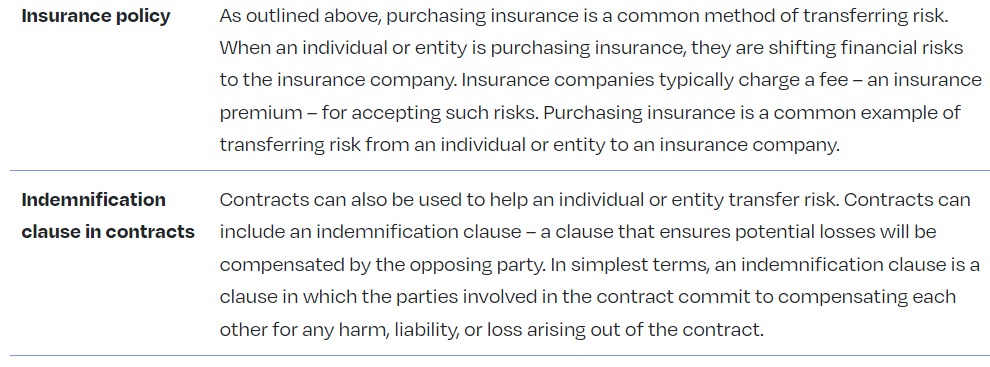
The following figure provides an overview of insurance solutions commonly requested in the photovoltaic industry, based on an detailed insurance study and market analysis (EXXERGY, 2018).

Sector reputational risks
As the share of solar power generation is moving towards 10%, 20% and more, the visibility of the PV market will continue to increase to the point where the performance of solar power plants will eventually become system critical. To avoid a loss of sector reputation, it is highly recommended that relevant stakeholders apply proper risk management strategies, including quality assurance procedures and conformity assessments regularly throughout the lifetime of a PV power plant. Initiatives that support this objective include PVQAT as well as an international system under IEC defining international standards for conformity assessment, IECRE. A suite of internationally accepted operational documents for conformity assessment has been issued by IECRE already, and more are expected to be developed in the near future, including a rating system for PV power plants.
D. Stakeholders
There are several stakeholders involved at various stages in the lifecycle of a solar power plant. Having a common understanding of each one’s role will help ensure clear lines of responsibility and accountability throughout a project. Whilst separate definitions are given for all these terms, that is not to say that a single entity cannot perform multiple functions. For example, an EPC service provider can also be an Independent Power Producer, and an O&M service provider at the same time, throughout the lifecycle of one project.
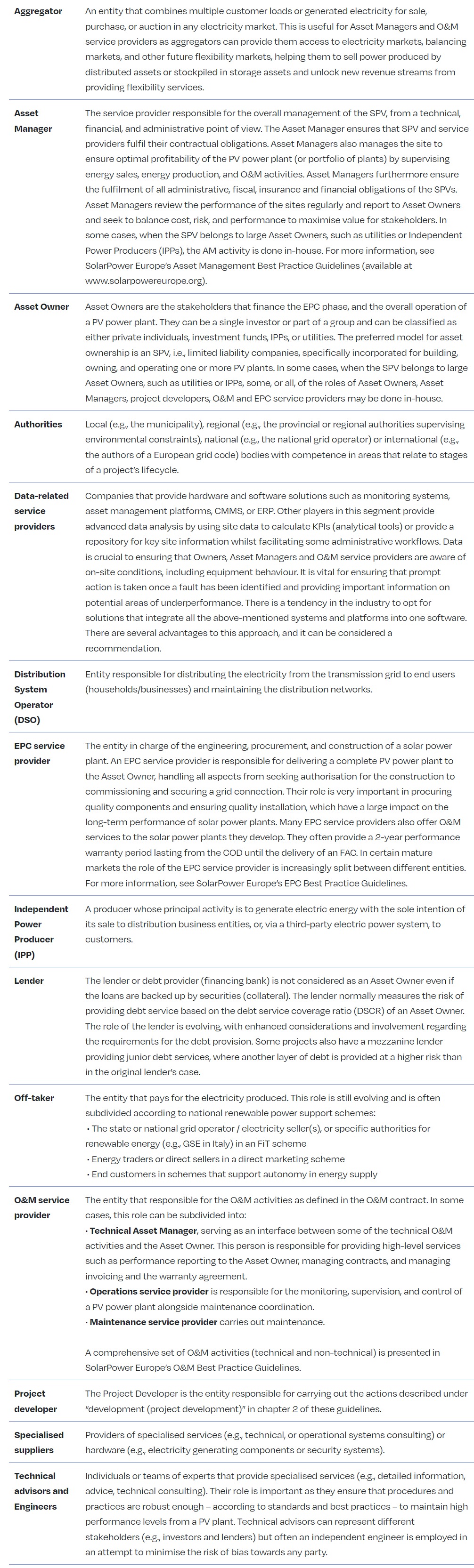
E. Fundamentals of Lifecycle Project Management
Effective Lifecycle Project Management (LPM) ensures that all the necessary actions throughout the development, EPC, O&M, and decommissioning/disposal phases are performed. Therefore, LPM has two different focuses: on the one hand, it has to ensure the timely and cost-effective progress of the project through each of the lifecycle phases; on the other hand, it has to ensure that this progress is not impeded by avoidable problems that could affect the profitability of the project.
While there are other definitions for risk and risk management, in these guidelines we see Risk Management (RM) as the overarching management system which ensures that project progress, throughout its lifecycle, is timely and cost-effective, with a reasonable trade-off between risk and cost. To achieve this, RM includes the following areas:
- Risk Analysis
- Health, Safety, Security & Environment (HSSE)
- Due Diligence
- Quality Management
The four areas can each be divided into four sub-areas, explained below.
Risk Analysis
RM starts with the Risk Analysis (RA), for which we define the following steps:
- Risk Identification (RI)
- Risk Assessment (RAss)
- Risk Prevention & Mitigation (RP)
- Risk Plan Communication & Implementation (RC)
a) Risk Identification
RI is the beginning of RM. As a minimum, it is important to identify and define all major risks with a significant chance of occurrence. If this does not happen or happens too late, the whole project could be jeopardised.
b) Risk Assessment
Once a risk is identified, an assessment must take place to determine how likely it is to occur, what the impact would be, and estimate the costs of eliminating or reducing the risk.
c) Risk Prevention & Mitigation
Once the RAss has been conducted a decision must be made on the best way to prevent (by establishing barriers) or mitigate the risk and/or its consequences.
d) Risk Plan Communication & Implementation
Once a decision has been made on how to prevent or mitigate the risk, a plan on how to do so must be communicated.
Health, Safety, Security and Environment (HSSE)
HSSE are priorities throughout an asset’s lifecycle. There are legal requirements in most countries, and internationally accepted standards, such as the IFC Performance Standards and the Equator Principles, to ensure that solar projects do not negatively impact the environment and guarantee a healthy and safe workplace. Furthermore, international financial institutions also use HSSE, and social requirements when assessing projects. Security is often a requirement in insurance policies, otherwise claims can be void.
Good HSSE coordination is fundamental to achieving all HSSE objectives, which can be summarised as follows:
- Establish an HSSE culture within the organisation and the relevant project team
- Establish, implement, and maintain an effective integrated HSSE management system
- Ensure compliance with applicable health, safety, and environmental legislation, codes, and standards and, whenever possible, with higher standards and best practices
- Ensure surveillance of the project site, especially of high-value products, as well as components which are difficult to replace quickly
- Ensure that intrinsically safe design is achieved by monitoring progress and preparation of results and systematically reviewing the design process, if necessary
- Manage risks in the design, procurement, construction, installation, commissioning, operation, and maintenance activities
- Ensure appropriate levels of skills for all staff engaged in carrying out critical HSSE activities and provide training where necessary
- Check for any potential HSSE impacts in the project area and ensure that these are minimised
- Make sure that the site surveillance is in line with the insurance requirements
- Ensure that a complete inventory of all waste and discharges is maintained and that all waste is disposed of in an environmentally acceptable way, in compliance with the relevant regulations
- Review lessons learned, performance and any opportunities to continuously improve, to update safe design.
For this purpose, it is important that Asset Owner, the EPC, and other service providers meet to align on procedures to follow to avoid risks, especially when different service providers are working on the site simultaneously.
Due Diligence
Over the lifetime of a project, the asset, and its operating company – typically a special purpose vehicle (SPV) – move through a number of defined stages.
These stages are typically marked by changes in contractual liability and obligation, and the transitions or ‘stage-gates’ between phases are usually accompanied by contractual documentation. This could be in the form of a new contract starting with a different service provider, or third-party certification, with supporting documents, as defined in an ongoing contract.
A very important step of each due diligence assessment is the collection of the relevant documentation. An advisor should have comprehensive documentation check lists and conduct a “gap analysis” in the data-room. Within this context, the role of the Asset Manager (AM) is also very important as they can ensure that a structured data-room is properly built at all stages of a project.
The Due Diligence (DD) process can be divides into four sub-areas:
- Legal DD
- Technical DD
- Financial DD
- Political DD
Financial DD consists of the Insurance DD, Accounting DD, and Taxation DD.
Challenges and opportunities in due diligence processes
An effective due diligence process requires a structured methodology to assess key elements of risks and communicate the related outcomes to decision-makers, in a timely manner. This can result in changes to the structure of a project or the way that investments are monitored.
Relying on a weak methodology, unqualified or inexperienced assessors, or a poorly defined project plan to conduct due diligence, results in a cumbersome and ineffective process that does not produce the key information needed for effective decision-making.
There are numerous challenges in the due diligence process:
- The scope of work may not be well-defined, leaving key questions unanswered
- Information requested may be poorly communicated, leading to more time spent gathering new or different data
- Transaction responsibilities and timelines may not be well-understood; critical matters uncovered during due diligence may not be communicated to the appropriate counterparty.
At the same time, there are many benefits to conducting effective due diligence as it can help stakeholders:
- Objectively understand the assets and their underlying historical performance, including deviations from historical and recent trends
- Identify key risks faced by the lender/investors and establish a communication framework to address these risks, including potential mitigation efforts. This could also result in deal-structuring alternatives such as pricing considerations, collateral requirements, or enhancements to required periodic reporting
- Develop an understanding of critical policies and procedures used to prepare information used for decision-making and identify potential areas of information weakness.
Market confidence relies on and will improve with more effective and frequent due diligence. Increasing the cost-competitiveness of solar PV in the future will rely heavily on quality due diligence services can help avoid asset underperformance, or non-performance.
Quality Management
Quality – if not set by clear criteria and measurements – is a perceptual, conditional, and somewhat subjective attribute and may be understood differently by different people. In general, it can be defined as a commitment to customers in the market or as fitness for intended use, in other words, how well the product performs its intended function. Quality also encompasses the reduction of harm that a product may cause to the environment or human society.
Quality management is key in all phases of LPM, from development to decommissioning. When done robustly, it ensures that a PV power plant works at its maximum efficiency for longer, lowering the levelized cost of electricity (LCOE) and making PPAs cheaper and more competitive. This is crucial to maintaining the growth of solar PV and attracting the necessary commitments and investments to support this. Taking a strong approach to QM will enable the industry to move on from past mistakes and confidently deliver solar plants as part of Europe’s critical energy infrastructure.
Key to effective QM is a strong Quality Management System (QMS). Like QM, a QMS must always be present in LPM, from site selection to the end-of-Life phase and actions should always be flanked by good documentation. A sound QMS can form an important prerequisite for accessing project financing from banks and investors as it minimises the risks of a project. To further boost access to project finance, it is also important to ensure the power plants conform, and are certified to, international standards throughout their lifecycle. There a several international certification schemes and conformity assessment systems available for this. For more information see the Risk management in the operational phase chapter of the Asset Management Best Practice Guidelines and the Risk management in the EPC phase of the EPC Best Practice Guidelines (available at www.solarbestpractices.com).
The four pillars of the QMS as defined in these guidelines are:
- Quality Review (QR)
- Quality Control & Assurance (QC)
- Quality Planning (QP)
- Quality Improvement (QI)
Quality Review
QR consists of a Quality Audit (QAu) and Quality Monitoring (QMo) of component and equipment suppliers. As a recommendation, this pillar should be supported by third-party audit/test firms. The QAu shall take place before a contract is signed. It should ensure that a supplier is capable of delivering on the terms of a contract. The QMo takes place once a contract has been signed and provides an ongoing review of a supplier’s quality management processes. This might be in the form of pre-shipment testing, the commissioning (of parts) of the power plant, or the analysis of the plant performance. The QMo is necessary because an EPC service provider is not in control of a supplier’s quality management processes. It is limited to reviewing the quality performance of the supplier and rejecting or accepting their components based on whether they conform to quality standards within the contract between the two parties.
Quality Control & Assurance
Another pillar of the QSM is the Quality Control & Assurance (QC). This applies more to suppliers as they need sound QC to avoid financial losses from rejections, or claims, and to fulfill their duties towards banks and insurers. It must be ensured that all standards and agreed criteria in a contract are met.
Quality Planning
While QI starts with the supplier selection process, QP will have already started before. While QI is designed to help a supplier improve their processes, QP is designed to help select the right component type. For example, it might be possible to improve the service promise from the supplier for central inverters in remote areas during the QI process. However, it might be a better decision, to design the project with string inverters, as they can be easily replaced with locally stored spare inverters. This shows that an optimised design is of utmost importance. QP begins with site selection, since they can impose significant limitations on project designers’ choices, either through natural or regulatory environments.
Quality Improvement
Using the QAu and drawing on their own experience can help service providers identify possible problems. These issues need to be addressed and actions must be agreed with the supplier, such as implementing better processes, and giving improved (narrower, clearer, more detailed) specifications. This is another pillar of the QSM, QI. This pillar has large cost saving potential, as it helps avoid quality issues.
Lifecycle lessons learnt and feedback loop
Projects that have reached the operational stages of the lifecycle represent a significant learning opportunity from a technical, contractual, and financial perspective.
The experience and available operational data available can help stakeholders improve their services in two ways:
- Providing realistic, tested, and proven assumptions (both from a technical-operational perspective and from a financial-commercial one)
- Identifying areas of improvement that have created a positive impact on the overall return on investment and plant performance.
Carrying out lessons learned from the operational phases is a key tool in identifying ways of improving the efficiency of PV plants. More specifically the feedback loop has proven effective in identifying added value opportunities such as:
- Repeating the yield assessment based on reliable site data, aimed at improving the overall production expectations
- Fine tuning the contracting strategy (simplification of complex or redundant processes set forth in complex contracts, for instance the final acceptable processes)
- Re-defining the scope of work of the main service providers, rebalancing pricing, and risk allocation between stakeholders
- Strengthen the criteria for the selection of key component suppliers and manufacturers
- Increasing the sophistication and appropriateness of the spare parts strategy on a site- and portfolio-basis.
To take full advantage of the knowledge created by the operational phases of the lifecycle, a data driven, and analytical approach must be used from the very early stages of operation of the PV plants. This data is vital to establishing and carrying out a meaningful risk assessment and overall review of the PV plant as an investment. This risk driven approach is the foundation of stable operations and reduces the overall volatility of investments in PV plants.
F. Stage-Gates and Due Diligence
Introduction: discontinuity points across the lifecycle of solar assets
In the lifecycle of a PV plant, there are specific events that represent discontinuity points. They should be handled carefully to keep risks under control, ensure that the appropriate stakeholders and skillsets are involved, and avoid “gaps” in the transition phase.
In particular, the most relevant discontinuity events can be summarised as follows:
→ Change of phase of a project:
- Development, engineering, procurement
- Construction
- Operation under EPC warranty
- Operation under ownership
- Decommissioning & disposal
→ Change of ownership between Asset Owners
→ Change of financing structure, such as closing new financing or refinancing
The fundamentals of LPM are described in the previous section of these Guidelines. The present chapter focuses on the relevance of due diligence to ensuring continuity as a project transitions through the phases of its lifecycle.
Change of phase
When transitioning between project phases, it is crucial to conduct appropriate assessments to ensure the quality of a project, identify potential issues that could impact a project in the medium- and long-term, and ensure that the forecasted financial returns can be achieved.
A thorough assessment of solar assets typically requires a multi-disciplinary and holistic approach. The relevant assessments can be conducted by in-house teams if the right expertise is available. However, using an external advisor is recommended (especially for technical and legal due diligence assessments) to ensure a fully impartial view. In addition, an external advisor can provide a wealth of benchmarking experience from other projects or assets they have analysed. Information obtained via objective and independent due diligence is a critical component of the investment and lending process, and such efforts directly affect the confidence that key parties, in particular service providers, lenders, and investors, have in the solar markets.
Depending on the size of the PV portfolio involved, the standardisation level of some contracts (e.g., insurance policies) and the geographical focus, some due diligence tasks can be skipped.
The results of the various assessments provide the rate and reliability in terms of performances for the lifetime of a PV plant.
Development, engineering, procurement
This phase covers all the tasks undertaken to get the project ‘shovel-ready’ or ‘ready to build’. Usually, this is focused on the technical and financial development of the project, with a series of transactional milestones, such as investment committee approval, execution of EPC contracts and financial close.
It is important to assess the quality of the developed project to reach a final decision to build the project and sign the relevant contracts. In particular, the following aspects need to be analysed and it is recommended that they are properly investigated with legal and technical due diligence:
- Yield estimates
To estimate the energy yield potential of a PV plant, technical advisers typically use simulation software based on models that use the best available data and methods. The result of the modelling is the P50 estimate, or in other words, the “best estimate”. P50 is essentially a statistical level of confidence suggesting that the predicted solar resource/energy yield may be exceeded with 50% probability. P50 level of confidence may represent too high a risk for some investors. Therefore, other probabilities such as P90 (estimate exceeded with 90% probability) or P75 (estimate exceeded 75% of the time) might be considered. Lenders and investors might use P90 estimates in uncertain, or high-risk profile projects to be confident that sufficient energy is generated to comfortably repay the debt.
- Land rights
Ideally, the site on which the project is located should be free of obstacles. If these do exist, they must be considered during the design phase and the relevant consents or permits for the works must be obtained then (if required). If the site is affected by restrictive covenants which preclude solar PV (limitation to solely agricultural use can sometimes affect rural properties), then a release needs to be negotiated with the beneficiary of the covenant. Alternatively, defective title insurance can be put in place. This must be at a level which would fully compensate the project company for wasted capital costs, and loss of future income, arising from the project being decommissioned earlier than anticipated. Lenders will also want to see that insurance is in place where a site is affected by rights to run service media in unidentified locations, or where mineral rights are excepted from the title.
- Consistency of the authorisation process:
- Planning permission in respect of the PV plant which is clear from the risk of judicial review
- Planning permission for cable route works which is clear from the risk of judicial review
- All relevant conditions imposed on the permissions (in particular those required to be discharged prior to commencing works on site) to have been discharged
- Quality of the layout
A review of conceptual design is required in relation to the selected components, as well as infrastructures to ensure the plant design is in line with market standard and respect relevant constraints / prescription of the relevant permits
- Verification of the key terms of the PPAs: including, when applicable, the creditworthiness of the counterparty
- Connection to the grid: In most cases, solar PV projects require the right to connect to the grid. Therefore, a key part of the property due diligence is to check that both the site and project company have the rights to lay a cable to the point of connection to the grid.
Construction and operation under EPC warranty
If technical problems are not detected early during the construction of the plant, or at least within the two-year acceptance period, they can affect future performance and long-term operation. An Asset Owner/project developer will need the professional view of a technical advisor to check the overall quality of the plant. This will include a detailed review of components used on site, future yield estimations and site visits during and after construction. From the Owner’s perspective, it is crucial for the technical advisor to identify any major issues prior to the acceptance period commencing, or at the latest, before the acceptance period is complete. Some crucial steps in the operation of the plants are the acceptance. The role of technical advisor becomes crucial during the PAC and FAC tests (whose recommended protocol has been described under Chapter 9 of the EPC guidelines).
Operation under ownership
In addition to periodic technical verifications, other important areas of evaluation for plants in operation are accounting and tax matters. It is the responsibility of SPV directors to verify all relevant documentation, especially when dedicated tax benefits have been obtained, to ensure legal compliance and avoid significant penalties. It is best practice to include a third-party auditor in this process to ensure transparency.
Effective tax and accounting due diligence may also reveal key indicators of potentially fraudulent activity. These can range from unusual transactions, discrepancies in accounting records, activities/transactions outside the normal course of business, and changes in important credit and underwriting policies and procedures.
Decommissioning
During the decommissioning phase, the role of technical advisor is to confirm that the components of the plant have been dismissed/recycled according to the relevant regulatory framework and that the land/roof has been restored to its original conditions. This work is particularly relevant for local authorities, landlords, and building owners.
Change of ownership
If ownership a PV plant or portfolio changes hands, it is very important for the potential buyer to collect the relevant information and to learn as much as possible about the “history” of a plant and the SPV. In addition, due diligence may also benefit the seller as a rigorous assessment and examination may reveal market value that is higher than expected. Hence why it is not uncommon to also have a “vendor due diligence”, commissioned by the Seller prior to starting a selling process.
Financing or refinancing
The introduction of debt financing within a project’s capital structure or refinancing at any phase of the lifecycle of a PV plant, typically requires detailed verification. To satisfy lenders’ requirements for approving initial or further financing, all aspects of the project must be aligned and quality assured. Ensuring sufficient protection of an investor’s capital requires a fully functioning, and revenue-generating project, with all the required permits.
Accordingly, a solar project finance transaction is not a mere negotiation of financial structuring but also involves an analysis of real property rights, construction and development contracts, equipment warranties, power purchase and interconnection agreements, PV power plant performance, cash management, environmental permitting, energy regulatory matters, and, of course, tax analysis.
The key rule for project finance is risk mitigation: the transaction structure must allocate risks that could affect the project’s cash flow to a creditworthy party, with the ability to mitigate them . Much of the tension in negotiating solar project financing derives from each participant’s efforts to properly identify risks and shift them to others while retaining the benefits from the transaction. For example, the project sponsor usually seeks to shift technology risks to the equipment manufacturer and EPC service provider, while preserving as much of the cash flow and appreciation in project value as possible for itself. The lender will usually seek to shift risk to the Owner by taking paramount positions in the project revenues and assets. They will also seek to guarantee the loan repayment schedule by placing contractual obligations and risks related to warranties onto third parties, such as equipment manufacturers and EPC service providers.
Risk shifting can be done through various legal procedures, including (i) grants of liens on the project assets, revenues, and key project agreements; (ii) warranties and contractual requirements for the equipment and for the maintenance services performed; (iii) requirements for various types of insurance products to cover certain adverse events; (iv) and guaranties of each participant’s obligations from creditworthy entities. During a project financing transaction, the relevant advisor focuses on the calculation of risk magnitude, and the negotiation of risk-shifting devices. This normally results in substantial and complex documentation that must be effectively stored and closely evaluated.